SECNAV Attends 2024 USNI Defense Forum Washington Conference

From SECNAV Public Affairs, Dec. 11, 2024 

WASHINGTON (Dec. 11, 2024) – Secretary of the Navy Carlos Del Toro gave remarks at the 2024 U.S. Naval Institute (USNI) Defense Forum, Dec. 11, 2024. 
 
The forum consisted of Senior military officials, members of Congress, industry leaders, and defense analysts who discussed the current state of shipbuilding as well as examined issues such as static fleet size, maintenance challenges, operational availability, and the difficulties shipyards face with labor, training, budgeting, and requirements. 
 
Secretary Del Toro opened his remarks by discussing the future of building and sustaining the naval force structure for the nation’s needs. 
 
“For the first time since World War II, we face a comprehensive maritime power,” said Secretary Del toro. “Our Navy and Marine Corps Team serves as a proud and powerful testament of our Nation’s commitment to our allies and partners in Europe, the Middle East, and Indo-Pacific regions.” 
 
Secretary Del Toro also discussed strengthening maritime dominance and why it is important to build a culture of warfighting excellence. 
 
“To fight and decisively win our Nation’s wars, we cannot rely on merely maintaining our sea power—we must strengthen our maritime dominance,” said Secretary Del Toro. “Our people are the foundational strength of this Department, and they provide us competitive warfighting advantage over our adversaries.” 
 
“Our priority of building a culture of warfighting excellence is founded on strong leadership that is rooted in treating each other with dignity and respect,” said Secretary Del Toro. 
 
Secretary Del Toro continued by highlighting the importance of enhancing strategic partnerships. 
 
“Our greatest asymmetric strength lies in our network of partnerships with our Defense Industrial Base,” said Secretary Del Toro, “As we look to the future, we must continue to make informed decisions about shipbuilding, maintenance, repair, and the future of the fleet which will impact and shape the Navy for decades to come.” 
 
Secretary Del Toro concluded his remarks with sharing his pride in the U.S. Navy. 
 
“I am extremely proud of everything our department has accomplished over the last three years, and I am excited for our Navy-Marine Corps team as we chart a course for the future—a future that will require us to respond and adapt to whatever geopolitical challenges our Nation may face,” said Secretary Del Toro. 


JMSDF Fleet Air Force, U.S. Navy’s Task Force 70 Sign Memorandum to Increase Bilateral Electronic Attack Capability 

NAVAL AIR FACILITY ATSUGI (Dec. 6, 2024) Japan Maritime Self-Defense Force (JMSDF) Vice Adm. Koji Kaneshima, Commander, Fleet Air Force (CFAF), right, and U.S. Navy Rear Adm. Greg Newkirk, Commander, Task Force (CTF) 70, sign a memorandum of understanding (MOU) to increase bilateral operations between the forces’ electronic attack squadrons, at the CFAF headquarters aboard Naval Air Facility Atsugi, Japan, Dec. 6. (U.S. Navy photo by MC1 Caroline H. Lui) 

By Lt.Cmdr. Seth Koenig 

NAVAL AIR FACILITY ATSUGI  –  Japan Maritime Self Defense Force (JMSDF) Vice Adm. Koji Kaneshima, Commander, Fleet Air Force (CFAF), and U.S. Navy Rear Adm. Greg Newkirk, Commander, Task Force (CTF) 70, signed a memorandum of understanding (MOU) to increase bilateral operations between the forces’ electronic attack squadrons Dec. 6, 2024. 
 
The signing, which took place at Naval Air Facility Atsugi in Kanagawa prefecture, Japan, represented a pledge between the two commanders to increase bilateral operations and training between the JMSDF Air Reconnaissance Squadron (VQ) 81 and CTF 70 electronic attack assets, which include Carrier Air Wing (CVW) 5’s Electronic Attack Squadron (VAQ) 141, as well as expeditionary electronic attack squadron detachments rotationally deploying to Japan from Whidbey Island, Washington. 
 
“Today, ‘FUJIN’ MOU was revised for the purpose of further strengthening Integrated Fire capabilities between CFAF and CTF70,” said Kaneshima. “Besides that, with Rear Adm. Newkirk, we came to an agreement to promote ‘FUJIN’ program. We will keep developing the mutual understanding and tactical skills between the commands and units through the trainings and exercises.” 
 
Task Force 70’s electronic attack squadrons fly EA-18G Growler aircraft, while VQ-81 flies UP-3D electronic attack aircraft, among other assets. 
 
The EA-18G Growler integrates the latest electronic attack technology, including the ALQ-218 sensor for airborne situational awareness, as well as ALQ-99 pods capable of jamming adversarial radar and communications systems, and next-generation jamming technology as it is refined and implemented across the force. 
 
“Today, we’re formalizing our commitment to generate real warfighting advantage by increasing and enhancing our combined technology and expertise in the field of electronic warfare,” said Newkirk. “Our work together moving forward will allow us to expand our shared air and maritime domain awareness, as well as refine and perfect our combined electronic attack capability.” 
 
VAQ-141 is forward-deployed to Marine Corps Air Station Iwakuni as part of Carrier Air Wing (CVW) 5, while the expeditionary VAQ-134 operates out of Misawa Air Base in the northern part of the country and Kadena Air Base in Okinawa in the southern part of the country. 
 
Task Force 70 controls the preponderance of forward-deployed air and surface maneuver and striking forces in the U.S. 7th Fleet area of operations, overseeing Destroyer Squadron (DESRON) 15, Helicopter Maritime Strike Squadron (HSM) 51 and VAQ 134, as well as the ships and aircraft operating under Carrier Strike Group (CSG) 5, including the Nimitz-class aircraft carrier USS George Washington (CVN 73), the Ticonderoga-class guided-missile cruiser USS Robert Smalls (CG 62), the Arleigh Burke-class guided-missile destroyer USS Shoup (DDG 86) and CVW-5. 
 
U.S. 7th Fleet is the U.S. Navy’s largest forward-deployed numbered fleet, and routinely interacts and operates with allies and partners in preserving a free and open Indo-Pacific region. 


HII’s Ingalls Shipbuilding Undocks USS Zumwalt

From HII, Dec. 6 2024 

PASCAGOULA, Miss., Dec. 06, 2024 (GLOBE NEWSWIRE) — HII’s (NYSE: HII) Ingalls Shipbuilding division successfully undocked USS Zumwalt (DDG 1000), the lead ship of the U.S. Navy’s Zumwalt-class of guided missile destroyers, taking the ship one step closer to testing and returning to the U.S. Navy fleet.   

“In partnership with the Navy we are steadfast in our commitment to complete this complex work that adds significant hypersonic capability to Zumwalt,” HII President and CEO Chris Kastner said. “We are proud to support the incorporation of the conventional prompt strike for the Navy.” 

The undocking marked the completion of significant modernization work at Ingalls since the ship arrived at the Pascagoula shipyard in August 2023. Shortly after its arrival, the ship was put back on land in order to receive technology upgrades including the integration of the Conventional Prompt Strike (CPS) weapon system. The Ingalls team also replaced the original twin 155mm Advanced Gun Systems on the destroyers with new missile tubes. 

Zumwalt-class destroyers feature a state-of-the-art electric propulsion system, wave-piercing tumblehome hull, stealth design and is equipped with the most advanced warfighting technology and weaponry. These ships will be capable of performing a range of deterrence, power projection, sea control, and command and control missions while allowing Navy to evolve with new systems and missions. 

Photos accompanying this release are available at: https://hii.com/news/hiis-ingalls-shipbuilding-undocks-uss-zumwalt-ddg-1000/


Navy Accepts Delivery of Ship to Shore Connector, Landing Craft, Air Cushion 111

By Team Ships Public Affairs, Dec. 9, 2024 

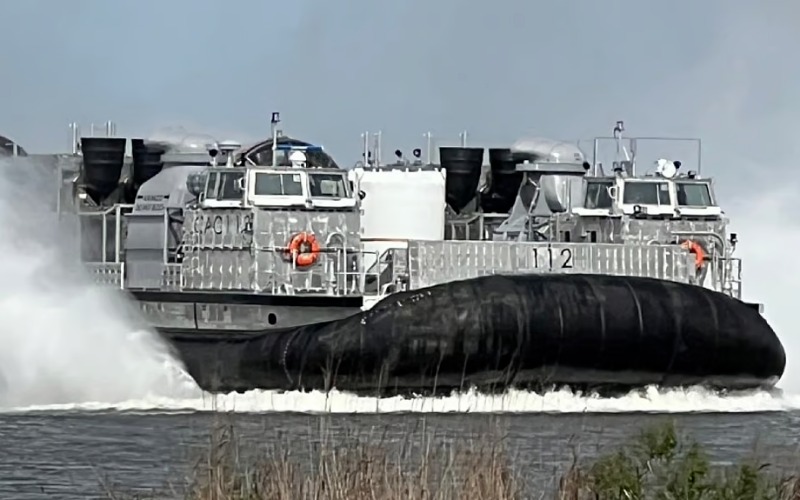
NEW ORLEANS – The latest Ship to Shore Connector (SSC), LCAC 111 was delivered to the Navy from Textron Systems on Nov. 27. 

The delivery of LCAC 111 comes after completion of Acceptance Trials conducted by the Navy’s Board of Inspection and Survey, which evaluated the readiness and capability of the craft to effectively meet requirements. This new addition to the fleet enhances Navy amphibious capability, providing a vital asset for rapid deployment and logistical support. 

“This new craft will provide the Navy and Marine Corps team with unparalleled capability in amphibious warfare, ensuring we remain agile and responsive to emerging threats and global challenges,” said Capt. Jason Grabelle, program manager for Amphibious Assault and Connectors Programs, Program Executive Office, Ships (PEO Ships). “The introduction of LCAC 111 into our fleet marks a significant milestone in our ongoing efforts to maintain and enhance operational readiness.” 

LCACs are built with configurations, dimensions, and clearances similar to the legacy LCACs they replace – ensuring that this latest air cushion vehicle is fully compatible with existing well deck-equipped amphibious ships, the Expeditionary Sea Base and the Expeditionary Transfer Dock . LCACs are capable of carrying a 60 to 75-ton payload. They primarily transport weapon systems, equipment, cargo, and assault element personnel through a wide range of conditions, including over-the-beach. 

As one of the Defense Department’s largest acquisition organizations, PEO Ships is responsible for executing the development and procurement of all destroyers, amphibious ships and craft, auxiliary ships, special mission ships, sealift ships, and support ships. 


USS Arleigh Burke Returns Home After 4-Month Patrol 

From U.S. Naval Forces Europe and Africa / U.S. Sixth Fleet Public Affairs 

Dec. 9, 2024 

ROTA, Spain – The Arleigh Burke-class guided-missile destroyer USS Arleigh Burke (DDG 51) returned home Dec. 7 after a four-month patrol, its fifth since shifting homeport to Rota. 

The Arleigh Burke-class guided-missile destroyer USS Arleigh Burke (DDG 51) returned home Dec. 7 after a four-month patrol, its fifth since shifting homeport to Rota. 

Arleigh Burke departed Rota, Spain Aug. 15 on patrol in support of regional Allies and partners, and U.S. national security interests in Europe and Africa. The ship began its patrol transiting east through the Strait of Gibraltar. 

“Arleigh Burke Sailors continuously amaze me with their hard work and dedication, no matter the challenges thrown their way,” said Cmdr. Tyrchra Bowman, the ship’s commanding officer. “I could not have asked for a better crew, and I am immensely grateful for having the opportunity to command America’s Lead Destroyer.” 

Burke’s patrol included many significant milestones, including deterrence operations in the eastern Mediterranean Sea; numerous gunshoot qualifications utilizing the MK 15 – Phalanx Close-In Weapon System (CIWS), the MK 38 25 mm machine gun system (MGS), and the 5-inch (127 mm)/54-caliber (Mk 45) lightweight gun; the pinning of eight new Chief Petty Officers; and a visit by Italian Navy Rear Admiral Andrea Petroni, Commander of Second Naval Division and Commander of Italian Maritime Forces, along with crew members of the Italian frigate Luigi Rizzo (F 595) for a passenger exchange; and seven underway replenishments, 11 flight quarters, and 14 small boat operations. 

Arleigh Burke closed out its fifth patrol by joining the Harry S. Truman Carrier Strike Group to serve as Air and Missile Defense Commander while the strike group transited to the Mediterranean Sea. The ship then returned to Rota, where the crew was welcomed by friends, family, and volunteers from the USO on Dec. 7, 2024 after 115 days away from home and 22,450 miles traveled. 

Commander, U.S. Sixth Fleet, headquartered in Naples, Italy, conducts the full spectrum of joint and naval operations, often in concert with Allied and interagency partners to advance U.S. national interests, security and stability in Europe and Africa. 


HII Christens Virginia-Class Attack Submarine Arkansas

From HII, Dec. 7, 2024 

NEWPORT NEWS, Va., Dec. 07, 2024 (GLOBE NEWSWIRE) — HII (NYSE: HII) today christened Virginia-class submarine Arkansas (SSN 800) at the company’s Newport News Shipbuilding (NNS) division. 

“Today we celebrate the mighty submarine Arkansas, and we honor bravery and impact: the heroes and heroic moments that shape our future and make us who we are,” NNS President Jennifer Boykin said. “As high school students, the Little Rock Nine exhibited courage, and showed the American people what determination and perseverance look like. Their spirit guided them then, and today SSN 800 will be instilled with this same spirit of courage, determination, and resilience.” 

The ship’s sponsors are the six women of the historic group known as the Little Rock Nine, the first African American students to attend all-white Central High School in Little Rock, Arkansas during desegregation. NNS honored all nine members during Saturday’s ceremony. 

The Little Rock Nine made history in 1957 with their response to the U.S. Supreme Court ruling in Brown v. Board of Education, declaring racial segregation in public schools unconstitutional. Faced with shouting mobs, threats of violence and hostile state leaders who blocked their way, the teenagers were escorted into the school by federal troops at the direction of President Dwight D. Eisenhower. 

Photos accompanying this release are available at: https://hii.com/news/hii-christens-virginia-class-attack-submarine-arkansas-ssn-800/

On behalf of the other members, sponsor Carlotta Walls LaNier performed the traditional honor of breaking a bottle of American sparkling wine across the submarine’s bow during the ceremony. She also addressed the assembled crowd in-person and those joining virtually from around the world, thanking the shipbuilders who have helped construct Arkansas. 

“You are part of the crew who built Arkansas,” LaNier said. “Your craftsmanship, your attention to detail, and your support for each other in the workplace made today a reality. Being able to point to something you have done that will outlast and outlive you is a worthy achievement. We offer a grateful nod to each of you who had some part in building Arkansas. Surely, this is an achievement to which you can point with pride.” 

Secretary of the Navy Carlos Del Toro provided the keynote address. 

Arkansas represents the very best of our submarine force capabilities and will operate confidently with her crew at sea,” Del Toro said. “She will always be propelled by the proud legacy of her namesake, represented here today by three of her courageous sponsors, who overcame tremendous adversity as members of the Little Rock Nine.” 

Arkansas is the 27th Virginia-class submarine and the 13th to be delivered by NNS. 

“The christening of Arkansas demonstrates the power of innovation and the dedication of our shipbuilders,” said Cmdr. Michael Huber, commanding officer of the pre-commissioning unit. “Today, Arkansas is one step closer to sailing away from our shores, building on the brave example set by her sponsors, defending American ideals and protecting freedom around the world.” 

NNS is one of only two shipyards capable of designing and building nuclear-powered submarines for the U.S. Navy. The advanced capabilities of Virginia-class submarines increase firepower, maneuverability and stealth. 

A video of the ceremony, along with additional information on Arkansas, the Little Rock Nine, and the Virginia-class submarine program, can be found at: www.HII.com/SSN800


Keel Laid for Future USNS Thurgood Marshall

San Diego, Calif. – USNS Thurgood Marshall (T-AO 211) Keel Laying Ceremony. 

By Team Ships Strategic Operations, Dec. 5, 2024 

SAN DIEGO – The keel for the future USNS Thurgood Marshall (T-AO 211), a John Lewis-class Replenishment Oiler, was laid during a ceremony on Dec 5 at General Dynamics (GD) NASSCO. 

The ship’s namesake, former Justice Thurgood Marshall, was the first African American justice to serve on the U.S. Supreme Court. As an Associate Justice for nearly 25 years, Marshall fought for affirmative action, opposed the death penalty, and supported a woman’s right to choose. Prior to becoming a Justice, Marshall was a civil rights lawyer, who argued cases against racial disparity. Marshall argued a variety of civil and human rights cases including; Smith v. Allwright, which found that states could not exclude Black voters from primaries; Shelley v. Kraemer, which struck down race-based restrictive housing covenants; and Brown V. Board of Education where the Supreme Court ruled that racially segregating children in public schools was unconstitutional. 

“Thurgood Marshall’s legacy is one of unwavering courage, intellectual brilliance, and an unyielding commitment to justice,” said Secretary of the Navy Carlos Del Toro. “His efforts helped to shape a more equitable society—and the future USNS Thurgood Marshall will carry that legacy forward.” 

Each keel laying ceremony represents the joining together of the ship’s modular components at land level. During the ceremony, the keel will be authenticated by the ship’s sponsors welding their initials into the keel plate. The ship’s sponsors are Justice Marshall’s granddaughters, Cecilla L. Marshall and Melonie Tibbs, and his granddaughter-in-law, Alissa Kamens Marshall. 

“USNS Thurgood Marshall honors the legacy of an extraordinary civil and human rights leader who is an example of perseverance to all,” said John Lighthammer, Program Executive Office, Ships (PEO Ships) program manager for Auxiliary and Special Mission Ships. “This keel laying marks the first of many significant milestones for this ship and we will work with a sense of urgency to deliver this ship to the Fleet.” 

John Lewis-class ships (T-AOs) are operated by Military Sealift Command and feature substantial volume for oil; significant dry cargo capacity; and aviation capability. T-AOs provide additional capacity to the Navy’s Combat Logistics Force and are a cornerstone of the Navy’s fuel delivery system. 

PEO Ships, one of the Department of Defense’s largest acquisition organizations, is responsible for executing the development and procurement of all destroyers, amphibious ships and craft, and auxiliary ships, including special mission ships, sealift ships and support ships. 


VUP-19 First Robotics Specialists Discuss Their Contribution to History

NAVAL STATION MAYPORT, Fla. (December 16, 2021) An MQ-4C Triton Unmanned Aircraft System (UAS), assigned to Unmanned Patrol Squadron 19 (VUP-19), lands at Naval Station Mayport, Florida, Dec. 16, 2021. VUP-19, the Navy’s first Triton squadron, will continue to maintain and operate the aircraft off the East Coast to further develop the concept of operations and refine tactics, techniques, and procedures. (U.S. Navy photo by Mass Communication Specialist 2nd Class Nathan T. Beard/ Released) 

by Commander, Naval Air Force Atlantic, 6 December 2024 

JACKSONVILLE, Fla. – The first crop of Robotics Warfare Specialists (RW) is contributing to the stand-up of their rating as they support MQ-4C Triton unmanned aircraft worldwide operations. The Robotics Warfare Specialists rating was created in March 2024.  

Chief Robotics Warfare Specialist Ryan Fox, assigned to Unmanned Patrol Squadron (VUP) 19 aboard Naval Air Station (NAS) Jacksonville, Florida, highlighted the need to build the team for the future. 
  
“In the history of the Navy, there are moments where you can start something new – be on the leading edge and make a big impact,” Fox said. “The United States Navy is working concept and requirements analysis for larger robotic systems, as well as the artificial intelligence applications that elevate the Navy’s lethality in an information-centric battlespace, and we have a seat at the table to experience these advances in technology.” 
  
The Chief of Naval Operations (CNO) Navigation Plan 2024, Navy’s strategic guidance from the 33rd CNO, specifically calls out the operationalization of robotic and autonomous systems. Additionally, CNO Adm. Lisa Franchetti’s Project 33 sets priorities for accelerated implementation and seeks to move proven autonomous systems into the hands of the warfighters like Fox and Robotics Warfare Specialist 1st Class Brandon Walker. 
  
Prior to converting into the RW rating, Walker served as an Information Systems Technician and joined the RW Community in May 2024. Walker emphasized how the Navy now leads the joint force in operationalizing robotic and autonomous systems. 
  
“It is incredible that we can take a multi-million-dollar aircraft flown on another side of the world and manage it from Jacksonville,” Walker said. 
 
The primary source ratings for RW conversions will be for those currently or previously assigned to billets in unmanned vehicle divisions, such as Fox and Walker and who hold an RW-identified specialty or Navy Enlisted Classification. 
 
The RW rating requires technicians to manage everything from deskwork to managing the operations required for the aircraft as well as trouble shooting and technical experience, servers, and equipment. The Navy will command and integrate distributed manned and robotic platforms across enormous distances in contested information warfare environments through resilient Maritime Operations Centers. 
 
Falling under Commander Patrol and Reconnaissance Group (CPRG), headquartered in Norfolk Virginia, VUP-19 is part of the Maritime Patrol Reconnaissance Force (MPRF) which is administratively organized into two continental U.S. units, Patrol and Reconnaissance Wings at NAS Jacksonville, Florida, and NAS Whidbey Island, Washington: including 14 Patrol and Reconnaissance squadrons, one Fleet Replacement Squadron and over 45 subordinate commands. The forward-deployed MPRF consists of three Patrol and Reconnaissance Wings in Manama, Bahrain, (CTF-57); Sigonella, Sicily, (CTF-67) and Atsugi, Japan (CTF-72). The MPRF is the Navy’s premiere provider for airborne anti-submarine warfare, anti-surface warfare, and maritime intelligence, surveillance, and reconnaissance operations. 


RTX’s Raytheon Awarded $590 Million Production Contract for Next Generation Jammer Mid-Band

An NGJ-MB pod is flown on the middle starboard wing station of an EA-18G Growler electronic attack aircraft. 

From RTX Raytheon, Dec. 5, 2024 

System plays critical role delivering revolutionary combat capability 

MCKINNEY, Texas, Dec. 5, 2024 /PRNewswire/ — Raytheon, an RTX (NYSE: RTX) business, has been awarded a $590 million follow-on production contract from the U.S. Navy for the Next Generation Jammer Mid-Band (NGJ-MB) system. 

NGJ-MB is a cooperative development and production program with the Royal Australian Air Force (RAAF). The contract includes delivery of shipsets, support equipment, spares and non-recurring engineering support.  

“NGJ-MB is a revolutionary offensive electronic attack system for the joint force that puts a critical combat capability in the hands of our Navy warfighters,” said Barbara Borgonovi, president of Naval Power at Raytheon. “We’re working with the U.S. Navy to ensure NGJ-MB provides the advanced electronic warfare solution needed as quickly as possible.” 

The U.S. Navy and RAAF will employ NGJ-MB on the EA-18G GROWLER® to target advanced radar threats, communications, data links and non-traditional radio frequency threats. The system reduces adversary targeting ranges, disrupts adversary kill chains and supports kinetic weapons to target. NGJ-MB allows naval crews to operate effectively at extended ranges and attack multiple targets simultaneously with advanced techniques. 

Work under this contract will take place in McKinney, Texas; Forest, Mississippi; El Segundo, California; and Fort Wayne, Indiana through 2028. 


USS Carney: a Destroyer at War

USS Carney (DDG 64) fires a Standard Missile (SM) 2, Oct. 19, 2023, to defeat a combination of Houthi missiles and unmanned aerial vehicles in the Red Sea. (MC2 Aaron Lau) 

From Austin Rooney, Dec. 4, 2024 

On Oct. 19, 2023, USS Carney (DDG 64) was involved on in the most intense combat engagement by a U.S. Navy warship since WWII.

WASHINGTON – October 19, 2023, started out as a routine day underway for Sailors aboard USS Carney (DDG 64) as the ship steamed through the Red Sea on its scheduled deployment to the 5th Fleet area of responsibility. However, starting at around 4 p.m. local time, things abruptly changed. 

“We were in berthing and heard [an announcement over the ship’s 1MC intercom system] ‘clear the weatherdecks,’ and I remember thinking, ‘what does that mean? I’ve never heard that before,’” recalled Fire Controlman (AEGIS) 2nd Class Justin Parker, a SPY radar technician assigned to Carney. 

Immediately after hearing the announcement, Parker said he heard the unmistakable sound of missiles being fired off the ship, as well as the destroyer’s main 5-inch gun being fired. With no scheduled live fire drills that day, he said he instantly realized something was wrong. 

“We had never done anything like this before – we had only trained to it,” said Gunner’s Mate 1st Class Charles Currie, a Mk. 45 gun technician assigned to Carney. “There was a lot of adrenaline going on – this was real-world now.” 

By the end of what became a 10-hour standoff, Carney had shot down 15 drones and four land-attack cruise missiles fired by Houthi rebels in Yemen, marking the most intense combat engagement by a U.S. Navy warship since WWII. 

Carney departed for deployment Sept. 27, 2023, before the now-infamous Hamas terror attack on Israel Oct. 7. Looking back, crewmembers said they had no idea what was in store for them as they departed their homeport of Naval Station Mayport, Florida. 

“I’ve only heard stories, but I expected to pull into ports and party a little bit,” laughed Fire Controlman 2nd Class Kameron Miller, a Mk. 160 gun console technician onboard, for whom this would be his first deployment. “That was not quite the case.” 

On Oct. 7, after the deadly terror attack that killed more than 1,200 people in Israel, crewmembers said they realized that the situation in the region would potentially be more complicated than they had anticipated, although the prospect of actual combat still wasn’t on their minds. 

“The XO told us flat out what the situation was, and what we could be facing,” recalled Currie. “At that point the crew just started to get ready.” 

Following Israel’s response to the Hamas attacks and its subsequent military operations in the Gaza strip aiming to free hostages and destroy the terror group responsible, the Iran-backed and Hamas-aligned Houthi rebels in Yemen began a terror campaign against civilian mariners and cargo shipping in the Red Sea, aiming to disrupt international trade to leverage an end to the operation in Gaza.  

National Security Council spokesperson John Kirby called the attacks “a clear example of terrorism and a violation of international law” and pledged that the U.S. and its allies would “do what we need to do to counter these threats and protect these ships.  

After the initial combat engagement on Oct. 17, Carney spent much of the remainder of its deployment on high alert, closing out its time in the Red Sea with a total of 51 combat engagements. 

“The entire crew definitely fell back on their training, starting from the very beginning,” said Lt. j.g. Haven Vickers, the Anti-Submarine Warfare Officer assigned to Carney. “Every single training experience we did before deployment – that’s what we fell back on.” 

Vickers said she credits the intensity of the crew’s training along with the camaraderie shared among her shipmates with the success they experienced in combat. While many admitted to being nervous at first, she said as time went on, they fell into a rhythm and were able to effectively react to and defend the ship from threats. 

“As nervous as you get, it’s not about you,” said Ens. William Hinckley, the Administrative/Legal Officer onboard Carney. “It’s about keeping everybody else safe. Thinking about everybody else and not just yourself is crucial.” 

Upon returning to their homeport following deployment May 10, 2024, the entire crew was awarded the Combat Action Ribbon (CAR), the first time a Navy crew has received the decoration since 1991 in the Gulf War. 

“I could not be more proud of what the Carney team has done since September,” said Chief of Naval Operations Adm. Lisa Franchetti, who attended the ship’s homecoming. “It has been eye-watering to watch; you truly are America’s Warfighting Navy in action.” 

For some of the crew, they said the impact of the deployment still hasn’t fully set in. 

“It’s really neat to know that we made history,” said OSC Noah Wicks, the Air Intercept Controller assigned to USS Carney (DDG 64). “Even though we’re a small ship, we had a very big impact on the world.” 

For the young crewmembers like Miller, who’s expectations of a routine deployment were shattered, he said the experience was a stark reminder of why he joined the Navy in the first place. 

“It was probably one of the most rewarding experiences I’ll ever have in my entire life,” said Miller. “It wasn’t just about traveling the world; it was about saving people’s lives and getting a job done.”