USS St. Louis Supports Operation Southern Guard at Naval Station Guantanamo Bay 

GUANTANAMO BAY, Cuba (Feb. 2, 2025) – Sailors assigned to Freedom-variant littoral combat ship USS St. Louis (LCS 19) and Coast Guardsmen assigned to Coast Guard Cutter Resolute erect expeditionary shelter tents in support of the Naval Station Guantanamo Bay’s Migrant Operations Center expansion February 2, 2025, as part of Operation Southern Guard. (U.S. Navy photo by MC2 Raphael Dorne) 

By USNAVSOUTH/4TH FLEET PUBLIC AFFAIRS, Feb. 4, 2025 

NAVAL STATION GUANTANAMO BAY, Cuba   –  The Freedom-variant littoral combat ship USS St. Louis (LCS 19) is moored at U.S. Naval Station Guantanamo Bay (NSGB) and the crew is supporting the expansion of the base’s Migrant Operations Center as part of Operation Southern Guard. 
 
At the direction of the President of the United States to the Department of Homeland Security (DHS) and the Department of Defense (DOD), U.S. military service members are supporting removal operations led by DHS at NGSB. U.S. Southern Command has set up a Joint Task Force Migrant Operations (JTF-MIGOPS) at the Naval Station to execute the directive. 
 
The USS St. Louis is currently deployed to the Caribbean conducting counter-illicit drug trafficking operations in support of Joint Interagency Task Force South (JIATF-South), and participating in operations with partner nations in support of U.S. Naval Forces Southern Command/U.S. 4th Fleet. USS St. Louis arrived at NSGB on January 30, and the crew has been steadily assisting ever since. 
  
“As a forward-deployed asset, our crew is ready to respond to emerging tasks and missions at a moment’s notice,” said Cmdr. Timothy J. Orth, commanding officer of the USS St. Louis. “We’re honored to work alongside our joint task force partners and play a role in this important effort, which reflects U.S. Naval Forces Southern Command and U.S. Fourth Fleet’s commitment to security and cooperation.” 
 
While USS St. Louis is moored at NSGB, the Sailors are helping to set up tents and participating in other logistics activities in expanding the Migrant Operations Center. The first phase of expansion will increase the center’s capacity to approximately 2,000 migrants, with additional phases to follow at NSGB. 
 
U.S. Naval Station Guantanamo Bay is a critical forward-operating base that enables the United States to maintain persistent presence in the Caribbean, support regional security objectives, and defend the Homeland. 
  
“In support of DHS, we often practice our migrant contingency plan at U.S. Naval Station Guantanamo Bay” said Rear Adm. Carlos Sardiello, Commander, U.S. Naval Forces Southern Command/U.S. Fourth Fleet. “The naval station routinely provides support to joint and interagency operations like this.” 
 
U.S. Naval Forces Southern Command/U.S. 4th Fleet integrates and deploys all-domain combat power to expose, deter, degrade malign influences and activities, prevent and to respond to crises, and, if necessary, conduct decisive operations to prevail in conflict in the USSOUTHCOM AOR to protect the Homeland, ensure freedom of action in the maritime domain, protect U.S. interests throughout the region and enhance U.S. Alliances and partnerships. 


NAVWAR at WEST 2025: Future of Multi-Domain Warfare Demands Agility, Audacious Innovation 

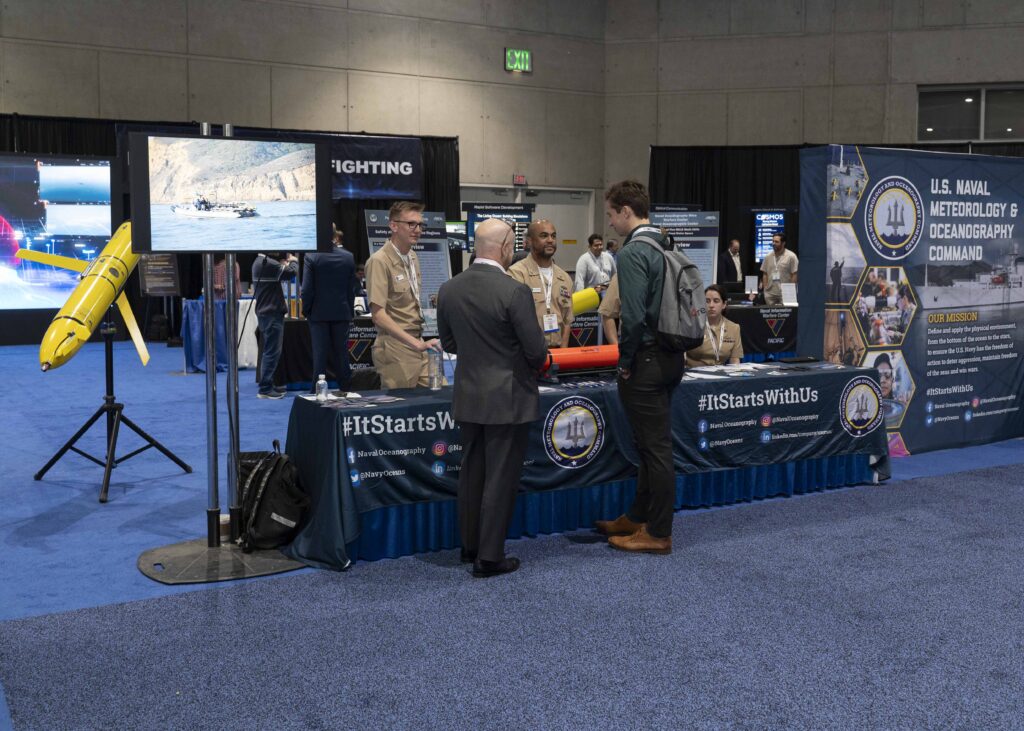
Naval Meteorology and Oceanography Command representatives explain their mission and capabilities to industry partners during WEST Conference 2025. WEST connects military, industry, and academia experts together to find innovative solutions to enhance operational capabilities that overcome complex challenges and evolving threats. (U.S. Navy photo by Ramon Go)

From Lily Chen, Naval Information Warfare Systems Command, Feb. 4, 2025 

SAN DIEGO, Calif. — At the 2025 WEST Conference in San Diego, Naval Information Warfare Systems Command (NAVWAR) reinforced its commitment to driving technological innovation and strengthening the Navy’s operational advantage. Through dynamic discussions, strategic engagements and live demonstrations, NAVWAR emphasized the need to rethink conventional approaches to warfare, as well as the role of artificial intelligence (AI) and machine learning (ML) tools to outpace emerging threats. 

As the premier naval conference and exposition on the West Coast, WEST offered industry and academia experts the valuable opportunity to engage with U.S. Navy, Marine Corps and Coast Guard leaders. Co-sponsored by Armed Forces Communications & Electronics Association (AFCEA) International and the U.S. Naval Institute (USNI), thousands of people attended at the San Diego Convention Center Jan. 28-30 to discuss the landscape of increasingly complex challenges in alignment with the theme: the future is now, are we advancing operational capabilities that pace the threat? 
 
NAVWAR Commander Rear Adm. Seiko Okano, representing the command for the first time at WEST, highlighted her organization’s commitment to supporting the Fleet with next-generation capability. On a panel with other military and industry experts, they discussed how the Department of Defense (DOD) is accelerating software development in support of the Replicator initiative, a DOD-wide effort to fast-track the acquisition of thousands of all-domain attritable autonomous systems. 
 
She highlighted the need for a shift in both culture and the development ecosystem, emphasizing that transformative change is essential for driving progress. “This isn’t a technology problem; this is a culture problem. The faster we figure out how to shift this together, I think we win,” she said. “The Navy has always prided itself on having brilliant technologists at our research labs, but we should also embrace the really fantastic solutions from industry that we can leverage to help us innovate at speed.” 
 
On another panel with systems commanders from the Navy, Marine Corps and Coast Guard on acquisitions, Okano continued to speak about the unique role NAVWAR has in delivering innovative capability to the Fleet. “NAVWAR is at the center of a significant shift in warfare—where traditional domains are blurring, and the fight is increasingly multi-domain and multi-spectral. Our role is to deliver a decisive information advantage, requiring speed, agility and adaptability,” she said. “The challenge is breaking down silos, fostering collaboration and instilling a culture that embraces rapid change to meet the demands of modern conflict.” 
 
During an informational brief about NAVWAR and its needs, John Pope, executive director of NAVWAR, reiterated the importance of rapid and easy adoption of new technologies. “In our world of information warfare, we need to be the ones who are the quickest to respond to what the Fleet needs,” he said. “To achieve that, we’re asking our workforce and our industry and academic partners to embrace our core values of audacious innovation and radical ownership to get after what we need to fix any outdated equipment until we can find modern solutions.” 
 
At the Navy’s Information Warfare pavilion, experts from across the NAVWAR enterprise had a significant presence, interfacing with industry at engagement zones and presenting cutting-edge technology. From Naval Information Warfare Center (NIWC) Pacific; Program Executive Office (PEO) Digital and Enterprise Services (Digital); PEO Manpower, Logistics and Business Solutions (MLB); and PEO Command, Control, Communications, Computers and Intelligence (C4I), NAVWAR’s wide-ranging program offices were represented on the exhibit floor. 
 
The tech demonstrations from NIWC Pacific showcased the latest and greatest from their labs, ranging from cloud development to cryogenic probes to a robot dog designed to assist in ship maintenance. One of the demos featured a Rapid Recreation into Modeling and Simulations (R2MS) tool, spearheaded by the Integrated Fires Team. This platform uses real-world data to create live virtual simulations at rapid speed, an invaluable tool for training and mission planning. “We’re exploring how AI and ML can take R2MS’ capabilities even further,” said Nadil Lopez, project manager for the Integrated Fires team. “There is a lot of untapped potential with this tool in creating complex and realistic environments for the Fleet.” 
 
All of NAVWAR’s PEOs also had significant industry engagement throughout the course of WEST. Through PEO C4I’s annual Engagement Event and the joint PEO Digital/MLB Industry Open house, around 250 individual companies met government representatives and leaders for insightful and collaborative conversations across all three PEOs. NIWC Pacific program managers and technical leads also met with industry through the engagement zones to discuss their needs in an informal one-on-one discussion. 
 
“As underscored by several of the leadership keynotes this year, the rapid pace of both technological and global change demand stronger partnerships across government, industry and academia,” said Michael McMillan, executive director of NIWC Pacific. “WEST 2025 provides NIWC Pacific the opportunity to showcase our latest innovations while forging connections that accelerate the transition of critical technologies from research and prototyping to operational capability. By strengthening collaborations today, we ensure our Navy remains ahead of tomorrow’s threats.” 
 
Efforts from PEO Digital were also acknowledged at the Department of Navy (DON) Information Technology Excellence Awards, held Monday, Jan. 27 prior to WEST. In honor of leading Flank Speed Zero Trust, the DOD’s first zero trust compliance pilot, Darren Turner received the Person of the Year award for his exceptional leadership and dual roles for both DON Chief Information Officer (CIO) and PEO Digital’s technical director office. Zero trust is a network security philosophy that states no one inside or outside the network should be trusted unless their identification has been thoroughly checked. The Navy’s Flank Speed service currently delivers enhanced collaboration, productivity and robust zero trust security to more than half a million users worldwide, completed three years before the DON CIO’s 2027 deadline. 
 
Rodrick Adams, the Marine Corps Logistics Integrated Information Systems (LI2S-MC) security manager at PEO MLB, was also recognized with a Fiscal Year 2024 Copernicus Award from AFCEA International and USNI. This award honors individual contributions to C4I, information systems, cyber operations and information warfare. Adams’ efforts in leading the planning, development and implementation of the Naval Identity Services effort for Global Combat Support System-Marine Corps led to greatly enhanced financial transaction security for its users. 
 
In continuing its commitment to helping the Navy reach new heights in cybersecurity and information warfare capabilities, NAVWAR leverages next-generation tools like AI/ML and industry partnerships to further drive innovation. As the battlefield becomes more complex, their role in the future fight demands a culture shift driven by collaboration, adaptability and agility. 
 
About NAVWAR: 
 
NAVWAR identifies, develops, delivers and sustains information warfighting capabilities and services that enable naval, joint, coalition and other national missions operating in warfighting domains from seabed to space and through cyberspace. NAVWAR consists of more than 11,000 civilian, active duty and reserve professionals located around the world. 


Northrop Grumman Advances Airborne Navigation Capabilities for the US Navy 

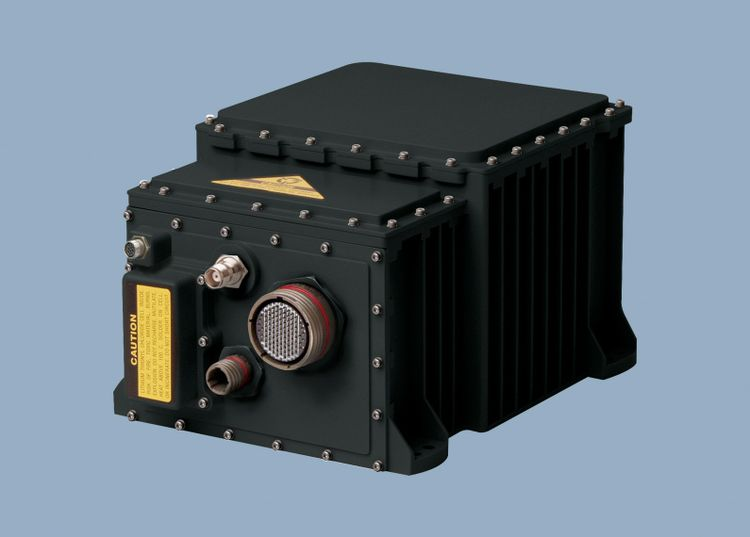
Northrop Grumman is implementing the U.S. Navy’s first M-code airborne navigation solution, the M-code capable LN-251 Inertial Navigation System/Global Positioning System (INS/GPS). (Photo Credit: Northrop Grumman) 

From Northrop Grumman, Feb. 4, 2025 

WOODLAND HILLS, Calif. – Feb. 4, 2025 – Northrop Grumman Corporation (NYSE: NOC) is advancing the U.S. Navy’s airborne navigation capabilities with implementation of the LN-251M, the next-generation upgrade of the LN-251 Inertial Navigation System/Global Positioning System (INS/GPS). The LN-251M features M-code – an encrypted, military-specific signal with stronger jam resistance to shield against adversarial threats. 

  • This is the first M-code navigation system for naval aircraft. 

  • M-code technology provides enhanced robustness to counter GPS signal degradation, enabling pilots greater ability to effectively operate in air spaces where GPS has been shut down or spoofed. 

  • LN-251s equipped with Selective Availability Anti-Spoofing Modules GPS may easily upgrade to M-code configuration. 

Expert: 

Ryan Arrington, vice president, navigation and cockpit systems, Northrop Grumman: “The LN-251M is Northrop Grumman’s newest innovation in elevating airborne navigation to the next level. This important enhancement is a critical milestone for delivering advanced positioning, navigation and timing capabilities because it enables pilots to safely operate with a jam-resilient navigation system for naval aircraft.” 

Program Details: 

LN-251s are designed to seamlessly integrate with current aircraft navigation systems and perform cohesively with future software and GPS modernization upgrades. Northrop Grumman began producing the LN-251 INS/GPS in 2003.To date, the company has delivered nearly 5,000 LN-251s and similar LN-270 INS/GPS units. 


USS Lake Erie Returns Home to San Diego 

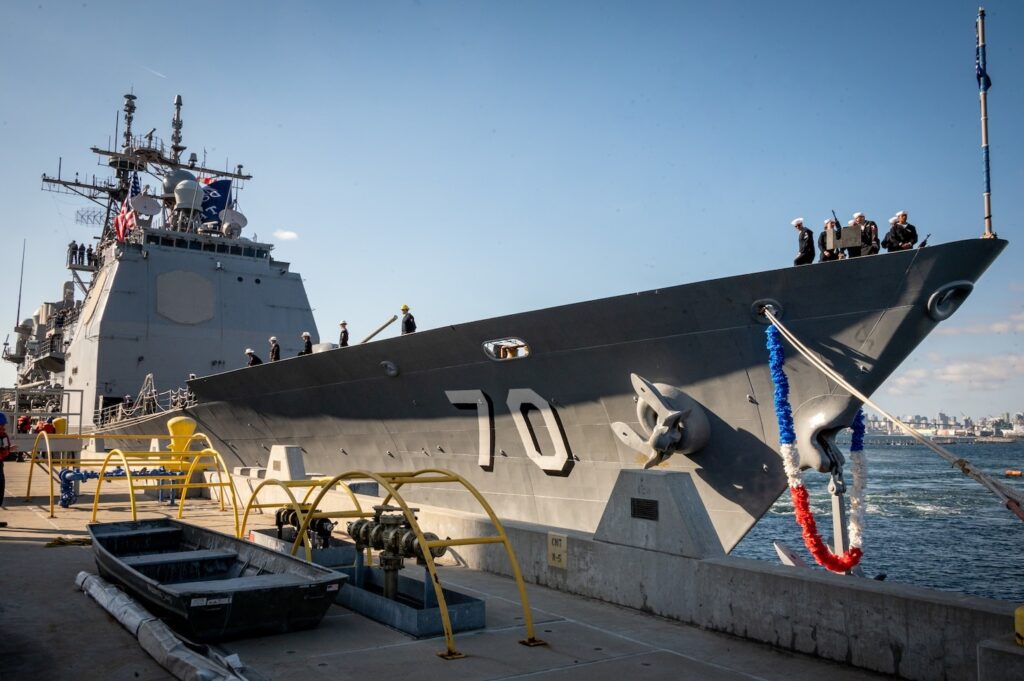
The Ticonderoga-class guided-missile cruiser USS Lake Erie (CG 70) returned to its homeport of Naval Base San Diego, Jan. 30, after completing a seven-month deployment to the U.S. 3rd and 7th Fleet areas of operations. (U.S. Navy photo by MC1 Brandon Roberson) 

From Lt. j.g. Selena Esteban,  Jan. 31, 2025 

The Ticonderoga-class guided-missile cruiser USS Lake Erie (CG 70) returned to its homeport of Naval Base San Diego, Jan. 30, after completing a seven-month deployment to the U.S. 3rd and 7th Fleet areas of operations. 

Lake Erie departed San Diego July 1, 2024, to conduct independent operations in the Indo-Pacific region. 

While deployed to U.S.7th Fleet, Lake Erie conducted operations across multiple warfare areas, deterring aggression, promoting regional stability and security, and protecting free flow of commerce. Lake Erie participated in various multi-national exercises, operating with the Japan Maritime Self-Defense Force, the Royal Canadian Navy, the Philippine Navy, and the Royal Australian Air Force. Throughout deployment, Lake Erie reinforced the U.S. commitment to allies and partners in the Indo-Pacific region, demonstrating the growing strength of regional and international cooperation. 

Lake Erie was led by Commanding Officer Capt. Drew A. Borovies, Executive Officer Cmdr. Raymond T. Ball before turning over duties to Cmdr. Clinton R. Cabe last December, and Command Master Chief Raina Hockenberry. 

“Lake Erie was the can-do cruiser in 7th Fleet. This deployment showed how capable Lake Erie and our Sailors are by responding whenever we were needed. No matter what challenges were thrown Lake Erie’s way, the crew rose to the occasion and achieved success every single time,” said Capt. Drew A. Borovies, commanding officer, Lake Erie. “I am incredibly proud of all the hard work from the team. We came to show how powerful the United Sates Navy is and that is exactly what we did.” 

In the last seven months, Lake Erie sailed over 40,000 nautical miles with embarked Helicopter Maritime Strike Squadron (HSM) 35 Detachment 1 flying a total of 774 hours, together defending and supporting a free and open Indo-Pacific. 

“I am glad that I was able to join this inspiring team,” said Cmdr. Clinton R. Cabe, executive officer, Lake Erie. “Lake Erie truly built up their reputation in the last seven months, completing a wide variety of exercises and always maintaining a high state of readiness. None of this could have been done without the resilience of our Sailors. I am very excited to continue working with this wonderful crew and be a part of future accomplishments.” 

As an integral part of U.S. Pacific Fleet, Commander, U.S. 3rd Fleet operates naval forces in the Indo-Pacific and provides the realistic and relevant training necessary to execute the U.S. Navy’s timeless role across the full spectrum of military operations—from combat missions to humanitarian assistance and disaster relief. U.S. 3rd Fleet works together with our allies and partners to advance freedom of navigation, the rule of law, and other principles that underpin security for the Indo-Pacific region. 


U.S. Navy Awards Contract for Deployment of Future Mine Countermeasures Capabilities

The Mine Countermeasures Unmanned Surface Vehicle. (U.S. Navy photo)

By PEO USC Public Affairs, Feb. 3, 2025 

WASHINGTON – The U.S. Navy has recently awarded a series of contracts, under Program Executive Office, Unmanned and Small Combatants (PEO USC), to facilitate Littoral Combat Ship (LCS) Mine Countermeasures (MCM) Mission Package (MP) deployments.   

The MCM Unmanned Surface Vehicle (USV) is an unmanned, diesel-powered surface craft that can be launched from an LCS, vessel of opportunity, or shore. Its modular flexibility allows integration with multiple payload delivery systems that perform MCM missions, including minesweeping, mine hunting, and mine neutralization. By awarding these contracts, the Navy is ensuring it has the most advanced unmanned systems to effectively conduct mine countermeasure missions in the littorals.   

The Navy awarded the first contract to Bollinger Shipyards for an MCM USV Advanced Material Order (AMO), valued at $7.7 million, which is expected to be completed in September 2025. This contract will procure items needed to improve the MCM USV based on findings from operational testing.   

The Navy also awarded a production contract for the Minehunt Payload Delivery System (MH PDS) to Raytheon Technologies. This contract is valued at $18.3 million to produce five units with deliveries by the end of FY26.   

Additionally, the Navy awarded a production contract for the Minesweep Payload Delivery System (MS PDS) to Textron Systems. This contract is valued at $12.1 million to produce four units, for delivery early in FY27.  

“With the first deliveries of the MCM MP underway and deployments closely following, it is critical to ensure we have the contracts in place to procure and deliver the quantity of mission packages to the Fleet required in today’s changing world,” said Capt. Matthew Lehmann, LCS Mission Modules program manager. “These contract awards ensure our Littoral Combat Ships will continue to receive the modernized MCM equipment needed to conduct their missions, allowing our Sailors to operate safely and stay outside of the minefield.”   

Leveraging the flexibility of the MCM USV, the Minehunt and Minesweep Payload Delivery Systems integrate within the USV, enabling it to perform missions. The MS PDS provides acoustic and magnetic minesweeping capabilities to the MCM Mission Package, while the MH PDS uses the AN/AQS-20 sonar to perform mine hunting missions.   

“These contracts are pivotal to ensure that the Navy’s LCS are equipped with the most advanced and reliable Mine Countermeasures capabilities,” said Rear Adm. Kevin Smith, PEO USC program executive officer. “As we continue to face evolving threats in the littoral environment, these investments not only enhance our operational readiness but also demonstrate our commitment to safeguarding our Sailors and maintaining a competitive edge. By modernizing and expanding our MCM mission packages, we are providing our forces with the tools necessary to maintain access to key maritime regions and keep global shipping lanes safe.”  

A part of the PEO USC portfolio within NAVSEA, the Navy’s LCS Mission Modules program office designs, develops, builds, and delivers the Navy’s unmanned maritime systems; mine warfare systems; special warfare systems; expeditionary warfare systems; small boats/craft; and small surface combatants.  

NAVSEA continues to prioritize stability in procurement profiles and design configurations, make targeted industrial base investments, and increase collaboration with both government and industry partners to optimize schedule, quality, and cost performance.  

For more information on PEO USC, visit:  

https://www.navsea.navy.mil/Media/News/.


BAE Systems to upgrade additional Mk 45 Naval Guns for U.S. Navy 

From BAE Systems, Jan. 27, 2025 

Advanced firepower will continue to play a critical role at sea as Sailors face advanced threats 

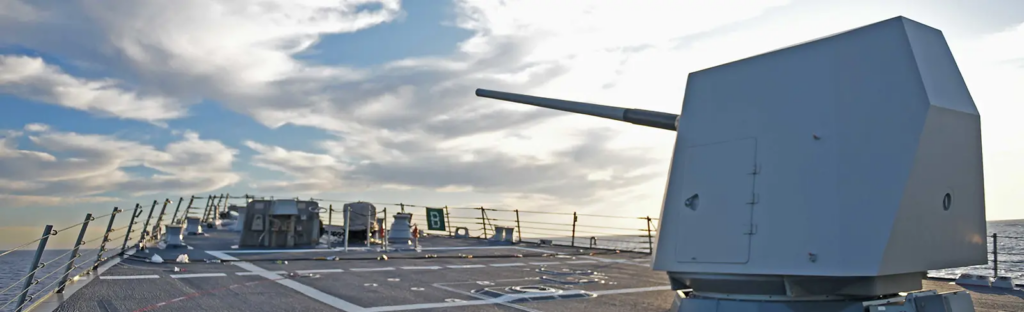
The U.S. Navy has awarded BAE Systems over $70 million to upgrade Mk 45 5-inch naval gun systems and ancillary equipment. On Sept. 30, BAE Systems received a $23.5 million modification to a $47 million contract awarded at the end of July, bringing the total value to over $70 million. Under the contract, BAE Systems will upgrade and overhaul existing systems to the Mk 45 Mod 4 configuration. 

The upgrade to the Mk 45 Mod 4 configuration includes a 62-caliber barrel and a mechanically strengthened gun mount. It also features a fully digital control system that easily integrates targeting and fire control data. Together, these upgrades allow the use of modernized munitions with 50% greater firing energy and prepare for future precision-guided munitions with unprecedented ranges. 

“Events in the Red Sea this year have underscored the importance of firepower aboard U.S. Navy ships,” said Brent Butcher, vice president of Weapon Systems at BAE Systems. “Equipped with the latest configuration of the Mk45 gun system, the men and women in the Navy have the capabilities to protect themselves at sea. We continue our commitment to providing the latest naval gun technology, including advanced munitions, to U.S. Sailors and their allies.” 

Upgrades and overhauls to the Mk 45 are a cost-effective solution to ensure that U.S. Navy Sailors have the modern long-range strike and air defense capability that they require, ensuring peak performance from a deep magazine of advanced 5-inch projectiles that are easily replenished at-sea. By upgrading these platforms, Sailors will receive the latest innovative technology that will support advanced munitions and future mission capabilities at a lower cost than a new gun system. 

Work on the contract will take place at the BAE Systems production facility in Louisville, Kentucky, and will be completed by the end of 2028. 


Maxim Watermakers Completes Testing of First U.S. Navy Closed Loop Cooling System 

From Fairbanks Morse Defense, Jan. 28, 2025 

Maxim Watermakers, a business unit of Fairbanks Morse Defense, has successfully completed qualification testing for a first-of-its-kind submarine maintenance Closed Loop Cooling System (CLCS) for Pearl Harbor Naval Shipyard and Intermediate Maintenance Facility (PHNS and IMF). This qualification is the first CLCS implementation for the U.S. Navy and Maxim’s initial application of this groundbreaking technology at naval facilities. 

The testing, funded by the Maritime Sustainment Technology and Innovation Consortium (MSTIC), highlights Maxim’s engineering expertise and commitment to advancing U.S. Navy operations. 

The innovative CLCS is designed to support submarines during dry dock maintenance by enhancing operational efficiency, reducing corrosion, optimizing maintenance schedules, and ensuring long-term system reliability. These advantages are particularly critical for naval vessels operating in environmentally sensitive regions or areas with stringent water resource management regulations. 

The system features a ship service skid to circulate cooling water through the submarine and a chilled water skid to circulate water through high-capacity air-cooled chillers. 

Maxim’s full-scale testing flawlessly executed 14 separate evaluations, proving the system meets U.S. Navy requirements. The rigorous, four-day testing process verified normal operations, emergency responses, test modes, and essential filling and draining functionalities. 

“This milestone reflects the engineering excellence of Maxim Watermakers and Fairbanks Morse Defense’s dedication to innovation in naval systems,” said Monica Rogers of Maxim Watermakers.“By leveraging MSTIC’s support alongside our technical capabilities, we deliver state-of-the-art solutions that address evolving client needs and enhance critical naval operations worldwide.” 

Fairbanks Morse Defense and Maxim Watermakers continue to lead the development of advanced water treatment technologies. Through ongoing innovation, the companies aim to deliver reliable, high-performance water systems that address critical challenges and support their customers’ operational needs. 


Lockheed Martin Offers Mk70 Launcher to Increase Lethality of LCS

An SM-6 missile is launched from a containerized launcher on board USS Savannah (LCS 28) on Oct. 24, 2023. (U.S. Navy photo) 

By Richard R. Burgess, Senior Editor 

ARLINGTON, Va. — Lockheed Martin has adapted its Mk41 vertical missile launcher into a scalable containerized system than can be deployed on U.S. Navy ships, including the littoral combat ships (LCS) and non-traditional platforms of opportunity to increase their lethality with mid-range precision strike and air defense capabilities. company officials said. 

The system, called the Mk70 Payload Delivery System, is a 40-foot-long ISO container in which four VLS cells can be fitted. The Mk70 system, designed for and deployed with the U.S. Army in a land-based configuration, can launch any type of missile certified for the Mk41, including the Tomahawk cruise missile, the various Standard surface-to-air missiles, the antisubmarine rocket, and the Evolved SeaSparrow missile. The Mk70 container is transportable on a C-17 cargo aircraft.   

Ed Dobeck, director for launching systems at Lockheed Martin, told Seapower that the Mk70 was developed two years ago in concert with the Defense Department’s Strategic Capabilities Office to provide the Army with the ability to deploy and fire the Raytheon-built SM-6 Standard missile. 

The same container can be secured on the flight deck or helicopter landing pad of a Navy ship using helicopter tie-down chains, occupying 400 square feet of a flight deck. Power from the ship’s electrical system can supply 400 volts to the Mk70. No modifications are required to the ship itself. The container can be installed within hours with a pier-side crane. A command shelter with virtual Aegis and Tomahawk control systems controls the launch of the missiles. 

The flight deck of the Freedom-class LCS can accommodate three Mk70 containers, while the Independence-class LCS can accommodate four containers, Dobeck said. With one or more containers installed, the ships are unable to launch or land helicopters. The missile tubes can be reloaded horizontally, an advantage over the ship-installed Mk41’s need for vertical re-load by cranes.  

Lockheed Martin has demonstrated containerized launch of SM-6 missiles from two Navy ships. An SM-6 missile was fired from the USS Savannah (LCS 28) in October 2023 and before that another was fired from the Overlord medium unmanned surface vessel Ranger during an exercise. 

Dobeck said that the Navy has shown great interest in the Mk70 system, which already has been delivered to the Army. Two full batteries — totaling eight missile cells — have been delivered to the Army and two have been delivered to other customers. The Army has deployed the Mk70 to the Philippines


Operation Southern Spear: Latest Development in Operationalizing Robotic and Autonomous Systems 

Operation Southern Spear will deploy unmanned air and surface vessels to help determine combinations of unmanned vehicles and manned forces to provide coordinated maritime domain awareness and conduct counternarcotics operations. 

From U.S. 4th Fleet, Jan. 28, 2025

MAYPORT, Fla.  –  U.S. Naval Forces Southern Command/U.S. 4th Fleet is advancing the Navy’s Hybrid Fleet Campaign through Operation Southern Spear, which will start later this month in U.S. Southern Command Area of Responsibility (USSOUTHCOM AOR) and at U.S. 4th Fleet Headquarters at Naval Station Mayport. 
  
“Southern Spear will operationalize a heterogeneous mix of Robotic and Autonomous Systems (RAS) to support the detection and monitoring of illicit trafficking while learning lessons for other theaters,” said Cmdr. Foster Edwards, 4th Fleet’s Hybrid Fleet Director. “Southern Spear will continue our (4th Fleet’s) move away from short-duration experimentation into long-duration operations that will help develop critical techniques and procedures in integrating RAS into the maritime environment.” 
  
Specifically, Operation Southern Spear will deploy long-dwell robotic surface vessels, small robotic interceptor boats, and vertical take-off and landing robotic air vessels to the USSOUTHCOM AOR. 4th Fleet will operationalize these unmanned systems through integration with U.S. Coast Guard cutters at sea and operations centers at 4th Fleet and Joint Interagency Task Force South. Southern Spear’s results will help determine combinations of unmanned vehicles and manned forces needed to provide coordinated maritime domain awareness and conduct counternarcotics operations. 
  
U.S. 4th Fleet is conducting Operation Southern Spear in support of our Navy’s Project 33 targets to operationalize RAS. Using RAS to increase presence in, and awareness of, strategically and economically important maritime regions will help decision-making, strengthen sovereignty, and facilitate regional cooperation. 
  
“Operation Southern Spear is the next step in our Hybrid Fleet Campaign,” said Rear Adm. Carlos Sardiello, Commander, U.S. Naval Forces Southern Command/U.S. Fourth Fleet. “We look forward to the results of Southern Spear. Hybrid Fleet operations increase our collaboration with partners in the region while furthering the Navy’s tactics, techniques, procedures, and processes.” 
  
U.S. Naval Forces Southern Command/U.S. 4th Fleet is the trusted maritime partner for Caribbean, Central and South America maritime forces leading to improved unity, security and stability. 


Secretary Hegseth’s Message to the Force

From U.S. Department of Defense Public Affairs, Jan. 25, 2025 

ARLINGTON, Va. — The following message to the U.S. armed forces was released by the new Defense Secretary, Pete Hegseth:   

“It is the privilege of a lifetime to lead the warriors of the Department of Defense, under the leadership of our Commander in Chief Donald J. Trump. We will put America First, and we will never back down. 
  
The President gave us a clear mission: achieve Peace through Strength. We will do this in three ways — by restoring the warrior ethos, rebuilding our military, and reestablishing deterrence.    
  
o    We will revive the warrior ethos and restore trust in our military.  We are American warriors. We will defend our country.  Our standards will be high, uncompromising, and clear. The strength of our military is our unity and our shared purpose.   
  
o    We will rebuild our military by matching threats to capabilities. This means reviving our defense industrial base, reforming our acquisition process, passing a financial audit, and rapidly fielding emerging technologies. We will remain the strongest and most lethal force in the world.  
  
o    We will reestablish deterrence by defending our homeland — on the ground and in the sky. We will work with allies and partners to deter aggression in the Indo-Pacific by Communist China, as well as supporting the President’s priority to end wars responsibly and reorient to key threats. We will stand by our allies — and our enemies are on notice. 
  
All of this will be done with a focus on lethality, meritocracy, accountability, standards, and readiness. 
  
I have committed my life to warfighters and their families.  Just as my fellow soldiers had my back on the battlefield, know that I will always have your back. We serve together at a dangerous time.  Our enemies will neither rest nor relent.  And neither will we.  We will stand shoulder to shoulder to meet the urgency of this moment.     
  
Like each of you, I love my country and swore an oath to defend the Constitution. We will do that each and every day, as one team.  Together we will accomplish the President’s mission to deter war, and if necessary, defeat and destroy our enemies. Godspeed!”