Theodore Roosevelt Carrier Strike Group Returns to San Diego After 9-month Deployment 

16 October 2024 

From Courtesy Story 

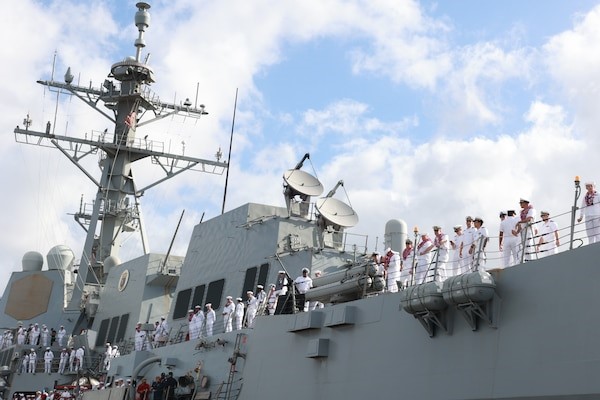
SAN DIEGO – The Nimitz-class aircraft carrier USS Theodore Roosevelt (CVN 71), the flagship of the Theodore Roosevelt Carrier Strike Group (TRCSG) returned to its homeport of San Diego Oct. 15 after conducting operations in the U.S. 3rd, 5th and 7th Fleet areas of operation as part of a routine deployment in support of global maritime security operations. 

TRCSG is a multiplatform team of ships, aircraft, and more than 6,000 Sailors, capable of carrying out a wide variety of missions around the globe. Deploying units of the strike group include Theodore Roosevelt, Destroyer Squadron (DESRON) 23, Carrier Air Wing (CVW) 11, and the Ticonderoga-class guided-missile cruiser USS Lake Erie (CG 70). While the Arleigh Burke-class guided-missile destroyers USS Russell (DDG 59), USS Halsey (DDG 97) and USS Daniel Inouye (DDG 118) also returned to their respective home ports, Lake Erie and Arleigh Burke-class guided-missile destroyer USS John S. McCain (DDG 56) remain deployed in the 7th Fleet area of operations supporting global maritime security operations. 

 
TRCSG deployed to the Indo-Pacific region to support regional security and stability, keep sea lanes open, and to reassure our allies and partners of the U.S. Navy’s unwavering commitment to the region. The strike group was later ordered to the U.S. Central Command area of responsibility to strengthen U.S. military force posture and capabilities throughout the Middle East in light of escalating regional tensions. 
 
“The strike group’s ability to quickly adjust from operations in 7th Fleet to 5th Fleet is a testament to both the flexibility of our naval forces as well as the strength and training of our Navy Sailors,” said Commander, Carrier Strike Group 9, Rear Adm. Christopher Alexander. “We had the distinct honor to strengthen our skills and relationships with 10 allied and partner nations, demonstrating our nation’s commitment to the freedom of navigation.” 
 
The TRCSG strengthened interoperability through dual carrier operations with the Carl Vinson Carrier Strike Group and Abraham Lincoln Carrier Strike Group, participation in exercise Valiant Shield 2024, and numerous bilateral and multilateral maritime exercises in the Philippine and South China seas as well as in the U.S. Central Command area of responsibility. 
 
Notable key leader engagements and visits aboard Theodore Roosevelt included the president of the Republic of Korea, chief of naval operations for the Republic of Korea Navy, lieutenant governor of Guam, U.S. Pacific Fleet commander, U.S. 7th Fleet commander, Republic of Singapore Navy fleet commander, U.S. ambassadors to the Republic of Korea, Singapore, Thailand and Qatar, and senior officers from the armed forces of the Japan Maritime Self-Defense Force, Republic of Korea and Royal Thai Navy, among others. 
 
The deployed Sailors from the TRCSG demonstrated their proficiency in enhanced maritime security operations through more than 9,000 sorties including 21,000 flight hours, 28 replenishments-at-sea, and more than 71,000 nautical miles traveled. 
 
Ships of the TRCSG conducted routine port visits to Bahrain, Diego Garcia, Guam, the Republic of Korea, Singapore and Thailand. 
 
“The crew worked incredibly hard and maintained mission focus this entire deployment,” said Capt. Brian Schrum, commanding officer, Theodore Roosevelt. “I am extremely proud of our Sailors and the work accomplished across the world’s oceans to keep our nation safe at home.” 
 
CVW 11 consisted of nine squadrons: the “Blue Blasters” of Strike Fighter Squadron (VFA) 34, the “Fist of the Fleet” of VFA-25, the “Flying Checkmates” of VFA-211, the “Black Knights” of VFA-154, the “Liberty Bells” of Airborne Command and Control Squadron (VAW) 115, the “Rooks” of Electronic Attack Squadron (VAQ) 137, the “Wolf Pack” of Helicopter Maritime Strike Squadron (HSM) 75, the “Eightballers” of Helicopter Sea Combat Squadron (HSC) 8 and the “Rawhides” of Fleet Logistics Support Squadron (VRC) 40. 
 
As an integral part of U.S. Pacific Fleet, Commander, U.S. 3rd Fleet operates naval forces in the Indo-Pacific and provides the realistic and relevant training necessary to execute the U.S. Navy’s timeless role across the full spectrum of military operations—from combat missions to humanitarian assistance and disaster relief. U.S. 3rd Fleet works in close coordination with other numbered fleets to provide commanders with capable, ready forces to deploy forward and win in day-to-day competition, in crisis, and in conflict. 
 
For more information about Carrier Strike Group 9 and USS Theodore Roosevelt visit https://www.surfpac.navy.mil/ccsg9/ and https://www.dvidshub.net/unit/COMCARSTRKGRU-9; Facebook: www.facebook.com/usstheodoreroosevelt 


USS Russell Returns Home to San Diego 

USS Russell (DDG 59) returns to homeport after an eight-month deployment Naval Base San Diego, Oct. 15, 2024. (MC2 Maria G. Llanos) 

16 October 2024 

From Courtesy Story 

SAN DIEGO – The Arleigh Burke-class guided-missile destroyer USS Russell (DDG 59) returned to Naval Base San Diego Oct. 15, following an eight-month deployment with the Theodore Roosevelt Carrier Strike Group (TRCSG) to the U.S. 3rd, 5th, and 7th Fleet areas of operation. 

Russell and its crew, known as the Red Dragons, departed San Diego Feb. 10, 2024, and joined TRCSG to conduct global maritime security operations supporting regional stability. 

“Our Red Dragon team performed superbly on deployment. No matter the challenge, our Sailors rose to the occasion and represented our ship, Navy, and country with honor,” said Cmdr. Mike McInerney, commanding officer of Russell. “Keeping Russell in its highest state of readiness for eight months straight is no easy feat, yet our crew of 300 did this with a self-sufficient mindset, grit, and determination. We have a proud, combat ready, and battle-minded crew. I’m honored to be part of this fantastic team, and the crew is excited for some well-earned time off with loved ones.” 
 
While deployed, Russell provided primary ballistic missile defense support and secondary air and missile defense support to the Nimitz-class aircraft carrier USS Theodore Roosevelt (CVN 71). Additionally, Russell executed 161 MH-60 Seahawk helicopter deck hits, to include refueling and personnel and parts transfers, from Helicopter Maritime Strike Squadron (HSM) 75 and Helicopter Sea Combat Squadron (HSC) 8. 
 
During port visits, the Red Dragons made a point to volunteer their time through community outreach events. While in Singapore, Sailors performed maintenance and cleaning at the Teen Challenge therapeutic center. In Thailand, they volunteered their time at the Father Ray Foundation for underprivileged children. Community outreach events give Sailors a chance to make a positive impact and diversify their cultural knowledge by developing relationships with partner and ally nations. 
 
“It was really cool to be of service to the Father Ray Foundation in Thailand,” said Personnel Specialist 1st Class Chilee Osuji. “It felt rewarding to provide services to those in need, meet the local people and play soccer with the kids! I’m grateful I had the opportunity to expand my worldview in this way.” 
 
Russell also conducted various exercises with partner navies, strengthening important relationships with allies and partners. Russell participated in a trilateral exercise in April with TRCSG, the Japan Maritime Self-Defense Force and the Republic of Korea Navy. In September, Russell conducted a bilateral exercise with the Italian Navy, increasing interoperability between the two countries’ navies. 
 
Maintaining crew proficiency was important for the Red Dragons to sustain readiness while underway. Russell’s training schedule included over 150 casualty response drills, integrating tactical and technical scenarios to include anti-air warfare, anti-surface warfare, anti-submarine warfare, electronic warfare, engineering, damage control and seamanship. 
 
The Theodore Roosevelt Carrier Strike Group is comprised of Carrier Strike Group 9 staff, Destroyer Squadron (DESRON) 23 staff, the flagship Nimitz-class aircraft carrier USS Theodore Roosevelt (CVN 71), with embarked Carrier Air Wing (CVW) 11, and DESRON 23 ships that include guided-missile destroyers USS Daniel Inouye (DDG 118), USS Halsey (DDG 97), USS John S. McCain (DDG 56) and USS Russell (DDG 59). 
 
An integral part of U.S. Pacific Fleet, U.S. 3rd Fleet operates naval forces in the Indo-Pacific and provides the realistic, relevant training necessary to execute the U.S. Navy’s role across the full spectrum of military operations – from combat operations to humanitarian assistance and disaster relief. U.S. 3rd Fleet works together with our allies and partners to advance freedom of navigation, the rule of law, and other principles that underpin security for the Indo-Pacific region. 
 
For more information on Russell, please visit https://www.surfpac.navy.mil/ddg59/ and https://www.dvidshub.net/unit/USSR-DDG59. 


BAE Systems and Kongsberg Sign Teaming Agreement for New Platform Situational Awareness Tool 

PACIFIC OCEAN (March 11, 2022) U.S. Marines assigned to the 3rd Assault Amphibian Battalion, 1st Marine Division conduct waterborne training with the Amphibious Combat Vehicle (ACV) from aboard the amphibious transport dock USS Anchorage (LPD 23 (U.S. Navy photo by MC2 Hector Carrera) 

The Integrated Combat Solution tool will give Warfighters the situational awareness they need for any mission, as well as options to respond to potential threats 

From BAE Systems 

WASHINGTON — October 16, 2024 — BAE Systems has entered into a teaming agreement with Kongsberg Defence and Aerospace to bring Integrated Combat Solution (ICS) to the U.S. defense market. The transformational battlefield situational awareness tool for combat vehicles will provide the Warfighter with the capability to link and share video streams, metadata, target information, slew-to-cue commands, and much more, reducing the typical threat response speed from minutes to seconds. Together, with Kongsberg developing the ICS tool and BAE Systems integrating it onto combat vehicles, the companies will support technology upgrades through the product lifecycles.  

“The ability for troops to rapidly pass targeting information across the battlefield to other platforms and engage a target remotely is critical to their mission,” Andy Corea, vice president and general manager of BAE Systems’ Combat Mission Systems business, said. “The combined talents of Kongsberg’s innovation and expertise in remote weapon systems and our lead systems integration capability provides the Warfighter the opportunity to obtain fully integrated enhanced combat capability – helping them stay aware and unmatched in battle.”  

ICS is a tool that can be used across the U.S. Marine or U.S. Army’s fleet of vehicles as a critical enabler of their mission. Built with an open-systems approach, ICS can be integrated on any battlefield platform equipped with a weapon system and on-board sensors – keeping troops aware and safer in the fight. ICS will give Warfighters more options to respond to potential threats, matching the rapid pace of warfare in the future. ICS uses an integrated network to link the sensors on different battlefield assets together, allowing command and control of weapon stations, turrets, jammers and other effectors from a single screen inside the vehicle. 

“Together we will deliver ICS as a core enabler of modern warfare, providing all-domain visibility, command and control,” said Kjetil Reiten Myhra, executive vice president defence systems, Kongsberg Defence and Aerospace. “This force multiplier streamlines complicated threat responses, networking mobility platforms and other assets for increased combat capability.” 

The ICS capability has already been demonstrated on the Amphibious Combat Vehicle (ACV) and Armored Multi-Purpose vehicle platforms, and the combined team of BAE Systems and Kongsberg looks forward to the opportunity to provide it across the ground combat forces. The ICS system is also featured at the BAE Systems booth (#6041) at AUSA this week on the Armored Multi-Purpose Vehicle (AMPV) platform, further demonstrating the team’s ability to integrate it on different combat vehicles. 


Navy Demonstrates First At-sea Reloading of Vertical Launching System 

From Thomas McMahon, Oct. 15, 2024 

SAN DIEGO—The U.S. Navy achieved a breakthrough in combat readiness today as it successfully demonstrated the Transferrable Reload At-sea Method (TRAM) on an underway warship in open ocean for the first time. 

Sailors aboard the Ticonderoga-class cruiser USS Chosin (CG 65) used the hydraulically-powered TRAM device to load an empty missile canister into the ship’s MK 41 vertical launching system (VLS) while off the coast of San Diego on Oct. 11. 
 
The successful demonstration marks a critical step in the capability to rearm warships at sea—a top priority outlined by Secretary of the Navy Carlos Del Toro. 
 
“Today, we proved just how game-changing TRAM truly is—and what a powerful deterrent it will be to our competitors,” said Del Toro, who witnessed the demonstration. “This demonstration marks a key milestone on the path to perfecting this capability and fielding it for sustained operations at sea.” 
 
“This was an outstanding effort by the sailors and civilians involved in demonstrating this game-changing capability for the Navy,” said Capt. James “Mike” Williams, commanding officer of Chosin. 
 
The groundbreaking at-sea test follows a successful land-based demonstration in July at Naval Surface Warfare Center, Port Hueneme Division (NSWC PHD) in California. 
 
Engineers at NSWC PHD developed the TRAM prototype as a way to rearm warships during the underway replenishment (UNREP) process—when a supply ship connects to a combatant at sea to transfer vital material such as fuel and food. 
 
“The combatant can stay near the fight to be rearmed, refueled and resupplied all at the same time,” said Rich Hadley, UNREP division manager at NSWC PHD. “As Capt. Arleigh Burke said, ‘All time spent in replenishing was time lost in combat.’ TRAM improves operational effectiveness by reducing the amount of time the warfighter must spend away from the fight replenishing.” 
 
For the at-sea demonstration, Chosin connected to USNS Washington Chambers (T-AKE 11), a Military Sealift Command dry cargo and ammunition ship, which transferred the missile canister across cables to the cruiser. The sailors then used TRAM to move the missile canister along rails attached to the cruiser’s VLS modules, tilt it into a vertical position, and lower it into a VLS cell with TRAM’s built-in cable and pulley system. 
 
“Deploying TRAM into the Military Sealift Command logistics fleet,” said Tim Barnard, director of the NAVSEA technology office (05T), “would enable combatants to remain in theater while reloading their VLS missile launchers instead of having to travel long distances to a port, greatly expanding the volume and tempo of long-range fires—and the U.S. Navy’s advantage over adversaries.” 
 
MK 41 VLS provides rapid-fire missile launch capability for the U.S. Navy’s destroyers, cruisers and future Constellation-class frigates. 
 
Del Toro said the Navy is on track to begin fielding TRAM in two to three years. 


Paws for Effect: Support Pup Sage is Popular on USS Gerald R. Ford

Sage, a three-year-old female Labrador Retriever, deployed aboard the world’s largest aircraft carrier, USS Gerald R. Ford (CVN 78) through Mutts with a Mission, watches the Thanksgiving Turkey Trot 5K on the flight deck, Nov. 23, 2023. U.S. Navy | Chief Mass Communication Specialist Mike DiMestico

Captain Rick “Powder” Burgess took command of the aircraft carrier USS Gerald R. Ford (CVN 78) just eight days before it was to sail on its first full-length combat deployment. In putting the new ship through its paces he would be employing 23 different new technologies, but his first decision as commanding officer involved a 24th innovation — the Navy’s first-in-class vessel, its largest, longest and most advanced, would have a specially trained dog aboard to boost morale and help the crew go the distance.

The three-year-old female Yellow Labrador named Sage was on board as the Gerald R. Ford left Norfolk in May 2023 for duty that was expected to involve being near the Russia-Ukraine conflict.

“I made the decision to deploy with Sage. That was not directed by admirals or anyone else,” Burgess said. “I wanted to bring her on in an effort to help Sailors with the resiliency piece, which has always been a challenge. And you know it’s probably always been a challenge, but we were coming off a couple years with Covid, and we were having longer deployments.”

While military dogs have seen duty on land and aboard ship doing security duties, Sage was specially trained to bring peace of mind and comfort, both sorely needed by Sailors battling loneliness and stress, close confines and combat tempo. Sage was provided by arrangement with a Virginia Beach non-profit called Mutts With A Mission, founded to provide disability and support dogs for veterans and first responder organizations.

“And I saw her as a free opportunity, honestly, to help out with Sailors. And so, Sage is unique in many ways, she’s the first of the program,” Burgess said.

“Ideally, the way the program is conceived, between the ages of two and three these handpicked dogs will go through training. They will get immersion, they’ll find out or figure out how to climb up and down ladders. They will do all that part of it, the logistical side of it. Then they come to the crew, at the age of three, and they’ll stay until they’re 10 years old.”

Sage’s job is to help Sailors handle immense emotional stress and the Ford’s first journey would prove to be an unanticipated stressor when war broke out in Israel on Oct. 7. A five-month tour turned into an eight-month endurance session of homecomings delayed, including three about-faces from homeward bound back to a Middle East aflame from Syria to Gaza and on down to the Red Sea. That’s also where the second demonstration dog, a male named Demo, served aboard USS Dwight D. Eisenhower (CG 69), which replaced Ford on deployment.

“We had an extraordinarily low number of admissions for suicidal ideations compared to those folks that previously deployed, so clearly Sage obviously contributed to that success,” Burgess said.

Sage, a three-year-old female yellow Labrador Retriever, is deployed aboard the aircraft carrier USS Gerald R. Ford (CVN 78), May 3, as part of the Expanded Operational Stress Control Canine pilot program. U.S. Navy | Mass Communication Specialist 2nd Class Jackson Adkins

Fans on Ford and Beyond

While the new ship, new captain, new crew and new dog were all getting their sea legs, the sweet and gentle creature quickly developed a fan base.

“We learned early on too there was a new thing on ‘Green Sheet,’ which has the daily schedule for the crew to look at … someone came up with the idea to put a paw print by where the events [were] and where Sage would participate. And we immediately saw attendance double, triple, quadruple,” Burgess said.

“Come for the dog, stay for the talk,” was the goal of shipboard presentations where Sage held court for groups of sailors, as COMNAVAIRLANT [Commander, Naval Air Force Atlantic] PAO Dawn Stankus told Navy Times. The playful pup was center stage as the Navy’s mental health teams aboard ship described the options available for seeking help.

Coral Gables, Florida, psychiatrist Arthur Bregman has internationally recognized expertise treating ADHD, depression, anxiety, PTSD, substance abuse disorder, and many other issues for a wide range of ages.

“It’s the 20- to 40-year-olds, the Millennials, who are our new Greatest Generation,” Bregman said of the current generation of military service members with that perfect description of the age range on a naval vessel from the youngest Sailors to the senior officers.

“There’s a powerful health benefit,” Bregman said of Sage’s healing skills during the week in January that the Ford and Carrier Air Wing 8 returned home. “It decreases depression, reduces anxiety, lowers stress … it’s just so good to have a dog involved, to be attuned to our behavior and emotions.”

Bregman’s insights come from his fame, from Europe to America in print and broadcast news stories, on his pinpointing of the global peacetime crisis known now as Cave Syndrome. From Covid then to the aircraft carrier now, people have felt the effect of being trapped emotionally and physically in close confines for so long and then have trouble adjusting to the outside world.

Whether before groups or one-on-one, Sage was a valued emotional resource, Burgess said.

“She made an appreciable difference on people. There were many examples of Sailors going to her handler and saying, ‘Hey, could I just spend five minutes with Sage?’ Again, we don’t know if that saved somebody from going down and seeking admission for mental health reasons or otherwise, but she was a calming presence. and every time Sailors got to spend time with her, it was meaningful.”

Sage’s popularity soon grew to include not only the Sailors and Marines of the attached air wing but also every ship in the Ford Strike Group. This led to Sage being outfitted with proper PPE [‘pup protective equipment’] and heading via helo to the guided missile cruiser USS Normandy [CG 60], goggles and booties and all of that, she did great. They fenced off part of their flight deck for her and the crew to come to her,” Burgess said with a proud smile.

Burgess asked the cruiser’s captain why he wanted Sage to hold court on the flight deck rather than inside the ship. “It was a logistics problem. The entire crew wanted to get in there … the entire crew wanted to see her.”

With both ship and crew back home and preparing for the next deployment, Sage remains on board many days of the week continuing her permanent assignment to the ship. And as her captain is certain, she is very much a member of the crew.

This story appears in the October 2024 issue of Seapower magazine.


Fifth U.S. Navy DDG Homeport Shifts to Rota, Spain 

NAVAL STATION ROTA, Spain (Oct. 15, 2024) Cmdr. Scott Burrill, the commanding officer of the Arleigh-Burke class guided-missile destroyer USS Oscar Austin (DDG 79), raises a Spanish flag with Spanish Armada Capt. Ernesto Guesos, Commander, 41st Frigate Squadron, during the ship’s homeport shift to Naval Station (NAVSTA) Rota, Spain, from NAVSTA Norfolk, Va., Oct. 15, 2024.

by U.S. Naval Forces Europe and Africa/ U.S. Sixth Fleet Public Affairs 

15 October 2024 

ROTA, Spain – The Arleigh Burke-class guided-missile destroyer USS Oscar Austin (DDG 79) arrived to its new homeport of Naval Station Rota, Oct. 15, as the first of two additional DDGs to join the Forward Deployed Naval Force-Europe (FDNF-E) force. 

The arrival of Oscar Austin expands U.S. Navy capabilities in the U.S. European Command (EUCOM) and U.S. Africa Command (AFRICOM) areas of responsibility. Oscar Austin is now assigned to Destroyer Squadron (DESRON) 60 / Commander, Task Force (CTF) 65 and U.S. 6th Fleet. 

“USS Oscar Austin’s arrival to Naval Station Rota strengthens our commitment to maintaining a forward presence in Europe,” said Vice Adm. J.T. Anderson, Commander, U.S. 6th Fleet. “The addition of this ship to our forces in the region provides our Allies with an added layer of security and assurance, and serves as a powerful symbol of the enduring partnership between the United States and Spain.” 

Modernized with the latest Aegis Ballistic Missile Defense (BMD) upgrade, USS Oscar Austin offers a key capability for the U.S., directly contributing to extended deterrence by providing Allies and partners protection against the threat of ballistic missile attack. The second U.S. Navy destroyer to shift its homeport to Naval Station Rota, scheduled to arrive in 2026, also has the latest Aegis BMD upgrade. 

“Arleigh Burke-class guided-missile destroyers are true multi-mission ships, capable of providing maritime security, conducting anti-air and anti-submarine warfare, and providing humanitarian assistance and disaster relief,” said Capt. Alex Mamikonian, commodore, DESRON 60 and CTF 65. “Bringing USS Oscar Austin to Spain enhances our ability to maintain ready and postured forces to assure, deter and defend in an increasingly complex security environment.” 

Oscar Austin departed Norfolk, Va. Sept. 30 to transit to Spain and assist in providing full coverage and protection for all NATO European populations, territories and forces against the increasing threats posed by the proliferation of ballistic missiles. 

The initial decision to base destroyers out of Spain is part of the U.S. European Phased Adaptive Approach announced by President Obama in 2009. Since its announcement, the U.S. has broadened its Ballistic Missile Defense (BMD) capabilities in theater including increasing FDNF-E from four to six and the finalization of the second Aegis Ashore site in Poland. 

Oscar Austin is the first Flight IIA Arleigh Burke-class guided-missile destroyer and proudly bears the name of Pfc. Oscar P. Austin, United States Marine Corps. Oscar Austin was commissioned on August 19, 2000, in Norfolk, Va. Oscar Austin is ballistic missile defense, anti-submarine, and anti-surface warfare capable. The ship can embark two MH-60R Seahawk helicopters to assist in anti-submarine and other warfare areas. Destroyers can work with Carrier Strike Groups, Surface Action Groups, Expeditionary Strike Groups or independently. 

U.S. 6th Fleet, headquartered in Naples, Italy, conducts the full spectrum of joint and naval operations, often in concert with allied and interagency partners, in order to advance U.S. national interests and security and stability in Europe and Africa. 


Project Link: New T-45 Mixed Reality Trainer Improves Readiness 

Shown is a T-45C prototype mixed reality cockpit view. Note: Dials, displays, and out-of-the-cockpit view are virtual images while the cockpit panels and buttons are seen in the “real world” via a video pass-through camera.

From Naval Air Systems Command, Oct. 11, 2024  

PATUXENT RIVER, Md. — The Naval Aviation Training Systems and Ranges Program Office (PMA-205) and the Naval Air Warfare Center Training Systems Division (NAWCTSD) are bringing the future of training to student aviators with the new T-45C Goshawk mixed-reality simulator, also known as Project Link. 

The Navy is pioneering emerging technologies through the Naval Aviation Training Next (NATN) program, focusing on extended reality (XR) for aviation training. XR encompasses virtual reality (VR), augmented reality, and mixed reality (MR), offering immersive experiences by blending virtual and real worlds. 

Project Link is one of several efforts aligned under the NATN program advancing aviation training by exploring the use of XR trainers; providing individualized training syllabi; and improving performance assessment through updated methods, metrics, and measurements.  

The NATN program is an innovative initiative by the U.S. Navy to use advanced technologies like VR and artificial intelligence to streamline and enhance the training process for new student naval aviators. While AR/VR/MR training solutions do not entirely replace other methods of training, the benefits of these systems can be profound. 

Recent technological advancements made MR a promising solution for flight training, with MR trainers showing potential in supplementing operational flight trainers and offering greater realism and immersion through a blend of virtual and physical cockpit elements.  

“I am excited about the feedback from Chief of Naval Air Training instructors and students on mixed reality technology,” said Capt. Kevin McGee, PMA-205 program manager. “Industry has been improving mixed reality over the past five to seven years and I believe MR is now mature enough to provide significant value in the virtual training environment, replacing some of the larger, more expensive visual projector systems that are employed in our pilot training systems.” 

An initial capability evaluation of the T-45C MR simulator prototypes, conducted by the Naval Undergraduate Flight Training Systems Program (PMA-273), assessed their capability to support future procurement decisions for the undergraduate jet training pipeline. Despite closely resembling the T-45C Goshawk cockpit and using commercial head mounted display systems for visual projection, the prototypes faced some limitations in certain functionalities. The PMA-205/NAWCTSD team addressed the discrepancies and improved the system fidelity, leading to the procurement of four training devices delivered to Meridian, Mississippi, in April. Through the Office of the Under Secretary of Defense for Research and Engineering’s Accelerate the Procurement and Fielding of Innovative Technologies (APFIT) program, the Navy procured an additional 20 systems with eight to arrive in Meridian and 12 to be delivered to Kingsville, Texas, in 2025. 

“These systems reached a level of readiness that allowed for their delivery and immediate integration into training programs. This successful outcome demonstrates the effectiveness of collaborative efforts in refining and advancing military training technologies,” said Cmdr. Lee “Scampi” Sciarini, deputy director, Research and Technology Programs, Naval Air Warfare Center Training Systems Division (NAWCTSD). 

Lt. Cmdr. Joseph Geeseman, PMA-205 Science and Technology Portfolio manager, emphasized the importance of fleet feedback during the development process. 

“These user-evaluation events provide the development teams the opportunity to more narrowly focus their efforts, ensuring that the T-45C MR trainer end product not only meets training requirements, but also exceeds fleet expectations in the look, feel, and ease-of-use of these leading-edge training systems,” Geeseman said. 


RTX’s Raytheon Completes Hydrodynamic Testing for the Barracuda Mine Neutralization System  

Milestone moves program one step closer to operational testing  

From RTX 

PORTSMOUTH, R.I. (October 7, 2024) — Raytheon, an RTX (NYSE: RTX) business, recently conducted a series of controlled environmental tests for the Barracuda Mine Neutralization System at the Naval Surface Warfare Center Carderock Division. 

Using a production representative test unit, Barracuda operated and collected data in environments of various sea states and water currents, demonstrating the ability to hydrodynamically control itself in conditions simulating the ocean. 

The test demonstrated the ability of the vehicle to detect, track and hold position on a target on its own. It was the first time Raytheon has executed this type of testing with the Barracuda mine neutralizer underwater vehicle and moves the program one step closer towards meeting operational requirements. 

“This event marks a significant milestone in the advancement of underwater security and naval defense,” said Barbara Borgonovi, president of Naval Power at Raytheon.  “Barracuda’s performance reaffirms its position as a game-changing solution for identifying and neutralizing naval mines, a critical challenge in modern naval operations.” 

Barracuda is the U.S. Navy’s program of record for next-generation mine neutralization. It is a semi-autonomous system that uses sonar and camera systems to locate and neutralize undersea mine threats.   

Raytheon was first awarded a contract for Barracuda in 2018. The program completed its critical design review in March 2023, and has now entered its qualification testing phase. In July 2023, Raytheon was awarded a contract to deliver engineering development model units to the U.S. Navy. The program will go into Low-Rate Initial Production in 2027. 


CH-53K Advanced Aviation Training Device Declared Ready for Training 

The CH-53K Advanced Aviation Training Device is a new “first of its kind” trainer for both pilots and aircrew of the CH-53K. The mixed-reality static trainer recently completed a test readiness review and joint final testing and was declared ready for training. (U.S. Navy)

From NAVAL AIR SYSTEMS COMMAND, Oct. 10, 2024 

PATUXENT RIVER, Md. — A Test Readiness Review (TRR) and Joint Final Testing (JFT) were recently completed for the CH-53K Advanced Aviation Training Device (AATD) 1, resulting in the trainer being declared Ready for Training (RFT) on Aug. 16. The new mixed-reality static training device is the first of its kind to support both pilot and aircrew training on the CH-53K King Stallion.   

Veraxx Engineering Corporation developed the AATD prototype for the H-53 Heavy Lift Helicopter Program Office (PMA-261). 

According to Maj. Daniel Meckley, H-53 Training Systems Integrated Product Team Lead, “The purpose of the device is to provide cockpit familiarization and crew resource management training to pilots and aircrew.”  

The AATD provides mixed reality goggles for pilots, which simulates the external environment while also allowing them to see their hands.   

“With the AATD, the pilots don’t need to use the goggles because there is a big screen TV in front of the device to conduct basic training,” explained Meckley.   

The crew chief also wears a set of goggles, but these are virtual reality instead of mixed reality.  

“This means the crew chief cannot see his or her hands,” said Meckley. “All they see is the simulated environment.”  

According to Meckley, even though the crew chief station is physically located behind the cockpit, the training can simulate being anywhere inside or outside the aircraft.  

“This leads to enhanced communication and crew resource management during specific training areas like aircraft startup/shutdown, confined area landings, formation flights, etc.,” he said.  

PMA-261 manages the cradle-to-grave procurement, development, support, fielding and disposal of the entire family of H-53 heavy lift helicopters, including the CH-53K King Stallion, the CH-53E Super Stallion and the MH-53E Sea Dragon.  


USS Annapolis Returns Home to Naval Base Guam Following Indo-Pacific Deployment 

USS Annapolis (SSN 760) arrives at Naval Base Guam. (MC1 Justin Wolpert) 

From Lt. James Caliva, Oct. 10, 2024 

NAVAL BASE GUAM – The Los Angeles-class fast-attack submarine USS Annapolis (SSN 760) returned to its homeport of Naval Base Guam after a successful three-month deployment in the Indo-Pacific region, Oct. 5, 2024. 

 “USS Annapolis exemplifies excellence and stands as the pinnacle of our submarine force, playing a vital role in ensuring a free and open Indo-Pacific,” said Capt. Neil Steinhagen, commander, Submarine Squadron 15. “Their unwavering commitment to advancing theater security and executing operational tasks has produced outstanding results. True to their motto, ‘Born Free, Hope to Die Free,’ the crew of Annapolis consistently meets every challenge head-on, showcasing unparalleled operational readiness and exceptional teamwork. Bravo Zulu, team—welcome home!” 
 
Under the command of Capt. James Tuthill, Annapolis completed missions vital to national security, bolstering operational maritime capabilities in the Pacific. During their deployment, the submarine participated in key bilateral operations with the French Navy and welcomed Rear Adm. Chris Cavanaugh, commander, Submarine Group Seven, during a port visit to Yokosuka, Japan. 
 
“My crew answered the call, exemplifying remarkable dedication to our mission across the Pacific,” said Tuthill. “I couldn’t be prouder of them, or the tenacity and professionalism they displayed every day at sea. Their resilience, determination, and refusal to quit when things got hard define my extraordinary team. It’s a true honor to lead such an inspiring group. They rose to every occasion.” 
 
Commissioned on April 11, 1992, Annapolis is the fourth ship in the history of the U.S. Navy to be named for Annapolis, Maryland, home of the United States Naval Academy. 
 
Assigned to Commander, Submarine Squadron 15 at Polaris Point, Naval Base Guam, Annapolis is one of four Los Angeles-class fast-attack submarines forward-deployed in the Pacific. Renowned for their unmatched speed, endurance, stealth, and mobility, Los Angeles-class submarines form the backbone of the Navy’s submarine force, ensuring readiness and agility in safeguarding maritime interests around the world.