Admiral: Navy Actively Experimenting With Cargo UAS Between Ships
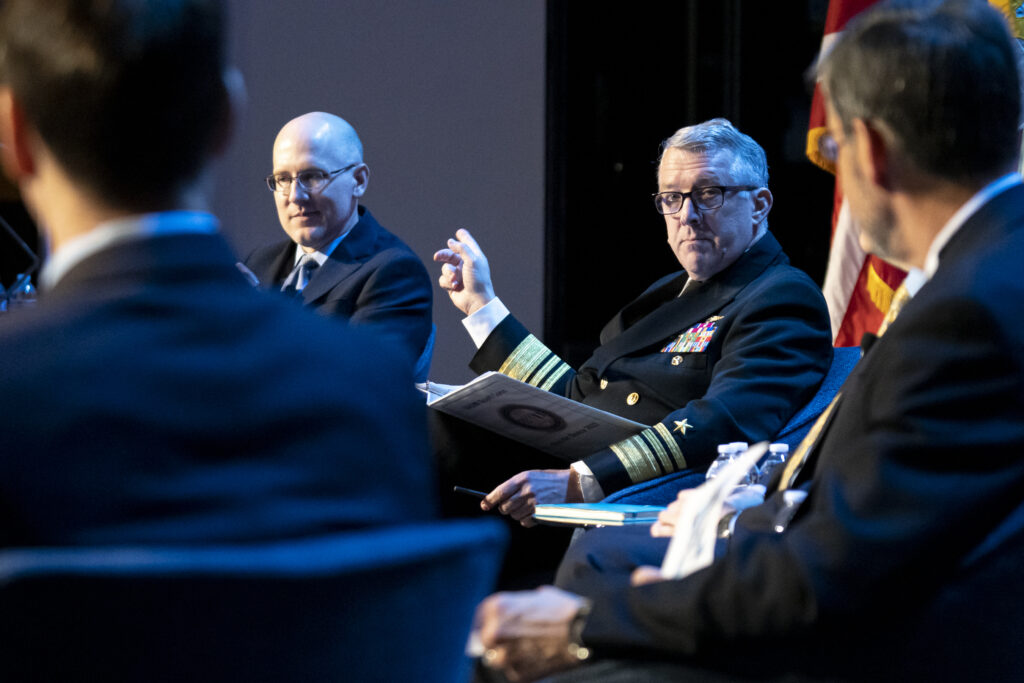
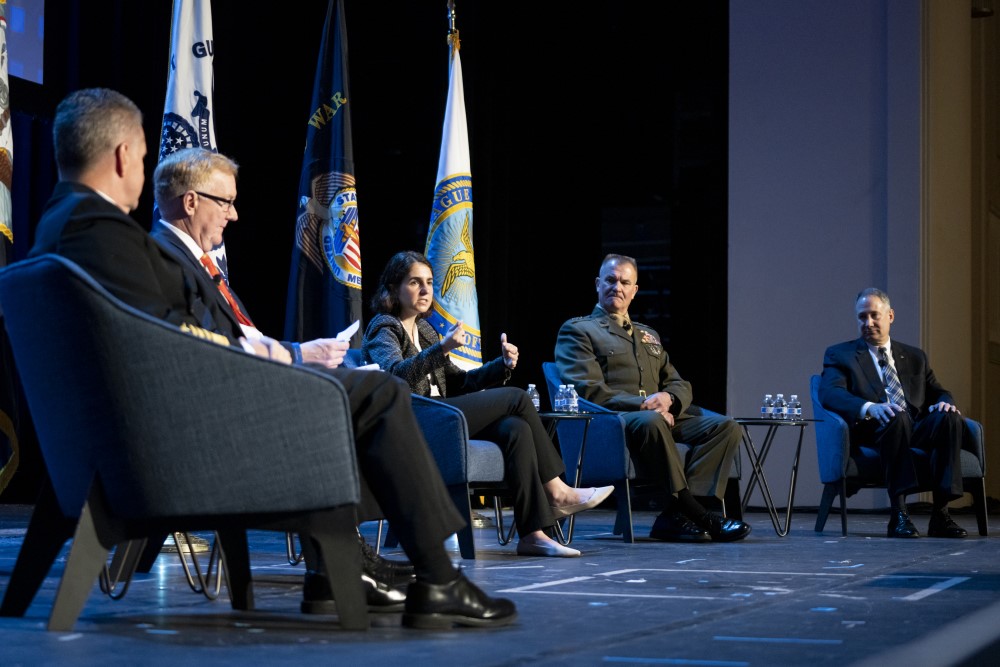
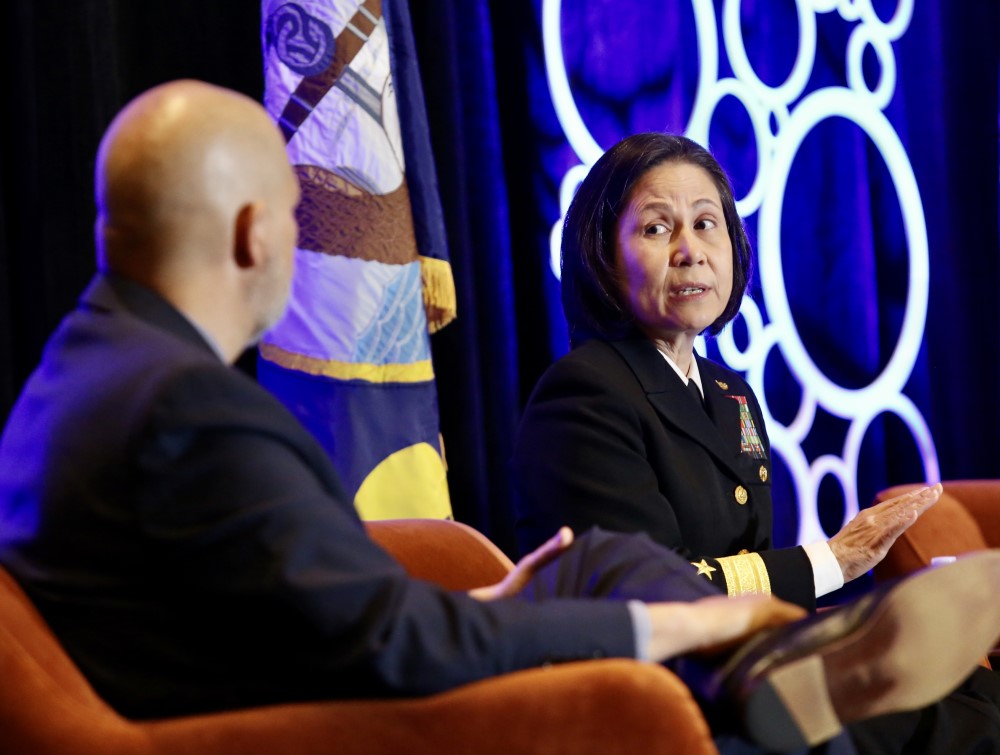
Rear Adm. Brian Corey, program executive officer for unmanned and weapons, discusses Navy UAS. SOLARES PHOTOGRAPHY
NATIONAL HARBOR, Md. — The Navy has been conducting flights between ships as part of an effort to experiment with a cargo unmanned aerial system for maritime use.
Recently, the Navy used an aerial vehicle to transport a part 200 miles between ships, said Rear Adm. Brian Corey, program executive officer for unmanned and weapons (PEO-U&W) at Naval Air Systems Command, during an address at the Navy League’s Sea-Air-Space symposium.
“That’s going to continue,” Corey said of the experiments, while noting that the question of when it could be fielded was up to Navy leadership. “It’s not a technology question, but there are some engineering choices and some work left to be done.”
The program has partnered with both the Navy and Military Sealift Command on the effort to demonstrate the capability to transport small parts ship to ship.
“We believe we could deliver those 200 miles with a relatively small, very inexpensive vehicle,” Corey said. “So that’s what we’re trying to do to enable that is to get the networks and interoperability down and get a small family of ground systems or maybe a single one — that’s unknown at this stage. And then how can we get the autonomous takeoff and landing?”
In a separate effort, the program is experimenting with a cargo UAS for the Marine Corps.
“It’s not yet come to a spot where we have decided to go forward with a program and field it,” Corey said of the Tactical Resupply Unmanned Aircraft System. “The decision will be coming before long depending on how well it works in the field.”
There are some clear advantages to such a system, he said.
“I think that’s some of the most innovative thinking we have going on right now,” he said. “Why drive down a road and potentially get an IED [improvised explosive device] … when you can fly?”
Navy’s AARGM-ER Missile Tracking Toward 2023 IOC
The Navy’s Advanced Anti-Radiation Guided Missile-Extended Range (AARGM-ER) completes its first live fire event July 19 off the coast of Point Mugu Sea Test Range in California. U.S. NAVY
NATIONAL HARBOR, Md.— The Navy’s Advanced Anti-Radiation Guided Missile-Extended Range (AARGM-ER) is tracking toward an initial operational capability of the fourth quarter of fiscal 2023, the Navy program manager said.
The Northrop Grumman-built AGM-84G AARGM-ER is a growth of the baseline AARGM, the AGM-84E. The improved missile, built to suppress or destroy enemy air defenses, includes a new, larger airframe housing a new solid rocket motor, a new warhead, tail control surfaces and a new control actuation system for more maneuverability, increased range and improved survivability.
The AARGM-ER is being developed to arm the F/A-8E/F Super Hornet strike fighter, the EA-18G electronic attack aircraft and the F-35 Lightning II strike fighter.
Speaking April 4 to reporters at the Navy League’s Sea-Air Space expo at National Harbor, Maryland, Capt. Alex Dutko, the program manager, also said operational testing is continuing this year and is expected to be completed in fiscal 2023, with IOC slated for the fourth quarter. Full-rate production is planned for fiscal 2025.
The AARGM-ER entered low-rate initial production during the fourth quarter of 2021, the first of two LRIP lots. The first developmental test flight was conducted in late fiscal 2021 followed by a second test flight in February 2022. A third developmental test flight will be scheduled before operational test begins.
Doug Larratt, Northrop Grumman’s AARGM-ER program director, also briefing reporters, said the production of the baseline AARGM is winding down, with deliveries continuing through fiscal 2024 to support transition to the ER version.
He said Northrop Grumman has delivered more than 11,400 AARGMs (including training missiles and spares) so far out of a program of record of 1,803 baseline AARGMs.
SAIC Partners to Promote Loitering Munition, Underwater Comms System
The UVision Hero 400-EC loitering munition, which SAIC is helping develop to meet U.S. Navy requirements. LISA NIPP
NATIONAL HARBOR, Md. — SAIC (Booth 801) is working with partners on weapons systems it says are of great interest to the U.S. Navy and other militaries: a loitering munition, such as those that have seen action in Ukraine, and an underwater communication system flexible enough to let divers control unmanned aircraft.
One is the Hero 400-EC long-endurance loitering munition system, originally developed by Israel’s UVision. The canister-launched system could carry a variety of payloads, including munitions and has an endurance of up to two hours.
“We help them bring overseas technology that perhaps meets the requirements of DoD, and we take that technology, we Americanize it and then offer it up to DoD to meet their requirements,” said Bob Carruthers, vice president of SAIC’s Charleston Naval Business Unit in North Carolina.
UVision won a Marine Corps contract for a smaller version of the Hero. The Navy is developing requirements for a larger loitering munition for use on ships such as destroyers and cruisers, for which the 400 could contend, Carruthers said.
On the underwater side, SAIC is working with Mistral Inc. on the C-Master MKII and Orca, “a covert underwater communication system,” said Peter J. Brown of SAIC’s Industrial Manufacturing & Systems Engineering.
As many as 15 divers could share their locations and communicate underwater using the system’s small antenna, and could even launch small unmanned aircraft and control drones or loitering munitions from underwater without the antenna having to break the surface.
“You can see 15 other divers on that screen, up to 3 kilometers away, underwater, using low intercept probability acoustic signatures, and at the same time you could potentially control a UAV, get the feed and control a terminal munition,” Carruthers said.
Brown said the system has been tested in prototype form with other navies and U.S. SEALs have had a look at it as well and provided feedback.
Russia is Acute Threat, China is Priority Threat, Speakers Say
Brig. Gen. Sean Salene called the United States a “Pacific nation.” LISA NIPP
NATIONAL HARBOR, Md. — The U.S. Defense Department will continue to have a priority focus on China despite the global military community’s recent attention to the war in Ukraine, said Elbridge “Bridge” Colby, a former U.S. deputy assistant secretary of defense for strategy and force development, in a one-on-one April 4 discussion with U.S. Marine Corps Brig. Gen. Sean Salene.
“The China problem remains very grave,” said Colby. “In a lot of respects, this to me is really going to be the core of the defense strategy going forward. We see China continue to be named as the priority challenge. China is the long-term challenge, and the only one that can challenge the United States and our interests in a really sustaining and global way.”
As he prepared to introduce Salene, Colby posited questions about the concept of integrated deterrence, and asked whether the U.S. will prioritize the Indo-Pacific region and over what time period. Overall, he said the U.S. needs a sustainable Indo-Pacific strategy and must carefully consider the nature of its alliances and partnerships in the region. He said the United States must work to fully understand how to deal, for example, with countries like India, which may have a different perspective on Russia than does the U.S.
“What does it mean that Russia is an acute threat whereas China is the priority threat? How are we going to go about doing that? Or do we need to prioritize at all? Some people are saying maybe we double the defense budget and you get out of prioritization,” Colby said.
Salene, the director of the Strategy and Plans Division, Plans, Policies and Operations at Marine Corps Headquarters, said there are four overarching priorities in the National Defense Strategy, among them “first and foremost” to defend the homeland. Other priorities include deterring a strategic attack against the United States and against its allies and partners; deterring aggression from China, particularly in the Indo-Pacific, and then against the Russia challenge in Europe; and building a resilient joint force and the ecosystem that supports it inside the defense establishment.
Salene said the Indo-Pacific region is critically important to the U.S. and its partners and allies, and the U.S. is committed to helping its allies defend their own sovereignty.
“We are a Pacific nation,” Salene said. “You probably know how much trade goes though there. You probably know the value and the rise of Asia, and what it means to the development of the entire world.”
He said the most important themes going forward involve the key strategic advantages of working with allies and partners, and the “integrated nature at which we would apply all of the elements of our national power,” also known as integrated deterrence.
More Than 50 Employers Discuss Civilian Transitions at Job Fair
Yonny Dublinsky of Boeing talks with Staff Sgt. Abigail Scott about possible job opportunities after the military at the Transition Connection job fair. SOLARES PHOTOGRAPHY
NATIONAL HARBOR, Md. — Navy Lt. j.g. Jen Fishbein is in transition. She has a baby due in August, she’s studying for a master’s degree in executive public management and she’s scheduled to separate from the military in two years — so, it made sense that she was visiting the Transition Connection Job Fair Monday afternoon.
The second annual Sea-Air-Space hiring event focused on providing job opportunities to members of the military and their families. More than 50 employers offered information and advice to attendees who were investigating civilian careers.
“I want to see what’s out there if I were to get out of the military,” says Fishbein, who currently works at the National Reconnaissance Office. “I’m looking at where life can take me.”
Marine Sgt. Owen Budd was also taking a proactive approach to his post-military career. He’s separating in 2023, but he’s already looking to the future. He’s studying for an undergraduate degree in sports and health science at the American Military University, and hopes to parlay his work in human resources with the Marine Corps Embassy Security Group into a civilian career.
Budd was interested in ClearanceJobs, the country’s largest career network for professionals with U.S. federal government security clearances. ClearanceJobs’ online networking platform lists more than 60,000 defense and intelligence jobs, along with free advice on military transitions and services like resume-building templates.
“We have over 1 million users who can connect with pre-screened employers and communicate directly with recruiters,” said Katie Keller, ClearanceJobs editor. “We’ve served the cleared community since 2002.”
Other exhibitors included the Penn State University Applied Research Laboratory, a Navy University Affiliated Research Center focusing on defense science, systems and technologies.
Many of the laboratory employees are ex-military or their spouses. “They understand what we do,” said laboratory representative Tina Kephart.
Northern Virginia also had a presence at the Transition Connection Job Fair. The Fairfax County Economic Development Authority recruits military veterans for careers at a variety of employers, said representative Rod Williams. There are over 90,000 job listings available at workinnothernvirginia.com, with a median salary of $115,000 per job, he said.
Some of those jobs are in air traffic control, which appeals to Staff Sgt. Abigail Scott. Scott, who has been with the Marines for seven years and works as an air defense controller at the Marine Corps Embassy Security Group. Her service doesn’t end until January 2024, but she was at the Transition Connection Job Fair as part of her post-military networking strategy.
“I’m looking for a career where I can transfer my skills in security and air traffic control,” said Scott, who has provided physical security at U.S. embassies in Kazakhstan and the Central African Republic.
Saunes Recognized With National President’s Medal
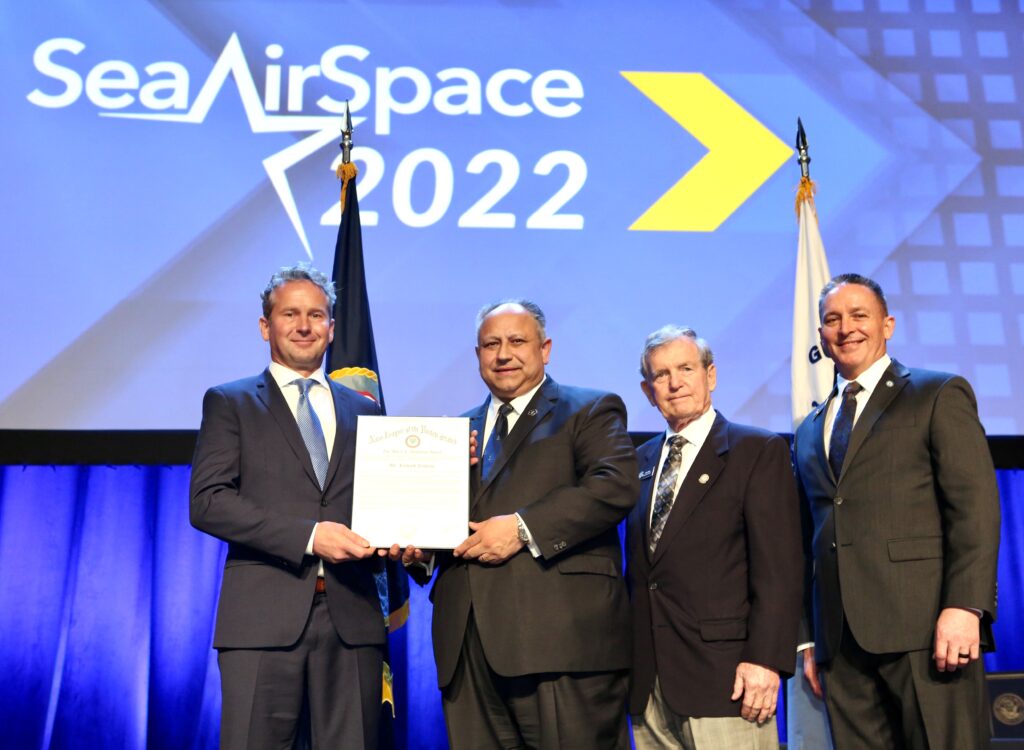
Navy League CEO Mike Stevens (left) and National President and Chairman Dave Reilly (right), present Saunes with the National President’s Medal. LISA NIPP
On Monday, April 4, the Navy League of the United States honored retired Rear Adm. Lars Saunes, professor and distinguished international fellow and former Chief of Royal Norwegian Navy, with its National President’s Medal. The nonprofit bestows this award to foreign dignitaries who “exemplify the highest ideals of the Navy League through their significant contributions to world peace, national security and outstanding service to their country and fellow citizens.”
In addition to his accomplishments to tackle Arctic challenges as Norway’s chief naval officer, Saunes was awarded for providing his expertise to the Navy League, serving as a moderator at Sea-Air-Space 2021 and also for the relationship he has forged with the Navy League’s Center for Maritime Strategy think tank.
Congressmen: Shipyard Improvements Will Continue to Lag With Proposed Budget
Reps. Joe Courtney and Rob Wittman, speaking at “The Future of Shipbuilding: A Congressional Discussion” panel, said it is “unacceptable” that it will take 10 years to modernize public shipyards with current budget plans. LISA NIPP
NATIONAL HARBOR, Md. — A major solution to the U.S. Navy’s chronic problems of building new ships and maintaining existing vessels is to make extensive and rapid improvements in its public shipyards and to encourage similar investments in the private yards, the bipartisan leaders of the House Armed Services Shipbuilding and Projection Forces Subcommittee said April 4.
With the level of funding to modernize the public yards in the newly released fiscal 2023 defense budget and in the long-term proposed spending, it would take 10 years to make any real improvement, subcommittee chairman Rep. Joe Courtney (D-Connecticut) and ranking member Rep. Rob Wittman (R-Virginia) said at the Navy League’s Sea-Air-Space 2022 exposition. That is unacceptable, the two lawmakers said.
Asked by the session moderator if there is a need for a new public yard, the two lawmakers were not sure if that was required, or obtainable. Improving the facilities at the public yards would also help with the growing problem of retaining the current workforce and attracting a new generation of worker, they said.
They also called for more investment in support for the shipbuilding industrial base as a whole, noting the recent addition of funds for the submarine supplier base, primarily focused on the urgent requirement to keep the Columbia-class ballistic missile subs on a tight schedule to replace the aged Ohio-class boomers.
Both men bemoaned the continuing delay in procuring replacements for the ancient sealift fleet, some ships of which are nearly World War II vintage. Wittman said that program must include new-build ships as well as converted retired commercial merchant ships. He insisted those U.S. built ships could be obtained for an acceptable price.
They also objected to the Navy budget proposal to stop construction of the San Antonio class of large amphibious ships and to delay start of the light amphibious warship program, which the Marine Corps is asking for. The Marines need both types of amphibs, they said.
Ultra’s ASW Sonobuoy Business Booming
Lt. Michael Kropp, assigned to the “Grey Knights” of Patrol Squadron (VP) 46, loads sonobuoys onboard a P-8A Poseidon maritime patrol aircraft, March 15, 2021. U.S. NAVY / Mass Communication Specialist 2nd Class Austin Ingram
NATIONAL HARBOR, Md. — The return of great power competition, which some call a new Cold War, is a bull market for the antisubmarine warfare sonobuoy business.
Sonobuoys — expendable floating sensors fitted with acoustic receivers, transmitters or both — are the primary antisubmarine warfare sensor of U.S. and NATO maritime patrol aircraft such as the P-8, P-3, and MH-60R. They are used to track submarines and provide locating positions for attack.
Eric Webster, Ultra’s president of Sonobuoy Systems, told Seapower April 4 at Sea-Air Space 2022 that his company — allied in a joint venture, ERAPSCO, with Elbit’s Sparton sector — is producing 200,000 sonobuoys per year, a level approaching the number built annually during the mid-1980s in the midst of the Cold War, when U.S. Navy and allied ASW expended thousands of sonobuoys to track Soviet submarines.
Last year, Ultra (Booth 327) “built more sonobuoys than ever before,” Webster said, noting the Navy may order more “above max quantity” of the current contract. He said the joint venture has built more than seven million sonobuoys for U.S. and international partners.
The increased orders reflect efforts by the U.S. and allied and partner navies and air forces to increase their capabilities and capacity to counter the Russian and Chinese submarine threats.
Ultra builds four types of sonobuoys and is developing the SSQ-125A version, which has a more powerful sound source than the SSQ-125 for transmission at submarines. Sonobuoys range in unit cost from $800 to less than $10,000, depending on type.
Ultra, headquartered in London, bases its sonobuoy business in Fort Wayne, Indiana. The company also produces receivers for signals from sonobuoys. The company is working to better interconnect its receivers with the broader network of platforms and sensors.
“The future is about integrating data … to achieve a shorter kill chain,” Webster said.
CMS Outlook: The Two-Front Cold War Has Begun – How Should We Handle It?
Marine Fighter Attack Squadron (VMFA) 314 works alongside their Navy counterparts to launch F-35C Lightning II through the rain on the flight deck of USS Abraham Lincoln as an integrated part of Carrier Strike Group 3. U.S. 3rd Fleet works together with U.S. allies and partners to advance freedom of navigation, the rule of law and other principles that underpin security for the Indo-Pacific region.U.S. MARINE CORPS / 1st Lt. Charles Allen
A two-front Cold War has begun, and history seems to repeat. Putin’s unprovoked invasion of Ukraine and partnership with China’s President Xi mirrors Kim Il-sung’s invasion of South Korea, which was only possible due to Stalin and Mao’s blessing.
Aggressors in both invasions badly miscalculated the opponents’ resolve and the free world’s swift response. China itself is also a major aggressor. In addition to continued territorial disputes and military base buildups in South China Sea, China is predicted to resolve its “unfinished business” with Taiwan by invading the island nation by 2027. One major difference is that there is no sign of a China-Russia split today, as Xi declines to condemn Russia and is reportedly considering support for Russia’s invasion. Contemplating the history that Mao’s disappointment over Stalin’s decision to not participate in the Korean War exacerbated the Sino-Soviet split, which the United States took advantage of by focusing only on one autocratic great power. The current crisis in Ukraine, and unified autocracies, pose a critical implication to the U.S.: How are we going to fight a two-front Cold War?
Without a division between the two autocratic, revisionist and nuclear-armed adversaries, the two-front Cold War in Europe and Indo-Pacific will be “difficult” and “expensive,” as the White House Indo-Pacific policy coordinator Kurt Campbell explains. For that reason, numerous politicians and defense experts asserted Washington must prioritize Indo-Pacific over Europe. Due to its geopolitical and strategic implications, Indo-Pacific is indeed the most consequential region to the United States. Stretching from our Pacific coastline to the Indian Ocean, Indo-Pacific covers over 60% of global GDP, 64% of global population, 65% of the world’s oceans and 50% of global trade traffic. To prevent coercion by any of the states that are seeking national priorities over international law, the U.S. government has been supporting partners and allies in the region by actively reaching economic partnerships and conducting Freedom of Navigation Operations and joint military exercises. Nonetheless, China’s aggressive resurgence continues. China’s ambition and intentions are increasingly evident with its military modernization to have a “world-class” military by 2049, featuring 400 ships and Type 004 nuclear aircraft carriers. Furthermore, China continues territorial contestations with democratic nations in the region while gradually expanding military ties and pursuing naval base establishments in strategically critical nations. Even in the face of the largest of the U.S. Navy fleets, the 7th Fleet, and the only continuously forward deployed carrier strike group, CSG-5 in the Indo-Pacific theater, China continues to expand.
However, picking one important region over the other will only cause a strategic catastrophe. American interests in Europe are too significant to be benched. It is the European Union, not Asia, that is the largest trade and investment partner. Furthermore, European allies have been with the U.S. at the forefront in advocating for the human rights and democratic values against Chinese actions. For example, the EU extended its human rights sanctions against China in November 2021, targeting private entities and government officials responsible for genocide of Uyghurs in Xinjang and political oppression in Hong Kong. Also, the EU most lately pressed China to condemn Russia’s invasion of Ukraine, aiding the United States’ two-front Cold War in both theaters. Accordingly, the European allies are by far the most important partners for Washington in addressing a wide spectrum of trade and human rights policy issues against Beijing.
In the wake of the invasion in Ukraine, increasingly more European allies are taking up the mantle. Although hesitant initially, Germany announced their plan to raise defense spending to more than 2% of their GDP, exceeding the NATO pledge. This would make Germany a country with the third highest military spending ($113 billion) after the U.S. ($778 billion) and China ($252 billion). The prime ministers of Sweden and Denmark also educated their public about the need to increase defense spending in the light of the invasion, and Finnish President Sauli Niinistö discussed possible membership with NATO Secretary General Jens Stoltenberg recently. Also, the NATO Response Force has been activated for the first time and deployed to the Eastern Flank to protect Allies near Russia and Ukraine. Ironically, Russia’s action not only failed to achieve a quick triumph in Ukraine but also triggered the NATO allies to renew their Cold War-era commitment.
Despite the European allies’ increased awareness and arms buildup, it will still not be enough to counter the autocratic aggression. Ukrainians under President Volodymyr Zelenskyy are gallantly fighting the invaders with American Stinger and Javelin man-portable air defense systems, but they are completely outgunned on the Black Sea. Russian amphibious battle groups as well as other vessels are approaching Ukraine’s southern coast and Russia has already seized Mariupol, Ukraine’s port city. As former Commander of U.S. Naval Forces Europe and Africa Adm. James Foggo analyzes, “the balance is tipped grossly in favor of the Russians,” and this will enable the Russians to dominate the maritime domain in and around Ukraine. Georgetown University professor Matthew Kroenig suggests the U.S. Army prioritize Europe while the Navy focuses on the Indo-Pacific. While this is a valid point, as it is critical to continue to reinforce the eastern flank with land forces, one must not be mistaken to forget the strategic importance of the Black Sea and the Sea of Azov. It is not only Ukraine but also Turkey, Bulgaria, Romania and Georgia — three NATO members and two prospective members — that encircles the waterway. We remain stronger together.
The challenge is clear. As the Center for Naval Analyses’ Michael Kofman depicted, China is a pacing threat and Russia is a persistent threat. The two-front Cold War is placing tremendous amount of pressure on not only the U.S. but also its allies and partners in both theaters. Unlike the past, the two great power competitors have formed a united front and are waging military, diplomatic, and cultural warfare against the Free World. Also, as history points out, allies lose confidence and attempt to seek alternatives when we exhibit bad performance in the global stage. The bungled U.S. withdrawal from Afghanistan and discount of alliances in the past administrations are good examples.
To secure favorable position and ultimately win the new Cold War, the United States must continue to reinforce the eastern flank and supply more capabilities to NATO allies to ensure they maintain freedom of navigation in the Black Sea; encourage NATO allies and other European allies to follow the example of Germany, fulfilling the commitment to spend 2% of GDP on defense; expand the naval presence in Indo-Pacific to counter China’s plan to acquire 400 ships, which will exceed the size of U.S. Navy unless we fund a 500-ship Navy; and reaffirm to the allies we are committed to both regions through active participation of multilateral military and trade initiatives.
Lockheed Seeks to Field Aegis Combat System Capabilities Faster Through Baseline 10
The United States Naval Academy’s Silent Drill Team performs at the christening ceremony for the future Jack H. Lucas (DDG 125) in Pascagoula, Mississippi, March 26. Lucas is the first Flight III guided-missile destroyer, and will be equipped with the most advanced technology and weapons systems. U.S. NAVY / Cmdr. Courtney Hillson
NATIONAL HARBOR, Md. — Lockheed Martin (Booth 1001) is promoting a new advancement to the Aegis Combat System that aims to increase the speed at which new upgrades can be made to the system.
Lockheed hopes to use this new architecture, known as Baseline 10, to shave months off the typical time frame to deliver a new capability to the fleet. The company says it is automating more tests to rapidly confirm software updates, calling Baseline 10 the “most comprehensive evolution of an Aegis baseline to date.”
Joe DePietro, Lockheed’s vice president and general manager of naval combat and missile defense systems, told Seapower in a phone interview that the Aegis Common Source Library makes all of this possible.
“It’s really enabled us to learn how we can transition to an integrated combat system and to deliver our system more quickly with capability to the fleet,” DePietro said.
Baseline 10 is new architecture that allows the team to push new capabilities into the library in three to four weeks instead of in three to four months in some cases.
“That allows us to always work from our most current capability,” DePietro said.
Baseline 10 will operate in much the same way as Baseline 9 did on Aegis Combat System-capable ships — such as cruisers, destroyers and littoral combat ships — it’s just that the latest version will feature a SPY-6 radar instead of a SPY-1. Under this new baseline, the team will continue to create capabilities through integration, push them into the library more quickly and, therefore, field new capabilities faster.
And it’s not just about fielding new technology, DePietro said.
“We’re also taking all of that tech that is fielded and getting them to work together,” he said, adding that these new developments will benefit not just the Aegis Combat System but related systems like Aegis Ashore.
It’s the speed at which all of this is happening that is particularly valuable, DiPietro said.
“If we keep the development pipeline going, we’re also pulling it all more quickly into the CSL [Common Source Library],” he said. “There’s development going on, and because of how we’ve set up the architecture and the pipeline, we can pull what was developed for Baseline 10 into Baseline 9. We are able to really leverage what’s going on, and you can also deploy it very quickly.”
Looking back at technologies in Baseline 7, it would take a couple of years to develop and field a new capability. Baseline 10 would rapidly accelerate that, he said.
“Recently, there was a critical need identified in operations, and we were able to take that feedback and get something back in basically less than two months,” he said. “I can do a medium-sized capability upgrade in anywhere from three to six months. And a full capability upgrade, like a new sensor or the programming of a missile, I can do that in less than a year.”
It’s not the coding or development that’s the challenge, it is having the architecture in place that allows that capability to be tested, validated and integrated more quickly, he said.
“You’ve got to get all of those pieces lined up,” DePietro said. “If you don’t have that architecture and the environment isn’t there, you’re behind the curve.”
The Arleigh Burke-class destroyer USS Jack H. Lucas (DDG-125), currently inching closer to commissioning, will be the first Baseline 10 ship, which marks a big milestone for the team and the architecture in general. The team has placed a node in Pascagoula, Mississippi, where the ship is built that can send data back to Lockheed’s labs, and then the labs can send data straight to the ship as integration efforts continue. That’s a lot easier than the old way of building physical hard drives and carrying them to the shipyard to load them up, DePietro said.