US Facing ‘Pearl Harbor Moment’ From Cyber Attacks, Vice Adm. Trussler Says

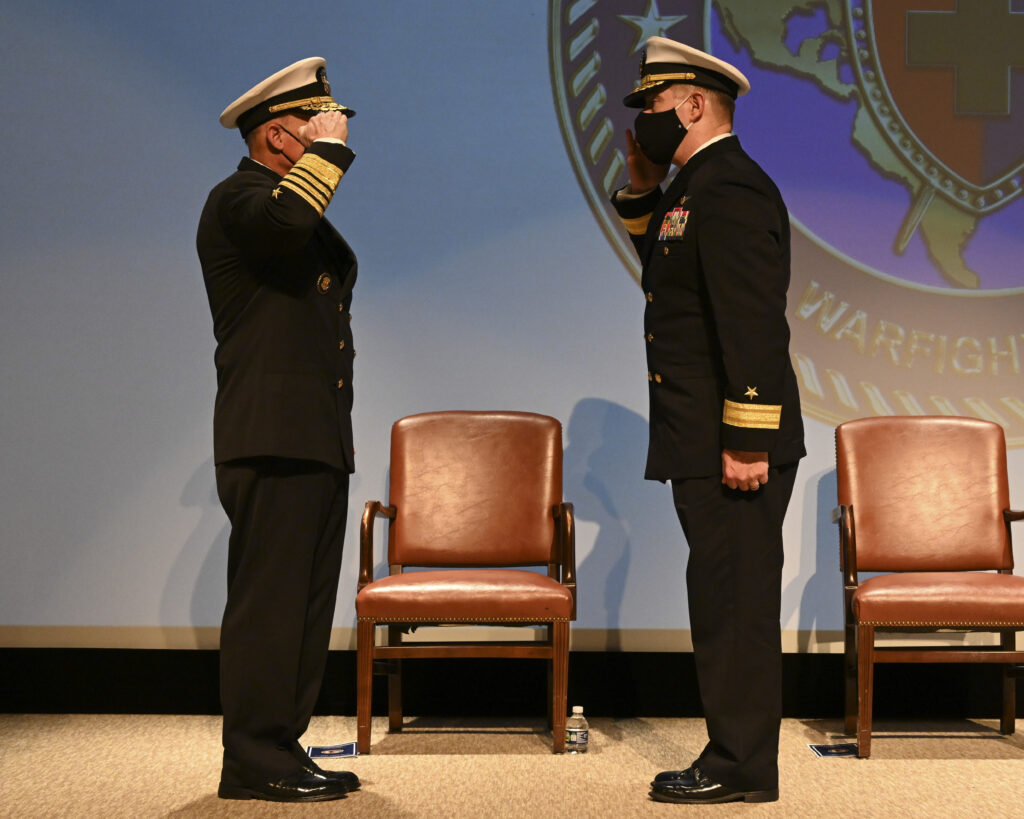
Vice Adm. Jeffrey Trussler says cyber attacks are something that now threaten every American. NAVY LEAGUE / Lisa Nipp

NATIONAL HARBOR, Md. — Vice Adm. Jeffrey Trussler, deputy chief of naval operations for information warfare and director of naval intelligence, said cybersecurity threats to the United States are such that “frankly, where we sit today in 2021, we ought to be having one of those Pearl Harbor moments without the Pearl Harbor.”

Trussler spoke on a panel at Sea-Air-Space 2021 panel on “Cyber Today’s Fight, Tomorrows Capabilities,” along with Rear Adm. Michael Ryan, commander of U.S. Coast Guard Cyber Command, Karen Van Dyke, director for positioning, navigation, and timing and spectrum management at the Department of Transportation, and Ryan Roberts, senior manager of cyber and strategic risk at Deloitte.

Trussler said cyber attacks — such as the one that disabled the Colonial Pipeline, affecting the flow of oil along the East Coast and Southeast — shows that the threat is no longer just about defense and security, but “you could be impacted personally from anywhere around the world, based on our dependency on technology … I’m worried that enough people aren’t hearing, wow, it’s a new world.”

Ryan said the Coast Guard is issuing an update to its Cyber Strategic Outlook and wants to embrace innovation on the cybersecurity front, which is where industry can help.

“We understand the value of partnerships, particularly with those in the room,” he said.

Van Dyke said from her point of view, a big fear is the jamming and spoofing of Global Positioning System signals.

“It’s a weak signal coming from space,” she said of GPS, and “it doesn’t take much power to jam GPS over a wide area.”

Jamming is a temporary threat, but spoofing can actually permanently disrupt communications, as a GPS user might lose access to their receiver for good.

“This is an increasing concern,” Van Dyke said, and DoT is working with the Department of Defense to counter these and other threats.

Roberts said automation will take on a larger role when responding to future cyber attacks, as eventually humans will be too slow.

If a major attack happens “and we convene a committee to decide what we’re going to do, we’ve already lost,” he said. “Over time, we’re going to have to remove that human in the loop and get to autonomous decision making.” It’s a scary thought, but “humans are not going to be able to respond quickly enough.”

Interagency cooperation is key to fighting cyber attacks, the panelists said. Trussler said he learned new things just by being on the panel, and said “Sea-Air-Space has done a really good job” in bringing together different viewpoints.

Ryan said the Coast Guard is already working with commercia shipping ports to assess their facilities so they can harden their infrastructure.

That’s a niche area for the service, he said, “but reflective of the fact this is a joint fight.”


Official: Navy Opposed to More Super Hornets Because Aircraft May Not Be Viable in 2050s

Rear Adm. Andrew Loiselle, third from left, spoke on an aviation panel on Aug. 3. NAVY LEAGUE / Lisa Nipp

NATIONAL HARBOR, Md. — A top Navy air warfare official said Aug. 3 the service opposes the addition of F/A-18E/F Super Hornets to the budget — which Congress wants to do this year as it done in many previous budgets — because the new buys would take the aircraft deep into the 2050s, when it would be no longer viable.

As they have done for years, lawmakers are once again seeking to add more F/A-18E/F Super Hornets to the Department of Defense’s budget to help close a gap in strike fighter capability. Chief of Naval Operations Adm. Michael Gilday said Aug. 2 at the Navy League’s Sea-Air-Space 2021 the Navy is opposed to this move, and the next day Rear Adm. Andrew Loiselle, director of the air warfare division (N98), said Gilday opposes it because the Navy doesn’t want fourth-generation fighters that many years into the future.

He pointed out that the last Super Hornet to be bought under this proposal would last 30 years, which “takes us out to 2055. There isn’t a lot of analysis out there that supports fourth-generation viability” that far into the future, Loiselle said.

Instead, the Navy is focused on continuing F-35 buys and managing the service lives for current Super Hornets, he said.

Additionally, Loiselle addressed what he described as incorrect interpretations that the Navy is reducing its F-35 program of record by decreasing the number of F-35s in an air wing to 14.

“Some interpreted that as a reduction in the program of record,” he said. “That is not the case. There has been no change to the program of record for the F-35.”


Newport News Shipbuilding Progresses Construction Activities on John F. Kennedy

Newport News Shipbuilding division is progressing through construction of the aircraft carrier John F. Kennedy (CVN 79) turning over more than 500 of the total 2,615 compartments, including the machine room, which is one of the larger spaces. The completed spaces allow Sailors to begin training on the ship while final outfitting and testing continues. HUNTINGTON INGALLS INDUSTRIES

NEWPORT NEWS, Va. — Huntington Ingalls Industries announced Aug. 2 that it is making significant progress in the compartment and systems construction of the aircraft carrier John F. Kennedy (CVN 79).

Newport News Shipbuilding division recently eclipsed the 20% mark on compartment completion, turning over to the ship’s crew more than 500 of the total 2,615 spaces. It also has installed more than 8 million feet of cable — or more than 1,500 miles — of the approximately 10.5 million feet of cable on Kennedy.

The most recently completed spaces include berthing, machinery and electrical. This allows Sailors assigned to the pre-commissioning unit to continue training on the ship while final outfitting and testing progresses.

“We are pleased with the progress being made on Kennedy,” said Lucas Hicks, vice president of the Gerald R. Ford (CVN 78) and John F. Kennedy (CVN 79) aircraft carrier programs. “We are in the very early stages of systems testing and look forward to successfully executing our work on equipment, systems and compartments that brings us closer to delivering the ship to the fleet.”

Kennedy is more than 80% complete overall and is scheduled to be delivered to the Navy in 2024.


Navy Implements New Process to Standardize Development of Autonomous Unmanned Systems

A Knifefish Unmanned Undersea Vehicle (UUV) transits the Massachusetts Bay at the completion of a mission during an operational test conducted by members from Operational Test and Evaluation Force (OPTEVFOR). U.S. NAVY / Mass Communication Specialist 1st Class Brian M. Brooks

NATIONAL HARBOR, Md. — The U.S. Navy is implementing a six-phase process to improve and standardize the development of autonomous unmanned systems, according to an official.

Pete Small, program manager for unmanned maritime systems (PMS 406) said Monday at Navy League’s Sea-Air-Space Expo in National Harbor, Maryland, that this process “represents the future of autonomous capability.”

“From day one, we know these platforms need to be upgradeable and interoperable,” Small said, noting that the Rapid Autonomy Integration Lab (RAIL) was key to achieving that.

To accomplish this, the program starts with a “software factory” approach, where software is rapidly developed, tested, and certified for autonomous capabilities.

The second phase is “DevSecOps,” which are a set of automated software tools, services, and standards that allow programs to develop and deploy applications securely.

The third phase is peer groups, who identify autonomy gaps, requirements, and performance metrics.

The fourth phase is Common Control, which standardizes vehicle planning and control across platforms. That is followed by Unmanned Maritime Autonomy Architecture, which standardizes autonomy interfaces.

The sixth phase involves making data available to support artificial intelligence and autonomy development.


Raytheon’s JPALS Proposed for Marine Expeditionary Use

Raytheon’s CJ Jaynes discusses the Joint Precision Aircraft Landing System at Sea-Air-Space 2021. SOLARES PHOTOGRAPHY

NATIONAL HARBOR, Md. — Raytheon has developed a version of its Joint Precision Aircraft Landing System (JPALS) designed for expeditionary airfields, which it is proposing as ideal for Marine Corps expeditionary base operations.

JPALS is a landing system based on differential Global Positioning System navigation. It is installed or being installed on the U.S. Navy’s aircraft carriers and amphibious assault ships and U.K. and Italian navy aircraft carriers. JPALS was first deployed in 2018.

CJ Jaynes, executive technical adviser, Precision Landing Systems for Raytheon Intelligence, Information and Services, speaking at the Navy League’s Sea-Air-Space Expo in National Harbor, Maryland, said the company has developed vehicle-portable JPALS that could be deployed to a forward base for providing precision landing for aircraft fitted with the JPALS avionics.

The expeditionary JPALS consists of a user display, antennas, and for processing racks, and a power generator. It can be carried in a vehicle such as a Humvee or Joint Light Tactical Vehicle. The system can be set up on site in 60-90 minutes by one or two personnel.

The JPALS uses triangulation to provide precision landing data to aircraft from a distance of up to 20 nautical miles. It can provide information to a fixed-wing aircraft while at the same time it provides the landing data to a helicopter within range.

The system does not rely on precision approach radar or an instrument landing system, said Brooks Cleveland, Raytheon’s senior aviation adviser for Precision Landing Systems.

Aircraft currently configured for JPALS include the F-35A/B/C strike fighters and the CMV-22B Osprey carrier-onboard delivery aircraft and will be installed on the MQ-25A Stingray unmanned aerial vehicle. Installation on the F/A-18E/F Super Hornet is planned for the 2026-2027 time frame.

The JPALS suite for aircraft includes the JPALS waveform, a reprogrammable radio, and computer power.

Raytheon demonstrated its expeditionary JPALS for three weeks in June at Yuma, Arizona. Marine Corps F-35Bs made 50 approaches.

Jaynes and Cleveland said the land-based system at the outlying field also was praised by Marine Corps F-35B pilots because it gave them practice using the system that would enable them to be more ready for shipboard deployment.

JPALS was first deployed on the amphibious assault ship USS Wasp for use by Marine Corps F-35Bs. The USS Carl Vinson deployed Aug 2 as the Navy’s first aircraft carrier to deploy with JPALS. The ship carries the F-35C and CMV-22B on their first deployments.

Raytheon built 12 engineering and manufacturing development versions of JPALS and has delivered 10 of 26 production versions. Raytheon expects to deliver the rest by 2023.


IW Deputy Chief: ‘Fusing Together Information Faster’ Will Create Advantage

Rear Adm. Gene Price, Vice Commander of Naval Information Forces, said AI and machine learning are areas that warrant critical attention. SOLARES PHOTOGRAPHY

NATIONAL HARBOR, Md. — All hopes of prevailing in the next conflict, if and when it arises, hinge on seizing the advantage in information warfare, the Navy’s chief officer of that domain said Aug. 2 audience at the Navy League’s Sea-Air-Space expo in National Harbor, Maryland. 

“Technologies that exist today are all about fusing together information faster,” said Vice Adm. Jeffrey Trussler, Deputy Chief of Naval Operations for Information Warfare. “Our data, our information, the use of artificial intelligence, robotics — the nation that harnesses that the best is going to have the advantage should we go to conflict. And I’m one of those guys who says we’re in conflict right now.”

Trussler then turned the floor over to Rear Adm. Gene Price, Vice Commander of Naval Information Forces, who described the roughly 11-year-old command as a place under which data from a host of communities is amalgamated.

“Information warfare is a combination of oceanography, meteorology, intelligence, electronic warfare, cryptology, cyber warfare, IT [information technology] — all these things — come together,” Price said. 

By integrating all of these disciplines as one, Price said, the Navy creates awareness, assured command and controlled integrated fires in the battlespace. 

“This is the heart and soul of what information warfare is all about – pushing [data] out to whoever needs it, whenever they need it, wherever it is,” Price said. “Our job is to make sure that the right weapon is in the right place at the right time.” 

Price cited AI/ML — artificial intelligence and machine learning — as a critical area that warrants attention. 

“It’s a data problem, a platform problem, a management problem,” Price said. 

Work on transferring data to AI/ML is ongoing, Price said. He also discussed continuing efforts in the field of LVC — live, virtual, constructive training. He noted that the aviation community has been involved in LVC for years, and that it should be incorporated more widely through all areas of training. The security benefits are tangible, he said. 

“If we go out and practice, we tip our hand to what we want to do,” Price said. “It’s readily apparent to information warfare that we have to have a way to train for the high-end fight in a way that the rates could do their thing without tipping off too much.” 

The capability is being managed mainly at the acquisition level, Price said, where a cross functional team with information forces is developing the command requirements and content necessary to make sure information is readily available in a controlled but usable environment. 


Changing Arctic Environment Could Also Change Technologies Needed to Protect It, Experts Say

Dr. Alyson Azzara, international trade specialist with the U.S. Department of Transportation, says replacement fuels will presumably need to be zero emission. NAVY LEAGUE / Lisa Nipp

NATIONAL HARBOR, Md. — In addition to cooperating with each other and maintaining a physical presence at the top of the world, Arctic nations need to consider what technologies will still be needed when there’s less ice to negotiate, according to a panel discussion on the Arctic domain.

“The demand for heavy ice breakers is going to decrease” in the not too distant future if the Arctic becomes “an ice-free zone,” Richard Jenkins, CEO of unmanned surface vessel (USV) maker Saildrone said Aug. 2 at the Navy League’s Sea-Air-Space expo in National Harbor, Maryland. 

“Unmanned systems are not a replacement for manned systems,” Jenkins said during the panel discussion, Arctic Domain Readiness. However, he added manned-unmanned teaming could reduce the need for humans to be present 24/7 in the harsh Arctic environment, with USVs or aerial or undersea drones keeping watch and alerting military, Coast Guard or scientific teams to changing situations. 

With no year-round ports for large ships, ice breakers like the Coast Guard Cutter Healy, which recently began a four-month deployment to the Arctic have to pack enough food and fuel for an extended stay in the region, Jenkins said. The changing environment may be “an opportunity to rethink how to design our ships going forward,” he added. 

Dr. Alyson Azzara, international trade specialist with the U.S. Department of Transportation, noted that new international regulations to address climate change will ban heavy fuel oil use by ships starting in 2024 and global fuel sulphur cap. Replacement fuels “will be, presumably, zero emission and low carbon fuels. And those fuels don’t exist yet,” she said.

In addition to concerns about the spread of pollution with increasing maritime traffic crossing the Arctic as melting sea ice opens more transit channels, scientists have noticed underwater noise pollution is on the rise. “The volume has doubled in under 10 years,” Azzara said.

“That’s important for the environment, for marine mammals,” she said, “but it’s also important for anything operating or listening or recording under the ice, under the water.” 

Operating in the Arctic “becomes more difficult when there’s more noise” under the water said Vice Adm. Andrew Lewis, commander of the U.S. 2nd Fleet, another panel member. 


Navy to Stand-Up 2 Fleet MQ-25 Squadrons to Deploy Detachments

The Boeing MQ-25 T1 test asset transfers fuel to a U.S. Navy F/A-18 Super Hornet on June 4, marking the first time in history that an unmanned aircraft has refueled another aircraft. The MQ-25 Stingray will assume the carrier-based tanking role currently performed by F/A-18s, allowing for better use of the combat strike fighters and helping extend the range of the carrier air wing. THE BOEING CO. / Kevin Flynn

NATIONAL HARBOR, Md. — The U.S. Navy plans to establish two MQ-25 squadrons to deploy detachments of the MQ-25A Stingray unmanned aerial refueling aircraft on board aircraft carriers. Later this year, the MQ-25A fleet replacement squadron will be established to train operators and maintainers for the Stingray.

The fleet replacement squadron, Unmanned Carrier-Launched Multi-Role Squadron 10 (VUQ-10) is slated for establishment on Oct. 1, 2021. It will be based at Naval Air Station Point Mugu, California.

Speaking Aug. 2 at the Navy League’s Sea-Air-Space expo in National Harbor, Maryland, Capt. Chad Reed, the Navy’s program manager for Unmanned Carrier Aviation, said that the two fleet squadrons will be VUQ-11 and VUQ-12.

The VUQ squadrons will operate under the administrative control of commander, Airborne Command & Control Logistics Wing — also based at Point Mugu — which also controls the Navy’s E-2 battle management aircraft.

The two fleet VUQ squadrons will deploy detachments to the E-2 squadrons to operate the Stingrays. Each detachment will deploy with five MQ-25As.   

The Navy plans to procure 72 Stingrays. A Boeing-owned prototype, T1, is being test-flown by the company. Boeing is building four Engineering and Manufacturing aircraft, two ground test articles, and three system demonstration aircraft. The Navy is scheduled to receive it first production fleet MQ-25A in 2024. 

T1 made its first flight in September 2019, and first flew with an aerial refueling store in December 2020. On June 4, it made history as the first unmanned aircraft to pass fuel to an aircraft in flight.

“T1 has just been tremendous,” Reed said.

The MQ-25A will be the “first unmanned aircraft intended to connect with a manned aircraft,” he said.

Reed said he is looking forward to taking T1 and the ground control station to a carrier deck for the critical trials in handling control on the deck.

The MQ-25A is scheduled to achieve initial operational capability in 2025. 

Reed affirmed that there is “no requirement in the current plan for armament [for the MQ-25A], but in the future it certainly could [carry armament].”

Intelligence, surveillance and reconnaissance is a secondary mission for the Stingray.

Four aircraft carriers are being modified with Unmanned Aviation Warfare Centers (UAWC) to control the MQ-25 missions, Reed said, with four more in planning for the modification.

The MQ-25A and the control system are being integrated in the planning for the Joint All-Domain Command and Control concept.


Emerging Tech Will Change the Character of War, and the US Must be Ready, Milley Says

Gen. John Milley, chairman of the Joint Chiefs of Staff, told Sea-Air-Space that America must master emerging new technologies. NAVY LEAGUE / Lisa Nipp

NATIONAL HARBOR, Md. — The rapid development of a vast array of new technologies is changing the fundamental character of war and if the U.S. military fails to adapt, it could mean future generations would suffer massive casualties in the next major power conflict, the nation’s top military officer said Monday.

About 40 to 50 new technologies will evolve very rapidly in the next 15 to 20 years and will fundamentally change the character of war, Army Gen. John Milley, chairman of the Joint Chiefs of Staff, told a luncheon audience at the Navy League’s Sea-Air-Space expo. He cited unmanned systems, artificial intelligence, 5G technology and other concepts that will be available to all major powers. The nation that masters those technologies “is likely to have a distinct advantage,” he said.

Recalling the heavy military casualties that America suffered due to its lack of preparation for both World War I and II, Milley said, it is the responsibility of the current leaders to make the right investments “so that future generations of Americans don’t have a disadvantage in the next war.”

“It’s not about the amount of money we’re spending, it’s what we’re spending it on,” he said.

Milley said he has “a great deal of pride” in the Navy because both of his parents served in the Navy during World War II — his father as a Navy corpsman with the Marines in the bloody battles in the Pacific and his mother as a Wave. He noted that America has always been a maritime nation and the Navy has played a major role in the nation’s military power with its mastery of sea control and power projection.

“That is the role of the Navy and no one has ever done it better. … The Navy today is the best in the world and we want to keep it that way,” Milley said.

 “The decisions we are making today — which are mostly economic — will determine the future of the U.S. Navy, and how we mange sea control and power projection,” he said.

In addition to the challenges of the rapidly changing technologies, Milley said the international order, which has been relatively stable since the end of World War II, “is under tremendous stress” because of international terrorists, crime cartels and the rise of new national powers. He singled out the growing economic and military power of China, which has developed “a world-class navy … China will be a major agent of change to the current international order, there is no doubt,” he said.

Milley said the U.S. military currently is ready for combat and “we have to maintain that readiness. But we most also modernize. Preparing for war is very expensive. But even more expensive is losing a war. … Our task as the military is to prepare for war,” because if war breaks out, “we must be prepared,” he concluded.


Navy Closing Capability Gaps in Joint Communications

Defense and industry officials, including Rear Adm. Douglas Small, second from left, discuss joint command and control. NAVY LEAGUE / Lisa Nipp

NATIONAL HARBOR, Md. – As the entire Department of Defense modernizes technology to enable commands, warfighters and autonomous systems to communicate with each other under the most trying of circumstances, significant questions remain. 

“We’re really about closing capability gaps and building the right resourcing requirement plans [to do so],” said Kelly McCool, acting director of the Navy Digital Warfare Office, speaking during a July 2 panel discussion on netted battlespace at the Navy League’s Sea-Air-Space 2021 in National Harbor, Maryland.

Joining McCool on the panel were Naval Warfare Systems Command commander Rear Adm. Douglas Small, Northrop Grumman chief technology officer Scott Stapp and L3 Harris Technologies chief technology officer Ross Niebergall. Patrick Tucker, technical editor at Defense One, moderated the discussion, which addressed the Navy’s role in improving JADC2 (joint all-domain command and control). 

Small said the Navy has a long history of expertise in connecting disparate sensors, weapons and command and decision systems. The current climate, he believes, is an expansion of this traditional role. 

“We’re talking about contested environments,” Small said. “How do you get that information to the right place in a contested environment, where every aspect of how you fight is being challenged?”

Stapp pointed out that JADC2, as its name suggests, must be applied across all services and domains as well. 

“It’s how you move that data into all those critical platforms,” Stapp said. “As a company, we are focusing on the integration of new and unique ways — multi-domain and multi-service.”

Niebergall discussed the need to take all the data generated by stand-alone systems and use it as a strategic asset. “We need to put it together into a collection that we can operate on, make sure it’s available everywhere, is secure, accurate and can be disseminated everywhere.” 

 The Navy is accustomed to operating in disconnected environments, Small said, providing commanders with information they need at the time they must make decisions.

“There are certainly areas where we can do a lot better — and we are,” Small said. “It’s more how you take that [data] from a naval platform and expand it out to the joint force.”