UK Donating Undersea Minehunter Drones to Help Ukraine Clear Coastline 
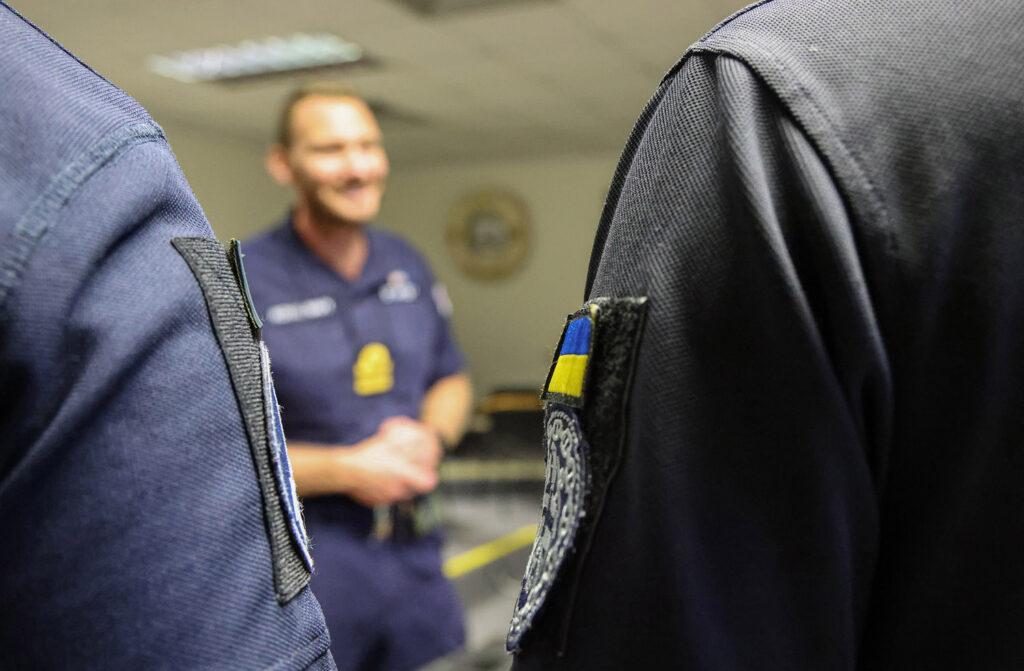
Ukrainian navy divers in the classroom learning how to use an unmanned underwater vehicle. U.K. ROYAL NAVY

LONDON — Dozens of Ukrainian personnel will be taught to use the autonomous mine-hunting vehicles by the U.K. Royal Navy and its U.S. partners over the coming months, the U.K. Ministry of Defence said in an Aug. 26 release. 

The U.K. is giving unmanned underwater vehicles to Ukraine and training Ukrainian personnel in Britain to use them to clear their coastline of mines. 

Six autonomous minehunting vehicles will be sent to the country to help detect Russian mines in the waters off its coast. Three of these will be provided from U.K. stocks, with a further three to be purchased from industry. 

The lightweight autonomous vehicle is designed for use in shallow coastal environments, operating effectively at depths of up to 100 meters to detect, locate and identify mines using an array of sensors so the Ukrainian navy can destroy them. 

Dozens of Ukrainian navy personnel will be taught to use the drones over the coming months, with the first tranche having already begun their training. 

Russia has been weaponizing food by destroying Ukrainian agriculture and blockading the country’s Black Sea ports to prevent exports, with devastating consequences for the world’s poorest people as food prices rise. 
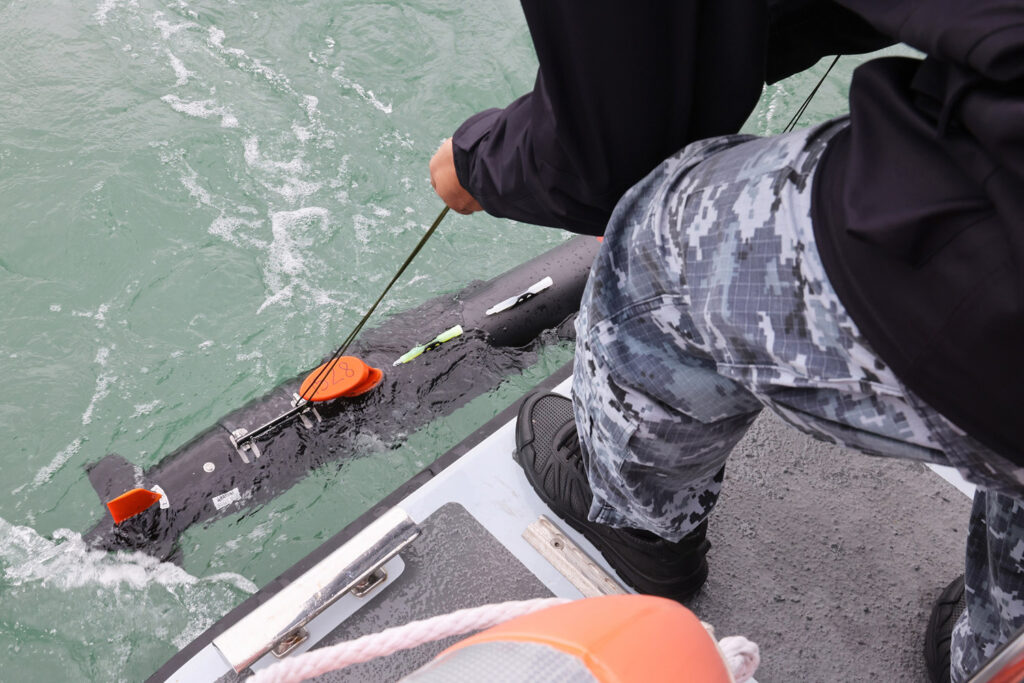
A Ukrainian sailor operates a Royal Navy-provided UUV. U.K. ROYAL NAVY

A small number of ships carrying grain have left Ukraine since the United Nations brokered a deal in July to allow food exports, but efforts to get food out of the country continue to be hampered by sea mines left by Russian forces along Ukraine’s coast. 

“Russia’s cynical attempts to hold the world’s food supply to ransom must not be allowed to succeed,” said Defence Secretary Ben Wallace. “This vital equipment and training will help Ukraine make their waters safe, helping to smooth the flow of grain to the rest of the world and supporting the armed forces of Ukraine as they look to defend their coastline and ports.” 

The Royal Navy’s Diving & Threat Exploitation Group will conduct the three-week training courses, alongside the U.S. Navy’s 6th Fleet. Having considerable experience using the equipment already they will conduct training at sea to operate the vessels and interpret the data they send back to identify mock mines. 

“Through the expert skills being taught here, our Ukrainian allies will be able to clear their own waters of mines,” said Adm. Sir Ben Key, First Sea Lord and chief of the Naval Staff. “These weapons target shipping indiscriminately, but particularly affect civilian traffic and trade and have had a devastating impact on freedom of navigation in the Black Sea. This training is another powerful demonstration of the UK’s ongoing commitment to Ukraine in their fight to defend their country and repel Russian aggression.” 


Bahrain Conducts Fifth Sentinel Shield Exercise with IMSC; Includes Saildrone USV  

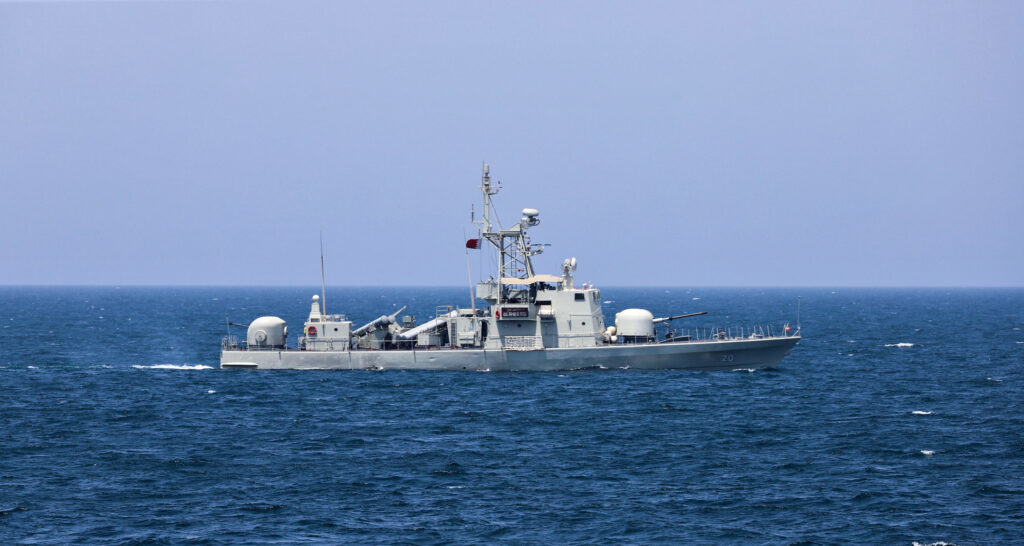
Royal Bahrain Naval Force patrol boat RBNS Ahmed Al-Fateh (P20) sails in the Arabian Gulf during exercise Sentinel Shield on Aug. 23. U.S. COAST GUARD / Electronics Technician 1st Class Jason Pickens

MANAMA, Bahrain — Forces from Bahrain and the United States completed a joint exercise in the Arabian Gulf on Aug. 23, led by a nine-nation coalition staff based in the Middle East, NAVCENT Public Affairs said Aug. 25.  

Royal Bahrain Naval Force ship RBNS Ahmed Al-Fateh (P20) and U.S. Coast Guard patrol boat USCGC Baranof (WPB 1318) participated in exercise Sentinel Shield with a Saildrone Explorer unmanned surface vessel from U.S. 5th Fleet.  

Sentinel Shield is a monthly exercise series organized by the International Maritime Security Construct (IMSC) to enhance communication and coordination among partner naval forces. This month’s iteration was the first designed to integrate unmanned systems.  

“The continued interoperability and coordination of U.S. and Bahraini naval assets are crucial to stability in the Arabian Gulf,” said Lt. Vaughn Gehman, commanding officer of Baranof. “Integration of unmanned systems is a force-multiplier for IMSC and its ability to detect and deter malign activity.”  

IMSC was formed in July 2019 in response to increased threats to freedom of navigation for merchant mariners transiting international waters in the Middle East. Coalition Task Force Sentinel was established four months later to deter state-sponsored malign activity and reassure the merchant shipping industry in the Bab al-Mandeb and Strait of Hormuz.  

The coalition is headquartered in Bahrain under U.S. 5th Fleet and includes forces from Albania, Bahrain, Estonia, Lithuania, Romania, Saudi Arabia, the United Arab Emirates, the United Kingdom and the United States.  

“I was delighted to see our host nation participating in this month’s exercise, and especially pleased to again see Bahrain leading the way in unmanned systems integration,” said British Royal Navy Commodore Ben Aldous, commander of IMSC and CTF Sentinel.  

In October, Bahrain was the first nation U.S. 5th Fleet partnered with after establishing a new unmanned systems and artificial intelligence task force. During a two-day training exercise, U.S. patrol craft and Bahrain Defense Force maritime assets sailed alongside Mantas T-12 unmanned surface vessels in the Arabian Gulf, marking the first time the platforms operated in regional waters.  

“Incorporating unmanned systems into Sentinel Shield enables the coalition to plan for the future by developing and exercising concepts of employment that most effectively utilize this new technology to benefit the Sentinel mission and strengthen our coalition,” said Aldous. 


DARPA’s NOMARS Program to Build, Test, Demonstrate First Unmanned Ship 

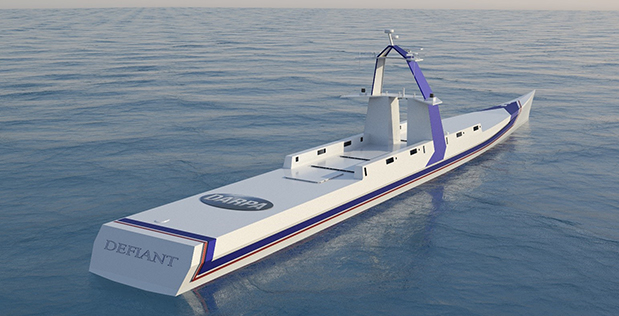
A concept design for the NOMARS Defiant unmanned ship. DARPA

ARLINGTON, Va. — DARPA is moving into Phase 2 of the No Manning Required Ship (NOMARS) program, which seeks to build and demonstrate a revolutionary new medium unmanned surface vessel that can go to sea and perform missions with unprecedented reliability and availability, while carrying a significant payload, the agency said Aug. 22. DARPA selected Serco Inc.’s design to move forward at the conclusion of Phase 1. 

NOMARS took a clean-sheet approach to ship design, holding to the requirement there will never be a human on board the vessel while it is at sea, including during underway replenishment events. By eliminating all constraints and requirements associated with humans, NOMARS opened up the design space to novel ship configurations and capabilities that could never be considered for crewed vessels. 

NOMARS is also pushing the boundaries on ship reliability. Because there is no crew on board to perform maintenance, NOMARS required new approaches for power generation, propulsion, machinery line-up, and control schemes to ensure continuous functionality throughout a long mission in all weather, temperature, and sea states. 

“NOMARS plans to demonstrate a next-generation completely unmanned ship that will enable entirely new concepts of operations,” said Gregory Avicola, program manager in DARPA’s Tactical Technology Office. “We will enable methods of deploying and maintaining very large fleets of unmanned surface vessels that can serve as partners, across the globe, for the larger crewed combatants of the U.S. Navy.” 

In Phase 1, Serco developed a new Design Space Exploration toolset that can evaluate spaces with a variety of parameters and outputs millions of ship designs to meet a diverse set of performance objectives and constraints. Serco used their DSX tool to create a set of ship designs ranging from 170-270 metric tons, then refined those into a single ship for the preliminary design review, which the company dubbed Defiant. In Phase 2, Serco will finalize ship design, build the ship and work through a series of rigorous testing activities before taking it to sea for a three-month demonstration event.

Defiant will be the first of its kind. The 210-metric ton medium USV-class ship aims to maximize performance, reliability, and maintenance efficiency while still carrying significant payload at tactically useful ranges. The goal is to achieve ultra-reliability objectives by integrating distributed hybrid power generation, podded propulsors and high-capacity batteries.

A key philosophy of NOMARS is “graceful degradation,” which allows individual equipment to fail over time by having enough system-level redundancy to meet full system requirements at speeds of at least 15 knots after one year at sea. The major system components of the selected design are modularized, so repairs can be conducted with equipment typically found in yacht yards worldwide. This maintenance philosophy supports rapid turnaround, allowing the ships to spend a majority of their lifetime at sea performing missions. 


BAE Systems to Perform Extended Work aboard USS Ross  

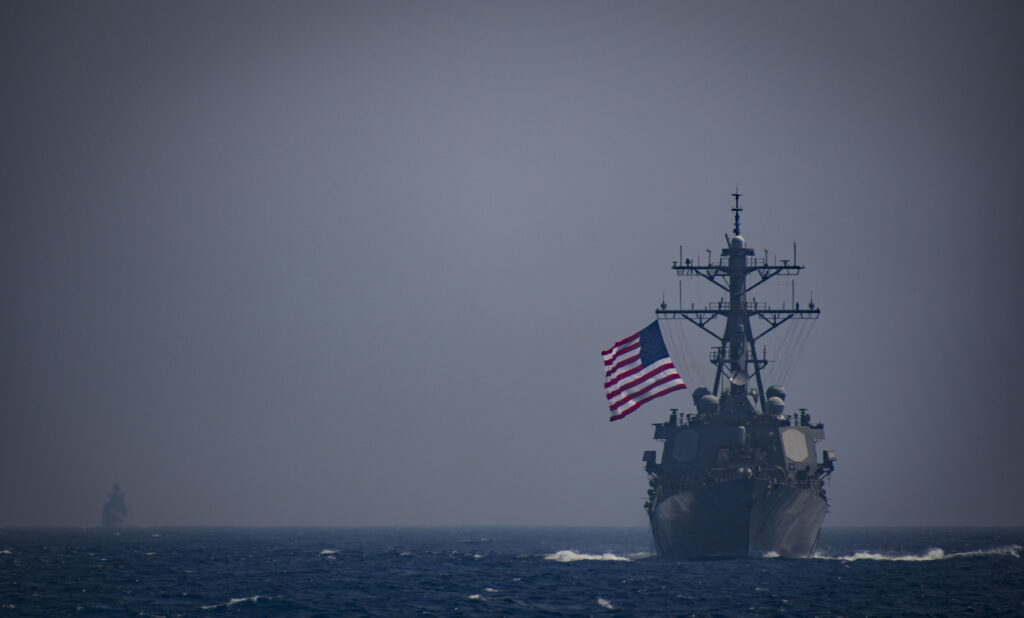
The Arleigh Burke-class guided-missile destroyer USS Ross (DDG 71) transits the Mediterranean Sea Sept. 3, 2018. U.S. NAVY / Mass Communication Specialist 1st Class Ryan U. Kledzik

NORFOLK, Va. — BAE Systems has received a $107.7 million contract from the U.S. Navy to modernize the guided-missile destroyer USS Ross (DDG 71), the company said Aug. 24.

Under this extended dry-docking selected restricted availability contract, the company will perform the modernization work at its Norfolk, Virginia shipyard. The contract includes options that, if exercised, would bring the cumulative value to $123.8 million. 

BAE Systems will dry-dock USS Ross to perform maintenance on the underwater hull, repair the ship’s main propulsion system, preserve internal ballast and fuel tanks and external superstructure and rehabilitate crew berthing and dining compartments. The modernization project is scheduled to take more than 500 days and be completed in April 2024. Once complete, the ship will be capable of serving in the fleet for another 10 years. The 16-year-old ship recently completed a seven-year operational period in Rota, Spain as a forward-deployed U.S. Navy combatant.  

“This is an important job for our employees, subcontractors, and the Navy to accomplish,” said Mike Bruneau, vice president and general manager of BAE Systems Norfolk Ship Repair. “We look forward to meeting the long-term maintenance goals for USS Ross to sustain the future capability and readiness of the ship.”  

The USS Ross was commissioned in June 1997. The ship is named after the first Medal of Honor recipient of World War II, Donald K. Ross. While serving aboard the battleship USS Nevada (BB 36) during the attack on Pearl Harbor on Dec. 7, 1941, Ross valiantly helped the badly damaged ship get underway during the attack. USS Ross is part of the Arleigh Burke class of destroyers. 


Newport News Shipbuilding to Host Ceremonial Keel-Laying of Enterprise (CVN 80) 

NEWPORT NEWS, Va. — HII’s Newport News Shipbuilding division will host a ceremonial keel-laying for Gerald R. Ford-class aircraft carrier Enterprise (CVN 80) on Saturday, Aug. 27, the company said in a release. 

CVN 80 is the third Gerald R. Ford-class aircraft carrier. Designed to replace Nimitz-class carriers, the Ford class features a new nuclear power plant, a redesigned island, electromagnetic catapults, improved weapons movement, an enhanced flight deck capable of increased aircraft sortie rates, and growth margin for future technologies. Enterprise will be the first aircraft carrier not only designed digitally but also built digitally.  

Olympic gold medalists Simone Biles and Katie Ledecky are the ship’s sponsors. Ledecky will participate in the keel-laying ceremony in person, while Biles will participate via video. 

CVN 80 will be the ninth Navy vessel to bear the name Enterprise. It carries on the name of the first nuclear-powered aircraft carrier in history, CVN 65, which was also built at Newport News Shipbuilding. As America recognizes the 100-year legacy of aircraft carriers this year, all nuclear-powered aircraft carriers operating in the U.S. Navy fleet today were built at Newport News Shipbuilding. 

This event is not open to public but will be livestreamed: https://HII.com/cvn80 


HII Marks Construction Milestone in Virginia-Class Submarine Massachusetts  

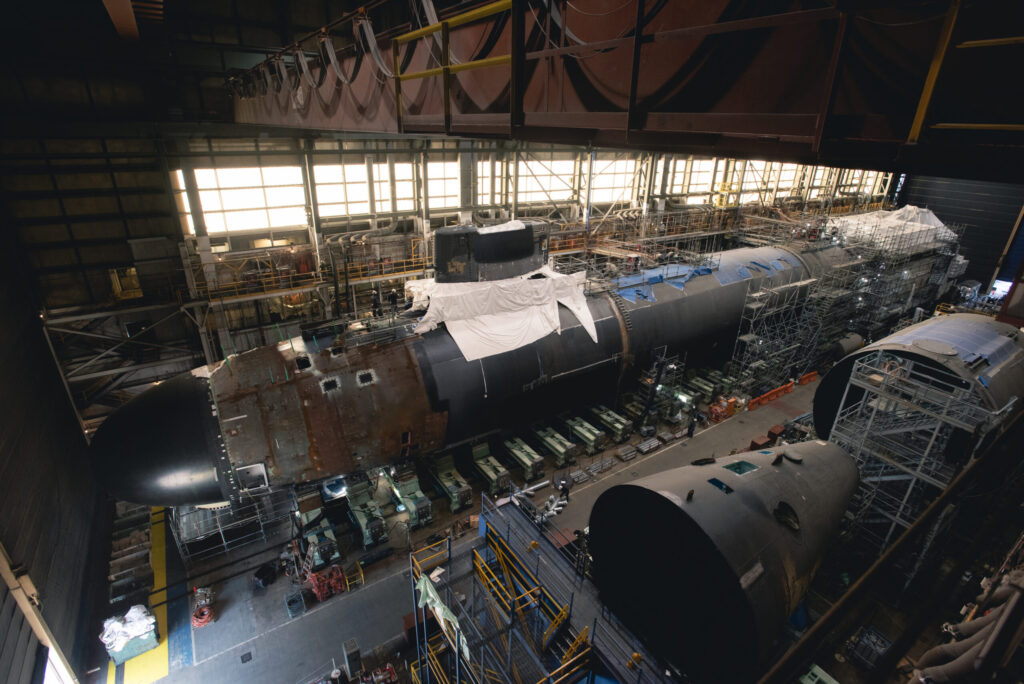
The USS Massachusetts, nearing completion. HII

NEWPORT NEWS, Va. — HII’s Newport News Shipbuilding division has achieved a significant milestone in construction of Virginia-class submarine Massachusetts (SSN 798), the company said Aug. 10. 

Shipbuilders working on Massachusetts recently reached pressure hull complete, meaning that all of the hull sections were joined to form a single, watertight unit. This is the last major construction milestone before the submarine is launched. 

“Our highly skilled shipbuilders are driven to serve the nation by delivering great submarines that help ensure America’s undersea superiority,” said Jason Ward, Newport News Shipbuilding vice president of Virginia-class submarine construction. “Reaching this point in construction demonstrates our commitment to getting Massachusetts ready as soon as possible to become part of the U.S. Navy fleet.” 

Newport News Shipbuilding is one of only two shipyards capable of designing and building nuclear-powered submarines. The advanced capabilities of Virginia-class submarines increase firepower, maneuverability and stealth. 

This milestone on Massachusetts comes following the delivery of USS Montana (SSN 794) and launch of USS New Jersey (SSN 796) at Newport News Shipbuilding earlier in 2022, as the shipyard continues to invest in its workforce and facilities to make steady progress on delivering these important assets to the Navy. 

Massachusetts is the 25th Virginia-class fast attack submarine. 


NHHC Debuts New Naval History and Research Center 

Chief of Naval Operations Adm. Mike Gilday, center left, Naval History and Heritage Command Director Sam Cox, second from right, Yeoman 2nd Class Lynnett Evans, and Kenneth Terry, vice president and operations manager at Grunley Construction Co., cut a ribbon during a ceremony showcasing NHHC’s newest conservation and preservation site. U.S. NAVY / Arif Patani)

WASHINGTON NAVY YARD — Naval History and Heritage Command held a ribbon-cutting ceremony to showcase its newest conservation and preservation site Aug. 8 at the Washington Navy Yard.

Chief of Naval Operations Adm. Mike Gilday spoke at the event for the new Naval History and Research Center (NHRC). Gilday had attended the new center’s ground-breaking ceremony two years ago.

“History shows that the Navy that adapted better, learned faster and improved faster gained warfighting advantages over the long haul,” said Gilday. “Stories of the past help us heed the warnings of history while helping us to reflect on and sustain our legacy as the world’s premier maritime force.

“This building and the stories and artifacts within will preserve the experiences and lessons of the past; use the Navy’s legacy of valor and sacrifice to inspire current and future generations of Sailors; and let those who serve today know that their sacrifice will always be remembered, honored, and valued,” Gilday said.

The new site, made up of two former ordnance factories and warehouses, has now been refurbished into a single state-of-the-art, two-floor structure that maintains the building’s national historic district status.

“The Washington Navy Yard is significant to the early history of the U.S. Navy, the development of Washington, D.C., and the nation for its role in the manufacturing of ship equipment, advances in ordnance, and naval administration,” said NHHC Director Sam Cox. “Not only will this building continue to be a historic site, but it will be dedicated to preserving all our future naval artifacts.”

NHHC and Naval Facilities Engineering Systems Command Washington began collaborations in 2018 to convert the two adjoining buildings. The NHRC will now house NHHC’s Navy Art Collection and Underwater Archeology Branch of the Collection Management Division and Histories and Archives Division, including the Navy Library and Archives Branch.

These divisions have long served researchers and the public in their research and inquiries about naval history.

Since the early 1800s, the Washington Navy Yard has been a collection point for naval artifacts and trophies. In this effort, the two buildings were converted from munitions storage facilities where they will house artifacts for years to come.

NHHC, located at the Washington Navy Yard, is responsible for preserving, analyzing, and disseminating U.S. naval history and heritage. It provides the knowledge foundation for the Navy by maintaining historically relevant resources and products that reflect the Navy’s unique and enduring contributions through our nation’s history and supports the fleet by assisting with and delivering professional research, analysis, and interpretive services.

NHHC comprises many activities, including the Navy Department Library, the Navy Operational Archives, the Navy art and artifact collections, underwater archeology, Navy histories, 10 museums, the USS Constitution repair facility and the historic ship Nautilus. 


Mark Fleming to Lead New VideoRay Defense and Government Business Unit  

VideoRay’s Mark Fleming. VIDEORAY

POTTSTOWN, Pa. — VideoRay, a global leader in underwater remotely operated vehicle technology, has established a Defense and Government business unit to further develop the company’s successful defense and government program, the company said Aug. 4.

Mark Fleming will lead the unit as vice president, defense and government, responsible for all strategic business development and customer support.  

Fleming, who served in the U.S. Navy specializing in explosive ordnance disposal and attained the rank of chief warrant officer five (CW5), joined VideoRay 10 years ago to increase government sales. Building on the company’s relationship with the U.S. Coast Guard, Fleming established new connections that led to contracts with the U.S. Navy, foreign navies and other governmental entities. He has built these relationships through his deep understanding of the challenges that defense personnel face in underwater missions and his strong customer service ethic. 

VideoRay has been experiencing substantial growth over the past two years, due in part to multimillion-dollar contracts with the U.S. Navy for Mission Specialist Defender ROV systems.  

“Defense and government sales of our Mission Specialist systems have grown because our capabilities are proven to be extremely valuable and unique for underwater explosive ordnance disposal. Mark is the driving force behind this success,” said Chris Gibson, vice president, sales and marketing.  

Fleming added, “I’m looking forward to advancing VideoRay’s defense and government outreach and developing new ROV technology to support safe underwater missions around the world.” 

Under Fleming’s direction, VideoRay will conduct a search for a new salesperson for the business unit.  

The Mission Specialist Defender ROV system is designed for precise control of the vehicle position and orientation, heavier payloads and demanding intervention applications. With seven thrusters, the Defender ROV system can move in any direction and maintain active pitch to face the vehicle in an upward or downward orientation, making it ideal for dangerous or heavy-duty missions. In addition, these submersible ROV systems use interchangeable modular components that reside on a single platform, which enables operators to integrate tooling, sensors and payloads quickly and easily in the field to meet mission objectives and maximize uptime.  


Exercise PANAMAX 2022 Kicks Off in Mayport, Florida 

Argentine Navy Rear Adm. Marcelo Fernandez, PANAMAX 2022 Combined Force Maritime Component Commander, throws the ceremonial first pitch at a Jacksonville Jumbo Shrimp minor league baseball game for the start of PANAMAX 2022, in Jacksonville, Florida, Aug. 2. U.S. NAVY / Mass Communication Specialist 3rd Class Jahlena Royer

MAYPORT, Fla. — U.S. Naval Forces Southern Command/U.S. 4th Fleet is hosting the Combined Force Maritime Component Command Staff participating in exercise PANAMAX 2022, in Mayport, Florida, Aug. 1-12. 

Exercise PANAMAX 2022 is a U.S. Southern Command-sponsored exercise that provides important training opportunities for nations to work together and build upon the capability to plan and conduct complex multinational operations. The exercise scenario involves security and stability operations to ensure free flow of commerce through the Panama Canal. 
 
U.S. forces participating in this year’s exercise include staff elements from Southern Command, U.S. Army South, U.S. Marine Forces South, Special Operations Command South, 12th Air Force (Air Forces Southern), and U.S. Naval Forces Southern Command/U.S. 4th Fleet, along with participants from 23 partner nations. 
 
Approximately 300 Sailors, Marines and public security forces will serve on the CFMCC staff under the leadership of Argentine Rear Adm. Marcelo Fernandez, who serves as Commander, Atlantic Naval Area for the Argentine Navy. 
 
“PANAMAX demonstrates our ability to ensure regional security and stability through multi-national maritime operations in support of the Panama Canal,” said Fernandez. “I look forward to the opportunity to work together with the U.S. and our other partner nations during this important exercise.” 
 
Under the exercise scenario, a multinational force has formed to execute a United Nations Security Council resolution calling for defense of the Panama Canal. The force includes air, land and special-forces components, in addition to the maritime component, which will plan and conduct simulated operations in and around the canal and its surrounding waters in the Eastern Pacific Ocean and the Caribbean Sea. 
 
There are no live forces in this year’s PANAMAX. Instead, component staffs will work through a computer-aided scenario in support of the Multinational Forces South Commander, Maj. Gen. William Thigpen, Commanding General, U.S. Army South. 
 
Forces will participate in the training at various U.S. locations including Joint Staff Exercise Directorate at Suffolk, Virginia; U.S. Southern Command, Doral, Florida; Fort Sam Houston, San Antonio, Texas; Homestead Air Reserve Base, Homestead, Florida; Davis-Monthan Air Force Base, Tucson, Arizona; and Naval Station Mayport, Florida.
 
For the fifth straight PANAMAX, the air, land and maritime component commanders for the exercise are partner nation flag or general officers. 


HMAS Canberra Stows an Osprey for The First Time at Sea 

The aviation support team from Royal Australian Navy landing helicopter dock HMAS Canberra (L02) transfer an embarked U.S. Marine Corps MV-22B Osprey into the ship’s hangar during Rim of the Pacific 2022. ROYAL AUSTRALIAN NAVY / Petty Officer Chris Szumlanski

PACIFIC OCEAN — Royal Australian Navy landing helicopter dock ship HMAS Canberra (L02) embarked two MV-22B Osprey military aircraft onboard and successfully moved the Osprey off the flight deck into the hangar for the first time at sea during Rim of the Pacific 2022, Commander, U.S. 3rd Fleet public affairs said in a release.

The MV-22Bs operated from Canberra for the duration of RIMPAC in another first for the ship. The aircraft are onboard for the duration of the tactical phase and are one in many types of helicopters to land and take off from Canberra’s flight deck during the exercise.

A team of staff from the Aircraft Maintenance and Flight Trials Unit (AMAFTU) have embarked for RIMPAC and, in a first for Canberra, the aircraft have been moved and stowed onboard.

Australian Army Maj. David Ellson said what the unit is achieving has taken some work by AMAFTU to get to this point but is important for future capability and a great achievement to see.

“This is the first time at sea we have taken a MV-22B down from the flight deck onto the elevator lift and into the hangar,” Ellson said. “It all forms part of the trials for AMAFTU to enable coalition aircraft to routinely embark on our ships. The evolution to move and stow the MV-22B involved approximately 10 crew and provided an opportunity for AMAFTU and the MV-22B crew to observe which is what this phase of RIMPAC is about, the interchangeability between Australia and coalition nations such as the United States.”

Canberra has not only embarked the two aircraft but their pilots, ground crew and maintainers. The 25 members are living onboard and integrating into life with fellow Aussies. 

“Moving and stowing the Osprey was done at a careful slower pace with our Canberra crew working alongside the Osprey crew as it’s a big aircraft and the crews have not done this at sea, we needed to ensure the aircraft could be stowed inside the ship and achieved safely,” Ellson said.