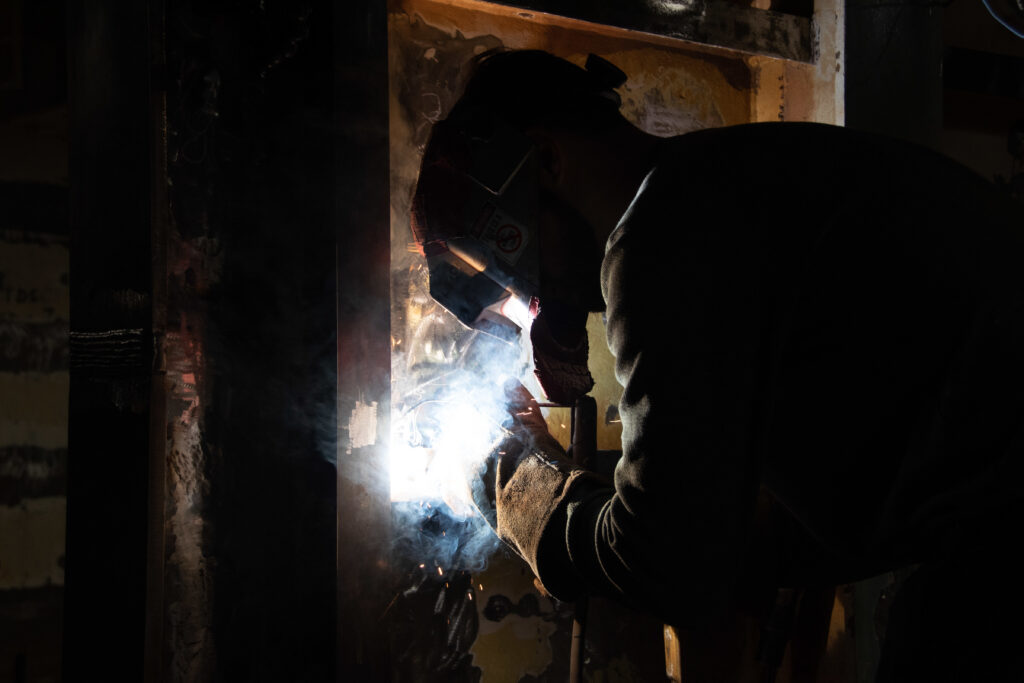
Newport News Shipbuilding contractor Justice Gibson, from Franklin, Virginia, welds a bulkhead aboard the aircraft carrier USS John C. Stennis (CVN 74), in Newport News, Virginia, April 28. U.S. NAVY / Mass Communication Specialist Seaman Curtis Burdick
NEWPORT NEWS, Va. — Global defense and technologies partner HII announced May 23 that the company’s Newport News Shipbuilding division plans to hire approximately 5,000 people this year to meet the shipbuilding needs of the Navy.
The shipyard anticipates hiring nearly 21,000 people within the next decade as HII fulfills orders for U.S. aircraft carriers and submarines.
“We at NNS are driven to support the men and women in uniform, to serve the nation, by delivering great ships,” said Xavier Beale, vice president of Human Resources and Trades for Newport News Shipbuilding. “This is not just a job. It is a mission to serve national security, and we are committed to investing in our people so those who choose this mission can create a long and rewarding career.”
Newport News Shipbuilding intends to hire nearly 3,000 skilled trades in 2022, including entry-level positions and trainee fitters and welders.
Entry-level trade positions at Newport News can pay $21 plus per hour; no experience is required and training is provided. Candidates may be eligible for $500 sign-on bonuses and up to $1,500 for relocation. Newport News is also offering weekly paychecks, comprehensive benefits, an on-site health center and employee discounts.
For more information on all open positions and benefits, visit buildyourcareer.com.
Austal USA Launches the Future LCS USS Augusta
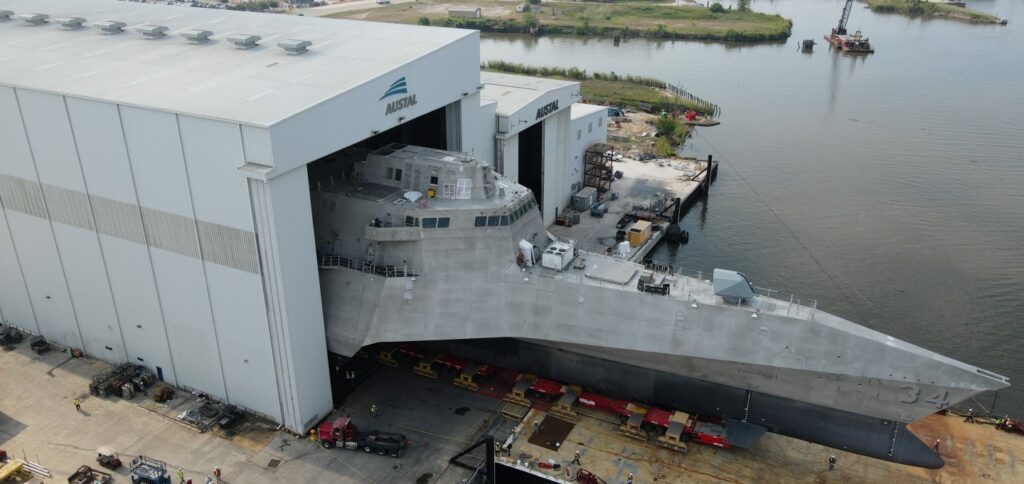
The future USS Augusta (LCS 34) prepares to take to the water. AUSTAL USA
MOBILE, Ala. —On May 23, Austal USA successfully launched the 17th Independence-variant littoral combat ship, the future USS Augusta (LCS 34), the company said in a release.
Assisted by tugs, the ship was escorted out of Austal USA’s floating dry dock and secured pier side on the waterfront for machinery commissioning and system activation in preparation for sea trials later this year.
The launch of Augusta was a multi-step process which involved lifting the 2,500-metric-ton ship almost three feet in the air, moving it approximately 400 feet onto a moored deck barge adjacent to the assembly bay using transporters and then transferring the LCS from the deck barge to a floating dry dock. The floating dry dock was submerged with LCS 34 entering the water for the first time.
“We’re proud to announce another successful milestone achievement for the LCS program at Austal USA,” said Austal USA’s Vice President of New Construction Dave Growden. “Austal USA’s team of talented shipbuilders are excited to have another LCS in the water and are looking forward to delivering her to the Navy so she can join her sister ships in the Pacific fleet.”
Augusta is the 17th of 19 Independence-variant littoral combat ships Austal USA is building for the U.S. Navy. Five LCS are under various stages of construction. Austal USA is also constructing four expeditionary fast transport ships for the U.S. Navy and will begin construction on Navajo-class towing, salvage and rescue ships this summer.
Teledyne FLIR Defense Introduces SeaFLIR 240 and TacFLIR 240 Surveillance Systems
TAMPA, Fla.― Teledyne FLIR Defense announced today at SOFIC 2022 the official launch of SeaFLIR 240 and TacFLIR 240, the latest additions to its line of high-definition, multi-spectral surveillance systems developed for a variety of maritime and land-based operations.
With a lightweight stabilized turret, HD payload options, and inertial navigation capabilities, SeaFLIR 240 can support a wide range of at-sea missions, including intelligence, surveillance and reconnaissance, search and rescue and special operations. The system’s advanced image-processing technology, coupled with a small form factor, make it ideally suited for U.S. Navy, Marine Corps and Coast Guard combatant craft, small boats, and unmanned surface vessels, the company says.
Tailored for manned and unmanned vehicle use, TacFLIR 240 is designed to identify and track smugglers, terrorists and other threats, day or night, over the toughest terrain. The system can support mid-range object and vehicle detection and assessment both for military and homeland security customers.
“Our new SeaFLIR/TacFLIR 240 line is a powerful solution in a smaller package, mission-ready for a host of maritime and land applications,” said Dr. JihFen Lei, executive vice president and general manager of Teledyne FLIR Defense. “Leveraging multiple technology enhancements, such as the ability to support developing Aided Target Recognition capabilities, the new 240 line-up can help users dramatically boost operational surveillance, threat detection and classification, all of which improves situational understanding.”
L3Harris Selected for US Navy Next-Generation Submarine Tender Design Study
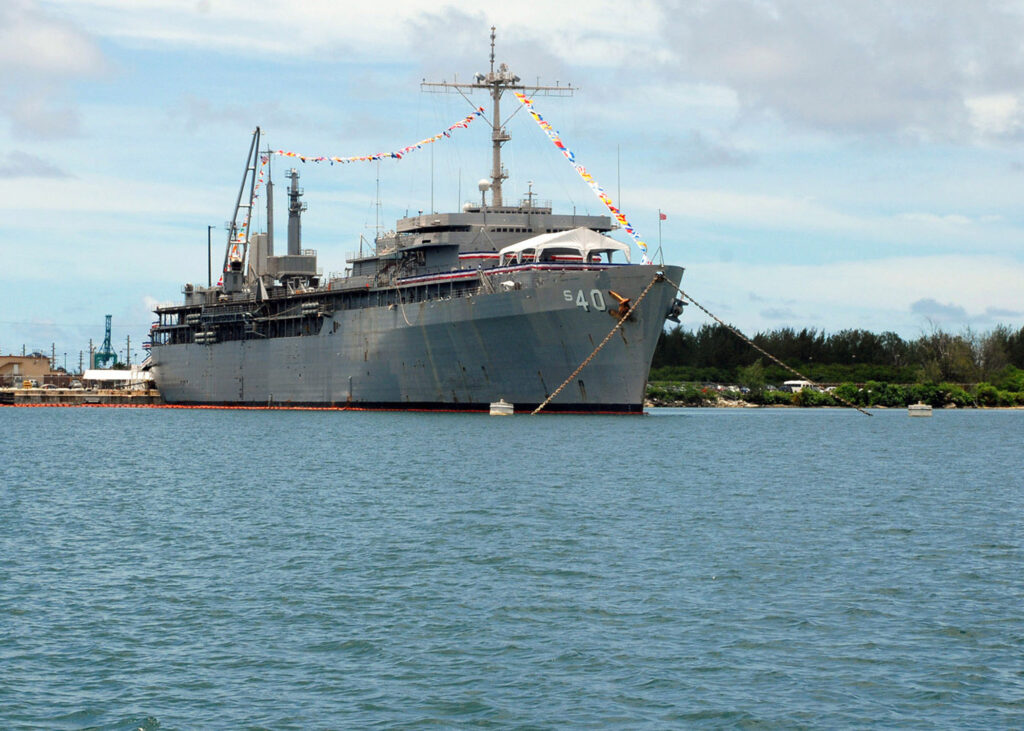
USS Frank Cable (AS 40) in 2009. Cable is one of two aging submarine tenders intended to be replaced by the new AS(X). U.S. NAVY
HERNDON, Va. — L3Harris Technologies is one of three companies selected to provide preliminary designs for the next generation submarine tender, a support vessel that will provide expeditionary maintenance and repairs for U.S. Navy submarines, the company said May 17.
L3Harris will support the development of the AS(X) ship specifications, interface specifications, ship cost estimates and construction schedules under the base AS(X) Concept Refinement and Preliminary Design contract. The nine-month concept refinement and preliminary design study includes options for an additional nine-month concept refinement and preliminary design update and an overarching 36-month period for special studies.
“We are excited to participate in the design study for the AS(X) submarine tender,” said Rosemary Chapdelaine, president of Maritime at L3Harris. “In the coming months, we will work closely with our customer and industry partners to bring innovative solutions to advance the technology that will inform and define the future capabilities on this new class of ships.”
The AS(X) will be capable of providing support and maintenance for up to four submarines, replacing the U.S. Navy’s two aging tenders, the USS Emory S. Land (AS 39) and USS Frank Cable (AS 40), commissioned in 1979. The current tenders provide intermediate-level maintenance and repairs, hotel services and logistics support at sea to nuclear-powered guided missile and attack submarines deployed in the 5th and 7th fleets areas of responsibility.
L3Harris’ Herndon, Virgina, facility will perform the program management and engineering design tasks and is partnered with Philly Shipyard Inc. and VARD Inc. for design development.
Boeing Names Northern Virginia Office Its Global Headquarters; Establishes Research & Technology Hub
Boeing’s Arlington, Virginia campus, now its global headquarters. BOEING
ARLINGTON, Va. — Boeing announced May 5 that its Arlington, Virginia campus just outside Washington, D.C. will serve as the company’s global headquarters.
The aerospace and defense firm’s employees in the region support various corporate functions and specialize in advanced airplane development and autonomous systems. In addition to designating Northern Virginia as its new headquarters, Boeing plans to develop a research and technology hub in the area to harness and attract engineering and technical capabilities.
“We are excited to build on our foundation here in Northern Virginia. The region makes strategic sense for our global headquarters given its proximity to our customers and stakeholders, and its access to world-class engineering and technical talent,” said Boeing President and CEO Dave Calhoun.
Boeing will maintain a significant presence at its Chicago location and surrounding region.
“We greatly appreciate our continuing relationships in Chicago and throughout Illinois. We look forward to maintaining a strong presence in the city and the state,” said Calhoun. “We also want to especially thank [Virginia] Gov. [Glenn] Youngkin for his partnership, and Senator [Mark] Warner for his support as we worked through the process.”
Over the past two years, Boeing has implemented flexible and virtual solutions that have enabled the company to reduce its office space needs. At its Chicago office, less office space will be required for the employees who will continue to be based there. Boeing will adapt and modernize the workspace to better support future work requirements.
Research & Technology Hub
As part of its effort to tap into engineering and technology talent across the U.S and around the world, Boeing plans to establish a research and technology hub in Northern Virginia. The hub will focus on developing innovations in the areas of cyber security, autonomous operations, quantum sciences and software and systems engineering.
“The future of Boeing is digital,” said Greg Hyslop, Boeing’s chief engineer and executive vice president of Engineering, Test and Technology. “Focusing our R&D and talent development in areas that support digital innovation will fuel the introduction of cutting-edge capabilities. This new hub in Northern Virginia will follow the successful implementation of this technology strategy in other regions.”
As the nation’s largest exporter, Boeing employs more than 140,000 people and is hiring as the commercial market recovers and the company invests in production, innovation and product development. The company’s three business units will continue to be based at their current headquarters, which include Boeing Commercial Airplanes in Seattle; Boeing Global Services in Plano, Texas; and Boeing Defense, Space and Security in Arlington, Virginia.
General Dynamics Appoints Krugh as President of Bath Iron Works
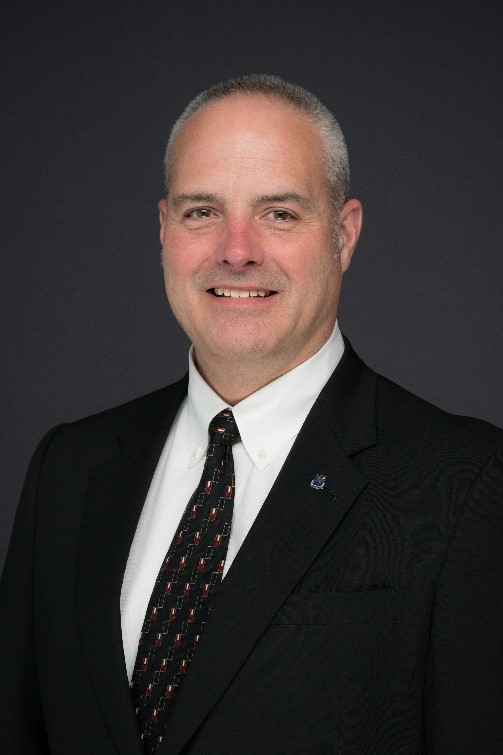
Charles F. Krugh, the new president General Dynamics Bath Iron Works. GENERAL DYNAMICS
RESTON, Virginia – General Dynamics has appointed Gulfstream Aerospace executive Charles F. Krugh as president of General Dynamics Bath Iron Works, General Dynamics said May 5.
“Chuck’s leadership, proven track record in manufacturing and expertise in managing complex supply chains will be an enabler to Bath Iron Works as it expands and increases the pace of shipbuilding for the U.S. Navy,” said Robert E. Smith, executive vice president for Marine Systems.
A U.S. Army veteran, Krugh served in a variety of aerospace manufacturing roles before joining General Dynamics in 2011 as a senior vice president and general manager for Jet Aviation. He was appointed as Gulfstream’s vice president for supplier operational support in 2018.
Navy Hospital Ship Departs for Pacific Partnership 2022
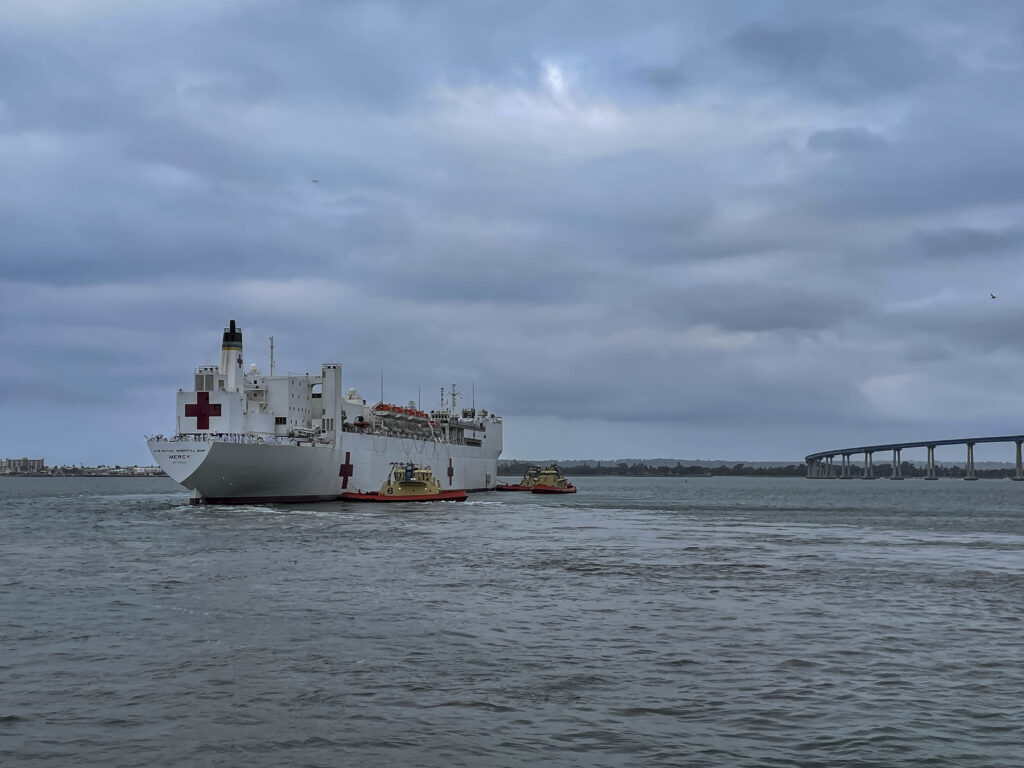
SAMilitary Sealift Command hospital ship USNS Mercy (T-AH 19) departs from Naval Base San Diego, May 3, marking the beginning of Pacific Partnership 2022. U.S. NAVY / Mass Communication Specialist 3rd Class Sang Kim
SAN DIEGO — Military Sealift Command hospital ship USNS Mercy (T-AH 19) departed San Diego, May 3, marking the beginning of Pacific Partnership 2022, the partnership’s public affairs said in a release.
Now in its 17th year, Pacific Partnership is the largest annual multinational humanitarian assistance and disaster relief preparedness mission conducted in the Indo-Pacific. The Pacific Partnership 22 team will work with host nation counterparts and regional partners to provide tailored medical, dental, and veterinary care and conduct bilateral engineering civic actions, and exchange information related to disaster response processes and procedures.
As part of PP22, Mercy and the mission team will conduct missions throughout Oceania and the Western Pacific. Typical Pacific Partnership events include the building of schools, medical and engineering expert exchanges, and host nation outreach events.
“Pacific Partnership is a unifying mission that builds trust among nations to work efficiently together in preparing to respond in crisis,” said U.S. Navy Capt. Hank Kim, Pacific Partnership 22 mission commander.
“I look forward to exchanging experiences and expertise with our host and partner nations to collectively build skills that will last well after the mission.”
HII Launches Virginia-Class Submarine New Jersey
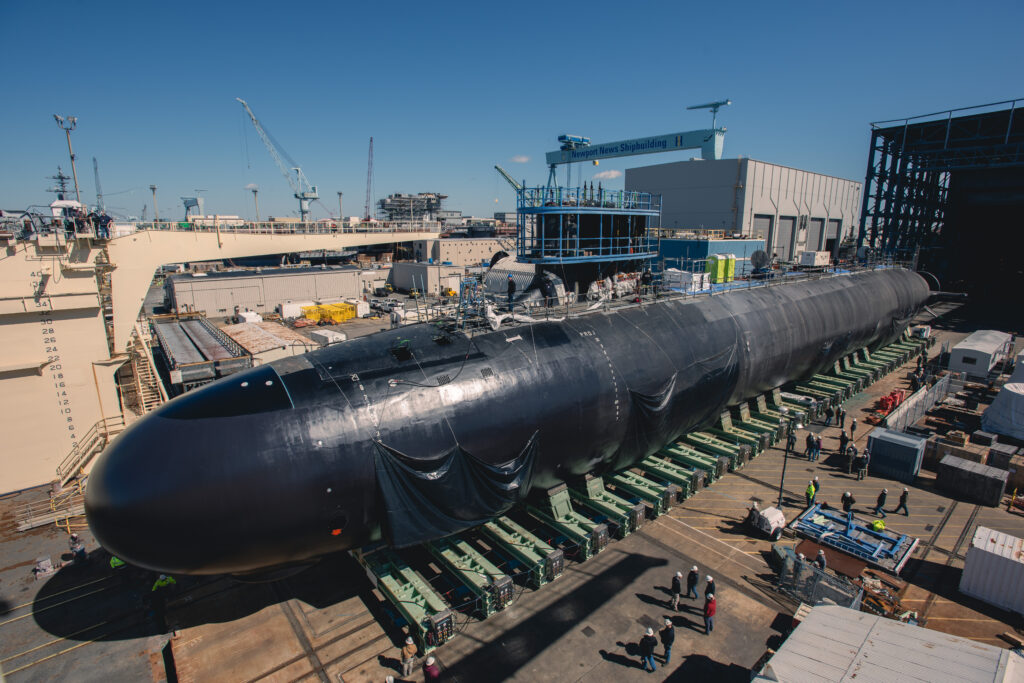
New Jersey (SSN 796) after its roll out to the floating dry dock. HII
NEWPORT NEWS, Va. — HII announced April 28 that Virginia-class attack submarine New Jersey (SSN 796) recently was launched into the James River at the company’s Newport News Shipbuilding division.
The 7,800-ton submarine, which had been in a floating dry dock since being transferred from a construction facility in March, was submerged and moved by tugboats to the shipyard’s submarine pier for final outfitting, testing and crew certification.
“Achieving this construction milestone is a very rewarding event to our shipbuilding team,” said Jason Ward, Newport News’ vice president of Virginia-class submarine construction. “Our shipbuilders and suppliers have dedicated years of hard work to this critical capability that will maintain our customer’s undersea superiority. We now look forward to executing our waterborne test program, and working toward sea trials so we can deliver to the Navy.”
Through the teaming agreement with General Dynamics Electric Boat, approximately 10,000 shipbuilders, as well as suppliers from 50 states, have participated in New Jersey’s construction since the work began in 2016. New Jersey is approximately 92% complete.
Virginia-class submarines, a class of nuclear-powered fast attack submarines, are built for a broad spectrum of open-ocean and littoral missions to replace the Navy’s Los Angeles-class submarines as they are retired. Virginia-class submarines incorporate dozens of new technologies and innovations that increase firepower, maneuverability and stealth to significantly enhance their warfighting capabilities. These submarines are capable of supporting multiple mission areas and can operate at speeds of more than 25 knots for months at a time.
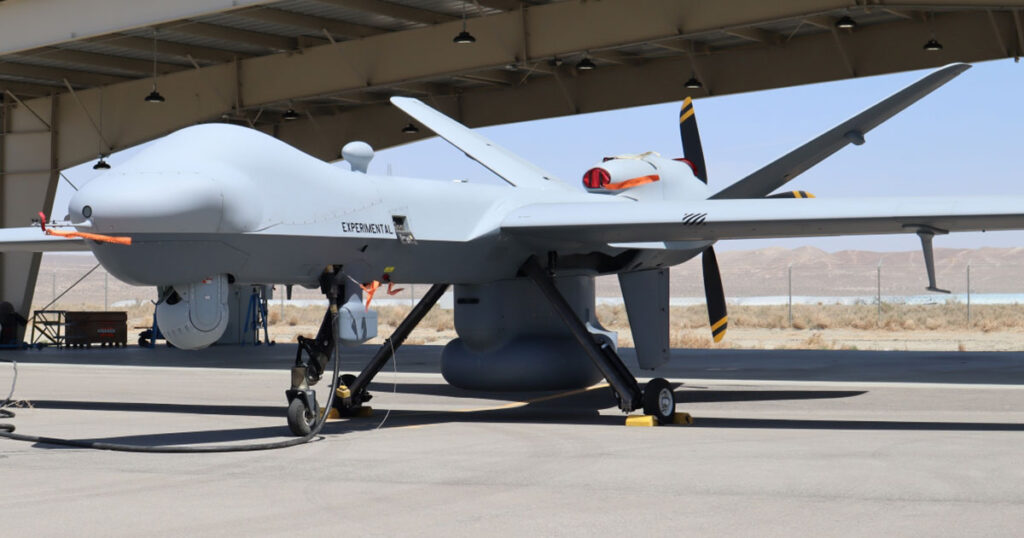
An MQ-9A Block 5 remotely piloted aircraft equipped with a Leonardo Seaspray 7500E V2 multi-mode radar. GENERAL ATOMICS AERONAUTICAL SYSTEMS
SAN DIEGO — General Atomics Aeronautical Systems Inc. has integrated the Leonardo Seaspray 7500E V2 multi-mode radar onto an MQ-9A Block 5 remotely piloted aircraft and performed its first test flight on April 14, the company said April 26. The maritime-focused radar is also being fitted for the MQ-9B SeaGuardian.
“The benefits of this Maritime Patrol Radar in the complex littoral and maritime intelligence, surveillance and reconnaissance environment will add world-class situational awareness for our RPA,” said GA-ASI Vice President of International Strategic Development Robert Schoeffling.
Designed and manufactured in Edinburgh, United Kingdom, the Leonardo 7500E V2 radar is the latest variant of the highly successful Seaspray Active Electronically Scanned Array radar family, featuring updated processor and receiver technology to meet the evolving demands of the ISR mission set. The 7500E V2 is the largest and most capable Seaspray AESA radar and enhances the operationally proven 7500E.
The Seaspray greatly enhances the capabilities of GA-ASI RPA and builds on the already close working partnership between GA-ASI and Leonardo.
“Seaspray’s long-range, wide-area maritime and ground surveillance capability makes it an ideal fit for the MQ-9A and MQ-9B,” said Tony Innes, vice president of sales, Radar and Advanced Targeting at Leonardo. The V2 offers significant range increases for certain critical modes, improved maritime detection and the ability to handle a high number of targets, while improving on its already-capable over-land mode suite.”
Honeywell Demonstrates Alternative Navigation Capabilities in GPS-Denied Environments
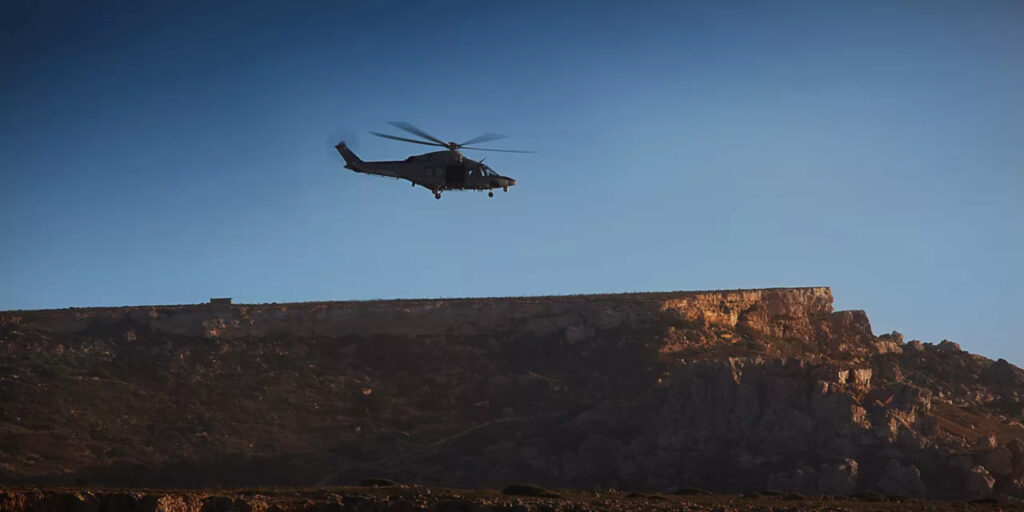
Honeywell has demonstrated alternative navigation technologies to help ensure seamless navigation even when GPS signals are blocked, using aircraft including an AgustaWestland AW139 helicopter. HONEYWELL
PHOENIX — Honeywell has successfully demonstrated several advanced alternative navigation technologies intended to help ensure seamless navigation, even when GPS signals are blocked, interrupted or unavailable, Ahjay Rai of Honneywell said in an April 20 release.
Testing took place on both an Embraer E170 aircraft and an AgustaWestland AW139 helicopter.
Alternative navigation systems use sensors such as cameras, star trackers, radars and radios to augment and or aid inertial navigation systems. These systems correct inertial navigation systems in environments where global navigation satellite systems are denied.
“Our customers are seeing an increase in both intentional and unintentional navigational disruptions, including jamming for GNSS-based navigation,” said Matt Picchetti, vice president and general manager of Navigation and Sensors at Honeywell Aerospace. “There hasn’t been a single set of solutions that meet all our customers’ operational needs, so we decided to create one. Our modular and scalable alternative navigation technologies are setting a new benchmark in terms of reliability and performance in GNSS-denied environments compared with what is available in aviation today.”
Alternative navigation technologies provide position, velocity and heading information in GNSS-denied environments. The successfully demonstrated technologies onboard the E170 and AW139 include:
Vision Aided Navigation: Honeywell’s Vision Aided Navigation system achieved GPS-like performance on both the Embraer E170 and AW139 platforms during GPS-denied conditions. Additionally, the technology showed 67% improvement in GPS-denied performance compared with earlier testing last year. The system uses a live camera feed and compares it with maps to provide a passive, not jammable, and highly accurate absolute position.
Celestial Aided Navigation: Honeywell’s Celestial Aided Navigation system on the Embraer E170 achieved an accuracy of 25 meters circular error probability of 50% (CEP50). This represented a 38% improvement in GPS-denied performance compared with tests last year. Most importantly, this is the first time a Resident Space Objects-based (RSOs) navigation solution was demonstrated on an airborne platform, as most competing solutions rely only on star-based navigation. The system utilizes a star tracker to observe stars and RSOs to provide a passive, not jammable solution with GPS-like accuracy in GPS-denied or spoofed conditions.
Magnetic Anomaly Aided Navigation: Honeywell conducted the world’s first real-time magnetic anomaly-aided navigation on an airborne platform, the Embraer E170. This is a historic milestone, as almost all previous magnetic tests were done in special environments to mitigate electromagnetic noise. Honeywell demonstrated this passive, not jammable, all-weather, 24/7 technology on an embedded platform, which measures earth’s magnetic strength and compares it with magnetic maps to accurately identify the position of the vehicle.
Additionally, Honeywell demonstrated inertial navigation systems, when paired with the GPSDome (anti-jamming device), showed significant improvement in position accuracy and integrity performance in the presence of GPS jamming. The ability of GPSDome to enable tracking of GPS satellites under more aggressive jamming environments reduces performance degradations that come with GNSS-denied conditions.
Alternative navigation prototype systems will be available in 2022, with initial deliveries expected to start in 2023.