IMSC Integrates Unmanned Vessel During IMX/CE22  

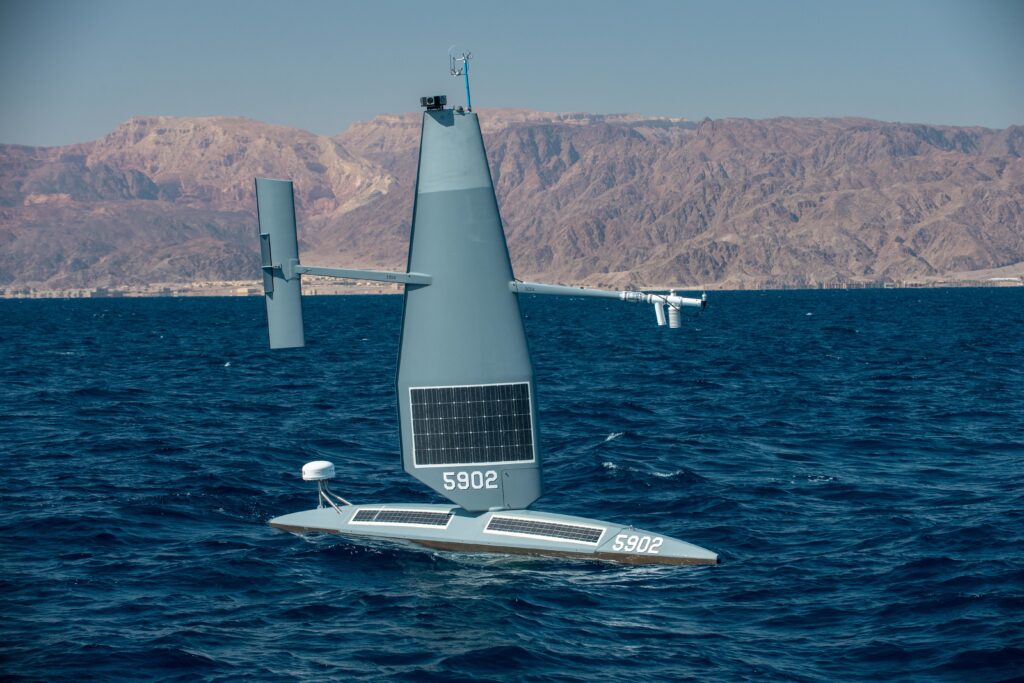
A Saildrone Explorer unmanned surface vessel sails in the Gulf of Aqaba during International Maritime Exercise/Cutlass Express 2022. U.S. NAVY / Mass Communication Specialist 2nd Class Dawson Roth

NAVAL SUPPORT ACTIVITY BAHRAIN — International Maritime Security Construct participated in unmanned integration operations in the Arabian Gulf during International Maritime Exercise/Cutlass Express 2022, Feb. 3, the Coalition Task Force Sentinel Public Affairs Office said Feb. 8.  

IMSC personnel operated with two Saildrone Explorer unmanned surface vessels. The Saildrones were launched by Task Force X, a combined task force established for conducting portions of the exercise focused on unmanned systems and artificial intelligence integration.  

The Saildrone Explorer is a 23-foot-long, 16-foot-tall USV reliant on wind power for propulsion. The vessel houses a package of sensors powered through solar energy for building a shared picture of the surrounding seas.  

Leaders from IMSC observed the capabilities of unmanned systems deployed during operational training scenario at sea from aboard the Royal Bahrain Naval Force ship RBNS Al Muharraq.  

“The exercise was a perfect demonstration of progress towards delivering a genuinely ‘digital ocean’ where navies increasingly employ a combination of manned and unmanned systems, on, above, and below the surface, to deliver unparalleled situational awareness and operational choice to the commander,” said Commodore Don Mackinnon, commander of CTF Sentinel.  

CTF Sentinel is a multinational maritime effort that promotes maritime stability, ensures safe passage, and enhances freedom of navigation throughout key waterways in the Arabian Gulf, Strait of Hormuz, Gulf of Oman, Gulf of Aden, the Bab al-Mandeb and the Red Sea. The coalition is comprised of eight member nations including Albania, Kingdom of Bahrain, Republic of Estonia, Lithuania, Kingdom of Saudi Arabia, United Arab Emirates, United Kingdom and the United States. 


Philippines Acquires BrahMos Supersonic Anti-Ship Missiles

Indian army BrahMos missiles mounted on mobile autonomous launchers. WIKIPEDIA

The Philippines Department of National Defense has contracted for BrahMos shore-based anti-ship missile system. The $368 million contract is for three batteries, as well as launcher vehicles, command and control, training and support.

“Equipping our navy with this vital asset is imperative as the Philippines continues to protect the integrity of its territory and defend its national interests. As the world’s fastest supersonic cruise missiles, the BrahMos missiles will provide deterrence against any attempt to undermine our sovereignty and sovereign rights, especially in the West Philippine Sea,” said Defense Secretary Delfin N. Lorenzana.

The BrahMos uses either an active radar homing system or satellite targeting to deliver its 440-pound warhead. The missile travels at Mach 4 and can reach targets up to 180 miles away. The cruise missile can be used against fixed land targets as well as ships at sea.

The Philippines have been alarmed by Chinese claims to large portions of the South China Sea, including Philippine islands. India, as well, has been engaged in hostilities with China at the border in Ladakh. Both nations are modernizing their militaries, and China is a major motivation.

The BrahMos program began in 1998. BrahMos is a joint Russian-Indian project, and comes in land-based and ship-mounted versions. The weapon is operational with India’s navy and army. India has been seeking export customers for Brahmos for some time. The Philippines deal is the first.

The BrahMos anti-ship batteries will be operated by the Philippines marines. Additional BrahMos systems for precision strike land attack missions are being sought for the army artillery regiment.

The installed radar with the launcher system has limited range, nowhere near the range of the weapon. The system is best employed as part of an integrated with a intelligence, surveillance reconnaissance engagement network, which can include land, sea and space-based sensors, something the Philippines need to develop.


General Atomics Demonstrates Autonomous Flight Termination Units During Navy/Army Hypersonic Rocket Test Flight    

The launch of the successful test of General Atomics’ Autonomous Flight Termination Units. GENERAL ATOMICS ELECTROMAGNETIC SYSTEMS

SAN DIEGO — General Atomics Electromagnetic Systems announced Feb. 1 that its Autonomous Flight Termination Units carried onboard two sounding rockets were successfully demonstrated and performed as expected during a High Operational Tempo for Hypersonics test flight campaign sponsored by the Navy Strategic Systems Programs and Army Hypersonic Program Office on Oct. 20, 2021, at Wallops Island, Virginia.  

The AFTUs help assure missile flight safety and were part of a test campaign to demonstrate technologies to advance the development of the Navy’s Conventional Prompt Strike and the Army’s Long Range Hypersonic Weapon offensive hypersonic strike capability.  

“GA-EMS’ long-established cooperative relationship with the Army, Navy and Sandia National Labs has been key to the design and advancement of hypersonic weapons technologies,” said Scott Forney, president of GA-EMS. “Test flight demonstrations such as this are a critical part of the process toward verifying and inserting this technology into future hypersonic weapon systems. We are pleased the AFTUs performed successfully, advancing the readiness of the AFTU technology. This represents a major step in proving the AFTU’s capability to successfully operate in the hypersonic environment for which they were designed.”    

GA-EMS’ state-of-the-art AFTU offers greater flexibility to assure flight safety for missiles launched for space applications or military weapons testing. Integrated aboard a missile, the AFTU takes a pre-launch defined mission profile and compares it with what the launched missile experiences as it flies. If the flight profile rules or boundaries are violated during flight, the AFTU will command the vehicle to destruct. The AFTU’s compact, lightweight design reduces the size, weight, and power requirements aboard the test vehicle.  

“The missile and space flight industry must provide a means of preventing a launch or aeronautical vehicle and its hazards, including any payload hazards, from reaching any populated or other protected area in the event of a vehicle failure,” Forney said. “Our AFTUs provide the flexibility to operate independently or can be paired to operate together to share data, with the ability to continue the flight should one fail, thus increasing mission assurance.”  


Center for Maritime Strategy Hosts Ribbon Cutting

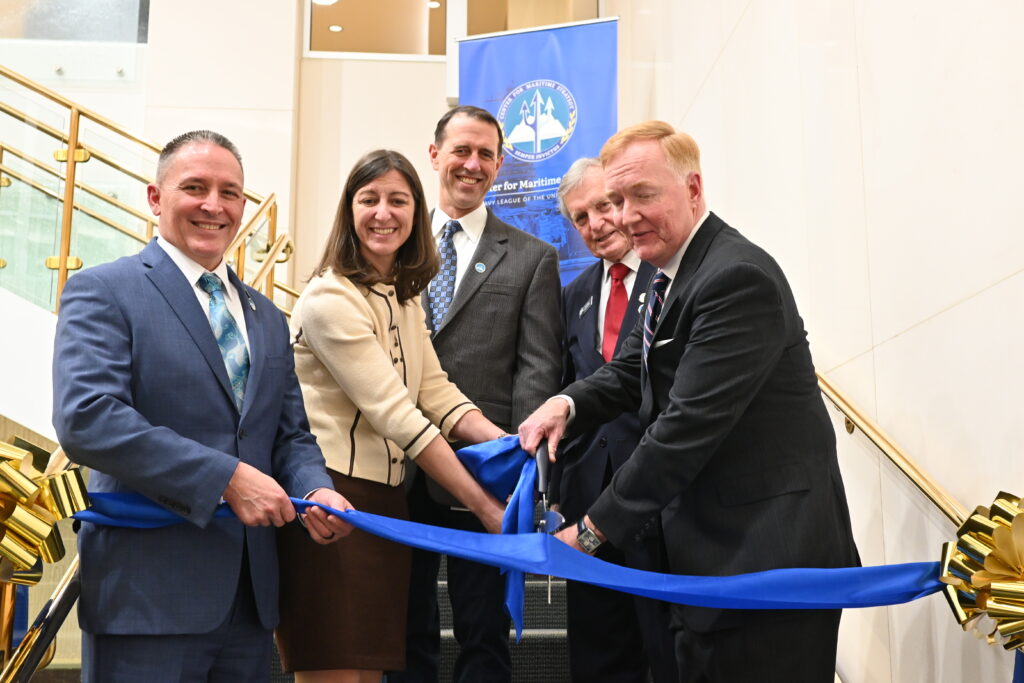
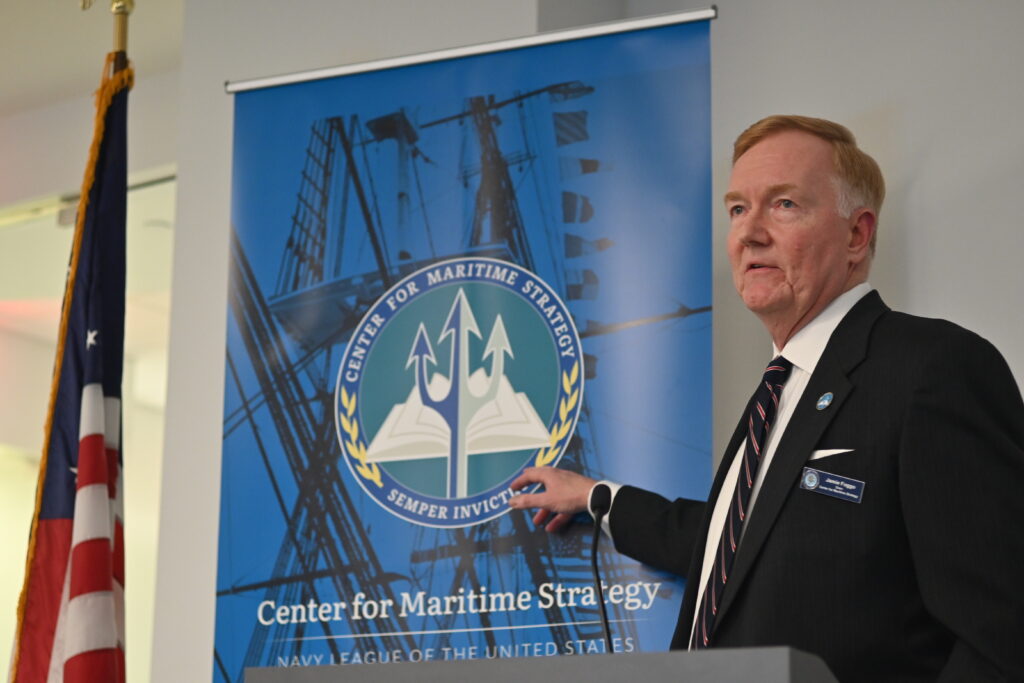
Navy League CEO Mike Stevens, Rep. Elaine Luria (D-Virginia), former Chief of Naval Operations Adm. John Richardson, Navy League President David Reilly and Center for Maritime Strategy Dean Jamie Foggo cut the ribbon on the new CMS. NAVY LEAGUE / Brett Davis

ARLINGTON, Va. — The new Center for Maritime Strategy at the Navy League of the United States held its ribbon-cutting opening ceremony on Jan. 31, with the center’s first dean, retired Adm. Jamie Foggo, saying it will provide thought leadership and advocacy for all the sea services and advocate for a strong industrial base to build the needed platforms that support them.

“Ninety percent of the world’s traded goods go via the sea … there are a lot of actors and factors out there that threaten these sea lines of communication,” Foggo said during the ceremony at the Navy League building in Arlington, Virginia.

He noted the last National Defense Strategy called out five adversaries: China, Russia, Iran, North Korea and violent extremist organizations, all of which remain formidable opponents.

Foggo cited a speech by former Chief of Naval Operations John Richardson about the narrow margin of victory at Midway, which turned the tide in the Pacific in World War II.

“With adversaries surrounding us and our interests, resources tight, and lots of domestic concerns at home, the margins to victory in any future conflict may once again be razor thin,” Foggo said. “It’s our goal in the Center for Maritime Strategy to help the maritime services in collaboration with our leadership in the administration and Capitol Hill, think through this and come up with a winning combination of strategy, force structure, and resources.”

Rep. Elaine Luria, D-Virginia, a two-decade Navy veteran, speaks at the CMS ribbon cutting. NAVY LEAGUE / Brett Davis

Congressional Viewpoint

Rep. Elaine Luria, D-Virginia, a 20-year Navy veteran and vice chair of the House Armed Services Committee, was the keynote speaker at the event.

“We need a real center like this who can think through and justify” the Navy’s needs, including the number of ships required to fulfill its mission, Luria said.

In the days of President Theodore Roosevelt, a former under secretary of the Navy who supported the founding of the Navy league, shipbuilding was robust, Luria said, and “that was part of the American psyche.”

The message about the importance of the sea services needs to “get outside of this room” and be part of the “dialogue with the American people.”

Attendees at the event included active-duty admirals, congressional staffers, retired flag officers, naval attaches from allies and partners from around the world, representatives from prestigious think tanks and leaders from industry.

Center for Maritime Strategy Dean Jamie Foggo discusses the new center’s logo. NAVY LEAGUE / Brett Davis


Indonesia’s New Fast-Attack Trimaran Combines Speed and Stealth

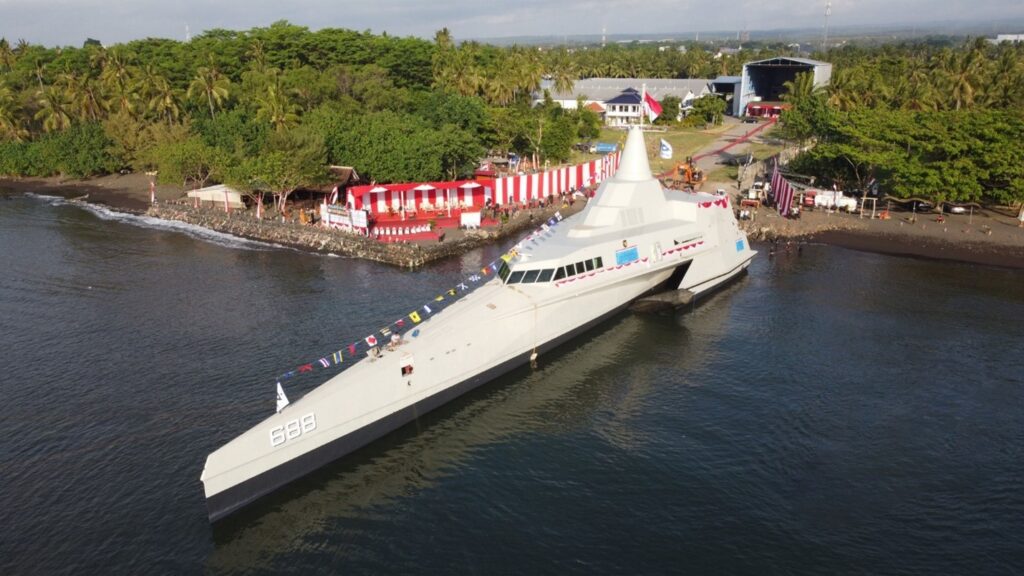
The Indonesian navy’s first stealth trimaran fast-attack craft, KRI Golok. PT LUNDIN

INDONESIA — The Indonesian navy commissioned its first stealth trimaran fast attack craft, KRI Golok (688), at Surabaya on the island of Java on Jan. 14. The ship was built by PT Lundin at Banyuwangi, on Java’s eastern tip, from composite fiber materials.

The commissioning ceremony took place at the naval base in Surabaya, East Java. Also commissioned at the ceremony was the lead ship in a new class of hospital ships KRI dr. Wahidin Sudirohusodo (991),

Speaking at the ceremony, Adm. Yudo Morgono, chief of the Indonesian navy, said, “This type of ship is not only important to support naval operations as part of the task force and the navy fleet, but is a tangible manifestation of the navy’s commitment to modernizing defense equipment in humanitarian operations.”

The term “golok” refers to a cutting took, similar to a machete, which can serve as a tool or weapon.  During the naming ceremony last August, Margono said the composite material offers high strength, light weight, excellent fatigue resistance and is virtually corrosion free. The Indonesian navy sees the trimaran design and material as a prototype development purposes.

“With its high speed and high destructive power, it is hoped that this ship will be able to carry out the hit and run fast missile boat tactic,” Margono said.

The ship has not yet been fitted with weapons, but is able to mount a gun up to 76mm and can carry up to eight antiship missiles, such as the RBS 15, Naval Strike Missile, Harpoon or Exocet.

According to a video prepared by PT Lundin, the ship has greatly reduced radar, infrared, acoustic and magnetic signatures. The weapons and RHIB are concealed inside the structure or discretely shaped to maintain stealth.

PT Lundin said the composite and carbon fiber foam-sandwich material — fabricated with fire-resistant vinyl ester resin — creates a structure that is much lighter than steel or aluminum, resin but has similar fire-resistance and ballistics protection properties and superior protection from blast and underwater explosions.

According to an Indonesian navy statement, the fast attack craft has an overall length of 205 feet (62.53 meters); a 52.5-foot (16 meter) beam; a 61-foot mast height (18.7 meters), and a current displacement of 245 tons. The ship will be heavier after the installation of weapons. The trimaran can achieve speeds up to 30 knots, and can cruise at 16 knots for 2,000 nautical miles. The ship and its 25-person crew will have an endurance of 40 days. Additional personnel, such as special forces or a humanitarian assistance landing party can also be carried.

The wave-piercing trimaran can cut through waves instead of ride over them, maintain higher speeds and heavier sea states.  An enclosed hangar on the stern can carry a 12-meter RHIB.

The trimaran, with four water jets, is well suited for Indonesia’s archipelagic operations. The FAC is extremely maneuverable, has a shallow draft and can literally back up onto a beach — where its radar signature becomes indistinguishable from the land — waiting for targets to engage.

Golok is powered by four 1800 HP MAN V12 diesel engines, each connected to a Marine Jet Power 550 waterjets. In a company video, PT Lundin refers to the trimaran as the “ultimate in high-speed missile boats.”


Keel Authenticated for Future LPD USS Harrisburg 

The amphibious transport dock ships USS San Antonio (LPD 17) and USS New York (LPD 21) in 2011 off the coast of Virginia. They are sister ships to the future USS Harrisburg (LPD 30). U.S. NAVY / Mass Communication Specialist 1st Class Edwin F. Bryan

WASHINGTON — The keel for the future USS Harrisburg (LPD 30), the Navy’s 14th San Antonio class-amphibious transport dock ship and the first Flight II ship, was laid at Huntington Ingalls Industries’ Ingalls Shipbuilding, Jan. 28, Team Ships Public Affairs said in a release. 

A keel laying is the recognition of the start of a ship’s construction. It is the joining together of a ship’s modular components and the authentication or etching of an honoree’s initials into a ceremonial keel plate. The ship’s sponsor, Alexandra Curry, wife of Middletown, Pennsylvania, Mayor Jim Curry, had her initials etched into the keel plate by HII welders. 

“LPD 30 marks the beginning of the LPD Flight II builds and the continuation of the superb capability that the San Antonio Class platform has brought to the Navy–Marine Corps team,” said Cedric McNeal, program manager, Amphibious Warfare Program Office, Program Executive Office Ships. “With its flexibility and adaptability, LPD Flight II ships are essential to projecting power and delivering the combat capability needed to shape the future fleet.” 

The city of Harrisburg, Pennsylvania, and her surrounding region play a central role in our national defense infrastructure, hosting a myriad of defense logistics and naval supply support activities that bring support and sustenance to our Navy’s fleet and our forward deployed Sailors and Marines. This is the second U.S. Navy ship to be named after the city of Harrisburg. The first was a troopship acquired during World War I. 

The LPD Flight II ships will be the functional replacement for the Whidbey Island-class (LSD 41/49) dock landing ships. The San Antonio-class is designed to support embarking, transporting, and landing Marines and their equipment by conventional or air-cushioned landing craft. The ship’s capabilities are further enhanced by its flight deck and hangar, enabling the ship to operate a variety of Marine Corps helicopters and the Osprey tilt-rotor aircraft. Because of the ships inherent capabilities, they are able to support a variety of amphibious assault, special operations, expeditionary warfare, or disaster relief missions, operating independently or as part of amphibious ready groups, expeditionary strike groups, or joint task forces. 

HII’s Ingalls Shipbuilding Division is currently in production of the future USS Richard S. McCool (LPD 29) and the future USS Fort Lauderdale (LPD 29). LPD 28 and 29 will serve as transition ships to LPD 30. 


HII Names Chris Kastner President and CEO

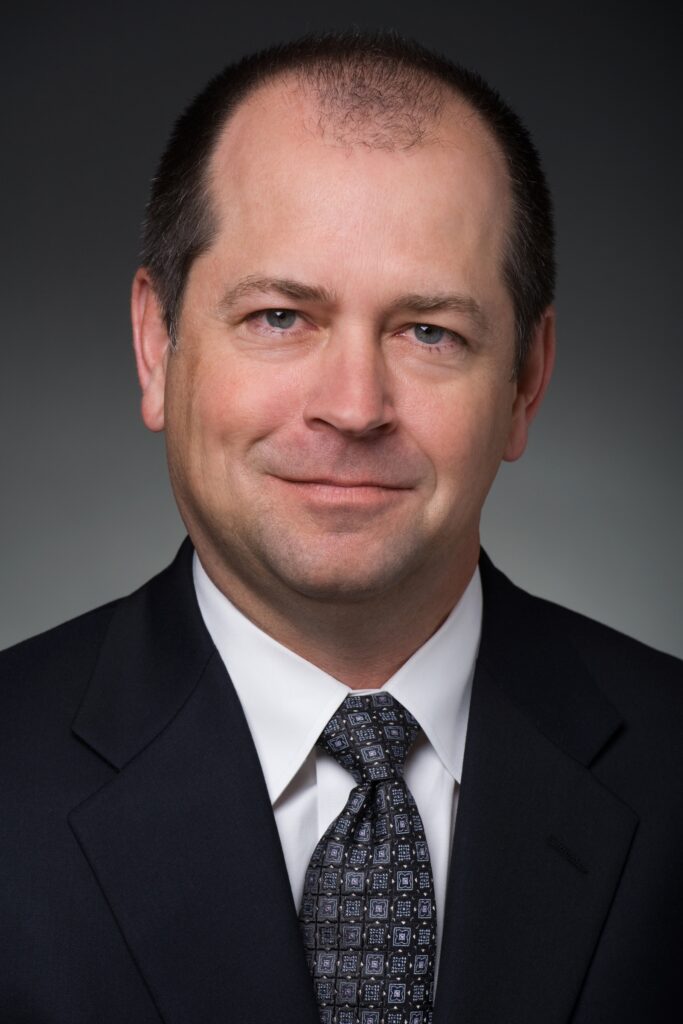
HII’s Christopher Kastner, who will become president and CEO on March 1. HUNTINGTON INGALLS INDUSTRIES

NEWPORT NEWS, Va. — Huntington Ingalls Industries announced Jan. 27 its board of directors elected Chief Operating Officer Chris Kastner to become HII president and chief executive officer, consistent with the company’s succession plan. The board also elected President and CEO Mike Petters to become executive vice chairman of the board for a transition period. Both changes are effective March 1.

Petters and Kastner, who has acted over the past decade as chief financial officer, head of corporate strategy and divisional financial officer, are credited with nurturing the company’s current $48 billion shipbuilding backlog. The pair also steered its recent technology-oriented acquisitions to strengthen and broaden the capabilities HII delivers to customers.

“We’ve spent the past 11 years building a company for the 21st century,” said Petters, who took the helm of HII when Northrop Grumman spun off its shipbuilding business in 2011, after leading in various capacities for 24 years within HII’s shipbuilding divisions. “HII is now that company, with a leadership team and portfolio to serve our nation’s critical national security needs. I am proud of the work we have done together and excited to watch the company fulfill its promise. I have complete confidence in Chris and the senior leadership team in this next chapter.”

Starting March 1, Petters will support the leadership transition as executive vice chairman and will remain an HII employee through 2022, during which time he will continue to represent HII. Succeeding Petters as CEO, Kastner brings extensive leadership and program management experience. Kastner was promoted to his current COO position in February 2021, after serving as HII’s executive vice president and chief financial officer since March 2016. Kastner also served as vice president and CFO for HII’s Ingalls Shipbuilding division based in Pascagoula, Mississippi. Prior to HII’s spin-off from Northrop Grumman in 2011, he held increasingly responsible positions on the B-2, Joint STARS and Global Hawk programs, and served as corporate director of strategic transactions. His selection to succeed Petters is part of HII’s multi-year succession planning process.

“Given HII’s support for national security, the company takes business continuity extremely seriously,” said Kirk Donald, chairman of the board of HII. “We are grateful to Mike for his immeasurable contribution to the nation, and for what is now a supremely responsible leadership hand-off. The entire board joins me in congratulating Chris as he takes the helm of HII. The company’s workforce and customers can be confident that HII’s work will carry on with the same great sense of mission and service to our customers and our country.”

In addition to overseeing HII’s growth during his leadership tenure, Petters has also become a leading voice in the business community on matters of ethics, pre-K education and workforce development. Petters will also continue to serve as chairman of the board of governors of the Aerospace Industry Association, an advocacy organization on behalf of aerospace and defense companies.


Austal USA Celebrates Keel Laying for Navy’s Future Flight II EPF Cody  

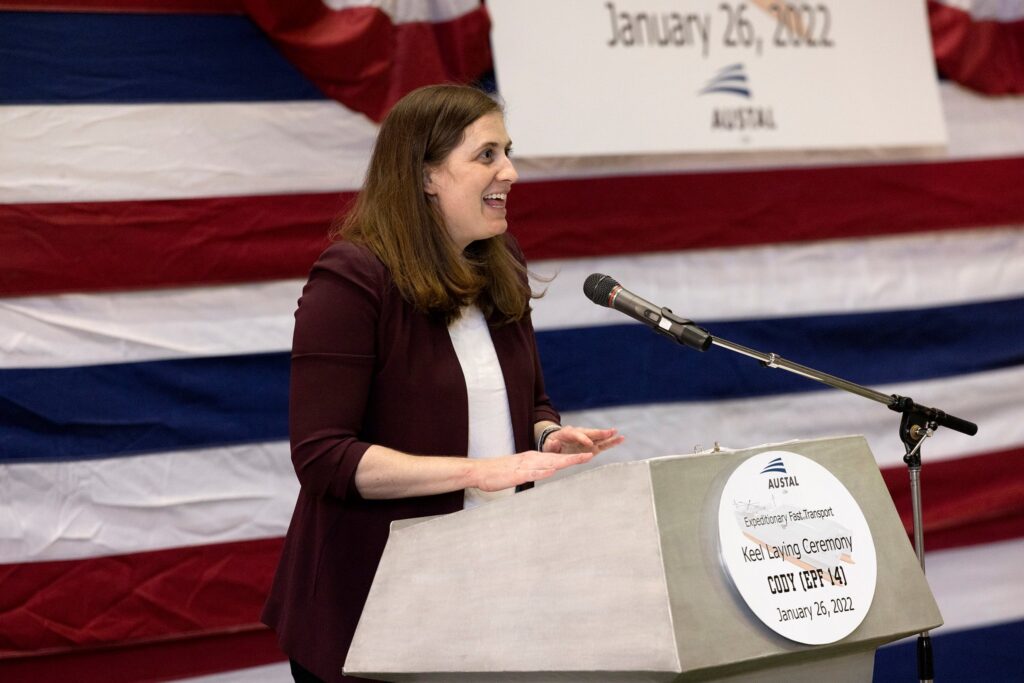
Averil Spencer, sponsor of the future USNS Cody, speaks at the keel laying ceremony. AUSTAL USA

MOBILE, Ala. — Austal USA celebrated the Jan. 26 keel laying of the future USNS Cody (EPF 14) at its ship manufacturing facility in in Mobile, Alabama, the company said in a release. 

Cody is a Spearhead-class expeditionary fast transport (EPF), one of 15 the Navy has contracted Austal to build. The ship is the first U.S. Navy ship named for the city of Cody in Wyoming. 

A keel laying ceremony is the formal recognition of the start of a ship’s construction. At Austal USA, the keel laying symbolically recognizes module erection in final assembly and the ceremonial beginning of a ship. 

The ship’s sponsor is Averil Spencer, founder and executive director of Launch gURLs, a nonprofit that aims to close the gender gap in economic opportunities through entrepreneurship programming for adolescent girls globally. In honor of the U.S. Navy ship keel laying tradition, Spencer welded her initials onto a metal plate that will be installed in the ship. She was assisted by Austal USA A-class welder Amy Cunningham. 

T-EPFs 14 and 15 will be built as Flight II variants. The Flight II Variant is an adaptive, modular package that can better host an embarked unit or be set up as a Role 2E medical facility, capable of performing primary surgery, resuscitative trauma surgery, critical care, oxygen generation, blood operations, laboratory functions, and associated ancillary services. The Flight II variant also incorporates an 11-meter workboat for mission use.  


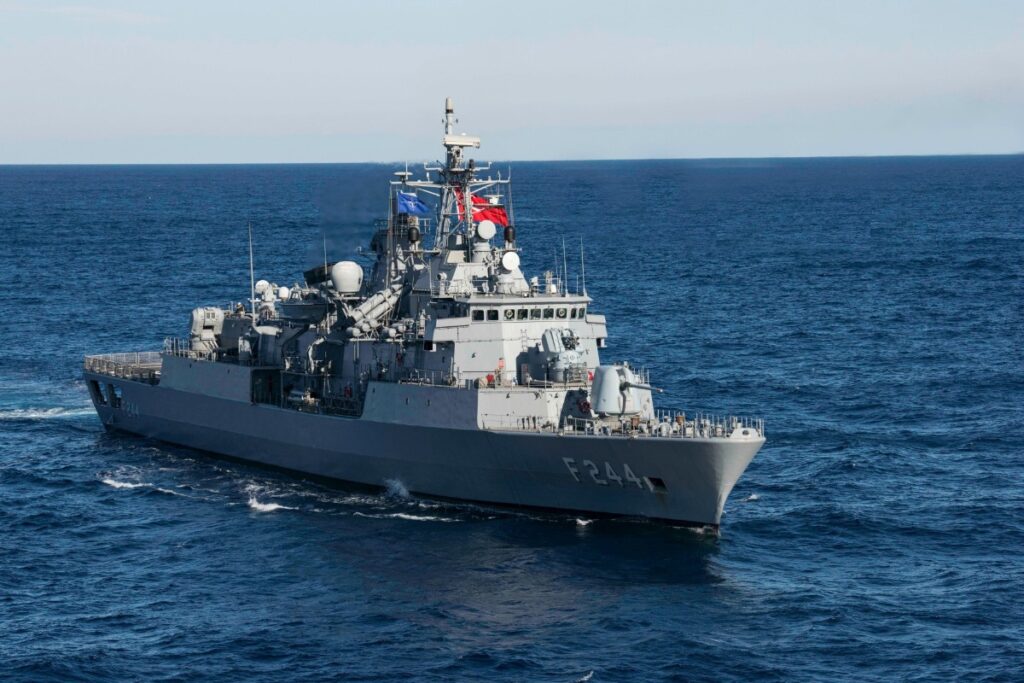
Turkish frigate serving as flagship for NATO Operation Sea Guardian in Mediterranean

The Turkish frigate TCG Barbaros is serving as flagship for NATO’s Operation Sea Guardian focused patrol. NATO ALLIED MARITIME COMMAND

MEDITERRANEAN SEA — NATO is continuing its Operation Sea Guardian with its first focused patrol for 2022.

Turkish frigate TCG Barbaros is currently deployed to the Eastern Mediterranean Sea and is serving as flagship for NATO’s current OSG focused patrol.

According to a statement from NATO Allied Maritime Command, Barbaros’s three-week deployment is the first of six Operation Sea Guardina-focused operations scheduled this year and will run until Feb. 12, 2022.

“This focused patrol incorporates maritime patrol aircraft from Greece, Poland and Turkey in addition to submarines from Greece and Turkey in support of the flagship,” the statement said. “Simultaneously, Standing NATO Maritime Group 2 comprised of the flagship ITS Margottini,  ESPS Blas de Lezo and TCG Goksu will be deployed in the Eastern Mediterranean Sea, contributing NATO’s maritime situational awareness efforts.” 

According to MARCOM, Operation Sea Guardian is a non-Article 5, “collaborative, year-round maritime security operation designed to maintain maritime situational awareness, deter and counter terrorism activity and build capacity and interoperability among NATO Allies and partners.”

Aimed at working with Mediterranean stakeholders and partners, the operation has been conducting focused patrols at specific areas of interest in the Mediterranean Sea. Operation patrols commenced in 2016 to “maintain an accurate picture of the maritime environment and contribute to the safety and security in the region.”

NATO’s website states that “Operation Sea Guardian is a flexible operation that can potentially cover the full range of NATO’s maritime security operation tasks. At present, it is operating in the Mediterranean and is conducting three MSO tasks: maritime security capacity building and support to maritime situational awareness and to maritime counter-terrorism.”

As needed, Operation Sea Guardian can also be directed to uphold freedom of navigation, conduct maritime interdiction, fight the proliferation of weapons of mass destruction and protect critical infrastructure.

“I cannot think of a better example that speaks to the relevance of inter-agency cooperation than Operation Sea Guardian,” said Allied MARCOM’s commander, Royal Navy Vice Adm. Keith Blount, speaking at the NATO Maritime Security Conference last year at Souda Bay, Crete. “Our obligation to ensure maritime security in the Mediterranean requires a multitude of actions, in collaboration with our allies and partners, and represents the full spectrum of capabilities that we possess.”


Canadian Coast Guard Conducts Sea Trials of V-BAT UAS  

A V-BAT vertical takeoff and landing unmanned vehicle. MARTIN UAV

OTTAWA, Ontario — Kongsberg Geospatial has successfully conducted sea trials of the Shield AI V-BAT unmanned aerial system on behalf of the Canadian Coast Guard, operating from a small cargo vessel far offshore in international waters, Kongsberg announced Jan. 25. 
 
The Canadian Coast Guard is conducting trials of the long-endurance, vertical takeoff and landing UAS surveillance system for possible deployment on Canadian Coast Guard Vessels under a project funded by Defence Research and Development Canada. The Shield AI V-BAT aircraft was selected due to its unique ability to combine VTOL from the small confines aboard ship with the long endurance of a fixed-wing aircraft while carrying multiple sensors. 
 
Kongsberg Geospatial teamed with Shield AI to deploy the V-BAT VTOL UAS for a three-day sea trial in international waters in the Gulf of Mexico. The trials tested the capability of the aircraft to provide rapid launch and recovery, long endurance, and confined space takeoff and landing from a moving vessel in a variety of weather conditions, during the day and night. In addition to tracking and identifying other ships at long ranges, the flights conducted a variety of simulated missions designed to emulate real-world situations where the Canadian Coast Guard would use the drones. These included locating and tracking dye patches that simulated wreckage or oil spills and locating life preservers in choppy seas and in a variety of weather conditions. 
 
The V-BAT operators used Kongsberg Geospatial’s IRIS UxS software to safely pilot the aircraft at long ranges from the launch vessel. The IRIS software provides a comprehensive situational awareness picture of the operational airspace, data from a variety of sensors and data feeds and shows the location of other aircraft and surface ships, as well as the launch vessel and the “ownship,” or drone being operated. 
 
Sensor data feeds from the cameras and sensors carried by the UAS were ingested, at real-time, into the Kongsberg Geospatial Modular ISR Data Analysis and Storage system. The MIDAS system records video and other data from the UAS, and serves as a “mission intelligence coordinator” to view current and historical sensor feeds of the UAS within a temporal and geospatial context to increase sensor utilization effectiveness. 
 
“While the sea conditions were perhaps a little rougher than expected, they were ideal for testing the launch and recovery capabilities of the V-BAT from a small ship under the kind of conditions you might expect during real operations,” said Rex Hayes, a retired U.S. Navy and Coast Guard officer and the director of Unmanned Systems at Kongsberg Geospatial. “We were also very pleased with the performance of IRIS and the MIDAS system when handling integrated sensor data feeds from extended missions.” 
 
Trials like these are important to the continued health of the industry, according to Brandon Tseng, Shield AI’s cofounder and former U.S. Navy SEAL. “We love supporting our allies. It will take strong partnerships — technological, military, and economic — to maintain stability during challenging times. Sharing tech like the V-BAT strengthens strategic relationships and contributes to global stability. Our recent engagement with the Canadian Coast Guard and Kongsberg exemplifies our commitment to ensuring our allies have the cutting-edge technology and products they need.” 
 
This series of endurance trials is the second set of flight trials of the Shield AI V-BAT conducted by the Canadian Coast Guard. The first series of flight trials were conducted at a UAS test range in Oklahoma last year to establish flight characteristics of the aircraft. The V-BAT was developed by Martin UAV, which was acquired by Shield AI last year. Kongsberg Geospatial is a subsidiary of Kongsberg Defence & Aerospace.