BAE Systems Launches Next-Gen Power and Propulsion System to Help Operators Reach Zero Emissions

BAE SYSTEMS

ENDICOTT, N.Y. — Nov. 23, 2021 — BAE Systems, a leader in electric propulsion, has launched its next-generation power and propulsion system for the marine market. The HybriGen Power and Propulsion system is a flexible solution to help operators reach zero emissions — improving electrical efficiency and vessel range, increasing propulsion power, and simplifying installation.

The HybriGen Power and Propulsion system uses smaller and lighter components for vessels, building on the company’s 25 years of experience in electric propulsion systems. Its modular accessory power system and modular power control system allow for a scalable, tailor-made solution to fit the specific power and propulsion requirements of a range of vessels, from sailboats and tugs to passenger ferries.

“Our investment in this next-generation technology will provide marine operators with cutting-edge capabilities to create clean transportation,” said Steve Trichka, vice president and general manager of Power & Propulsion Solutions at BAE Systems. “Using a modular design, we can customize our solution to meet the exact needs of each customer, simplifying the installation and improving system reliability. The increased propulsion power and electrical efficiency mean our customers can now accelerate their journey to zero emissions.”

BAE Systems’ electric propulsion technology supports low and zero emission applications with proven controls and components that are available in multiple system configurations.

BAE Systems has more than 14,000 power and propulsion systems in markets around the globe. Each year, those systems contribute to a cleaner world by saving more than 30 million gallons of fuel and eliminating 335,000 tons of carbon dioxide each year — the equivalent of taking 59,000 cars off the road or planting 4.5 million trees.

Work on the HybriGen Power and Propulsion System will be conducted at the company’s facility in Endicott, New York.


U.S. Navy, Jordan Partner on New Unmanned Systems Integration

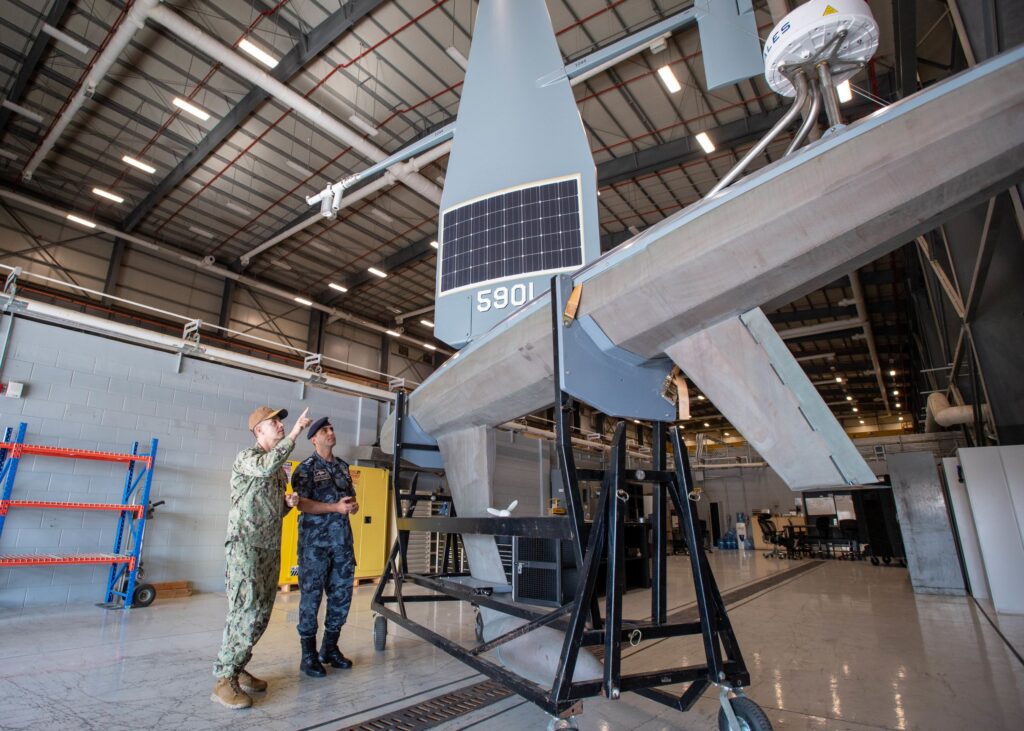
Vice Adm. Brad Cooper, commander of U.S. Naval Forces Central Command, U.S. 5th Fleet and Combined Maritime Forces, left, and Col. Hisham Khaleel Aljarrah, commander of the Royal Jordanian Naval Force, examine Task Force 59’s new Saildrone Explorer unmanned surface vessel at Naval Support Activity Bahrain, Nov. 18. U.S. NAVY / Mass Communication Specialist 2nd Class Mark Thomas Mahmod

MANAMA, Bahrain — U.S. Naval Forces Central Command (NAVCENT) briefed the head of Jordan’s navy on U.S. 5th Fleet efforts to integrate new unmanned systems during a visit to U.S. Naval Support Activity Bahrain, Nov. 18, NAVCENT said in a release. 
 
Personnel from NAVCENT’s Task Force 59 briefed Col. Hisham Khaleel Aljarrah, commander of the Royal Jordanian Naval Force, alongside Vice Adm. Brad Cooper, commander of NAVCENT, U.S. 5th Fleet and Combined Maritime Forces on the task force’s new Saildrone Explorer unmanned surface vessel (USV). 
 
The visit signaled U.S. 5th Fleet’s commitment to partnering with Jordan after establishing the new unmanned task force in September to focus U.S. 5th Fleet efforts on unmanned systems and artificial intelligence integration. 
 
The Royal Jordanian naval base in Aqaba, Jordan will become a joint hub for Saildrone USV operations in the Red Sea next month. The United States and Jordan share a strong bilateral partnership in maintaining regional maritime security and stability. 
 
“This is a major step in our effort to integrate new unmanned systems with our regional partners,” said Cooper. “Our strong partnership with Jordan will help accelerate new system development and integration to enhance maritime domain awareness and strengthen deterrence.” 
 
The Saildrone Explorer is a 23-foot-long, 16-foot-tall USV reliant on wind power for propulsion. The vessel houses a package of sensors powered through solar energy for monitoring the maritime environment. 
 
“We are working harder and smarter to achieve maritime security, in all domains — surface, subsurface, and over the sea,” said Hisham. “The Red Sea will witness a significant increase in monitoring and power projection to maintain stability and security within international waters” 
 
The Middle East region’s unique geography, climate, and strategic importance offer an ideal environment for unmanned innovation through multilateral collaboration. The area includes the world’s largest standing maritime partnership, Arabian Gulf, Red Sea, Gulf of Oman and parts of the Indian Ocean. 


MDA Selects Raytheon as One Co. to Develop First Counter-Hypersonic Interceptor

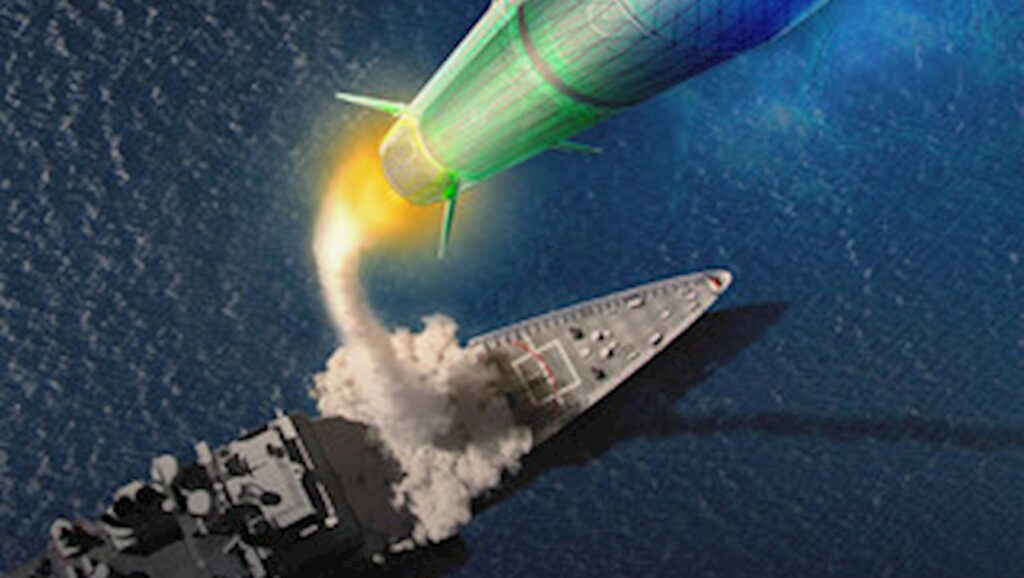
Raytheon Missiles & Defense’s artistic rendering of a GPI conceptual design. RAYTHEON MISSILES & DEFENSE

TUCSON, Ariz. — Raytheon Missiles & Defense, a Raytheon Technologies business, has been selected by the Missile Defense Agency (MDA) as one of the companies to develop and test the first interceptor specifically designed to defeat hypersonic threats, the company said Nov. 19.

The weapon, called Glide Phase Interceptor (GPI), is intended to defeat a new generation of hypersonic missiles, weapons that travel more than five times the speed of sound and maneuver rapidly in flight. 

“Raytheon Technologies systems are the cornerstone of today’s ballistic missile defenses. We’re building on that knowledge to advance the missile defense system for future threats,” said Tay Fitzgerald, vice president of Strategic Missile Defense. “GPI’s speed, ability to withstand extreme heat, and maneuverability will make it the first missile designed to engage this advanced threat.” 

GPI will intercept hypersonic weapons in the glide phase of flight, which occurs once a missile has re-entered Earth’s atmosphere and is manuevering toward its target. The initial development phase will focus on reducing technical risk, rapidly developing technology, and demonstrating the ability to intercept a hypersonic threat. 

Developed on behalf of the MDA, GPI will be integrated into the U.S. Navy’s Aegis Weapon System, a ship- and shore-based defense system. 

Raytheon Technologies’ missile defense portfolio combines sensors, interceptors and command and control networks to track and defeat a wide range of threats. Today, the company is responsible for portions of nearly every air and missile defense system deployed by the U.S. and its allies.  


Aegis Ashore in Poland on Target for 2022

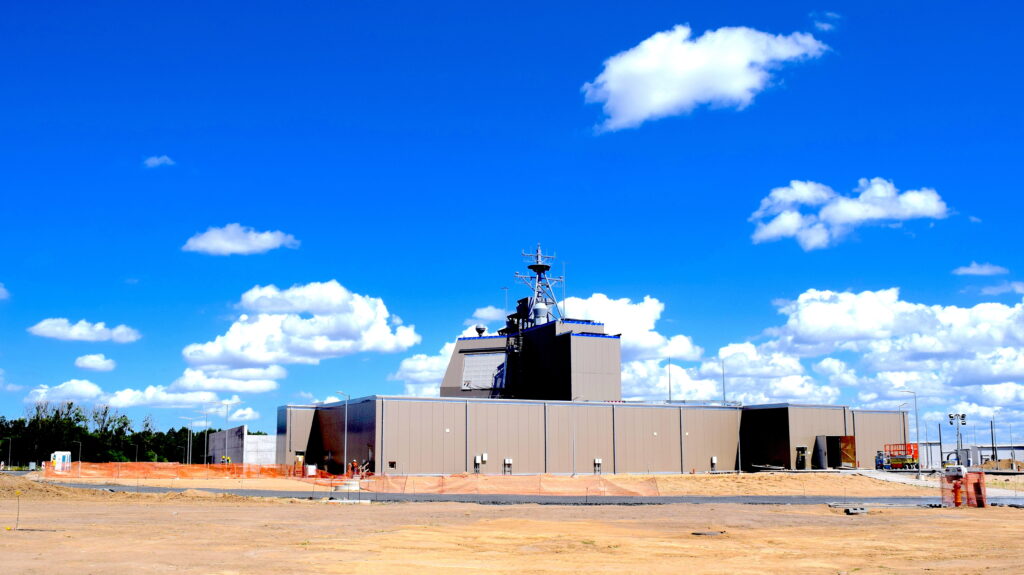
The new Naval Support Facility in Redzikowo, Poland, will be home to the Aegis Ashore Ballistic Missile Defense System(AABMDS) mission in the coming years and is expected to be completed sometime in late 2020. U.S. NAVY / Lt. Amy Forsythe

ARLINGTON, Va. — The Aegis Ashore capability planned for Poland is moving ahead to be operational by the end of next year, the program executive officer for Aegis Ballistic Missile Defense said Nov. 19. 

The Aegis Combat System was originally designed as a shipboard system to track and destroy incoming enemy targets, but the system has also been deployed for use on land as “Aegis Ashore.” 

Already an Aegis Ashore capability is up and running in Deveselu, Romania, about 90 miles from Bucharest. The site, under the control of NATO, has been in operation for more than five years now. 

A site similar to the one in Romania is also planned for Redzikowo, Poland, near the Baltic Sea. But that site has been delayed due to construction issues, although efforts are now underway to get the site operational by the end of next year. 

“My part, which is to install the Aegis Weapon System, has been delayed as we work the military construction with our contractors,” said Rear Adm. Tom Druggan during a discussion on Thursday at the Center for Strategic and International Studies in Washington, D.C. “We are behind, given the original schedule, no question about that. The good news is we’re getting the quality we want for a facility that’s going to be there 50 to 75 years, and we now have the right management in place in order to move ahead and complete this.” 

Over the summer, Druggan said, the Aegis system in Poland was pulled out of storage there and assembled to test its operations. 

“We … put the whole weapon system together with the exception of the antennas,” he said. “We energized it. And the equipment had been in the containers for a while. We found some issues — good news is we fixed them. And then we did an upgrade, which is saving time from a future availability. So that system is actually our most upgraded system today, ready to be installed.” 

In an unusual move, Druggan said, the Aegis Ashore capability in Poland is now being set up as the infrastructure on the ground to support it becomes available. He said antennas for the AN/SPY radar system have already been set up. 

“We’re installing the backbone of the radar behind it,” he said. “We’ve installed some systems. And we’re going to keep installing our pieces in parallel to the commissioning of all the industrial equipment, power, cooling, ventilation, that’s going on, on the construction side.” 

Normally, he said, installing an Aegis system wouldn’t happen until all the supporting construction was complete. 

“I made the decision long ago that we were not going to wait,” he said. “We were going to do what we could, when we could, based on the conditions within the deckhouse. That has proved to be a successful strategy. And now we’ve got good momentum.” 

Druggan said he expects the Aegis Ashore site in Poland to be operational by the end of 2022, and at that point the transition of the system can happen first to the Navy, then to U.S. European Command, and finally to NATO. 


Boeing Delivers First P-8A Poseidon to Norway

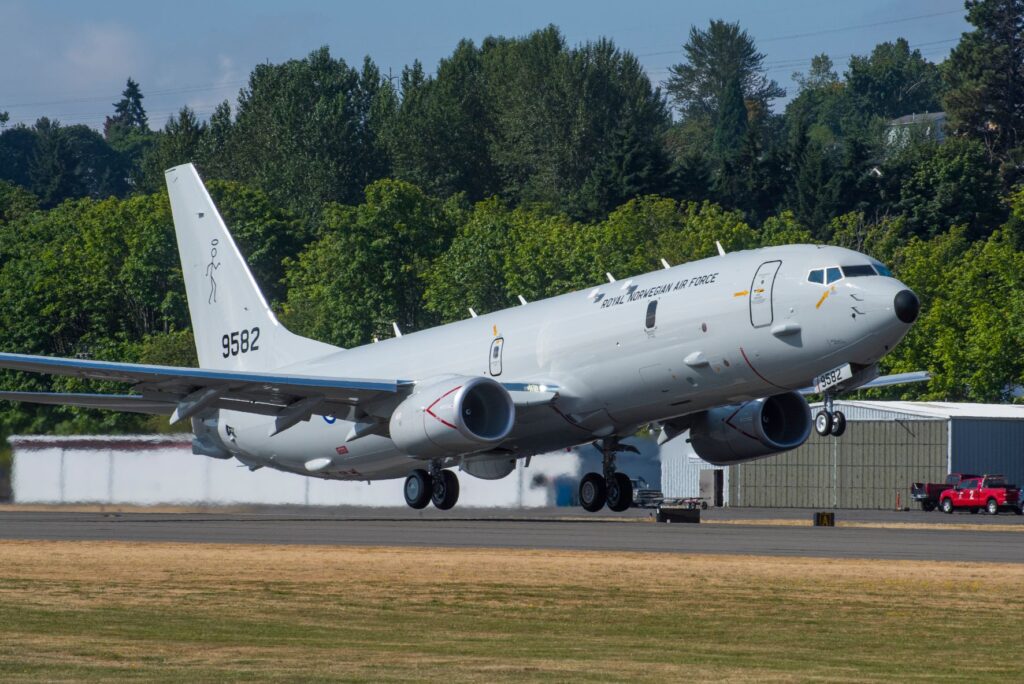
The first of five P-8A Poseidon aircraft bound for Norway had its first flight Aug. 9. THE BOEING CO.

SEATTLE — The Norwegian Defence Materiel Agency (NDMA) accepted on Nov. 18 the first of five Boeing P-8A Poseidon maritime patrol aircraft that will be operated by the Royal Norwegian Air Force (RNoAF), the company said in a release.  

“Norway is responsible for large maritime areas in a strategically important part of the world, and the new P-8A Poseidon will represent a tremendous improvement in our ability to both protect our sovereignty and understand developments in these areas. Today’s delivery of our first P-8A is an important milestone in the modernization of Norway’s maritime patrol aircraft capability,” said Mette Sørfonden, director general of the Norwegian Defence Materiel Agency. “I’m very pleased that the NDMA will soon be able to provide the Norwegian Armed Forces with a whole new generation of aircraft that will play an important role in preserving our national security for many years to come.” 

Norway’s first P-8A aircraft, named Vingtor, was delivered to the NDMA during a ceremony at the Museum of Flight in Seattle, Washington. The milestone comes four years after the NDMA entered into an agreement with the U.S. Navy for the P-8A, and two years before the new aircraft are scheduled to begin taking over maritime patrol duties in Norway’s high north. 

“We’re honored to provide this unmatched, multimission maritime patrol capability to Norway,” said Stu Voboril, vice president and program manager, P-8 Programs. “Norway joins seven other global customers that have selected or already operate the P-8 and benefit greatly from its long-range maritime surveillance and anti-submarine warfare capabilities. We look forward to enhancing our continued and enduring partnership with the U.S. Navy and the Royal Norwegian Air Force, and supporting the future fleet’s sustainment and training needs.”  

Norway’s four remaining aircraft are all in advanced stages of production and will be delivered to the NDMA in 2022. The five P-8As will replace the RNoAF current fleet of six P-3 Orions and two DA-20 Jet Falcons and will be operated by 333 Squadron at Evenes Air Station. 

Norwegian companies Nammo, Kongsberg Defence & Aerospace, Andoya Space and Berget currently have agreements with Boeing that are part of a tailored industrial cooperation plan related to Norway’s acquisition of five P-8A aircraft. Boeing continues to work with the NDMA and Norwegian industry to expand that plan and support economic growth throughout Norway.  

The delivery to Norway also marks the 142nd P-8 aircraft delivered to global customers, including the U.S. Navy, the Royal Australian Air Force, the Indian Navy and the United Kingdom’s Royal Air Force. First deliveries to New Zealand, Korea and Germany will take place in 2022, 2023 and 2024 respectively. 

To date, the global operating P-8 fleet has amassed more than 400,000 mishap-free flight hours. The P-8 is a long-range anti-submarine warfare, anti-surface warfare, intelligence, surveillance and reconnaissance aircraft capable of broad-area, maritime and littoral operations. In addition, the P-8 performs humanitarian and search and rescue missions around the globe. 


AeroVironment’s New Mantis i45 N Multi-Sensor Imaging Payload Delivers Advanced ISR for Night Ops

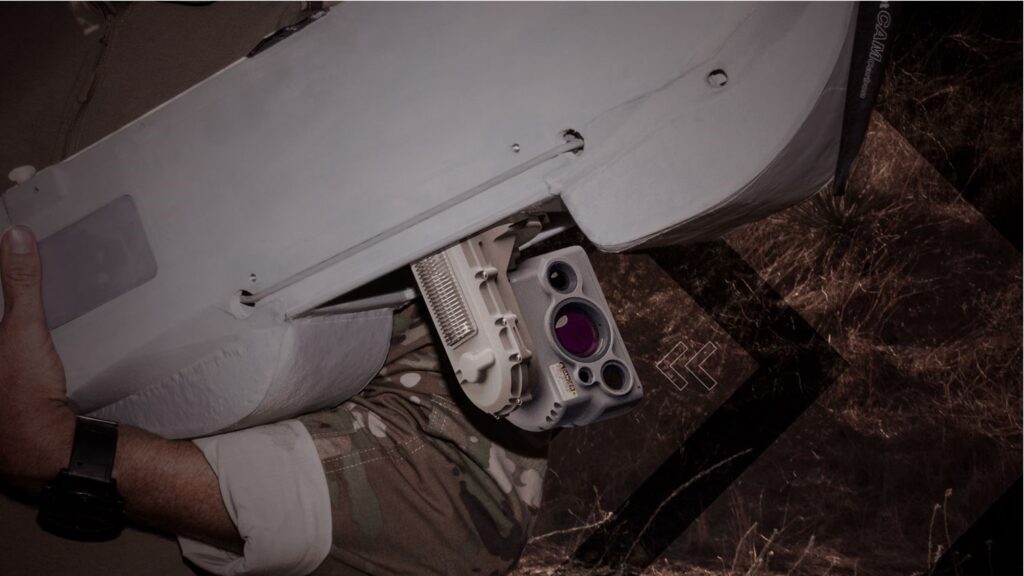
AeroVironment’s new Mantis i45N imaging payload, intended for nighttime imaging. AEROVIRONMENT

ARLINGTON, Va. — AeroVironment Inc. introduced the Mantis i45 N, a multi-sensor nighttime imaging payload compatible with Puma2 AE, Puma3 AE and Puma LE small unmanned aircraft systems (UAS), the company said Nov. 16. 

Lightweight (905 grams) and compact, the new Mantis i45 N joins AeroVironment’s expansive Mantis product line of micro-gimbals delivering high-quality video and imagery downlink to UAS operators.  

Mantis i45 N is a dual-axis, gyro-stabilized, multi-sensor nighttime imaging payload designed for maximum visibility during low-light or nighttime intelligence, surveillance and reconnaissance (ISR) operations. The next-generation imaging system features improved long-wave IR (LWIR) thermal cameras with narrow-angle 32 mm and wide-angle 9.2 mm IR with 7.6x electronic zoom, allowing operators to capture high-resolution video at extended range. Designed for both superior night and low-light performance, the new imaging system also includes an upgraded 5-megapixel monochrome low-light camera sensor and high-powered 860 nm laser illuminator. Through its advanced suite of sensors, the Mantis i45 N payload allows Puma UAS operators to extend aircraft standoff distance for covert operations. 

“Today’s battlefield is dynamic and UAS operators increasingly rely on multiple payloads to successfully complete their missions,” said Charles Dean, AeroVironment vice president for global business development and sales of UAS. “The new Mantis i45 N is a game changer during low-light or nighttime ISR operations, delivering increased situational awareness and advanced threat detection in any environment.”  

Built on the trusted and battlefield proven Mantis i45, the enhanced night variant Mantis i45 N maintains the same housing form-factor, allowing for a quick and simple change-out of payloads between day and night operations. Plug and play operational, no software updates are required for Puma UAS avionics or ground control stations for legacy system compatibility. Mantis i45 N is also natively compatible with AeroVironment’s Crysalis next-generation ground control solution. 


L3Harris Opens Canadian Facility to Address Growing Wescam MX Product Demand

L3Harris’ new 330,000 square-foot Canadian facility increases Wescam MX product production and program execution capabilities. L3HARRIS

MELBOURNE, Fla. — L3Harris Technologies has opened its new $110 million (USD) state-of-the-art facility in Waterdown, Ontario, Canada, to address the growing demand for its Wescam MX-Series electro-optical and infrared imaging technologies, the company said in a Nov. 16 release.  

The new 330,000-square-foot facility is designed to create cross-functional efficiencies across research and development, engineering, assembly, service and office space. Currently 1,250 employees work either remotely or out of this new facility. By the end of 2025, L3Harris anticipates more than 1,500 employees will report into this location.  

The investment in the new facility represents L3Harris’ commitment to its global customers and partners, and employees throughout the region. The purpose-built facility has been designed to maximize efficiency and sustainability — increasing overall manufacturing over its previous capacity by 80%.  

“This larger and leaner factory enables us to optimize production flow, enhancing L3Harris’ ability to meet our customers’ needs quicker, while increasing capacity for larger program execution and future growth,” said Sean Stackley, president, Integrated Mission Systems, L3Harris.  

L3Harris’ Wescam MX systems are active in more than 80 countries. Operating across air, land and maritime domains, these intelligence, surveillance and reconnaissance and targeting systems support more than 200 different platforms. 


Future USNS Apalachicola Christened at Austal USA

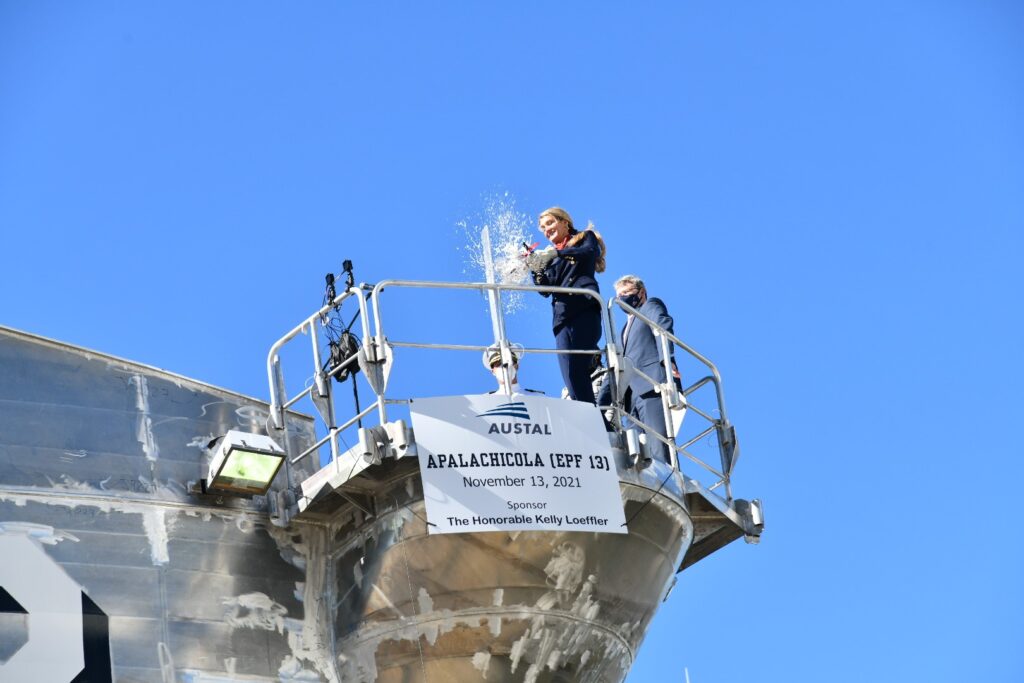
Austal USA christened Expeditionary Fast Transport (EPF-13) USNS Apalachicola during a ceremony at its state-of-the-art ship manufacturing facility on Nov. 13. AUSTAL USA

MOBILE, Ala. — Austal USA christened Expeditionary Fast Transport (EPF-13) USNS Apalachicola during a ceremony at its state-of-the-art ship manufacturing facility Nov. 13, the company said in a release.  Austal has delivered twelve EPFs since December 2012. USNS Apalachicola is slated for delivery this summer. 

Former Sen. Kelly Loeffler, ship sponsor of USNS Apalachicola, performed the ceremonial bottle break over the bow of the ship, the 13th EPF designed and constructed by Austal USA and the second U.S. Navy ship to be named after the Florida coast city. The first Navy ship named Apalachicola (YTB-767), A Natick-class large harbor tug, was also built in Mobile at Mobile Ship Repair in 1963. 

“Today we celebrate the christening of the 13th EPF with an Austal team of more than 3,000 employees,” said Austal USA President Rusty Murdaugh. “Apalachicola’s sister ships are successfully supporting naval commands on the U.S. East and West Coasts, along with forward deployments in the Middle East, Africa, Mediterranean, South America, and Asia regions. In the coming months, this highly complex, high-speed ship will join the others to support our great Navy.” 

EPFs have performed humanitarian assistance, disaster relief, maritime security, surveillance, command and control, counter narcotics, and additional operations in almost every region of the world. A unique characteristic of EPF 13 is that Austal USA has been contracted to design, procure, implement, and demonstrate EPF 13 as an autonomous platform, allowing EPF 13 to operate autonomously while retaining the capability for manned operation, reducing cost and centralizing ship operations to the bridge. 

Apalachicola is one of two Expeditionary Fast Transport ships Austal USA is currently building for the U.S. Navy, while the start of construction on the future USNS Point Loma (EPF 15) will commence at the end of this month. Five littoral combat ships (LCS) are also under various stages of construction at the Gulf Coast shipyard. 


ESG Delivers Sea Falcon UAS to the German Navy

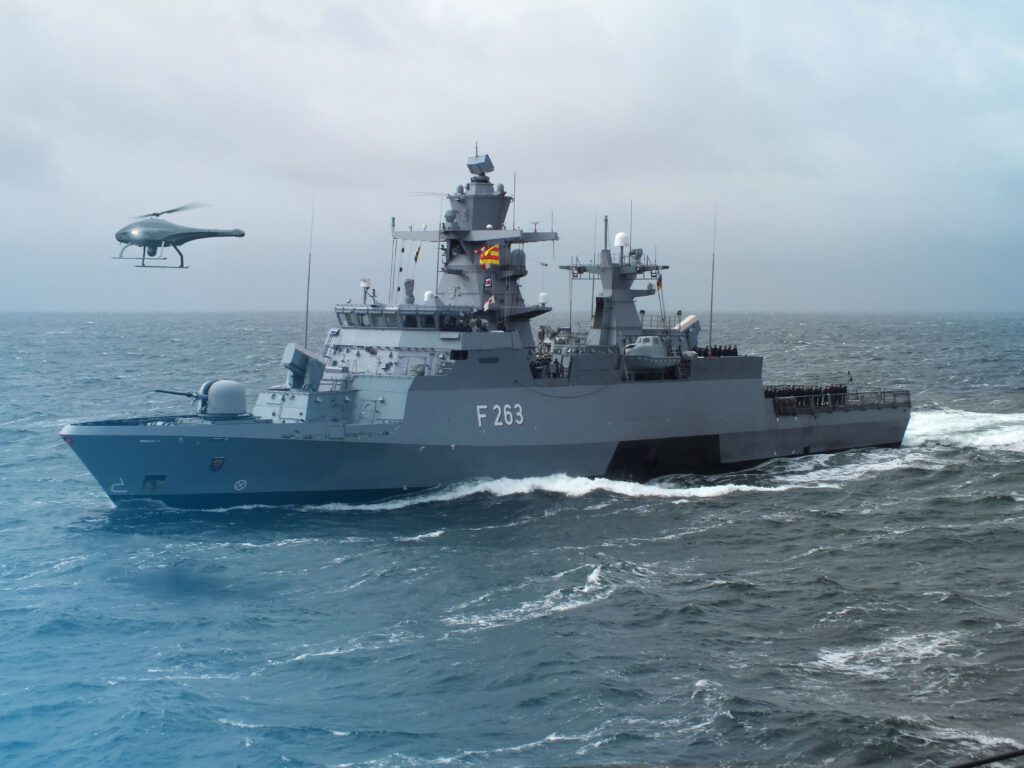
The German corvette F263 Oldenburg operating with a Skeldar V-200 UAS. UMS SKELDAR

FURSTENFELDBRUCK, Germany — ESG Elektroniksystem- und Logistik-GmbH has been named the main contractor for three Sea Falcon unmanned aircraft systems for the German navy’s K130 corvettes under a contract from the German federal armed forces. 

One system consists of two Skeldar V-200 unmanned aerial vehicles, a ground control station integrated on the corvette from which the aircraft is controlled, and equipment with tools and spare parts. The corvettes’ capabilities for imaging reconnaissance will be significantly expanded, as, objects can be detected and identified with the Sea Falcon far beyond the onboard sensor system. 

The Sea Falcon is based on the Skeldar V-200 from the Swedish manufacturer UMS Skeldar AB and can operate for up to five hours, with a maximum take-off weight of 235 kilograms, a maximum speed of 75 knots and a payload of up to 40 kilograms. It can take off and land automatically on the deck of the corvette in up to 20 knots of wind speed and sea state 3. An integrated sensor transmits real-time optical and infrared images to the ground control station. 

The UAS are part of the Reconnaissance and Identification in the Maritime Operational Area project, or AImEG, a four-year effort. 

The pilot phase will see UAS certification to meet requirements, the delivery of one system, including integration on a corvette, and initial training of armed forces personnel.

Two more systems will be delivered in the series production phase, one of which will also be integrated into a corvette with the other used for land-based training. In addition, three armament sets will be delivered for the future pre-fitting of further corvettes to accommodate a UAS. 


Military Sealift Command Selects GE Power Conversion for Ships

Dry cargo and ammunition ship USNS Cesar Chavez (T-AKE 14) prepares to go alongside the amphibious assault ship USS Essex (LHD 2) during a replenishment-at-sea in November. Military Sealift Command has awarded GE Power Conversion a contract to maintain the electric and hybrid power and propulsion systems on its vessels, including T-AKE ships. U.S. NAVY / Mass Communication Specialist 2nd Class John McGovern

BOSTON — The U.S. Navy Military Sealift Command (MSC) has awarded GE Power Conversion an indefinite-delivery/indefinite-quantity contract to maintain the electric and hybrid electric power and propulsion systems aboard its vessels, the company said Nov. 10. The five-year contract potentially could be worth $125 million. 

The contract covers maintenance, modernization and upgrades, training, repairs, parts, remote technical support and program management on 35 vessels, with more ships to be added as they are built and turned over to MSC after commissioning. The vessels operate throughout the world, and GE’s support is expected around the clock, 365 days per year. 

The contract also includes planned maintenance industrial assist for shipyard maintenance, industrial control system cybersecurity services support and hardware and software configuration management. 

As the original equipment manufacturer, GE Power Conversion received a three-year maintenance contract from MSC in 2012 covering just a few ships. Later, the contract was renewed, and more ships added, with GE earning excellent reviews for both contracts in the contractors past performance rating system. 

“We have demonstrated in the past that we are a responsive and knowledgeable service provider, long after equipment delivery,” said Mike Kircher, MSC fleet manager for GE Power Conversion. “This long-term contract is the result of customer confidence earned over years of demonstrated value for the range of service support we can provide.” 

One benefit of the GE contract is the modernization upgrades it supports. “This contract covers the most technologically advanced electric and hybrid power and propulsion systems in the MSC fleet; these systems allow a level of vessel control and agility that is without parallel, increasing ship handling confidence and safety,” Kircher said. “Looking ahead, the advantage our equipment gives to future ship classes is significant.”