Retired Adm. James ‘Jamie’ Foggo Hired as Dean of Think Tank Focused on Maritime Thought Leadership

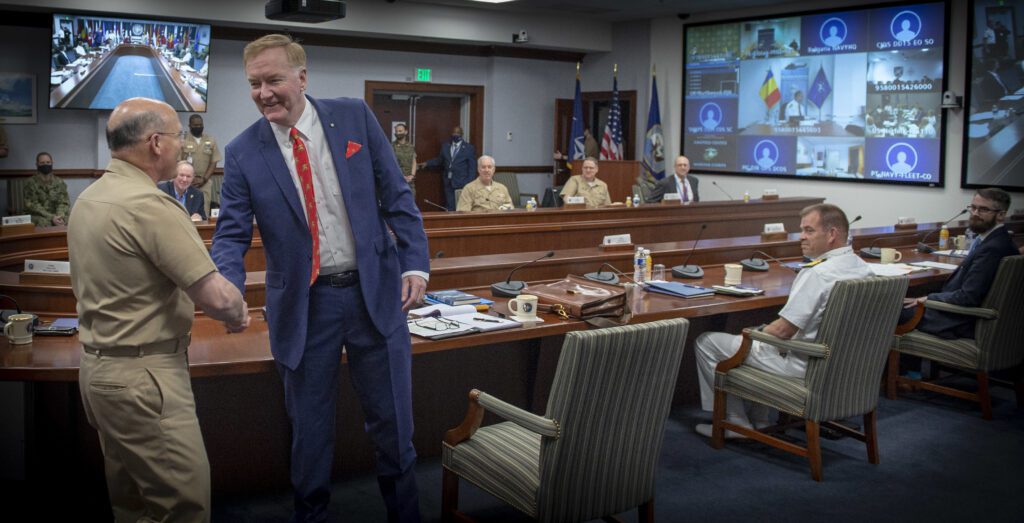
Adm. Mike Gilday, U.S. Navy chief of naval operations, speaks with retired Adm. James G. Foggo during the Combined Joint Operations from the Sea Center of Excellence (COE) Future Maritime Warfare Symposium 2021 in April. U.S. NAVY / Mass Communication Specialist 2nd Class Joshua M. Tolbert

ARLINGTON, Va. — The Navy League of the United States — a nonprofit civilian, educational and advocacy organization that supports America’s sea services: the Navy, Marine Corps, Coast Guard and U.S.-flag Merchant Marine — announced today it has launched a new think tank, the Center for Maritime Strategy, with retired Adm. James “Jamie” Foggo as its dean. This organization will conduct and support policy research and advocacy efforts across a broad spectrum of issues that impact the United States’ position as a maritime nation.

“Policy development and advocacy are the main reasons for the Navy League’s existence, and we are stepping up our activity in these areas to meet the requirements of 21st century maritime power,” said Navy League National President David Reilly.

The development of the Center for Maritime Strategy was led by a steering committee drawn from Navy League leadership. The committee was chaired by former Chief of Naval Operations and current Navy League National Vice President Adm. John Richardson. Other members of the committee included retired U.S. Fleet Forces commander Adm. John Harvey, former Master Chief Petty Officer of the Navy and current Navy League CEO Mike Stevens, Frank Russo of Forctis Advisory, and Fulton Homes CEO Doug Fulton. This committee will remain in place to provide general oversight and advice to the center’s dean.

“The Navy League’s Center for Maritime Strategy will be the go-to place for maritime strategic thought, policy recommendations and informed advocacy.” Richardson said. “The new organization will include a vibrant media operation to amplify it’s work. I’m excited about this initiative to boost the Navy League’s citizen voice and help strengthen the United States as a maritime nation.”


Hypersonics Pose ‘Huge Physics Challenge’ for Weapon Design

The U.S. Navy, in collaboration with the U.S. Army, conducts a static fire test of the first stage of the newly developed 34.5” common hypersonic missile that will be fielded by both services. U.S. NAVY / NORTHROP GRUMMAN

ARLINGTON, Va. — Arming hypersonic weapons with the advanced fuzing needed to give the weapon the desired effects is one of the more significant challenges facing the armaments industry, an industry official said. 

Hypersonic fuzing “is a huge physics challenge,” said Charlie Zisette, executive director of the National Armaments Consortium, a trade association of manufacturers of explosives, propellants, materials, fuzing, and other technologies related to armaments. 

“Here we’re trying to push the state of the art with fuzing now having to go on the front end of hypersonic weapons, which is a new problem statement for us in terms of the environment that the fuze has to function in … including hard-target penetration,” Zisette told Seapower. “We now can miniaturize things that we weren’t able to do before. Size and volume are critically important because we’ve got to be able to miniaturize and yet still take very significant accelerations that are as high as 10,000 Gs. 

“The ability to both miniaturize and harden our electronics will open up an opportunity to do some things that will help the hypersonics, that will help some of these long-range weapon systems that we’re trying to develop to support the warfighter,” he said. 

Zisette said “one of the advantages we have today in trying to solve that is we’ve really improved our modeling and simulation capabilities. That’s an important aspect in solving some of these very difficult fuzing problems at high rates of speed and rates of closure, in particular for things like hypersonic fuzing for ground-launched missiles.  

“An advantage we have today is people who have entered into our armaments ecosystem that are coming from what I would call a nontraditional defense contractor world who are very capable in computational analysis and modeling and simulation and bringing that to our arena within the armaments sector,” he said. “That has been very beneficial. So, we can do a lot of work before we actually have to get to the bench and start prototyping hardware where we can do a fair amount of advanced design through modelling and simulation.”  

The National Armaments Consortium membership includes 950 companies and universities. 


Roundtable Sees NATO Taking a Global Approach to Maritime Security

NORFOLK, Va. — The Combined Operations From the Sea Centre of Excellence (CJOS COE), based in Norfolk, conducted its annual maritime security regimes roundtable as a virtual event last week. CJOS is one of the 27 NATO accredited cenersof excellence.

About 250 people representing 30 countries from around the world took part in the conference.

“It’s not about having the numbers we have online, but about having the right people. We strive for tangible outputs and actions,” said Commodore Guy Thomas, the CJOS COE deputy director. “Talking and awareness is good, but action is better — a lot better.”

Welcoming remarks were delivered by Vice Adm. Daniel Dwyer, director of the CJOS COE, and U.K. Royal Navy Vice Adm. Keith Blount, who commands NATO’s Allied Maritime Command, delivered the keynote address.

Blount talked about the importance of the physical presence of NATO navies at sea, and the strategic affect that creates. He said that demonstrable credibility is a fundamental part of deterrence.

Blount said NATO has had to address a recent resurgence by Russia. Russia constitutes a spectrum of threats, from nuclear submarines and highly capable high-speed missiles to hybrid warfare forces occupying territory, he said. “After having been in the doldrums for many years following the Cold War, we see a different Russia emerging.”

He also called attention to the importance of protecting a increasingly vulnerable network of undersea infrastructure, including communication cables and energy pipelines.

Speakers during the roundtable discussed asymmetric threats such as terrorism, piracy, climate change and transnational crime, but there was also a lively conversation about China. Although not part of NATO’s traditional area of responsibility, the rise of China will be an important part of NATOs future. 

The forum underscored the importance of embracing multi-domain warfighting and capabilities. However, Blount said, “It’s not so much about the individual capabilities but about integration.”

In the view of some of the speakers, while Russia must still be reckoned with, there are only two superpowers — the United States and China. While China does not border any NATO nation, what happens with China in the South China Sea does affect the western world and NATO.

The discussions alluded to NATO’s new focus of blue-ocean warfare in the North Atlantic, to include the standing up of Joint Forces Command Norfolk and the reestablishment of the U.S. 2nd Fleet (whose commander, Dwyer, is also the director of CJOS COE).

Speakers brought the participants up to date with maritime security operations around the globe, including Operation Orion in Colombia, NATO Operation Sea guardian in the Mediterranean, EU NAVFOR Mediterranean IRINI and the arms embargo off Libya and EU NAVFOR Atalanta in the Indian Ocean.

Presenters also addressed the growing use of new technologies, especially unmanned and autonomous systems, to help create larger and more effective sensor networks.

Matthew Searle, chief technology officer with Maritime Arresting Technologies, was one of the technology speakers. “I was impressed by the diversity of the presenters, who covered all aspects or maritime security from high level strategy and global issues down to specific threats,” he said.

Searle’s company makes maritime security barriers both above and below the water, specializing in rapidly deployable port security booms. “The event was a great opportunity to discuss the use of non-kinetic effectors in grey zone encounters with many stakeholders,” he said.


U.S. Naval Sea Cadet Corps Florida-Based Battalion Dedicated to Preserving World War II History Through Personal Stories

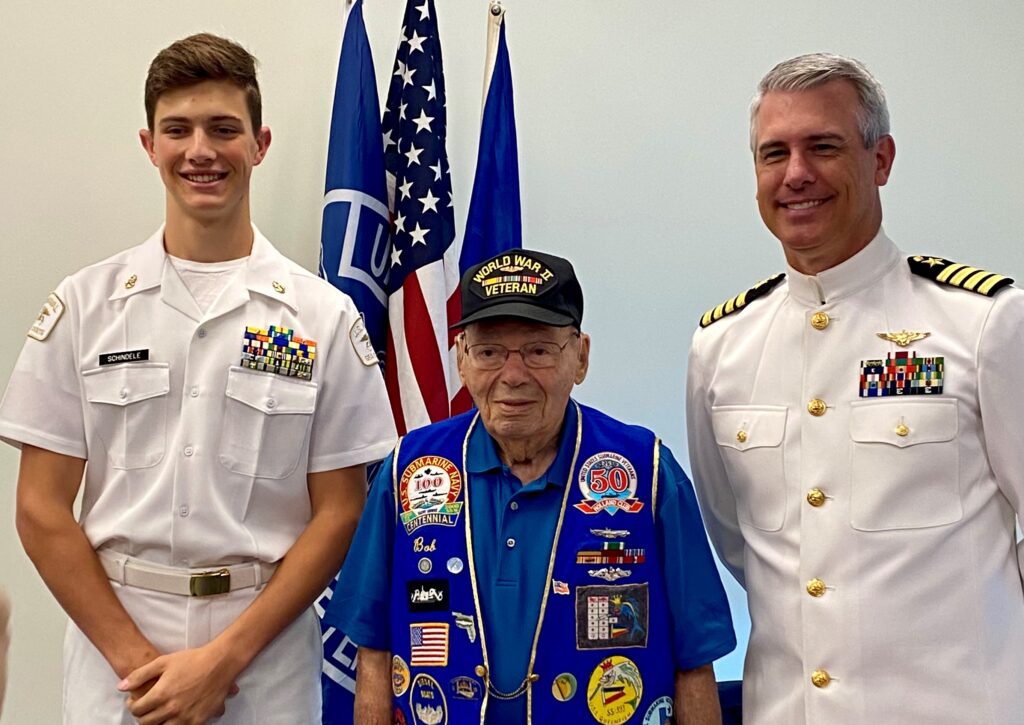
Sea Cadet Chief Kurt Schindele, retired Gunners Mate Chief Bob Dickenson and retired Navy Capt. Matthew Robinson, representing the Navy League, at Schindele’s interview with Dickenson about his World War II experiences. GARY SCHINDELE

CLERMONT, Fla. — U.S. Naval Sea Cadet Chiefs representing the Clermont Battalion have picked up the mantle of responsibility to document personal stories of World War II veterans residing in central Florida, with their first interview taking place Nov. 6.

Sea Cadet Chief Kurt Schindele, who just turned 18, interviewed Gunners Mate Chief Bob Dickenson, a 96-year-old submarine veteran who served multiple tours in the Pacific theater.

The Clermont Battalion, one of 400 units nationwide, has more than 40 Sea Cadets in the unit dedicated to preserving the history of service and tradition of the U.S. Navy, one story at a time.

Clermont Battalion Commanding Officer Lt. Gary Schindele, USNSCC, Kurt’s father, said he is proud of his son and his unit for taking on this responsibility.

“We can only learn from history if we know about that history. With the ever-decreasing number of World War II veterans alive, I feel that it is more important than ever to capture as much information about that era as possible when it is still available to receive a first-hand account,” Schindele said. “It is also the chief’s responsibility to preserve and pass on the history of the Navy, and these interviews serve as an excellent history and heritage teaching moment for our Sea Cadets.”

Dickenson discussed and shared the mementos he has saved from his service, which include commendation letters from Adm. Chester Nimitz and Adm. James Forrestal. During his service, Dickenson survived four successful war patrols onboard the USS Queenfish (SS-393) and contributed to destroying 45,000 tons of enemy shipping, personally sinking two enemy ships using the USS Queenfish’s 3-inch deck gun.

Dickenson served at Recruit Training Center, Newport, Rhode Island; Naval Base, Newport News, Virginia; Naval Submarine Base New London, Groton, Connecticut; USS Queenfish (SS393), Office New Construction, Mare Island, California, and USS Remora (SS-487).

Dickenson received the following citations and awards during his Naval career: American Campaign Ribbon, Asiatic Pacific Campaign Ribbon, World War II Victory Medal, Philippine Liberation Campaign Ribbon, Navy Commendation Medal, Qualified Submarine Warfare (Dolphins) and Good Conduct Medal.

The full interview is available for viewing on www.Southlaketv.com and its corresponding official Facebook page, @TVSouthLake. The U.S. Naval Sea Cadet Corps provides life-changing programs that instill the values of teamwork, discipline, camaraderie and service to young men and women aged 10 to 17. Run by a dedicated volunteer force, the Sea Cadet program relies on strong partnerships with the Navy League and our nation’s armed forces. To learn more about the Sea Cadets, visit www.seacadets.org.


CNO Speaks with UK’s First Sea Lord, Royal Navy Adm. Ben Key, on Key’s 1st Day in Office

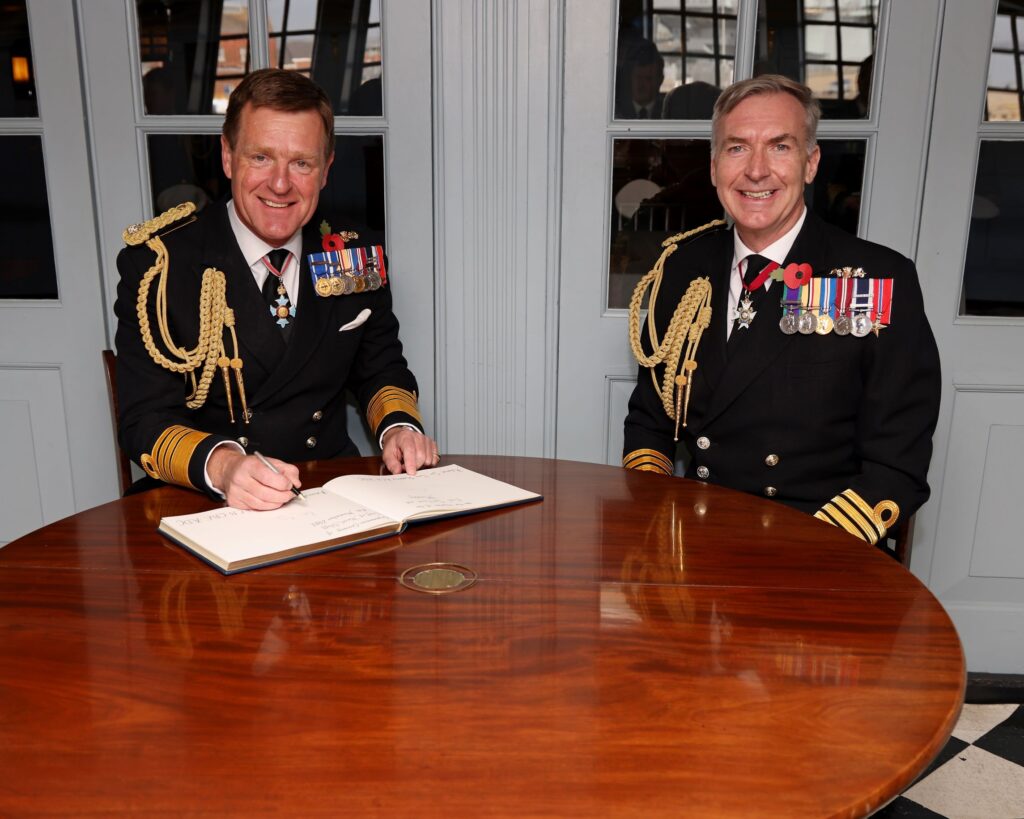
Aboard Nelson’s flagship Victory, Adm. Sir Ben Key, left, took over as first sea lord from Adm. Sir Tony Radakin, whose 29 months at the helm end as he moves on to become the new chief of defense staff. U.K. ROYAL NAVY

WASHINGTON — Chief of Naval Operations (CNO) Adm. Mike Gilday spoke with Royal Navy Adm. Sir Ben Key, first sea lord and chief of the naval staff, on Nov. 8 to reaffirm the special relationship between the two navies and discuss areas for continued collaboration and cooperation, the CNO’s public affairs officer said in release.   

Gilday spoke with Key on his first day in office as first sea lord.  

“I want congratulate Adm. Key on his appointment as first sea lord and I am excited to work closely with him,” said Gilday. “Our navies enjoy a long tradition of sailing together from the Atlantic to the Indo-Pacific and we work tirelessly and interchangeably to keep the maritime commons open and free. No doubt, our alliance is an anchor of peace and stability across the globe.”  

Key echoed Gilday’s sentiment.   

“I was delighted to be able to speak to Adm. Mike Gilday, the chief of naval operations, on the very day I took the helm as first sea lord,” he said. “The bonds between our two navies are deep and historic and I am determined to see they go from strength to strength. Having recently served as chief of joint operations, I have seen how closely we operate around the globe with our American cousins. From USS The Sullivans being an integral part of the HMS Queen Elizabeth Carrier Strike Group on her recent deployment to the Pacific, to our combined operations in the Atlantic in support of NATO, both our nations are benefitting from this outstanding strategic partnership with our shared endeavor to make the world a safer place.”  

The U.S. and Royal Navy operate together around the globe regularly. Most recently, USS The Sullivans (DDG-68) took part in a six-month deployment as part of Carrier Strike Group 21 with HMS Queen Elizabeth (R08). Both navies also conducted multilateral naval training with Australia and Japan during Maritime Partnership Exercise 2021 in October.  


AeroVironment Awarded $20.3M SOCOM Contract for Switchblade Missiles

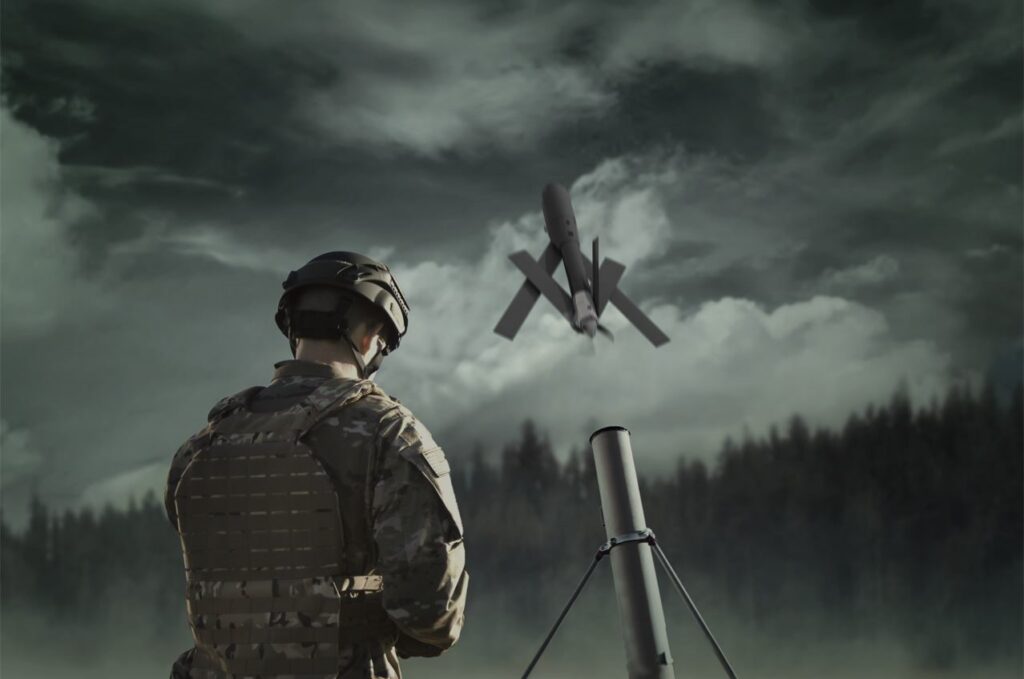
A Switchblade 600 tactical missile system. AEROVIRONMENT

ARLINGTON, Va., Nov. 4, 2021 —  AeroVironment Inc. was awarded a firm-fixed-price contract Sept. 28 by the U.S. Special Operations Command for $20.3 million for the procurement of Switchblade 600 tactical missile systems. Delivery is scheduled to be completed by January 2023. 

“Switchblade 600 is an all-in-one, man-portable tactical missile that provides warfighters with the capability to fly, track and engage non-line-of-sight targets and light-armored vehicles with precision lethal effects,” said Brett Hush, vice president and product line general manager for tactical missile systems. “The tube-launched Switchblade 600 can be easily transported for deployment from fixed and mobile platforms in any environment, providing operators with superior force overmatch and minimizing exposure to direct and indirect enemy fires.”  

Switchblade 600 is equipped with a high-performance electro-optical, gimbaled sensor suite, precision flight control and more than 40 minutes of flight time to deliver unprecedented tactical reconnaissance, surveillance and target acquisition. Its anti-armor warhead enables engagement and prosecution of hardened static and moving light armored vehicles from multiple angles without external ISR or fires assets. Switchblade 600’s patented wave-off and recommit capability allows operators to abort the mission at any time and then re-engage either the same or other targets multiple times based on operator command, resulting in minimal to no collateral damage. 


AeroVironment Demonstrates Switchblade Loitering Missile Integration for Air Launched Effects from JUMP 20 UAS

AeroVironment’s Switchblade 300 loitering munition, which can now be integrated with the larger JUMP 20 unmanned aircraft. AEROVIRONMENT

ARLINGTON, Va., Nov. 3, 2021 — AeroVironment has successfully demonstration of integrating Switchblade 300 loitering missiles and JUMP 20 medium unmanned aircraft systems (UAS) for increased mission autonomy and efficacy, the company said Nov. 3. 

This Air Launched Effects (ALE) proof-of-concept demonstration took place in August 2021 with the goal of launching an inert Switchblade 300 from the JUMP 20 and successfully recovering both air vehicles. 

The systems were integrated by fixing the inert Switchblade 300 tube-launch system to the existing JUMP 20 platform’s vertical lift boom with a custom-made bolt-on mount and firing system. Switchblade 300 was remotely fired using the JUMP 20 ground control solution with in-flight control taken by a separate Switchblade ground element. Both vehicles were successfully recovered, proving the demonstration event to be the first Switchblade 300 integration and air launch from a JUMP 20 Group 3 vertical takeoff and landing (VTOL) platform.  

“This end-to-end integrated solution enables customers with greater time on station than if they were to deploy a Switchblade on its own, resulting in the ability to conduct persistent real-time surveillance to increase the chance of identifying the correct target and minimizing collateral damage,” said Brett Hush, AeroVironment vice president and product line general manager of tactical missile systems. 

“It combines the combat-proven Switchblade loitering missile’s lethality, reach and precision strike capabilities with low collateral effects and the VTOL, fixed-wing JUMP 20’s advanced multi-sensor ISR services and 14-hour endurance.” 


AUKUS Agreement Will Provide Tomahawk Missiles to Australian Navy

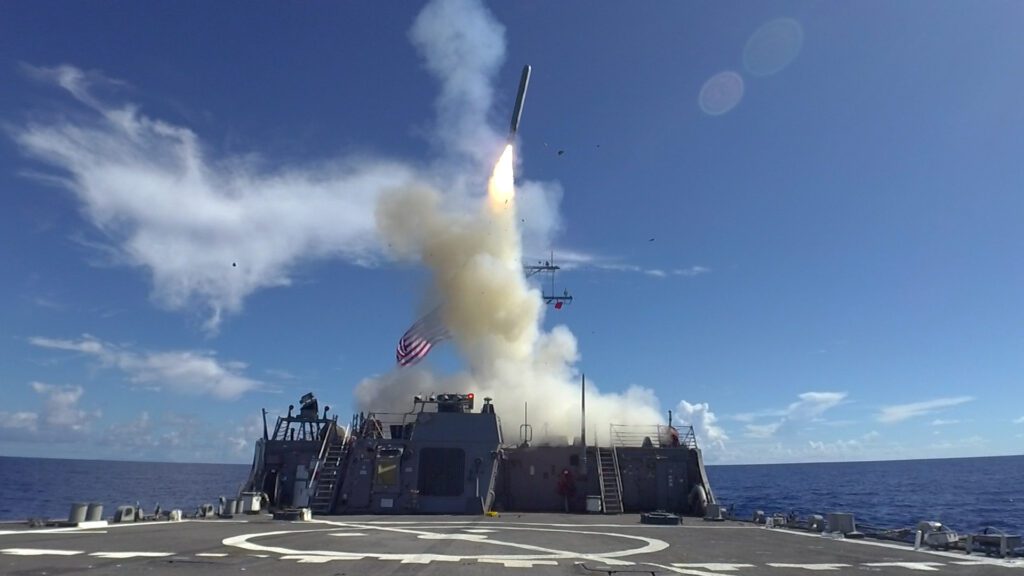
A tomahawk land attack missile is launched aboard the Arleigh Burke-class guided-missile destroyer USS Curtis Wilbur (DDG 54) during a live-fire demonstration as part of Pacific Vanguard (PACVAN) in 2019. U.S. NAVY / Mass Communication Specialist 2nd Class Taylor DiMartino

ARLINGTON, Va. — The AUKUS agreement between Australia, the United Kingdom and the United States announced last month highlighted the plan to add nuclear-powered attack submarines to the Royal Australian Navy (RAN), but the agreement also will add long-range precision-strike capability to the RAN in the form of Tomahawk cruise missiles to arm destroyers and also long-range precision missiles to the Royal Australian Air Force (RAAF) and to ground forces. 

“Throughout the decade, Australia will rapidly acquire long-range strike capabilities to enhance the ADF’s ability to deliver strike effects across our air, land and maritime domains,” the Australian Department of Defence said in a release. The management of this transition, and other capability acquisition options that will meet Australia’s strategic requirements, will be at the forefront of consultations through AUKUS over the next 18 months.” 

RGM-109 Tomahawk cruise missiles will arm the RAN’s three Hobart-class destroyers to enable the ships to strike land targets. The Tomahawks will be housed in Mk41 Vertical Launch System cells. The Tomahawk is built by Raytheon Missiles and Defense. 

The AGM-158B Joint Air-to-Surface Standoff Missiles (Extended Range) (JASSM-ER) will arm the RAAF’s F/A-18F Super Hornet strike fighters and, in the future, F-35A Lightning II strike fighters, to strike targets at ranges up to 900 kilometers.  

Also, the AGM-158C Long-Range Anti-Ship Missiles (Extended Range) (LRASM) will arm the F/A-18Fs Both the JASSM-ER and the LRASM are built by Lockheed Martin.  

Australia also will arm its land forces with unspecified precision-strike guided missiles “capable of destroying, neutralising and supressing diverse targets from over 400 [kilometers],” the release said. 

The Department of Defence also said it will be in “continuing collaboration with the United States to develop hypersonic missiles for our air capabilities.” 

The Australian government also will be “accelerating $1 billion for sovereign guided weapons manufacturing enterprise  — which will enable us to create our own weapons on Australian soil.” 

The nuclear-powered submarines for the RAN are a long-way off in time, so the government plans a life-of-type extension of Australia’s Collins class submarine fleet, which “will enhance Australia’s ability to deter and respond to potential security challenges.” 


Rolls-Royce Opens New $11 Million Facility to Support U.S. Navy Programs

Rolls-Royce’s flagship Naval Defense campus in Walpole, Massachusetts. ROLLS-ROYCE

WALPOLE, Mass. – Rolls-Royce has completed an $11 million investment in its flagship Naval Defense campus with the opening of a new high-tech manufacturing, repair and test facility. The 25,000-square-foot facility will enhance and modernize the company’s naval operations in Walpole, adding waterjet maintenance, repair and overhaul (MRO) servicing to its portfolio of world-class capabilities.  

“We’re excited to add this new capability so we can better serve our U.S. Navy customers,” said Dan Rediger, Rolls-Royce head of Naval Operations. “Our Walpole team has proudly equipped the Navy for more than 50 years and this investment ensures that we can continue to meet their growing needs for decades to come.” 

As the U.S. Navy Littoral Combat Ship (LCS) program continues to mature, Rolls-Royce is seeing an increased demand for spare equipment and MRO services associated with scheduled maintenance. Each Freedom-class variant of the LCS is equipped with four Rolls-Royce waterjets that were designed and manufactured on the company’s Walpole campus. The new facility gives Rolls-Royce the capacity and capability to perform the waterjet MRO work in Walpole, as well.  

Rolls-Royce is a global leader in propulsion equipment and continues to provide unparalleled products and services to the U.S. Navy. The company is the sole supplier of shock-rated propeller systems, which have demonstrated extraordinary levels of reliability and robustness in service. Rolls-Royce Propulsion equipment can be found on more than 95% of the U.S. Navy’s surface warfare fleet.  

“We are proud to provide the power to protect in support of our United States Department of Defense customers,” said Tom Bell, president, Rolls-Royce Defense and chairman & CEO of Rolls-Royce North America. “This investment is a clear signal that we remain committed to meeting their needs both today and well into the future with world-class, American-made products and services.”   

The investment is also expected to have a positive impact on the region, bringing new business to the local economy and new high-tech, manufacturing jobs to the Rolls-Royce Walpole campus.   

“I want to congratulate Rolls-Royce for expanding their footprint in Massachusetts, which promises to increase regional access to employment opportunities in high-tech manufacturing,” said Mike Kennealy, Massachusetts housing and economic development secretary. “The Commonwealth has made great strides in building a talented workforce and fostering innovation, and this facility ensures Rolls-Royce will continue to play an important role in our ecosystem well into the future.” 


Rapid HIMARS Deployment to Remote Location Demonstrates Distributed Lethality

The U.S. long-range artillery rocket system HIMARS is launched on Swedish territory. Joel Thungren/Försvarsmakten

GOTLAND, Sweden — Sweden and the United States conducted a recent exercise to deploy a mobile rocket launcher to a remote location and quickly engage targets.

Both Swedish and American C-130 Hercules aircraft demonstrated the ability to land on roads in a remote location on the island of Gotland in the Baltic Sea Oct. 23.   

A U.S. MC-130J Commando II Special Operations aircraft carried a Wisconsin Army National Guard M142 HIMARS (High Mobility Artillery Rocket System) long-range artillery system on board. The HIMARS was promptly unloaded and assembled for firing, then loaded onto the Swedish C-130H (designated as a TP 84 in the Swedish Air Force) and flown to another location in the northern part of the country, escorted by Swedish air force JAS 39 Gripen fighters, for a live firing event. The launch was successful.

According to the Swedish armed forces, “Within a few minutes, the system was assembled and ready to launch. It was then loaded on board the aircraft again and transported up to northern Sweden to demonstrate live firing. It was the first time this feature was fully exercised.”

“During the ongoing special forces exercise, new capabilities and weapon systems have been tested to enhance the joint operational capability in the vicinity of Sweden,” said a statement from the Swedish Ministry of Defense.

“Everything went very well. The joint exercises conducted this past weekend demonstrate how far we’ve come in our cooperation with the U.S.,” said Swedish Army Lt. Gen. Michael Claesson, Sweden’s chief of joint operations.

Gotland is Sweden’s largest island, and one of tens of thousands of islands strategically located in the Baltic Sea. Sweden is a neutral and independent country, and not a member of NATO treaty. It does, however, follow NATO military procedures and frequently participates in NATO and U.S. bilateral exercises.

The exercise demonstrates the ability to rapidly deploy lethal capabilities to remote locations, a key to the Navy and Marine Corps distributed maritime operations concept.