U.S. joint forces conduct a coordinated multi-domain, multi-axis, long-range maritime strikes in the Hawaiian Islands Operating Area during a sinking exercise on the decommissioned guided-missile frigate ex-USS Ingraham (FFG 61), Aug. 15, 2021. The exercise synchronized joint, multi-domain, multi-axis fires with near simultaneous times on target to sink the hulk. U.S. NAVY / Mass Communication Specialist 1st Class David Mora Jr.
PEARL HARBOR, Hawaii – U.S. joint forces conducted coordinated multi-domain, multi-axis, long-range maritime strikes in the Hawaiian Islands Operating Area during a sinking exercise on the decommissioned guided missile frigate ex-USS Ingraham, Aug. 15, the U.S. 3rd Fleet said in an 18 Aug. release.
Units from Vinson Carrier Strike Group (VINCSG), Submarine Forces Pacific, 1 Marine Expeditionary Force/3rd Marine Air Wing, III Marine Expeditionary/3rd Marine Division, and U.S. Army Multi-Domain Task Force participated in the joint, live-fire exercise.
“Lethal combat power was effectively applied to a variety of maritime threats over the last two weeks in a simulated environment as part of the Navy’s Large-Scale Exercise and expertly demonstrated Sunday with live ordnance,” said U.S. 3rd Fleet Commander Vice Adm. Steve Koehler. “The precise and coordinated strikes from the Navy and our Joint teammates resulted in the rapid destruction and sinking of the target ship and exemplify our ability to decisively apply force in the maritime battlespace.”
Former Navy vessels used in sinking exercises, referred to as hulks, are prepared in strict compliance with regulations prescribed and enforced by the Environmental Protection Agency under a general permit the Navy holds pursuant to the Marine Protection, Research and Sanctuaries Act.
Each exercise is required to sink the hulk in at least 1,000 fathoms (6,000 feet) of water and at least 50 nautical miles from land and surveys are conducted to safeguard against harm to people or marine mammals during the event. Prior to being transported for participation in a sinking exercise, each vessel is put through a rigorous cleaning process for environmental safety and is inspected to ensure the ship meets EPA requirements.
Ex-Ingraham was a guided missile frigate commissioned on Aug. 5, 1989, and was decommissioned on Jan. 30, 2015. The ship was named for Duncan Nathaniel Ingraham and is the fourth Navy ship with the namesake. It is the second of its name to be used in a sinking exercise; ex-USS Ingraham (DD 694), which was decommissioned in 1971 and sold to the Greek Navy, was sunk in 2001.
FRCSW Completes Final Major Maintenance of E-2C Hawkeye
Test line and support staff are pictured Aug. 3 in front of the last E-2C Hawkeye to complete PMI-2 at FRCSW. The aircraft was delivered to Carrier Airborne Early Squadron 116 (VAW-116) stationed at Naval Base Ventura County. U.S NAVY
NAVAL AIR STATION NORTH ISLAND, Calif. — The last E-2C Hawkeye to complete the planned maintenance interval two (PMI-2) procedure at Fleet Readiness Center Southwest (FRCSW) departed the command’s test line Aug. 3 to Carrier Airborne Early Squadron 116 (VAW-116) stationed at Naval Base Ventura County, the center said in an Aug. 12 release.
The aircraft was inducted Sept. 21, 2020, from VAW-123.
Developed by the Grumman Aircraft Co. in the mid-1960s, the twin turbo-propeller E-2 Hawkeye and its sister airframe, the C-2A Greyhound transport, still serve aboard naval aircraft carriers.
Production of the airborne early warning system (AEWS) E-2C variant began in 1973. With its detachable 24-foot diameter rotodome radar system, the Hawkeye’s ability to guard against airborne threats remains the standard for protection of naval carrier battle groups to this day.
FRCSW performs two levels of scheduled maintenance on the airframe: PMI-1, or a light maintenance interval at FRCSW’s Site Pt Mugu and FRC Mid-Atlantic, and PMI-2, or a heavy maintenance which is handled at FRCSW’s Building 460 onboard Naval Air Station North Island (NASNI).
During PMI-1, artisans assess the attachment points of the flight control surfaces on the body of the aircraft, the engines, and other areas identified in the maintenance specification. Sheet metal repairs are made and worn parts replaced.
FRCSW is the Navy’s sole provider of PMI-2 events to the airframe, and employs approximately 120 artisans and 53 indirect support personnel. Though not a complete overhaul, PMI-2 is a substantial disassembly of the aircraft down to the fuselage. Artisans remove the aircraft’s wings, engines, landing gear and tail.
By using chemical or physical means, the aircraft’s corrosion preventive paint is removed and an in-depth metal assessment is performed to locate surface anomalies like cracks, corrosion, exfoliation and missing fasteners.
PMI-2 procedures are completed under a project management method called the Critical Chain Project Management (CCPM) program. CCPM designates resources — like people and equipment — needed to complete a task in a specific amount of time. A software program called “Concerto” is used to manage the aircraft’s throughput as well as multiple CCPM projects.
The E-2 CCPM throughput is divided into four procedures: induction, repair, assembly and test line. Each step has a targeted completion time for a total of about 220 days, depending on material availability.
During fiscal 2020, FRCSW inducted five of the aircraft for PMI-2 and one for PMI-1. Approximately 29 E-2Cs remain in service. The command will continue to support the maintenance requirements of the airframe as the Navy transitions to the technologically advanced E-2D, the fourth variant that will replace the E-2C.
FRCSW delivered its first E-2D Hawkeye to complete PMI-2 last January.
Norway’s First P-8A Poseidon Performs First Flight
The first of five P-8A Poseidon aircraft bound for Norway had its first flight Aug. 9. THE BOEING CO.
RENTON, Wash. — The first of five Boeing P-8A Poseidon aircraft for Norway performed its first flight Aug. 9, the company said in a release. The aircraft took off at 10:03 a.m. Pacific time and flew for 2 hours, 24 minutes, reaching a maximum altitude of 41,000 feet during the flight from Renton Municipal Airport to Boeing Field in Seattle.
The first flight marks the next phase of the production cycle of this aircraft as it is moved to the Installation and Checkout facility, where mission systems will be installed and additional testing will take place before final delivery to the Norwegian Defence Materiel Agency (NDMA) later this year.
“This inaugural flight is an important milestone for Norway, and the Boeing team remains committed to delivering the P-8 fleet to the NDMA on schedule,” said Christian Thomsen, P-8 Europe program manager. “The P-8 is a capability that will help Norway improve anti-submarine warfare, anti-surface warfare, intelligence, surveillance and reconnaissance, and search-and-rescue missions, in addition to fostering valuable regional collaboration and interoperability with NATO nations.”
The five P-8As will eventually replace Norway’s current fleet of six P-3 Orions and three DA-20 Jet Falcons. The Royal Norwegian Air Force currently operates its P-3s from Andoya Air Station. With the introduction of the P-8s, flight operations will move to new facilities at Evenes Air Station.
To date, Boeing has delivered 136 P-8 aircraft to the U.S. Navy, the Royal Australian Air Force, the Indian navy and the United Kingdom’s Royal Air Force. Norway is one of eight nations that have selected the P-8A as their maritime patrol aircraft, along with the United States, India, Australia, the United Kingdom, Korea, New Zealand and Germany.
U.S. Central Command Releases Statement on Investigation into Attack on Motor Tanker Mercer Street
Some of the damage caused to the Motor Tanker Mercer Street. U.S. CENTRAL COMMAND
TAMPA, Fla. – Following the July 30 explosive unmanned aerial vehicle attack on the Motor Tanker (M/T) Mercer Street while transiting international waters off the coast of Oman, an expert explosive investigative team from the USS Ronald Reagan embarked the M/T to examine the evidence and interview the surviving crew members, the U.S. Central Command said in an Aug. 6 release.
The team found:
1) The M/T Mercer Street was targeted by two unsuccessful explosive UAV attacks on the evening of July 29. The crew reported the attacks via distress calls on the evening of July 29. Based on crew interviews, the investigative team found credible the reports of the attacks, which impacted the sea near the M/T Mercer Street. Investigators found small remnants of at least one of the UAVs on Mercer Street that the crew had retrieved from the water, corroborating the reports.
2) The investigative team determined that the extensive damage to the Mercer Street, documented in the attached slides, was the result of a third UAV attack on July 30. This UAV was loaded with a military-grade explosive, and caused the death of two crewmembers; the master of the ship, a Romanian citizen, and a United Kingdom national who was part of the security detail.
3) The explosive detonation following the UAV impact created an approximately 6-foot diameter hole in the topside of the pilot house and badly damaged the interior. Explosive chemical tests were indicative of a Nitrate-based explosive and identified as RDX, indicating the UAV had been rigged to cause injury and destruction.
4) Explosives experts were able to recover several pieces of this third UAV, including a vertical stabilizer (part of the wing) and internal components which were nearly identical to previously collected examples from Iranian one-way attack UAVs. The distance from the Iranian coast to the locations of the attacks was within the range of documented Iranian one-way attack UAVs. Following an on-scene analysis, some of the material was transferred to U.S. Fifth Fleet headquarters in Manama, Bahrain and subsequently to a U.S. national laboratory for further testing and verification.
5) U.K. explosive experts were provided access to the evidence at the 5th Fleet headquarters. Evidence was shared virtually with Israeli explosive experts. Both partners concurred with the U.S. findings.
U.S. experts concluded based on the evidence that this UAV was produced in Iran.
This statement was released with an accompanying briefing “Iranian UAV Attack Against MOTOR TANKER MERCER STREET”
The above statements and those in the accompanying briefing are attributable to U.S. Navy Capt. Bill Urban, the CENTCOM spokesman.
BAE Systems Awarded Contract to Sustain F-35’s Electronic Warfare System
An F-35C Lighting II assigned to the “Black Knights” from the Marine Fighter Attack Squadron (VMFA) 154 performs a touch-and-go on the flight deck of the aircraft carrier USS Abraham Lincoln (CVN 72) in July. U.S. NAVY / Mass Communication Specialist 3rd Class Jeremiah Bartelt
NASHUA, N.H. — BAE Systems has received a $93 million Undefinitized Contract Action (UCA) to provide critical sustainment support for the F-35 electronic warfare (EW) system, the company said in an Aug. 4 release.
BAE Systems has received a $93 million, five-year UCA from Lockheed Martin to provide critical sustainment support for the AN/ASQ-239 EW countermeasure system. The contract will ensure the mission readiness of the growing global fleet of F-35 aircraft.
“We have a strong track record of sustaining electronic warfare systems to support our customers’ mission readiness,” said Rob Dykema, F-35 Sustainment program director at BAE Systems. “This contract lays critical sustainment groundwork, establishing and optimizing the infrastructure to support the aircraft.”
Under the contract, BAE Systems will provide software maintenance, depot test equipment support, logistics analysis, obsolescence monitoring, technical field support, and reach-back support for the F-35 U.S. Reprogramming Laboratory.
The contract complements the BAE Systems F-35 performance-based logistics (PBL) program, through which BAE Systems ensures EW material availability. Under the EW PBL, BAE Systems has demonstrated a 60% improvement in supply support, delivering better than 85% EW material availability to the F-35 enterprise with reduced cost per flight hour using a cost-effective, outcome-based support strategy.
The AN/ASQ-239 electronic warfare suite provides real-time situational awareness and superior electronic warfare attack and countermeasure capabilities.
BAE Systems’ Next-Generation APKWS Guidance Kits Improve Rocket Range and Impact
BAE Systems has developed an advanced, hardened version of its APKWS guidance kit. BAE SYSTEMS
Hudson, N.H. — BAE Systems, Inc. has developed an advanced version of its combat-proven APKWS guidance kit that offers enhanced strike distance and precision strike lethality, the company said in an Aug. 2 release. The upgrade improves the effective range of APKWS guided rockets by up to 30%, allowing warfighters to engage targets from a greater standoff distance with improved survivability.
APKWS is the U.S. government’s only program of record for guiding 2.75-inch laser-guided rockets, providing an efficient, low-cost weapon in the U.S. arsenal of precision munitions. Initial production of APKWS block upgrade guidance kits will start in the third quarter of 2021.
“Our customers’ precision strike needs are changing,” said John Watkins, vice president and general manager of Precision Strike & Sensing Solutions at BAE Systems. “We’re focused on evolving APKWS guidance kits to provide them with a more capable low-cost product that’s easy to use and known for its accuracy.”
APKWS block upgrade guidance kits create an optimized flight trajectory that enables the rocket to engage targets at a steeper angle of attack, providing improvements in range and lethality. The optimized attack trajectory improves first-shot success against stationary and moving targets.
The enhanced guidance kits also provide logistics and training benefits to customers. A single variant of the weapon is now qualified for rotary-wing and fixed-wing aircraft across the U.S. armed forces customers, easing stock management and reducing the cognitive load on pilots. An upgrade to the surface danger zone logic also provides better training range options in certain conditions, allowing crews to improve their proficiency at home stations.
BAE Systems’ APKWS guidance kits are manufactured at the company’s production facility in Hudson, New Hampshire.
Sea-Air-Space 2021 Prequel: Law Of Sea Convention Could be Negotiated to Overcome Constitutional Objections, Analyst Says
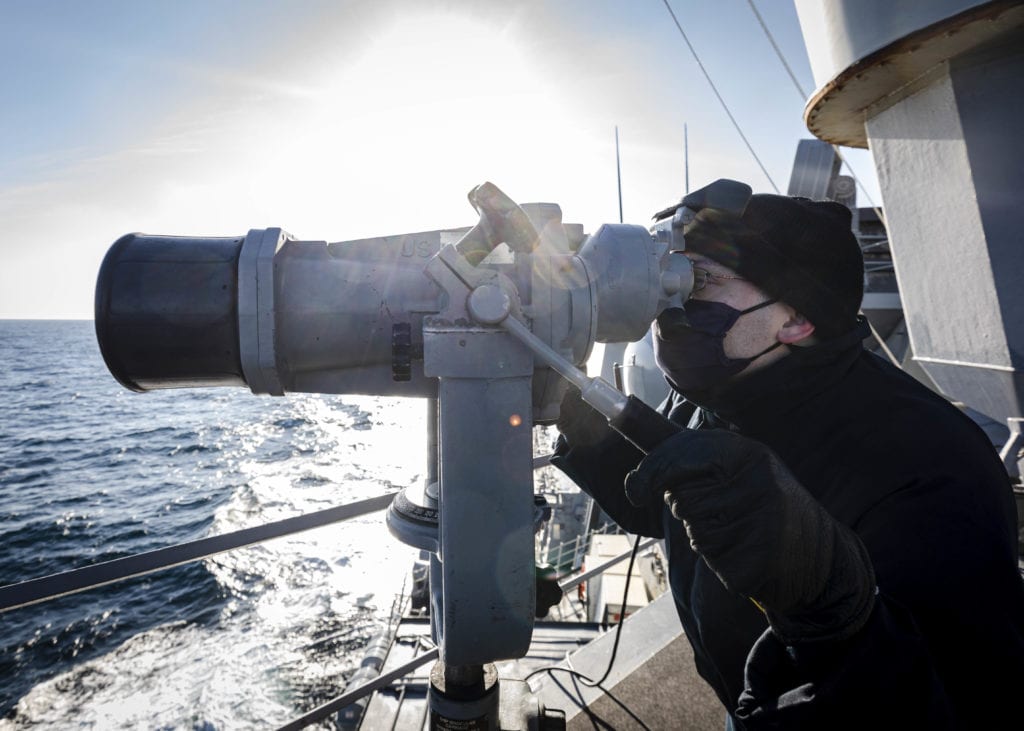
Ensign James Bateman, from Huntsville, Alabama, scans the horizon utilizing the “big eyes” while standing watch on the on the bridge wing as the guided-missile destroyer USS John S. McCain (DDG 56) conducts freedom of navigation (FON) operations in late 2020. U.S. NAVY / Communication Specialist 2nd Class Markus Castaneda
ARLINGTON, Va. — The United Nations Convention on the Law of the Sea (UNCLOS) could be ratified by the U.S. Senate if a few objections were addressed, a naval analyst said.
Speaking 20 July in a webinar of the Navy League’s Sea-Air-Space Prequel, Marine Corps Col. James McGinley, a retired naval aviator and a lawyer, said that the UNCLOS could be challenged on constitutional grounds that it could negate the right of the U.S Senate to provide “advice and consent.”
The UNCLOS, signed by 168 nations, governs a wide array of maritime issues including economic, military, commerce, mining interests. It has yet to be ratified by the Senate, where it last was given a hearing in 2012.
“The United States was a huge part of the formation of UNCLOS back in the ‘80s,” he said. “The United States signed [in 1994] but did not ratify,” said retired Adm. Jonathan Greenert, former chief of naval operations, also speaking in the webinar.
Speaking of the example of Arctic energy exploration and seabed mining, retired Adm. Paul Zukunft, former commandant of the Coast Guard, said during the webinar, “We have a right to this, yet we haven’t signed onto the ground rules to lay claim what is rightfully ours.”
Zukunft also pointed to the absurdity of the Chinese “Nine-Dash Line,” which the Chinese Communist Party uses to claim most of the South China Sea as its territorial waters.
“If you use that same [justification], then Denmark and Leif Ericsson should probably claim the United States EEZ [Exclusive Economic Zone],” Zukunft said. “We don’t have a voice at that forum because we have not ratified the Law of the Sea convention. We’re trying to resolve this with Freedom of Navigation [FON] exercises but at the end of the day, the fact that we don’t have a voice at the table for this aspect of maritime governance, all we can do is sit back and watch, and try to counterbalance using economic or military leverage to correct that behavior.”
The admiral said the Coast Guard has 65 bilateral agreements with other nations “that allow us to board vessels of those signatory nations — whether it’s a fishing violation, [an] encounter [with] drug movement, or even the potential of a weapon of mass destruction in the maritime domain — [the Coast Guard is authorized to] stop, apprehend, search those vessels on behalf of those flag nations.”
FON “doesn’t represent a policy,” Greenert said. “It is nothing more than a statement by us concerning free passage in certain straits or waters of the world.
“What’s happening right now is China is showing some real mischief and it goes beyond some of the seabed issues and Nine Dash Line issues,” he said. “China is starting to reinterpret UNCLOS. They’re pushing things around within the convention. Frankly, in my view, they need to be confronting by another leader. For example, China is working to change the definition of ‘high sea’ to their advantage. China is working to put the [EEZs] per UNCLOS to be controlled by the littoral nation. They have 28 land-locked countries in the United Nations on board in this endeavor.”
Greenert said that if this provision were adopted, military operations would need permission of the littoral nation.
McGinley spoke about the legal logjam of UNCLOS in the U.S. Senate.
“As it exists today, there has been such consistent resistance to ratification,” he said. “We’re now pushing half century. A lot of the original thinking on this was in 1956. There are parts of [UNCLOS] that are extraordinarily helpful to the U.S. and to our interests, but I worry that the poison pills that are buried in this thing — over 208 pages — are enough to keep us from success.”
McGinley suggested two approaches to achieve ratification.
“One would be a hard pivot and talk to the key opposition folks in the Senate and say, ‘Here’s what we need. What works for you?’ and then start with a fresh piece of paper with regard to — not to the entire globe — but to the key maritime partners as well as some of the other maritime nations we think would be most important to success,” he said.
“A second would be to take a radically different approach in the Senate,” he continued. “Part of the problem is Articles 309 and 310. The Constitution’s Article 2 Section 2 gives us advice and consent for our Senate. Part of what happens under the RUDS [Reservations, Understandings and Declarations] in any treaty is the ability for our Senate to say, ‘When we look at these words, we understand to mean this. Here is a statement of what we agree to,’ or, ‘here are our reservations; we don’t agree to these particular articles, but we do agree to these other articles.’”
McGinley explained the poison pills in the treaty.
“This is an odd treaty in that it purports to take away the constitutional right of the U.S. Senate to provide its advice and consent. … It is so significant that a ratification could actually face a successful constitutional challenge,” he said. “A fresh piece of paper would go beyond that, but if the Senate wanted to go forward with it, they ought to do it very publicly … that we are specifically rebuking 309 and 310, and then take a very tight look at Article 82 — which is a real significant transfer of the American families’ money — and also look at Article 144 — which is a straight-up transfer of technology. Almost all of this was negotiated at a time when we did not have the technological capability, so when those pills were put in, they were thought of as worthless and so far in the future it wouldn’t matter. Now those are real, and they are significant. They’re part of what makes this treaty harder to pass with each passing year.”
McGinley explained why the United States has been able to set a good example despite lack of ratification.
“My hat is off to the [U.S.] Navy, which I’ve watched out in the 5th Fleet with extraordinary seamanship,” he said. “It is that professionalism that has developed international customary law to the point that, even though we are not parties to this treaty, we actually exemplify — through our own conduct, and over time we have developed — norms.”
McGinley noted that in 2016 China said it would ignore binding arbitration from the verdicts from the court of arbitration about one of the islands in the South China Sea.
“It’s as if they have never signed the treaty,” he said. “So, it comes down to non-parties behaving as if they were parties and parties behaving as if they had never signed it. … The U.S. Navy’s professionalism still sets the standard and is developing navigational norms and customary international law as a result of their professionalism.”
Bell Begins UH-1Y Production for the Czech Republic
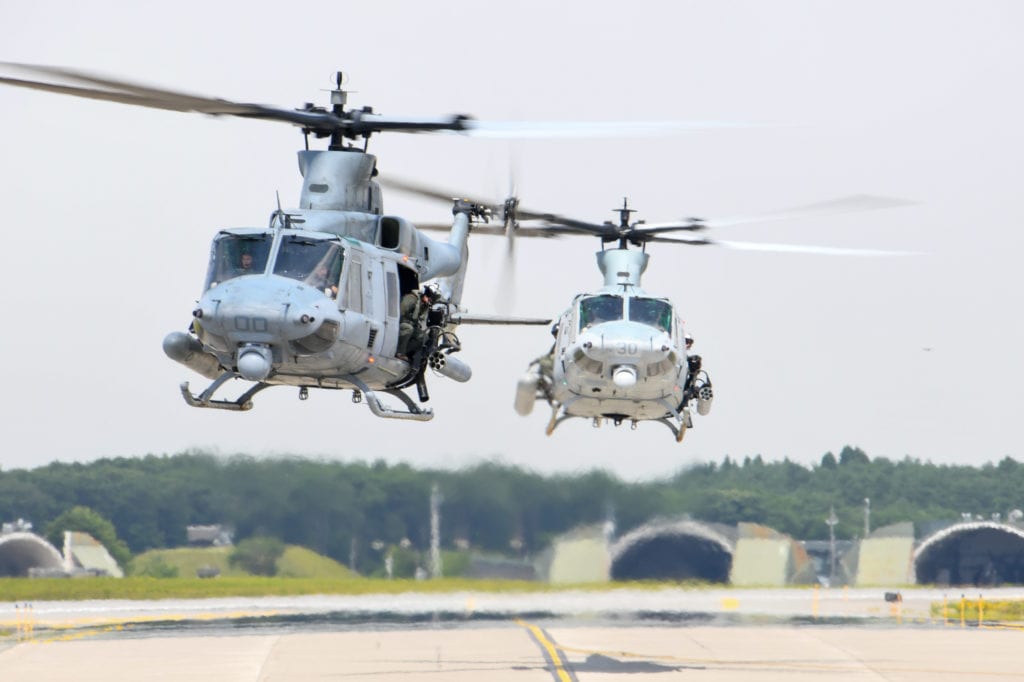
Two UH-1Y Venoms, assigned to the “Vipers” of Marine Light Attack Helicopter Squadron (HMLA) 169, prepare to land at Naval Air Facility (NAF) Misawa, Japan, on July 15. U.S. NAVY / Mass Communication Specialist 3rd Class Benjamin Ringers
CRESTVIEW, Fla. — Bell Textron Inc., a Textron Inc. company, has restarted UH-1Y Venom helicopter production for the first international operator. Crestview Aerospace has completed manufacturing the first of eight cabins at the Crestview Florida facility. The aircraft will complete final assembly at the Bell Amarillo Assembly Center.
The helicopters are part of the 2020 U.S. Department of Defense contract awarded to Bell for the production and delivery of eight UH-1Y and four AH-1Z helicopters for the government of the Czech Republic.
“Crestview Aerospace is honored and grateful for the opportunity to team with Bell on the continued production of the UH-1Y cabin for the first international customer,” said Paul Kohlmeier, senior vice president, Strategy and Business Development, Crestview Aerospace. “Crestview continues to build in the same high quality and reliability into the international Venom helicopters that underpin the aircraft currently operated by the United States Marine Corps around the world.”
Bell delivered the final UH-1Y for the U.S. Marine Corps program of record in April 2018 and has continued to produce and deliver the AH-1Z as part of the H-1 production contract for 349 H-1 aircraft, consisting of 160 UH-1Y and 189 AH-1Z.
The UH-1Y shares 85 percent commonality of parts with the AH-1Z. The commonality between the aircraft enabled critical component supply chains to remain active during AH-1Z production for the USMC.
“Time, logistics, and man-hours are all strategic resources,” said Mike Deslatte, vice president and H-1 program director, Bell. “Commonality helps ensure everything between the Viper and Venom, from manufacturing, maintenance, and upgrades, remains seamless while simultaneously providing lower program and life cycle costs. It’s a real tactical advantage on multiple levels.”
The UH-1Y and AH-1Z share the same engines, integrated mission system and dynamic components, such as the four-bladed rotor system. Both aircraft are specifically designed and produced for expeditionary operations. Together, they provide a full spectrum of military operations, unlike any other helicopter duo.
Bell anticipates production for the Marine Corps through early 2022, followed by continued production for foreign military customers. Bell has two signed Foreign Military Sales cases in production, Bahrain and the Czech Republic.
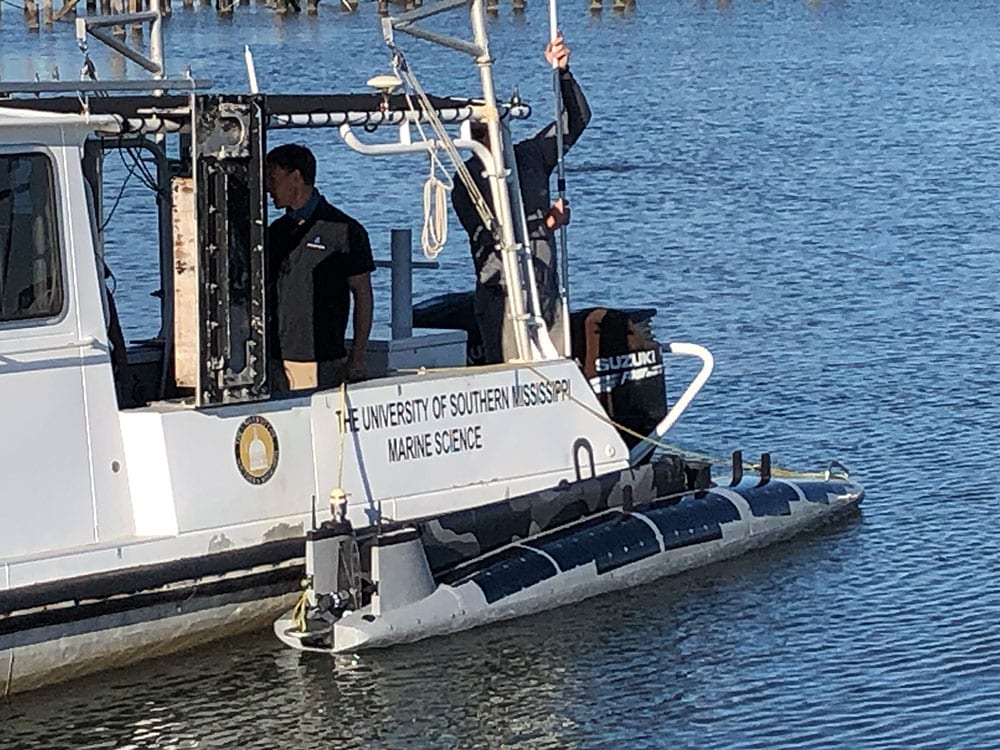
A Triton unmanned underwater vehicle, shown at the University of Southern Mississippi upon completion of its acceptance testing in 2020. UNIVERSITY OF SOUTHERN MISSISSIPPI
WASHINGTON– The Department of Homeland Security (DHS) Science and Technology Directorate (S&T) is evaluating innovative ocean surveillance technology to support the U.S. Coast Guard’s mission of protecting the more than 95,000 miles of maritime border shoreline and 15,000 miles of waterways, seaports, and other commercially navigable waters, the department said in a July 14 release.
DHS S&T teamed up with the Coast Guard, University of Southern Mississippi (USM), the U.S. Naval Research Laboratory (NRL), the Applied Research Laboratory (ARL) at Penn State, Ocean Aero, Inc., Cherokee Nation Strategic Programs (CNSP), and the Homeland Security Systems Engineering and Development Institute (HSSEDI), to develop, acquire, evaluate, and test specialized, environmentally powered (wind and solar), multi-mission capable, unmanned surface and underwater vessels.
The evaluation team initiated acceptance testing of six Triton vessels at USM’s Marine Research Center (MRC) at the Port of Gulfport. During this ongoing testing, they will utilize MRC’s specialized lab facilities and waterfront access to evaluate the Tritons’ capabilities in multiple areas, including navigation; surface, diving, and subsurface operations; operating effectively for long periods of time using only wind and solar power; and how well they can serve as a platform for cameras and advanced sensors to detect relevant anomalies and threats.
“S&T is excited about this opportunity to test and evaluate such a unique technology,” said S&T Program Manager Shane Cullen. “There are a number of autonomous vessels in the field that are utilized for both commercial and military applications. However, the Triton proposes to be able to navigate while submerged and rely solely on wind and solar power when on the surface. That could make it very useful for long-term maritime protection and law enforcement operations at sea.”
“Autonomous vessels represent an emerging technology that could be integrated into various Coast Guard missions,” said Scott Craig, the unmanned systems research and development domain lead for the Coast Guard. “Through evaluation and testing we can better determine how the service can take advantage of these types of vessels in the future.”
S&T, the Coast Guard, Ocean Aero, CNSP, NRL, HSSEDI, and USM will continue to evaluate the Triton autonomous marine vessels throughout the rest of the summer. Once NRL and ARL integrate selected advanced sensors into the Triton vessels later this summer, testing will continue offshore in Gulfport into the early fall.
Boeing Delivers Indian Navy’s 10th P-8I
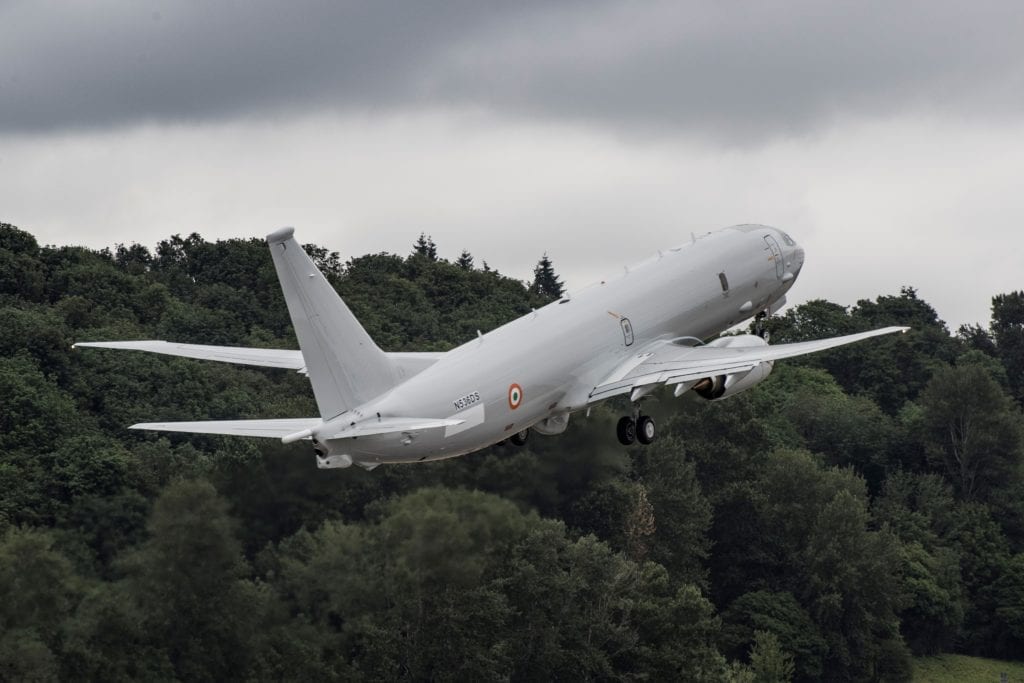
Boeing has delivered the Indian navy’s 10th P-8I long-range maritime patrol aircraft. BOEING
NEW DELHI, INDIA — Boeing is continuing to expand the Indian navy’s long-range maritime reconnaissance antisubmarine warfare capabilities with the delivery of the country’s 10th P-8I. The patrol aircraft is an integral part of the Indian navy’s fleet and has surpassed 30,000 flight hours since it was inducted in 2013.
This is the second aircraft to be delivered under an option contract for four additional aircraft that the Indian Ministry of Defence awarded in 2016. The Indian navy was the first international customer for the P-8, which is also operated by the U.S. Navy, the Royal Australian Air Force and the United Kingdom’s Royal Air Force.
In addition to unmatched maritime reconnaissance and antisubmarine warfare capabilities, the P-8I has been deployed to assist during disaster relief and humanitarian missions.
Boeing supports India’s growing P-8I fleet by providing training of Indian navy flight crews, spare parts, ground support equipment and field service representative support. Boeing’s integrated logistics support has enabled a high state of fleet readiness at the lowest possible cost.
Boeing is currently completing construction on the Training Support & Data Handling Centre at INS Rajali, Arakkonam, Tamil Nadu and a secondary maintenance training center at the Naval Institute of Aeronautical Technology, Kochi, Kerala, as part of a training and support package contract signed in 2019. This new indigenous, ground-based training will allow Indian Navy crew to increase mission proficiency in a shorter time while reducing on-aircraft training time resulting in increased aircraft availability.