AeroVironment Selected by USSOCOM for ISR Services Under Mid-Endurance UAS IV Program
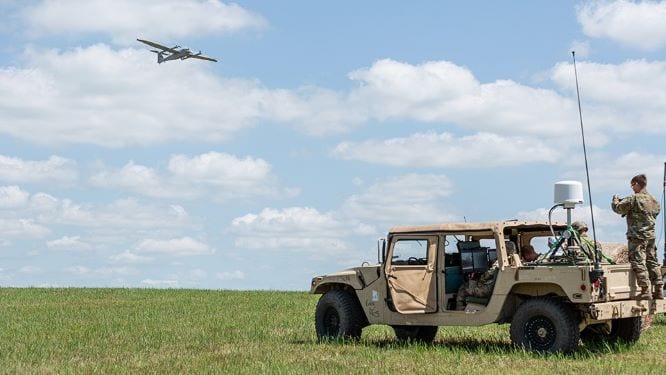
JUMP 20 is a VTOL, fixed-wing unmanned aircraft system that can be deployed quickly and requires no launch equipment or runway. AEROVIRONMENT
ARLINGTON, Va., July 13, 2021 – AeroVironment Inc. was awarded a competitive task order valued at approximately $22 million on May 21 from the U.S. Special Operations Command (USSOCOM) for ISR services using JUMP 20 medium unmanned aircraft systems (MEUAS) at an undisclosed customer location, the company said in a July 13 release.
The ISR services include the first satcom-enabled unmanned aircraft system for beyond line-of-sight operations as part of the existing indefinite delivery, indefinite quantity MEUAS IV contract. The task order specifies a 12-month period of performance and multiple follow-on option years for ISR services.
“The JUMP 20 delivers an unmatched level of versatility, with runway and infrastructure independence, multiple payload configurations, class-leading endurance and a track record of reliability and ruggedness,” said Gorik Hossepian, AeroVironment vice president and product line general manager for medium UAS. “The inclusion of a satcom payload adds beyond-line-of-sight operation to the JUMP 20, providing our customer with expanded reach and situational awareness, and representing another game-changing, market-leading capability.”
The AeroVironment JUMP 20 is the first fixed-wing unmanned aircraft system capable of vertical takeoff and landing to be deployed extensively in support of U.S. military forces. Ideal for multi-mission operations, JUMP 20 delivers 14-plus hours of endurance, a standard operational range of 185 kilometers (115 miles) and is runway independent. The system can be set up and operational in less than 60 minutes without the need for launch or recovery equipment and has a useable payload capacity of up to 30 pounds. The JUMP 20 also features a common autopilot and ground control system architecture providing a highly customizable, modular platform which can be custom configured to meet operational or customer requirements.
Exercise Sea Breeze 2021 Comes to a Close in Black Sea
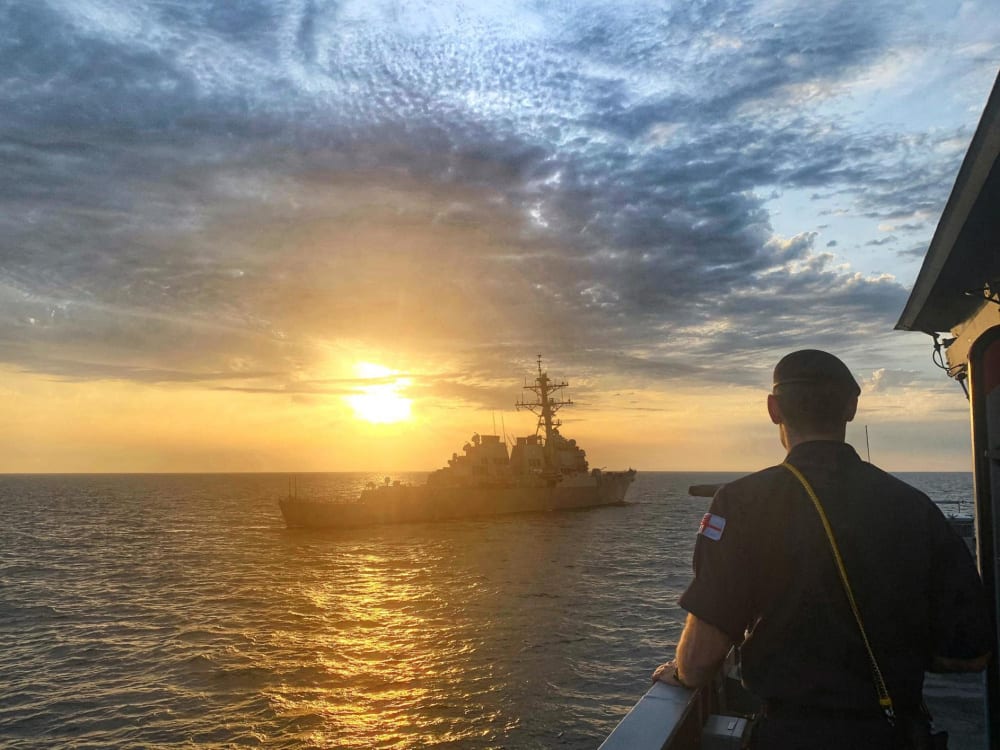
The Arleigh Burke-class guided-missile destroyer USS Ross (DDG 71) from the topside of the Royal Navy HMS Trent (P224) Odesa, Ukraine during Exercise Sea Breeze 2021, July 2, 2021. U.K. ROYAL NAVY / HMS Trent
The U.S. and Ukrainian navies wrapped up Exercise Sea Breeze 2021 July 10 in the Black Sea region.
“We’ve had the largest Sea Breeze since we began over 20 years ago,” said Capt. Stuart Bauman, the Sea Breeze 21 exercise director on the U.S. side during a press conference on Friday. “We’ve had the participation of 30 nations including observers and mentors; more than 5,000 Sailors, Soldiers, and Airmen; more than 40 aircraft participate; 32 ships and just a great amount of cooperation and partnership between all of the nations.”
Bauman said there was great participation from both NATO and non-NATO participants across a wide variety all around the globe, including Asia, Africa, North America, Europe, and the Middle East. “We had great participation from a wide variety of countries. We had folks come in to be mentors with the Ukrainian forces, we had teams participating in our diving exercises as well as being observers and across all of the different air, land, and maritime components.”
Participating Sea Breeze 21 nations included Albania, Australia, Brazil, Bulgaria, Canada, Denmark, Egypt, Estonia, France, Georgia, Greece, Israel, Italy, Japan, Latvia, Lithuania, Moldova, Morocco, Norway, Pakistan, Poland, Romania, Senegal, Spain, South Korea, Sweden, Tunisia, Turkey, Ukraine, United Arab Emirates, United Kingdom and the United States.
“The level of cooperation and integration is at its highest level that we’ve seen, and the Ukrainians are very capable as well as all of the partners that have joined in,” Bauman said. “And we’ve covered everything from maritime components to air, to land to special operations.”
Bauman said the forces took part in sea, air and land warfighting scenarios. “We had quite a bit of interoperability between many different nations across all of the domains of warfare, and they’ve all done an outstanding job.”
Cmdr. John D. John, commanding officer of Rota, Spain-based USS Ross (DG-71), said he and his crew were part of a five-ship battle group that incorporated a Ukrainian vessel, Hryhoriy Kuropiatnykov, the Bulgarian ship Bodry, the British ship Trent, and Romanian ship Macellariu. “Our mission has been to promote interoperability and enhance warfighting readiness for our collective of the Black Sea region to ensure safety and prosperity in this region for allies and partners.”
John said Sea Breeze enhances combat readiness amongst participating NATO and allied partner nations to rapidly respond to any threats. “I believe that we proved that our ability to seamlessly operate together to maintain a stable and prosperous Black Sea region sends a message to the world that we are committed to enhancing stability and deterring aggression. No nation can confront today’s challenges alone, and the Black Sea is no different. While it may be smaller than other international bodies of water, it’s still quite large and provides an appropriate area for nations to come together to learn from each other, strengthen relationships, and also contribute to each other to ensure the continued success of the longstanding alliance with NATO and our partner nations.”
John said the exercise took place in international waters in the Black Sea, and therefore there was the opportunity for both non-participating units and civilian vessels to be in and around the exercise area. “From all accounts, all vessels and aircraft participated or conducted themselves in accordance with international law and maritime regulations and with due regard for safety.”
“As professional mariners, regardless of what nation, safety at sea is paramount for all vessels,” John said. “There were at least two interactions over bridge-to-bridge VHF radio communication where both a non-participating unit and a participating unit communicated with each other effectively and professionally to ensure safe navigation of the exercise area. All of those communications were conducted in a routine and professional manner.”
U.S. Marine Corps Lieutenant Colonel Mastin Robeson, Jr., the commander of 1st Battalion, 6th Marines, was speaking from Oleshky Sands in Kherson Oblast, Ukraine, collocated with the 88th Marine Infantry Battalion as well as the 1st Separate Battalion, Airborne Marines. “I’ve got with me approximately 400 Marines from across the 2nd Marine Expeditionary Force, also known as II MEF. And our mission was to deploy from Camp LeJeune, North Carolina to Oleshky Sands to conduct training with other nation forces, to include Ukrainian marines, Georgian soldiers, as well as Moldovan forces.”
Robeson said the exercise consisted of multiple phases. “The first phase was an opportunity to really get familiar with the other services that we were working with from other nations. We had a transition period on the 4th of July where we paused to celebrate Naval Forces Day for the Ukraine and, of course, Independence Day for the United States, and then we moved into a final exercise.”
“The exercise has been a great experience for the Marines from 1st Battalion, 6th Marines and those from II MEF that accompanied us out here. The opportunity to operate in an expeditionary environment where we’re living in tents and out training with partner forces who maintaining stability in the Black Sea is a great win for us and I think a great win for the partners we worked with. We found that our partner forces are professionals, skilled, and have a lot of pride in what they do. We had the chance to work with equipment and folks we don’t work with every day,” said Robeson. “It was a great opportunity to exchange esprit de corps between the nations. And for the record, we had a lot of rain out here the whole way through it.”
A chart showing how international participation in Sea Breeze has increased over the years.
During the exercise, U.S., Ukrainian, Canadian, Polish and Georgian divers worked together to remove a civilian vessel that sunk in 2016 that was blocking a portion of the Odessa Port pier. Officials said the cooperative dive and salvage operation demonstrated the tangible lasting impacts the partnerships between participants as well as increasing port access and maritime safety.
During the press conference, reporters asked Bauman if Sea Breeze was a sign of increased NATO or American deployments in the Black Sea in the future. “Sea Breeze is just one of many exercises that we conduct both around the world and in Europe and the Black Sea region,” he said. “We do very regular deployments with a variety of partner countries, and we will continue to do so to strengthen and stabilize the region.”
Bauman said Russia should not be alarmed by the Sea Breeze maneuvers. “We have been performing and executing Sea Breeze for many years, all the way back to 1997, and so we have a long history of establishing what our cadence is and the types of activities that we perform, and even well beyond that just a general level of professionalism and being able to conduct military exercises safely and without provocation. We are very transparent in our intentions as well as providing boundaries on where we will be and when we will be there. All of our partners have a very high level of professionalism such that we minimize any provocation and operate only in accordance with those well-established conventions in international waters and air space. In fact, all vessels, both civilian and military, that were operating in the exercise area conducted themselves with professionalism in accordance with international law and maritime regulations with the most due regard for safety at sea, he said. “There was no interference at all.”
According to Bauman, most ships that participated in Sea Breeze will also be participating in Breeze, a Bulgarian-led exercise. “They will be remaining in the Black Sea for a period of time, but obviously not to exceed the time limits of the Montreux Convention.”
U.S., U.K., Dutch Naval Forces Conduct Joint Exercise in Gulf of Aden
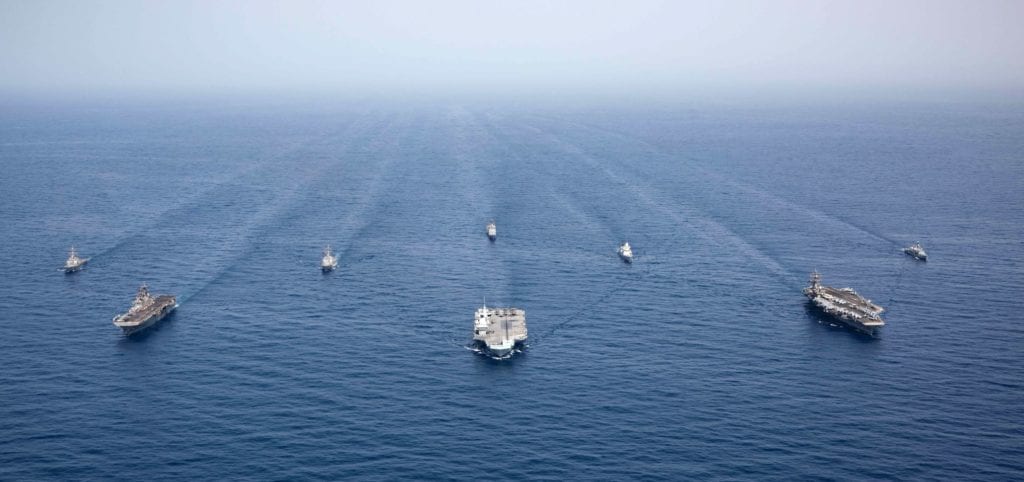
The combined, bilateral surface, air and sub-surface exercise was designed to enhance U.K., Dutch and U.S. maritime interoperability and demonstrate naval integration through a series of training scenarios. U.S. NAVY
GULF OF ADEN — The Queen Elizabeth (U.K.) and Ronald Reagan carrier strike groups (CSG), alongside the Iwo Jima amphibious ready group (ARG), conducted a large-scale joint interoperability exercise in the Gulf of Aden, July 12, Task Force 50 Public Affairs said in a release.
The combined, bilateral surface, air and sub-surface exercise was designed to enhance UK, Dutch and U.S. maritime interoperability and demonstrate naval integration through a series of training scenarios.
“Our team was proud to operate alongside the U.K. Carrier Strike Group during this unique opportunity to hone the full scope of our mutual capabilities,” said Rear Adm. Will Pennington, commander, Ronald Reagan CSG and Task Force 50. “By operating together at sea, we deepen our coalition partnerships and extend our global reach throughout the region’s critical waterways.”
Participating forces focused on the full spectrum of maritime warfare operations, practicing anti-air warfare, anti-surface warfare, and anti-submarine warfare tactics and procedures.
The crews exercised their abilities to conduct precision maneuvering, hunt simulated enemy submarines, provide layered defense against simulated air and surface threats, and conduct long range maritime strikes against simulated adversarial forces.
“The aircraft carrier is the ultimate expression of global maritime power,” said Commodore Steve Moorhouse, commander, United Kingdom Carrier Strike Group. “Queen Elizabeth, Ronald Reagan and Iwo Jima symbolize the might of the U.S. and UK partnership, and the ease with which our naval and air forces can combine here in the Gulf of Aden, or anywhere else in the world.”
This also marks the second time this year the Iwo Jima ARG has operated alongside the U.K. carrier strike group, following an exercise off the coast of Scotland in May.
“The Iwo Jima ARG remains in a high state of readiness to support our partners and allies as an effective amphibious force,” said Capt. Darren Nelson, commodore, Amphibious Squadron Four. “Operating with the Ronald Reagan and UK carrier strike groups allows us to better address common threats to regional security.”
Participating units included aircraft carrier HMS Queen Elizabeth (R 08) with embarked F-35B Lightning II Joint Strike Fighters from Royal Air Force 617 Squadron and U.S. Marine Corps Fighter Attack Squadron (VMFA) 211; aircraft carrier USS Ronald Reagan (CVN 76) with embarked Carrier Air Wing (CVW) 5 and Destroyer Squadron 15; amphibious assault ship USS Iwo Jima (LHD 7) and embarked 24th Marine Expeditionary Unit, anti-submarine frigate HMS Richmond (F 239); Dutch frigate HNLMS Evertsen (F 805); guided-missile destroyers USS The Sullivans (DDG 68) and USS Halsey (DDG 97); and guided-missile cruiser USS Shiloh (CG 67).
The Ronald Reagan CSG and Iwo Jima ARG are deployed to the U.S. 5th Fleet area of operations in support of naval operations to ensure maritime stability and security in the Central Region, connecting the Mediterranean and the Pacific through the western Indian Ocean and three strategic choke points.
Bollinger Christens Ocean Transport Barge Holland to Support Columbia SSBN Construction for General Dynamics Electric Boat
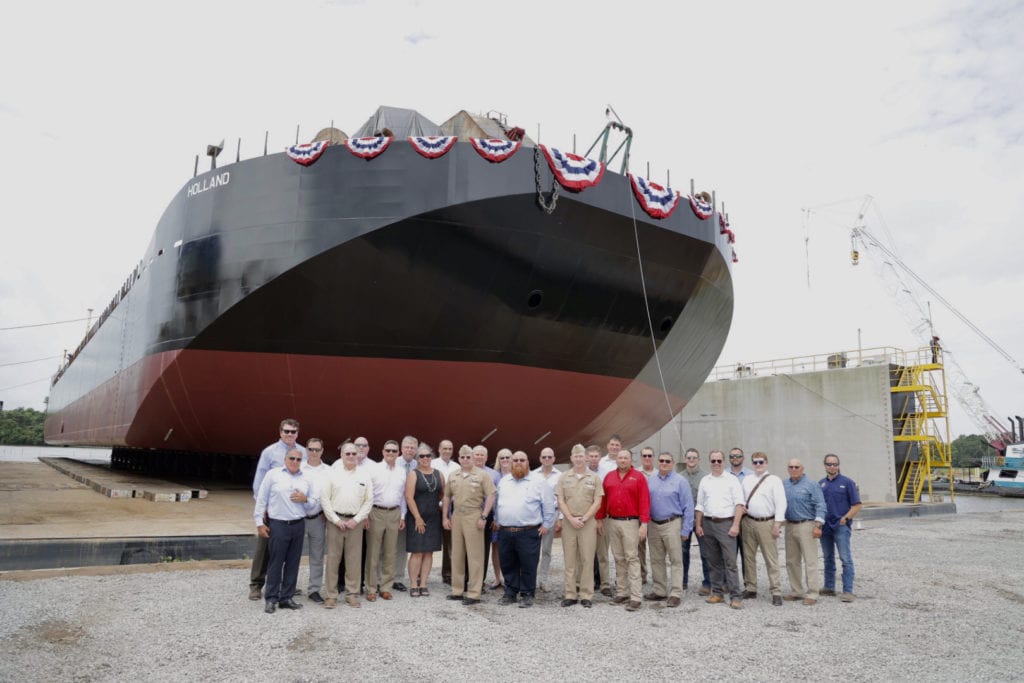
The Holland, a new ocean transport barge for General Dynamics Electric Boat. BOLLINGER SHIPYARDS
LOCKPORT, La. — Bollinger Shipyards LLC on Saturday, July 10, christened the Holland, an ocean transport barge for General Dynamics Electric Boat, Bollinger said in a release.
The Holland will support the construction and maintenance of the United States’ Columbia-class ballistic-missile submarines (SSBNs) and Virginia-class fast attack submarines. General Dynamics Electric Boat is the prime contractor on the design and build of the Columbia-class submarine, which will replace the aging Ohio-class SSBNs.
“Bollinger Shipyards is pleased to partner with General Dynamics Electric Boat to help meet the expanding needs of the United States’ Navy,” said Bollinger President and CEO Ben Bordelon. “We believe that in order to build 21st century American vessels, it requires 21st century American tools and equipment manufactured right here in the United States. The Bollinger management team and our skilled workforce are proud and look forward to continue supporting the efforts to modernize our Nation’s fleet.”
“The men and women of Electric Boat are proud of our long history in providing the world’s finest submarines to our Navy and our Nation,” said Kevin Graney, president, General Dynamics Electric Boat. “The Holland will play an integral role in our mission to design and deliver the Columbia class, the nation’s top strategic defense priority. It embodies the spirit of submarine designer John Holland, whose innovation, determination and commitment to excellence laid the foundation for modern submarine construction. We are thankful for the hard work and dedication of our fellow American shipbuilders at Bollinger that made today, and the continuing defense of our nation possible.”
”The recapitalization of the sea based strategic deterrent capability, the Columbia Class, is our Navy’s highest acquisition priority,” added Capt. Jon Rucker, program manager of the Columbia-class submarine program. “The Holland is an integral enabler in support of the construction and on time delivery of the Columbia Class to maintain the nation’s strategic deterrence capability. We recognize and appreciate the Bollinger team’s efforts to construct and deliver the Holland to support the Navy.”
In November 2019, General Dynamics Electric Boat selected Bollinger to construct the Holland, a 400-foot x 100-foot ocean transport barge. The concept and contract design was performed by the Bristol Harbor Group in Rhode Island, while Bollinger performed the detail design engineering at its Lockport, LA facility and construction at the Bollinger Marine Fabrication facility in Amelia, Louisiana.
Saildrone’s New Surveyor Autonomous Research USV Completes Ocean Crossing from San Francisco to Hawaii
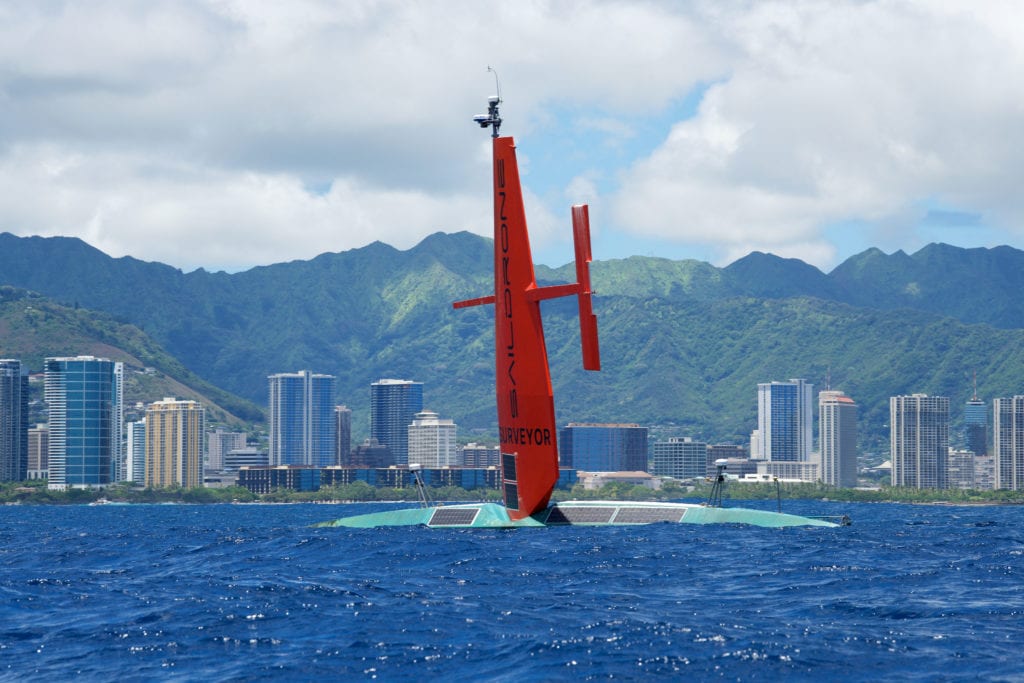
Saildrone’s Surveyor arrived in Hawaii on July 8 after a voyage from San Francisco to Honolulu. SAILDRONE
HONOLULU – The uncrewed, autonomous, Saildrone Surveyor arrived in Hawaii July 8 after a groundbreaking first voyage from San Francisco to Honolulu, Saildrone Inc. said in a release.
While ocean crossings are nothing new for Saildrone’s autonomous surface vehicles, the Saildrone Surveyor is a new, much larger class of vehicle optimized for deep-ocean mapping. During the 28-day voyage, the Saildrone Surveyor sailed 2,250 nautical miles and mapped 6,400 square nautical miles of seafloor.
Using renewable wind and solar energy for its primary power source, the Saildrone Surveyor is the only vehicle in the world capable of long-endurance, uncrewed ocean mapping operations. The valuable data it collects will help address issues impacting our world including climate change, offshore renewable energy, natural resource management, and maritime safety.
Measuring 72 feet long (22 meters) and weighing 14 tons, the Saildrone Surveyor carries a sophisticated array of acoustic instruments, normally carried by large, manned survey ships. The Surveyor’s sensors interrogate the water column looking at underwater ecosystems and map the seafloor in high resolution to a depth of 23,000 feet (7,000 meters).
Multibeam data from the Saildrone Surveyor has been calibrated and assessed by an external team from the University of New Hampshire (UNH), which normally calibrates large government survey vessels. “The data quality from the Surveyor is of very high quality, as good as anything we have seen from a ship,” said Larry Mayer, director for the UNH Center for Coastal and Ocean Mapping. “Due to the wind-powered nature of the vehicle, it is very quiet, and this enables the very accurate acoustic measurements needed to map to these depths.”
The ocean covers more than 70% of the planet, but more than 80% remains unmapped and unexplored. The lack of ocean exploration is largely due to the high cost of access to our oceans, which has traditionally been undertaken by large ships. These ships can cost hundreds of millions of dollars to build and hundreds of thousands of dollars per day to operate. The Saildrone Surveyor represents a paradigm shift in the cost of ocean access, performing the same job as a survey ship but at a fraction of the cost and carbon footprint.
“This successful maiden voyage marks a revolution in our ability to understand our planet,” said Richard Jenkins, Saildrone founder and CEO. “We have solved the challenge of reliable long-range, large-payload remote maritime operations. Offshore survey can now be accomplished without a large ship and crew; this completely changes operational economics for our customers. Based on this achievement, I am excited to apply Saildrone Surveyor technology to other markets normally reserved for large ships, such as homeland security and defense applications. The implications of a low-carbon solution to these critical maritime missions are significant.”
With this successful proof of concept voyage, Saildrone Inc. of California, will now build a fleet of Surveyors to be manufactured at U.S. shipyards. Saildrone intends to map the entire Earth’s oceans in the next 10 years.
Norway’s First P-8A Poseidon Rolls Out with New Livery
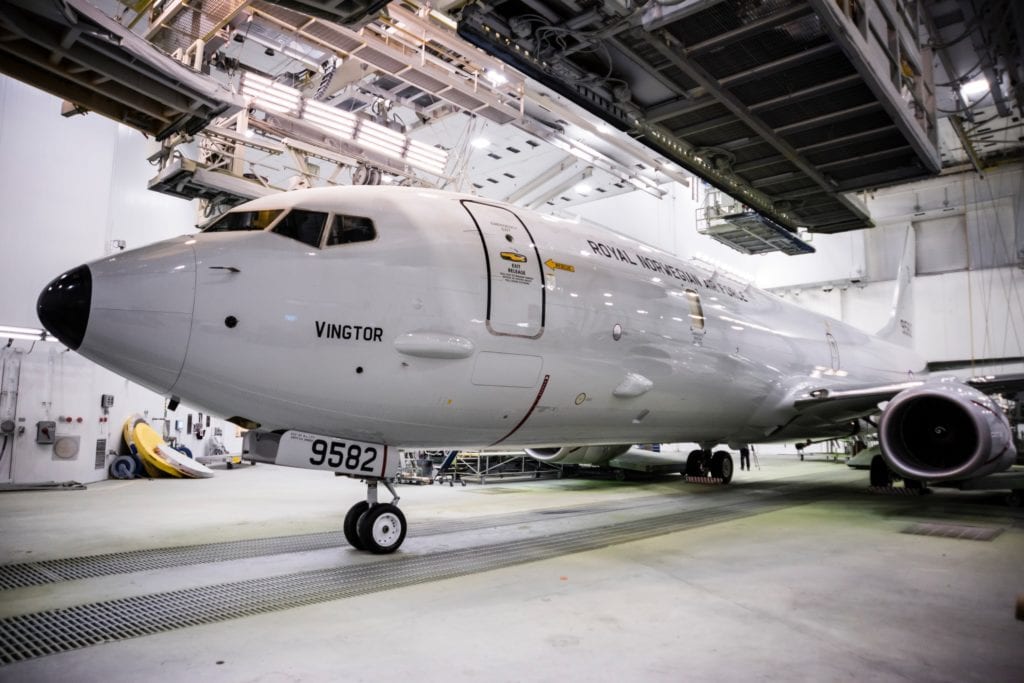
Norway’s first P-8A Poseidon, Vingtor, rolled out of the paint show in Renton, Washington, on July 9. It will return to the factory floor to prepare for flight testing. BOEING
RENTON, Wash. — The first P-8A Poseidon aircraft for Norway today rolled out of the paint shop in Renton, in Royal Norwegian Air Force livery, Boeing said in a July 9 release. Norway is one of eight nations to have acquired the P-8A as their new multi-mission maritime patrol aircraft.
Recently, the air force revealed the names of its five P-8A Poseidon aircraft: Vingtor, Viking, Ulabrand, Hugin and Munin. The names are inspired by Norse mythology and continue a tradition of almost 80 years that started when the names Vingtor, Viking and Ulabrand were used on Norway’s PBY-5 Catalina maritime patrol aircraft in 1942. Since then, other maritime patrol aircraft operated by the Royal Norwegian Air Force have carried those names, including its current P-3 fleet, which will be replaced by the P-8.
Norway’s first P-8A aircraft – Vingtor – will now return to the factory floor to be prepared for flight testing. First flight is scheduled for later this month, and mission systems will be installed on the aircraft after that.
CTF Sentinel Completes Third Joint Exercise in the Arabian Gulf
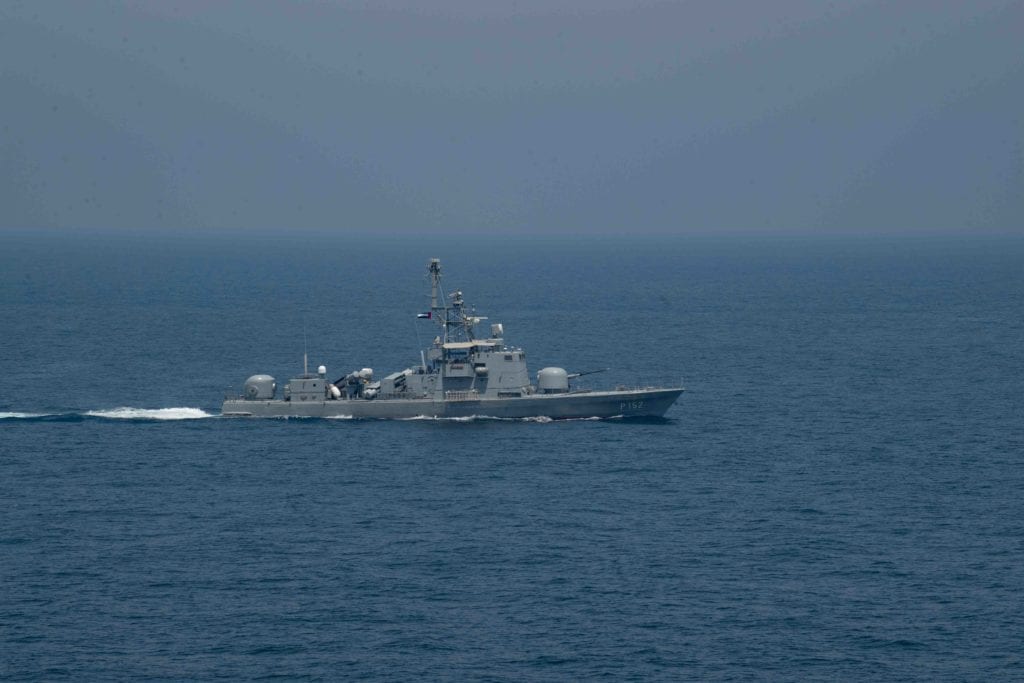
United Arab Emirates Navy missile patrol boat Marban (P 152) operates in formation with guided-missile cruiser USS Monterey (CG 61), not pictured, during a Coalition Task Force (CTF) Sentinel Shield-led interoperability exercise in the Arabian Gulf, June 26. U.S. NAVY / Mass Communication Specialist Seaman Chelsea Palmer
MANAMA, Bahrain — Coalition Task Force (CTF) Sentinel completed its third iteration of combined exercise Sentinel Shield in the Arabian Gulf, showcasing interoperability between coalition warships June 26, the task force spokeswoman said in a July 8 release.
During the exercise, the United Arab Emirates Navy missile patrol boat Marban (P152) and United States Navy guided-missile cruiser USS Monterey (CG 61) conducted synchronized tactical maneuvers while testing communications across systems and platforms with each other and merchant vessels.
“Two of our Gulf Coast Country partners participated in this exercise,” said Commodore Adrian Fryer, Royal Navy, CTF Sentinel commander. “Every engagement helps us promote partnerships, maintain our edge and remain vigilant in upholding the free flow of commerce in the region, and support the global economy.”
Regular training between Sentinel and Sentry patrols throughout the Arabian Gulf is a vital part of the CTF Sentinel mission.
Sentinels are large naval assets, such as frigates and destroyers, which provide overwatch of two critical choke points, the Strait of Hormuz and the Bab el-Mandeb Strait. Sentries are smaller naval vessels, such as patrol craft and corvettes, which patrol key transit areas between the choke points.
Each exercise increases synchronicity between partner nations enabling them to continue deterring state-sponsored malign activity in the region.
“On behalf of the crew of the Marban, it has been an honor to work with the USS Monterey on this mission that has increased our level of coordination which plays an important role at sea,” said United Arab Emirates Lt. Cdr. Saleh Almehrzi, commanding officer of the Marban.
The exercise was successful and we hope there will be many more opportunities to work alongside coalition members in the future to further our partnership.”
U.S. Navy Capt. Joseph Baggett, commanding officer of USS Monterey, highlighted the critical nature of CTF Sentinel’s mission and the importance of continued training exercises with our partners.
“Regional security and stability are directly linked to enhanced cooperation, understanding, and collaboration with key regional partners, like the UAE Navy, and it was an absolute honor to train and learn from our operations with Marban,” said Baggett.
CTF Sentinel is a multinational maritime effort to promote maritime stability, ensure safe passage, and enhance freedom of navigation throughout key waterways in the Arabian Gulf, Strait of Hormuz, the Bab el-Mandeb Strait, and the Gulf of Oman.
Boeing to Support RAF Poseidon Fleet and Train Crews for Next Five Years
Aviation Machinist’s Mate 3rd Class Audulio Garza, assigned to the “Grey Knights” of Patrol Squadron (VP) 46, signals to the pilots of a P-8A Poseidon anti-submarine warfare patrol aircraft, Dec. 14, 2020, in Lossiemouth, Scotland. U.S. NAVY / Mass Communication Specialist 2nd Class Austin Ingram
LOSSIEMOUTH, Scotland — Boeing and the U.K. Ministry of Defence have signed an agreement for Boeing to support the Royal Air Force’s (RAF) fleet of Poseidon MRA1 maritime patrol aircraft and train the crews that operate them, the company announced.
“Our new Poseidon fleet continues to grow from strength to strength and is already defending the U.K.’s maritime interests at home and abroad,” said Defence Secretary Ben Wallace. “This contract with Boeing Defence UK secures our critical submarine-hunting aircraft capabilities whilst also creating a home-grown training enterprise and creating over 150 British jobs.”
Under the aircraft and training support contract, valued at $321.6 million (£233.5 million), Boeing will provide maintenance services, spares and repairs, including tools and ground support equipment, as well as supply chain management, forecasting and inventory management, and airworthiness services for the RAF’s P-8 fleet.
The training element of the contract will offer a suite of training systems and courseware to prepare aircrew and maintainers to safely and effectively operate and maintain the fleet. Boeing will provide the flight instructors to train P-8A pilots, and under the terms of a subcontract, Burgess Hill-based CAE UK will create more jobs in the UK to provide rear crew and engineering instructors, and console operators and controllers who will perform role playing and support functions during training and mission rehearsal exercises.
These agreements will create 150 jobs in the United Kingdom, including more than 100 at RAF Lossiemouth in northern Scotland. Boeing employees are already working alongside RAF personnel at the station in Moray, supporting the current fleet of five Poseidons.
“The P-8A Poseidon brings the RAF critical reconnaissance capabilities, and we are proud to be a trusted partner in helping to keep RAF aircrew trained, and the P-8A mission ready,” said Anna Keeling, managing director of Boeing Defence UK. “We are excited to see our continued growing presence in Scotland with the creation of these highly-skilled jobs, in addition to our existing footprint of more than 2,500 employees across the U.K., reaffirming our commitment to help strengthen the aerospace and defense sector in Scotland.”
The RAF is on contract for nine Poseidon aircraft with five already delivered and the remaining four scheduled for later this year, when around 200 Boeing employees are expected to be based at RAF Lossiemouth focused on maintenance, training and support.
The second of two Operational Flight Trainers, jointly developed by Boeing and CAE for the Poseidon fleet, arrived at RAF Lossiemouth last month. Both will be installed in the Boeing-built Strategic Facility, which accommodates three Poseidon aircraft, squadrons and mission support facilities.
The P-8A Poseidon supports maritime surveillance, anti-submarine warfare and anti-ship warfare for the United Kingdom and increases protection of the country’s nuclear deterrent and Queen Elizabeth class aircraft carriers. More than a dozen U.K.-based suppliers produce components for the P-8, making up five percent of every P-8 aircraft around the world. Marshall Aerospace and Defence Group has built and delivered more than 900 auxiliary fuel tanks from its production facility in Cambridge.
AeroVironment Debuts Crysalis Ground Control System
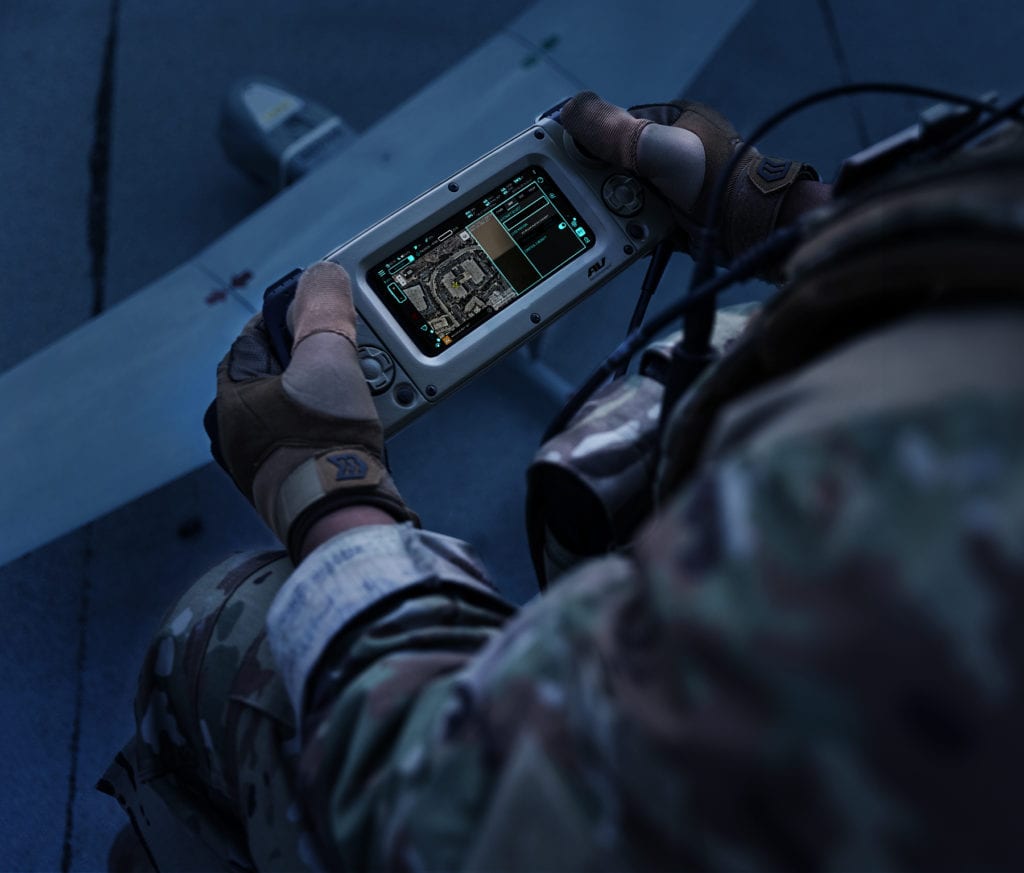
The new Crysalis ground control station, shown here in its Ultralight form. AEROVIRONMENT
Unmanned aircraft maker AeroVironment announced Crysalis, a new flexible, cross-platform ground control system the company says will form the command-and-control basis for all its products going forward.
Company President and CEO Wahid Nawabi and other company officials announced the product in a live video press conference on July 6, saying the goal is to make command and control much simpler for the warfighter and provide a “window” to all the systems they control, eventually including air, ground and maritime equipment.
“With the introduction of Crysalis, we are streamlining command and control of our small UAS and empowering warfighters with actionable intelligence at the speed of war to increase their tactical decision making,” Nawabi said. “Crysalis can be integrated into our portfolio of intelligent, multi-domain robotic systems and deliver easy-to-use, yet powerful new capabilities that enable our customers to succeed in full spectrum operations.”
Crysalis, which the company calls “ground control, simplified,” is built around hardware, software and antennas and comes in four sizes: RVT, or remote video terminal, the smallest, wearable, phone-based system; Ultralight, also wearable, but which adds joysticks and physical controls and is the smallest size that allows full command and control; Tactical, which adds a battery splitter for hot-swapping batteries for longer power life; and Command, a laptop-based variant intended for a fixed or semi-fixed command post location.
It’s cross platform with Windows, Android and Linux, and is flexible in that an Android-powered Crysalis system on a phone could interact with a Windows system on a laptop.
Ease of use is key to reduce “cognitive load” on warfighters, Nawabi said, and the system is designed to put critical information front and center. Size was also a key driver for the system because, as Chief Software Engineer Mark Graybill said, “Weight is about how much ammo you can’t pack.”
Saildrone USVs Set for 7th Arctic Mission
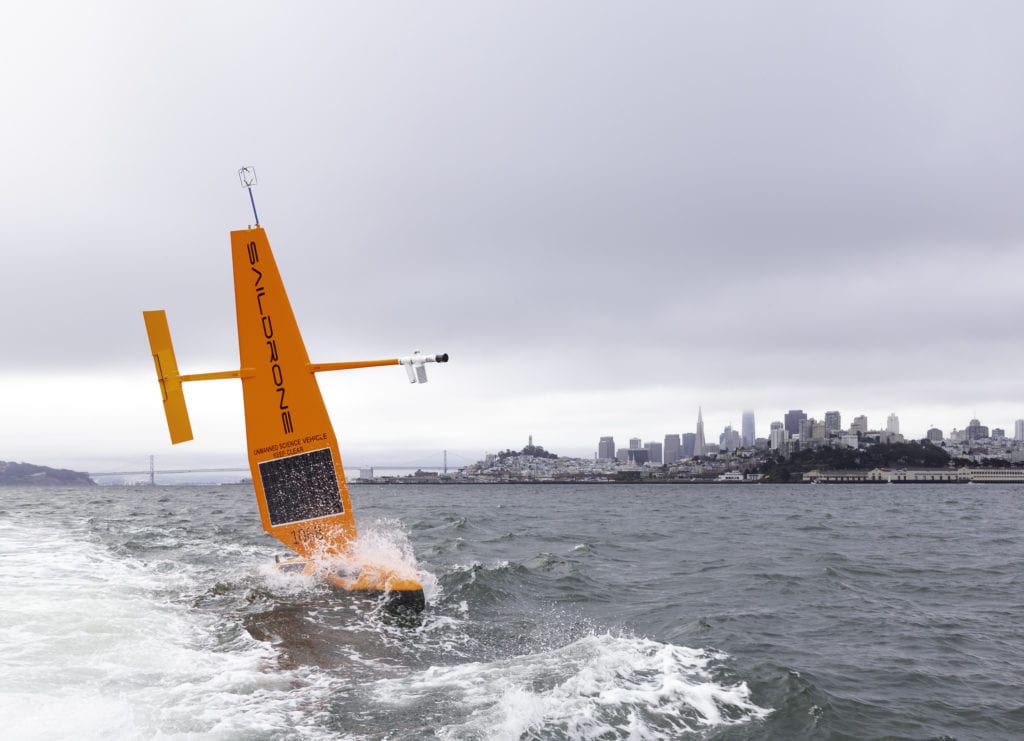
A Saildrone Explorer at work. SAILDRONE
ARLINGTON, Va. — Saildrone is set to conduct an Arctic research mission for the seventh consecutive year with its autonomous unmanned surface vessels (USVs) powered by wind and sun. The company is conducting the missions with six of its smallest USV, the 23-foot-long Explorer.
The six USVs are being launched from Dutch Harbor, a port in the Aleutian Islands. Four will collect data in the Bering Sea and two will collect data in the Chukchi and Beaufort Seas in the Arctic Ocean.
The voyages are being conducted to collect atmospheric, oceanographic and bathymetric data for the National Oceanic and Atmospheric Administration (NOAA) and NASA. The sensors on board the Saildrones will be collecting data on carbon dioxide dissolved in the water; bathymetry; climate and weather — including heat, radiation, carbon and atmospheric variables; wind speed and direction; and radiation and temperatures.
“Every year we have increased our capabilities,” said Rich Jenkins, Saildrone’s CEO, who noted that the Explorer USVs have “incredible reliability.”
For maritime domain awareness, the Explorers also are fitted with 360-degree cameras that record visual information 24/7 using machine learning algorithms to spot anomalies, such as a passing vessel, imaging every five seconds.
“We’ve amassed hundreds of millions of images of the open ocean from the Arctic down to the Southern Ocean,” Jenkins said. “We train the machine-learning model to recognize things visually” such as vessels, icebergs, birds, whales, dolphins, etc.
Data on vessels can be fused with data from the Automatic Information System for increased maritime domain awareness. Saildrone leases the services of Iridium commercial satellites for transmitting data between a USV and a ground station.