Huntington Ingalls Industries Debuts Proteus Unmanned Surface Test Vessel
The Proteus USV, which will be used to develop and test autonomy capabilities. HUNTINGTON INGALLS INDUSTRIES
NEWPORT NEWS, Va. — Huntington Ingalls Industries announced on May 20 the debut of the Proteus unmanned surface vessel (USV) for testing and development of autonomy capabilities. The 27-foot Proteus USV was outfitted with Sea Machines Robotics’ SM300 autonomy system and completed a successful demonstration on May 14 off the coast of Panama City, Florida.
“We are thrilled to launch our Proteus USV. The vessel performed exactly as expected with the SM300 system’s proven and safe autonomous capability,” said Duane Fotheringham, president of the Unmanned Systems business group in HII’s Technical Solutions division. “This marks a significant milestone in our commitment to advancing our unmanned systems capabilities and our continued partnership with Sea Machines to further develop USV solutions for our customers.”
For the demonstration, HII’s Proteus USV was equipped with commercial perception sensors, including GPS, automatic identification system, depth transducer, radar and a camera enabling a 360-degree field of view. HII deployed a separate 51-foot dive boat during the demonstration to illustrate SM300 system’s off-the-shelf solution including its obstacle avoidance capability and adherence to the International Regulations for Preventing Collisions at Sea.
“Our autonomy systems are built around core principles of capability, reliability and ease of use,” said Michael G. Johnson, Sea Machines CEO. “This initial Proteus USV demonstration proved the SM300 system performs as promised, and we look forward to our continued partnership with HII — supporting current and coming 21st century operational requirements on water.”
The Proteus USV will enable HII’s continued development of autonomy capabilities and sensor fusion to support the evolving needs of both government and commercial customers.
HII announced its minority share investment in Sea Machines in July 2020. Sea Machines’ SM300 system can be outfitted to ocean capable vessels to enable scalable autonomy, from remotely controlled to fully autonomous vessel operations.
New SEAL Dry Combat Submersible Set for Operational Test in Late 2021
A prototype Dry Combat Submersible. U.S. NAVY
ARLINGTON, Va. — The U.S. Special Operations Command (SOCOM) will be putting the new Dry Combat Submersible (DCS) Block 1 through testing in preparation for delivery this fall, a senior SOCOM official said, and is laying the groundwork for a DCS-Next version.
James Smith, acquisition executive for SOCOM, speaking with reporters May 17 in a roundtable of the National Defense Industrial Association’s Special Operations Industry Conference, said the first submersible, DCS1, is finishing up Developmental Test and will begin Operational Test this summer.
The 30-ton DCS provides a fully enclosed environment to transport SEAL teams to and from objectives without being exposed to cold and fatigue. The submersible is designed to be operated by a crew of two and to carry eight SEALs. The hull features two topside hatches as well as a lockout chamber. The DCS Block 1 is to operate from surface ships only and not from submarines. DCS1 was delivered in 2019 to begin sea trials.
In July 2016, Lockheed Martin was awarded a $166 million contract to build up to three lithium battery-powered DCSs over five years. The first vessel, DCS1, was delivered in 2019 to begin sea trials.
Smith also said SOCOM is working on “pre-program activities” for DCS-Next, which is planned as a DCS that will be able to operate from submarines, is scheduled for program start in fiscal 2024, but that SOCOM is “working right now to pull that left into ’23.”
Smith also noted that the prototype approach — three prototypes (one leased and two procured) — for DCS Block I would be too expensive for DCS Block II, but that using digital design and engineering would make the program affordable.
Lockheed Martin Offering Greece New Frigates, Based on Freedom-Class LCS
An artist’s representation of the Multi-Mission Surface Combatant tailored for the Greek navy. LOCKHEED MARTIN
The United States and Greece are actively discussing a potential acquisition of four Hellenic Navy Future Frigates (HF2s) from Lockheed Martin, based on the company’s for-export Multi-Mission Surface Combatant (MMSC) and Freedom-class variant of the littoral combat ship (LCS).
Saudi Arabia has ordered four MMSCs and signed a Letter of Intent for four more. The first two are under construction at Fincantieri’s Marinette Marine shipyard in Wisconsin, where the Freedom-class ships are built.
Fabrication for the first MMSC, HMS Saud, began in October 2019. Steel was cut for the second as-yet-unnamed MMSC in January of this year.
“We’ve integrated these capabilities with the Saudi MMSC, focused across those multi-mission warfare areas, and we see the Hellenic Navy asking for similar capabilities to this configuration,” said Lockheed Martin’s LCS program vice president Joe DePietro, who is also responsible for the MMSC and HF2.
According to DePietro, these differences show the tremendous flexibility of the seaframe. “We’re able to achieve that with our COMBATSS 21 combat management system, which is a derivative of our Aegis combat system, found on U.S. and international platforms, which come from the same common source library. We can quickly integrate different or new warfare capabilities from a systems perspective.”
The common combat management system and weapons, with the ability to share information between the platforms allow them to maximize capabilities in many domains.
What LCS does not have but will be common with the RSNF MMSC and HF2 is an eight-cell MK 41 vertical launch system (VLS). However, unique to the HF2 will be three additional single cell VLS tubes, giving it a total of 11 cells. Missiles like the Evolved SeaSparrow Missile or Sea Ceptor common anti-air modular missile – maritime (CAMM) can be quad-packed, giving each cell the ability to have four missiles in any one cell.
To make room for the VLS in the MMSC and HF2, the gun moves forward, which also makes the room for the additional cells.
“The beauty of single cells is that you can place them in multiple areas of the ship. Because of the flexibility of our hull form and the combat management system, we can accommodate those capabilities that our international partners want to include on their ships.”
DePietro said that Lockheed Martin invested in the capability to utilize multiple VLS cells on different platforms, especially for ships that did not have existing space for a full eight-cell system or larger configuration (some Arleigh Burke-class guided missile destroyers have up to 32 cells forward and 64 cells aft).
The Greek ship will have some variations from the basic MMSC design, such as a larger 76mm instead of the 57mm gun. The Saudi ship will have eight canister launchers for Harpoon anti-ship missiles, where the Greek ship may carry the Naval Strike Missile (NSM).
LCS is a focused-mission ship that allocates a significant amount of its volume to the mission packages. About 40 percent of the ship is set up to receive mission packages that can be connected to the ship’s computing environment to become part of the ship’s overall system. “That gives us a lot of flexibility to also integrate a more traditional multi-mission combat system — to include anti-air, anti-submarine and self-defense capabilities,” said DePietro.
For the Freedom-class LCS ships, LCS 1 through 15 carry the MK 31 RAM launcher, while LCS 17 and following ships will have the Sea-RAM installed (all of the Independence-class LCSs already have Sea-RAM). SeaRAM combines the radar and electrooptical system of the Phalanx CIWS Mk-15 Block 1B (CRDC) with an 11-cell RAM launcher to produce an autonomous system—one which does not need any external information to engage threats. The 11-missile SeaRAM will equip the Royal Saudi Navy’s multi-mission surface combat (MMSC) based on the Freedom-class littoral combat ships, but the Hellenic Future Frigate will employ the 21-missile MK 31 system.
“As with the Freedom class LCS, we’ve moved from the TRS 3D to TRS 4D AN/SPS-80 solid state radar with longer detection ranges and accuracy. That, along with the AN/SLQ-32C (V)6 electronic warfare system, gives greater capabilities with regards to the employment of the RAM missile,” said DePietro.
The HF2 will have a robust ASW capability. “We’ve looked at hull-mounted sonars for the MMSC for different customers,” DePietro said. “We believe a variable-depth sonar (VDS) paired with the MH-60R helicopter, which the Hellenic Navy has already bought, will give them a significant capability. We’re also looking at how we can maximize the capabilities of their upgraded MEKO-frigates and HF2s working together. We think the VDS will give them much needed sonar coverage of the areas where they expect to operate. We’re looking at the Thales CAPTAS 2 right now.”
The HF2 is designed to embark and operate multiple UAVs — depending on size — along with a minimum of one MH-60R, although the ship can carry two. The ship’s datalink will allow communication between the ship, the helicopter and whatever UAVs they choose, at the same time.
Like the parent LCS design, the MMSC and HF2 have Rolls-Royce MT30 gas turbines and Fairbanks Morse diesels for propulsion. DePietro said the new ships will benefit from all of the modifications, upgrades and improvements in survivability, as well as the substantial testing and validation from the LCS program since the beginning.
The export variants will have the same steel hull and aluminum superstructure. But, he said, Lockheed Martin also offers flexibility. “We can tailor the ship and the systems to meet the requirements of our customers.”
The four Saudi ships will be built at Marinette, and Lockheed is currently reviewing options to build a number of the HF2 hulls in Greece, providing an opportunity to revitalize the Greek shipbuilding industry’s capability and capacity, and to advance Greek industries.
DePietro sees more export opportunities. “We’re seeing interest from navies, particularly for ships with this Hellenic Navy configuration,” DePietro said. “There are a number of navies who would like to build them locally, in their shipyards. So, we have to go and assess the capability, and understand how that would work from a construction and contracts perspective.”
“We’re looking at the international arrangements with Fincantieri as our partner. Lockheed Martin partners around the globe for design and integration of ship platforms. Together you get a team that knows how to do this.”
Fleet modernization
New ships are needed to modernize the Hellenic navy. The HN currently operates four Hydra-class MEKO 200 frigates, built between 1992 and 1998, and nine Elli-class frigates, formerly Dutch Navy Kortenaer-class frigates, commissioned in the Royal Netherlands Navy between 1978 and 1983, and transferred to Greece between 1993 and 2002. (A total of 10 Kortenaers were acquired, but one has been decommissioned and is currently used for parts.)
While some news reports claim that Greece has made its decision on the Lockheed Martin solution for their new combatant, the actual process is complicated and not yet final.
There are other proposals being offered for consideration. British shipbuilder Babcock, partnered with Thales UK, is proposing its Arrowhead 140 design, based on the future Royal Navy Type 31 frigate (which is itself based on the based on the Danish Navy’s Iver Huitfeldt frigates. Dutch Shipbuilder Damen is reportedly offering its SIGMA 11515 frigate. A French group with Naval Group, Thales and MBDA, is proposing the Frégate de défense et d’intervention (FDI). A German team led by TKMS is proposing its MEKO A200NG or A3000 frigate. Spain’s Navantia is offering its F-110 and Fincantieri is proposing the FREMM, although they are also partnered with Lockheed Martin on the MMSC variant of LCS.
Greece wants more than ships. It wants a partnership that also includes modernization of its shipbuilding capability, upgrading of its four MEKO frigates and other considerations. The MEKO frigate upgrades offer an opportunity for the Hellenic Navy to drive commonality between MEKO frigates and HF2. Under consideration is the use of the AEGIS based COMBATSS-21 combat management system that streamline training pipelines and leveraged existing integrated systems on both ships such as the MH-60R.
“We are very committed to our Navy-to-Navy partnership with Greece,” said U.S. Ambassador Geoffrey R. Pyatt, speaking to reporters in Athens March 4.
Pyatt noted key programs where the U.S. is supporting Greece. “We want to see the Hellenic Navy be as capable as possible because that makes NATO stronger. The MH-60 Romeos are part of that. The P-3 upgrades are part of that. The Mark-5s for the Special Forces are part of that. So, we are already demonstrating our commitment to enhancing Greece’s naval capabilities. The next big step is going to be the frigates. This is a big decision for the Greek state. It’s a sovereign decision that Greece is going to make.”
Formidable Armada Conducts Drills in East China Sea
San Antonio-class amphibious transport dock USS New Orleans (LPD 18), joined by the Royal Australian Navy’s Anzac-class frigate HMAS Parramatta (FFH 154), the French navy’s amphibious assault helicopter carrier FS Tonnerre (L9014), and Japan Maritime Self-Defense Force’s Ōsumi class tank landing ship JS Ōsumi, transit together during exercise Jeanne D’Arc 21 (ARC-21), off the coast of Kagoshima, Japan, May 14, 2021. U.S. MARINE CORPS / Lance Cpl. Justin J. Marty
U.S. and allied navies took part in the multi-national exercise Jeanne D’Arc (ARC) 21 in and around Japan, exercises that began May 11 and wrapped up May 16.
The Sasebo, Japan-based USS New Orleans (LPD 18) joined with the Royal Australian Navy, French armed forces, Japan self-defense forces and other U.S. forces for ARC 21.
“This exercise brings together service members from each nation’s military in a combined effort to enhance interoperability in pursuit of common regional security goals,” said Navy spokesperson Lt. Cmdr. Sherrie Flippin. “Service members from participating units planned, coordinated and conducted operations over land and at sea.”
The 684-foot New Orleans, a San Antonio-class amphibious transport dock assigned to Amphibious Squadron 11, along with elements of the Okinawa-based III Marine Expeditionary Force and the 3rd Marine Logistics Group, have been engaged in amphibious landings and air assaults while also conducting formation maneuvers, air defense exercises and communication drills with the other units in the exercise. MV-22 Osprey tilt rotor aircraft and P-8A Poseidon maritime patrol aircraft also took part.
“On the New Orleans we are prepared to flex our amphibious skills with each of the teams here and strengthen our joint operational capabilities,” Capt. Brian Schrum, New Orleans’ commanding officer, said in the release. “Each event affords us the opportunity to collaborate across staffs developing deeper personal bonds, fostering trust between all our nations and in turn growing as a cohesive naval and Marine force.”
ARC 21 also included the 387-foot Anzac-class frigate HMAS Parramatta (FFH 154) from the Royal Australian Navy, as well as the French navy’s 653-foot Mistral-class LHD FS Tonnerre (L9014) and 410-foor La Fayette-class Frigate FS Surcouf (F 711).
Participating ships from the Japanese Maritime Self Defense Force included the 646-foot Hyūga-class helicopter destroyer JS Ise (DDH-182); 528-foot Kongō-class guided missile destroyer JS Kongō (DDG-173); 541-foot Atago-class guided missile destroyer JS Ashigara (DDG-178); 495-foot Asahi-class ASW destroyer JS Asahi (DD-119); 584-foot Ōsumi-class landing ship tank JS Ōsumi (LST 4001); and a pair of 164-foot Hayabusa-class patrol boats, JS Ōtaka (PG-826) and JS Shirataka (PG-829); along with other host nation air and ground forces.
The field training portion of the exercise began at the JSDF Kirishima maneuver area with a combat engineer subject matter expertise exchange, casualty evacuation and combat service support training, and simulated fire support coordination training between Japan Air Self Defense Forces and U.S. military personnel.
“This exercise, by bringing together our air, land, and maritime forces to increase our ability to jointly respond to crises across the range of military operations, is yet another demonstration of our rapidly growing constellation of partners, all united by the common goal of a free and open Indo-Pacific,” said Lt. Col. Jeremy Nelson, commander of the 3rd Landing Support Battalion. “It is commonly said that we train alongside our partners and allies in peace to be ready to fight alongside them in war, and exercises like ARC-21 are the best example of this.”
Forward deployed to Okinawa, Japan, the 3rd Marine Logistics Group provides responsive combat logistics support to III Marine Expeditionary Force and other Marine units within the U.S. 7th Fleet area of operations through expeditionary means, forward basing and global sourcing during exercises and contingency operations.
Nelson, who was also the commander of the Marine Forces in the exercise, said the U.S. Marines were represented by an Air Naval Gunfire Liaison Company, an Explosive Ordnance Disposal unit and a reconnaissance team detachment.
The culminating events included surveillance and insertion of forces via JSDF CH-47 Chinook helicopters from Tonnerre, followed by a helicopter-borne assault via U.S. Marine Corps MV-22 Ospreys from USS New Orleans, Flippin said.
Flippin said the exercise was conducted in adherence to strict COVID mitigation measures to protect participating forces as well as local communities.
Capabilities and Limitations
Speaking to reporters, Schrum and Nelson commented on the amount of effort involved in the staff planning process for exercises like ARC 21.
Nelson said the staff planning process is a way to understand the capabilities and limitations of the participating units, and how each of the forces conducts their planning — including who they bring to the table, and why.
“We were able to familiarize ourselves with tactics, techniques and procedures — how they conduct themselves on patrolling and in urban combat, how they use their own gear, equipment and communications and how they use their weapon systems,” Nelson said.
Schrum said communications is a key attribute to “achieving interoperability with partners and allies, and understanding their capabilities and what they can bring to the fight, and how we can all work together to achieve a common goal.”
Schrum noted one of the more interesting events in the exercise involved the approaches and dockings by Japanese LCACs (landing craft air cushion) in the well deck of the New Orleans.
“To see another county’s ship-to-shore connector come into our well deck and land was an amazing thing for our crew in the well deck, as well as our junior officers and watchstanders. They got a chance to see what it’s like to work with partners and allies here in this region.”
Nelson said there was a lot more commonality than differences among the different units. “They had very good gear and they take care of it,” he said. “They’re very disciplined, perform to standard and are eager to train. We worked through bad weather; the common understood COVID mitigation measures; and the language barrier, and were still able — through deliberate planning — execute a safe exercise that everyone mutually benefited from.
“Sharing experiences, tactics and best practices makes us all better. Anytime you train together, you’re better together,” Nelson said.
ARC21 is the first large-scale joint exercise involving the U.S. and France on Japanese soil, and is taking place at a time of growing Chinese assertiveness in the region.
Japanese Defense Minister Nobuo Kishi said the exercise is a way to deepen defense cooperation with the U.S. and “like-minded countries” that shares Japan’s vision of “a free and open Indo-Pacific.”
Defender-Europe 21 Exercise Tests Ability to Move Military Might Overseas
A stevedore at the Port of Jacksonville drives a military vehicle onto the U.S. Navy’s Military Sealift Command’s USNS Bob Hope March 26, 2021. The vessel was bound for the Defender-Europe 21 linked exercise. U.S. ARMY / Kimberly Spinner
A major U.S.-led multi-national exercise in Europe is testing America’s ability to move troops, cargo and vehicles overseas to support NATO and partner nations.
Defender-Europe is an annual, large-scale U.S. Army Europe and Africa-led, multinational, joint exercise designed to build strategic and operational readiness and interoperability between U.S., NATO allies and partners. Defender-Europe 21 activities began in March in the U.S. and across Europe and will continue into June.
Movement of vehicles from the Military Sealift Command large medium speed roll-on/roll-off (LMSR) USNS Bob Hope (T-AKR-300) are taking place this week in Albania.
“Defender-Europe 21 is a critical exercise that will provide V Corps with another great opportunity to build readiness in our march towards full operational capability, and promote interoperability as we work alongside allies and partners,” said Lt. Gen. John Kolasheski, V Corps commanding general. “We are looking forward to this chance to work closely with U.S. Army Europe and Africa and demonstrate U.S. resolve and commitment to Europe.”
Exercise Defender-Europe 21 will include “nearly simultaneous operations across more than 30 training areas” in a dozen countries.
While the exercise is a U.S.-led training event, it involves more than 30,000 multinational military personnel from 27 nations, along with 10,000 U.S. personnel including rotational forces from the continental U.S. About 10 percent are members of the National Guard or Army Reserve.
Last year’s exercise, Defender-Europe 20, was scaled back due to COVID restrictions, and while the pandemic does have an impact on this year’s events, with all activities being conducted in accordance with COVID 19 protocols, there are more NATO ally and partner nations conducting activities over a wider area than what was planned for last year.
A strict COVID prevention and mitigation strategy has been implemented by U.S. and participating nations. U.S.-based personnel will conduct pre-deployment COVID testing, quarantine in Europe upon arrival and conduct another COVID test before travelling in theater.
“While we are closely monitoring the COVID situation, we’ve proven we have the capability to train safely despite the pandemic. No matter what, our nations count on our forces being ready to defend the peace,” said Gen. Christopher Cavoli, U.S. Army Europe and Africa commanding general.
Cavoli said exercises like Defender-Europe 21 are essential to building readiness and or interoperability. “Defender-Europe 21 provides us the best opportunity to hone our abilities alongside our allies and partners in the strategically important Balkans and Black Sea region so that collectively, we are ready to respond to any crisis that may arise,” he said.
Ships and aircraft began movement of people and equipment from the continental U.S. in March, and Army prepositioned stock sites in Germany, Italy and the Netherlands began to moving supplies and equipment into position to support the training activities.
Seaports in five European countries — Albania, Croatia, Germany, Greece and Slovenia — were used to send or receive more than 1,200 pieces of equipment to or from the continental United States as part of the exercise.
Besides USNS Bob Hope, the expeditionary fast transport USNS Yuma (T-EPF 8) is also participating in the exercise, transporting cargo from USNS Bob Hope to other locations.
Journey from Jacksonville
For the U.S. Army’s 7th Transportation Brigade–Expeditionary, and the Military Surface Deployment and Distribution Command’s (SDDC) 841st Transportation Battalion, the loadout began at the Port of Jacksonville’s Blount Island Marine Terminal March 25-26, with the loading about 750 pieces of tactical vehicles and other equipment of the 53d Infantry Combat Team onto the Bob Hope.
Bob Hope is the first ship in a class of seven 62,000-ton, 951-foot vehicle cargo ships. It was built at Avondale Shipyard in Louisiana and entered service in 1998. The ships supports the U.S. Army storing and transporting supplies, tanks, trucks and other vehicles to equip an Army brigade. It is one of 11 T-AKRs operated by the Military Sealift Command with civil service mariner or contract crews. The ship is one of the 15 ships assigned to the Surge Sealift program, which are ships held in a reduced operational status until activated for missions.
“The support of Jaxport and its skilled labor force ensures that we have the right tools to carry out our mission seamlessly from start to finish,” said Lt. Col. Altwan Whitfield, Commander, 841st Transportation Battalion. “The most challenging part of a deployment operation is ensuring the synchronization of all of the elements, it is not a one-person show — it’s a team effort.”
With its key highway and rail connections, Jacksonville is designated as one of the nation’s 17 strategic seaports to move U.S. military cargo for national defense, foreign humanitarian aid and disaster relief.
“One of Jaxport’s most important roles is serving the community as one of the military’s strategic seaports,” Jaxport Chairman Jamie Shelton said. “By investing in our facilities and maintaining a world-class port, we ensure that we can continue to support our service members and the important work they do to protect our national security.”
“Supporting Defender-Europe 21 is a great opportunity,” said Maj. Mark Huey, 841st Transportation Battalion terminal management team officer in charge at Jacksonville. “The mission integrates units from the Reserve, National Guard and active duty, then also units on the naval side. We really get to exercise our full functionality.”
From Jacksonville, Bob Hope sailed to Portsmouth, Virginia, and loaded more equipment for the exercise before sailing for Durres, Albania, including an Army causeway section, warping tugs and other lighterage needed to move equipment from ships at anchor to shore.
The deployment of Bob Hope and the embarked equipment provided an opportunity to demonstrate the Joint Logistics Over the Shore (JLOTS) concept.
According to “JLOTS Vision 2010,” JLOTS is a unified commander’s joint employment of joint employment of Army and Navy LOTS assets to Army and Navy LOTS assets to deploy and deploy and sustain a force sustain a force. JLOTS operations allow U.S. strategic sealift strategic sealift ships to discharge over a bare, inadequate or damaged port, or over a bare beach. JLOTS watercraft can also be used to beach.
While Navy amphibious ships routinely deploy with Landing Craft, Air Cushion (LCACs), the Army gave up its air-cushioned watercraft about 35 years ago, and the Navy’s LCAC inventory cannot self-deploy or be lifted onboard existing sealift ships.
According to a news release from the 7th Transportation Brigade, “JLOTS operations are part of U.S. Transportation Command’s strategic sealift mission. The process allows combined Army and Navy forces to move equipment to and from a ship on air-cushioned watercraft to overcome anti-access and area-denial challenges while improving the ability to move forces closer to tactical assembly areas. JLOTS missions are unique in that they allow for an entire brigade-sized element to be moved on and off a ship with an improvised port infrastructure, providing flexibility to choose load locations such as a bare beach, austere port, or a damaged or fixed port.”
“It doesn’t require ramps, it doesn’t require anything other than the causeway, which can be assembled organically from the vessel. The ramp is able to lower onto the causeway and then equipment can begin to [roll-on/roll-off] expeditiously and be pushed ashore,” said Chief Warrant Officer 2 Jordan Milo, 841st Transportation Battalion mobility warrant officer and Defender-Europe 21 operations officer in charge at the Port of Portsmouth.
“Any limiting factors that would have existed from not having an improved infrastructure port, or if the depth of the water wouldn’t allow for the vessel to come in, that’s where these JLOTS operations allow us to project power ashore where we need it,” said Milo.
U.S. Soldiers unload a truck from the U.S. Army Logistic Support Vessel MG Charles P. Gross during Defender-Europe 21 Joint Logistics Over-the-Shore operations, May 1, 2021 in Durres, Albania. U.S. ARMY / Staff Sgt. Elizabeth Bryson
JLOTS Albania
The JLOTS capability was showcased at Durres, Albania, this week when USNS Bob Hope discharged its cargo of heavy equipment onto smaller vessels that was transferred to shore for onward movement, including USNS Yuma and the British roll on/roll off vessel Hurst Point, which delivered equipment from the U.K.’s 104th Logistic Support Brigade to Gazenica in Zadar, Croatia.
“As part of Defender-Europe 2021, we are transferring up to 1,000 vehicles for the 53rd Infantry Brigade Combat Team who, will arrive in Albania in the coming days, said Capt. James Hilton, the U.S. senior defense official/defense attache/security cooperation officer to Albania. He told attendees at a VIP event to witness the exercise port operations that JLOTS is a multi-step process.
“First, the vehicles are loaded onto a large, medium speed roll on/roll off vessel [LMSR] in the United States. That ship sails across the ocean in advance of the troops. Upon arrival, the vehicles must be transferred from the ship to the shore. In some ports, the LMSR pulls up to the pier and discharges the vehicles directly. However, a secure port is never guaranteed, so crews must practice an alternative method of offloading.
“Because the USNS Bob Hope is too large to enter the port of Durres, U.S. Army and Navy Soldiers and Sailors work together to construct a roll on/roll off to discharge facility that is connected to the LMSR a few miles away from here. Vehicles are then loaded onto smaller ships called logistic support vessels which transport the vehicles the final miles to the pier here. Additional ships from the United States and the United Kingdom will transfer vehicles to other Adriatic ports in support of Defender-Europe 2021.”
According to exercise officials, this was the first time this capability had been demonstrated since World War II. U.S. Ambassador to Albania Yuri Kim said Defender-Europe 21 was the largest ever multi-national military exercise in southeast Europe, and is taking place on the 30th anniversary of the reestablishment of U.S. Albanian relations.
Pentagon Press Secretary John F. Kirby said the exercise is building operational readiness and interoperability between NATO allies and partners. “It’s defensive in nature, focused on deterring aggression, while preparing our forces to respond to crisis and conduct large-scale combat operations if necessary.”
“When a crisis begins is not the time to wish America had the expeditionary capability and capacity to support power projection requirements of the Army and Marine Corps,” said retired Rear Adm. Sinclair Harris, Navy League national vice president of military affairs and chair of the Maritime Policy Committee.
“Not everything that is needed can be flown and America’s military has the unique and asymmetric advantage of being able to put what we need, where we need it, and when we need it. Be it for humanitarian operations or combat ops, ships like the USNS Bob Hope and systems such as JLOTS provide game changing options for our combatant commanders.”
The exercise will conclude in June with the redeployment of U.S.-based forces and equipment back home.
F-35B Jets to Join the Fight Against Daesh from the U.K. Carrier Strike Group
Lt. Col. Andrew D’Ambrogi, the commanding officer of Marine Fighter Attack Squadron (VMFA) 211, Carrier Strike Group (CSG) 21 “The Wake Island Avengers,” conducts carrier qualifications in an F-35B Joint Strike Fighter Lightning II aboard the Royal Navy aircraft carrier HMS Queen Elizabeth (R08) at sea, May 2, 2021. Alongside the Royal Navy 617 Squadron, VMFA-211 will form part of the largest carrier air group in the world. This deployment highlights the global reach of the U.S. and U.K. armed forces and their interoperability, and enhances the deterrence and defense capabilities of the NATO Alliance. U.S. MARINE CORPS photo by 1st Lt. Zachary Bodner
LONDON — U.K. F-35B fighter jets operating from HMS Queen Elizabeth will join Operation Shader in the fight against Daesh, the U.K Ministry of Defense said in a May 4 release.
F-35B Lightning II jets will be the cutting edge of the Carrier Strike Group’s (CSG21) formidable power in the air. These are next-generation, multi-role combat aircraft equipped with advanced sensors, mission systems and stealth technology, enabling them to carry out intelligence, surveillance and reconnaissance tasks.
This will be the first time U.K. fighter aircraft are embarked on an operational aircraft carrier deployment since 2010 and will be the largest number of F-35Bs ever to sail the seas. The embarked aircraft also include 10 F-35Bs of a U.S. Marine Corps squadron, Marine Fighter Attack Squadron 211.
The renowned 617 Squadron RAF (The Dambusters) will operate the jets to provide tangible and impactful support to counter-Daesh operations in Iraq and Syria. Daesh is another name for the Islamic State, or ISIS.
“The F-35B Lightning jets will pack a potent punch against Daesh and help prevent them from regaining a foothold in Iraq,” said James Heappey MP, minister for the Armed Forces. “This is a prime example of the U.K. armed forces stepping forward with our allies to confront persistent threats around the world. It is global Britain in action.”
CSG21, led by HMS Queen Elizabeth, is the largest concentration of maritime and air power to leave the U.K. in a generation and will set sail next month on its first operational deployment. This is a joint Royal Air Force and Royal Navy deployment which is committed to confronting persistent threats around the world and make a meaningful contribution to global security.
The F-35B Lightning jets, which will operate from HMS Queen Elizabeth throughout the deployment, will make a significant contribution in degrading Daesh.
“This deployment represents the embodiment of the UK’s Joint Expeditionary Capability and utilizing the F-35Bs in the fight against Daesh will further demonstrate our commitment to securing their global defeat,” said Chief of Joint Operations Vice Adm. Sir Ben Key.
March 2021 saw the second anniversary of Daesh’s final and total loss of territory in Syria. However, there remain significant numbers of Daesh terrorists in Iraq and Syria. The United Kingdom remains committed to defeating Daesh and enhancing security in the region, alongside the Iraqi Security Forces and our NATO allies. Operation Shader is the United Kingdom’s contribution to the Global Coalition against Daesh.
India Approved for Six More P-8 Maritime Patrol Aircraft
U.S. Navy, Indian navy, and Royal Australian Air Force P-8 Poseidons are staged at Joint Base Pearl Harbor-Hickam for Rim of the Pacific (RIMPAC) exercise 2018. U.S. NAVY / Mass Communication Specialist 1st Class Kevin A. Flinn
WASHINGTON — The State Department has approved a possible Foreign Military Sale to the government of India of P-8I patrol aircraft and related equipment for an estimated cost of $2.42 billion, the Defense Security Cooperation Agency said in an April 30 release.
India has requested six P-8I Patrol aircraft, including mission systems, support equipment and spares; publications; repair and return; transportation; aircraft ferry; training; U.S. government and contractor engineering, software, technical, and logistics support services; and other related elements of logistical and program support.
The Indian navy procured eight P-8I aircraft from Boeing in January 2009, via direct commercial sale, and contracted for an additional four aircraft in July 2016. The first P-8I aircraft were delivered to the Indian navy in 2013, providing interoperability and critical capabilities to coalition maritime operations. This proposed sale of an additional six P-8I aircraft will allow the Indian navy to expand its maritime surveillance aircraft capability for the next 30 years.
The prime contractor will be the Boeing Co., Seattle, Washington.
Logos Successfully Tests WAMI Sensor on RQ-21A Blackjack UAV
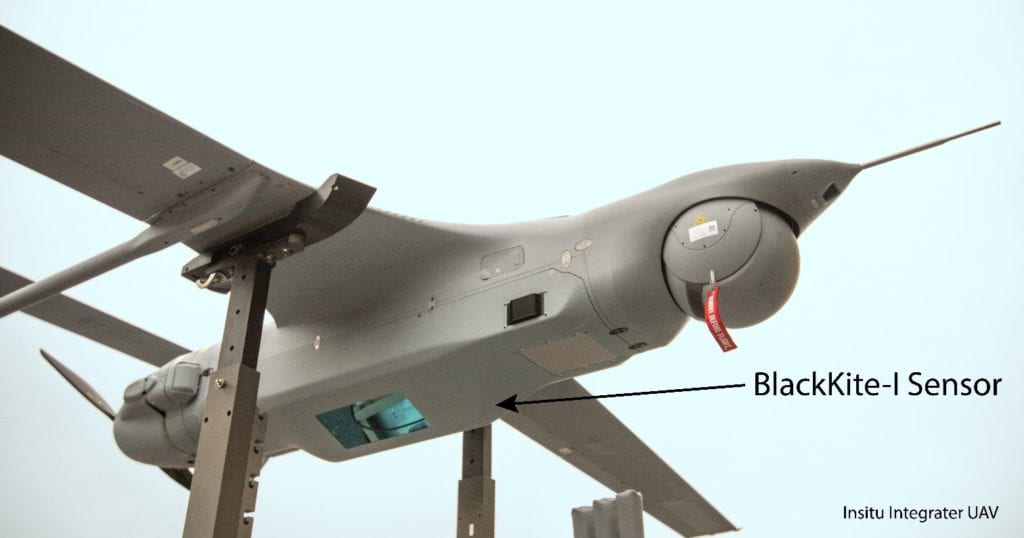
Logos Technologies LLC’s BlackKite-I sensor, shown mounted on an Insitu Integrator unmanned aircraft. LOGOS TECHNOLOGIES LLC
FAIRFAX, Va. – Logos Technologies LLC has successfully flown its wide-area motion imagery (WAMI) sensor aboard an RQ-21A Blackjack unmanned aircraft at a test range in Boardman, Oregon, the company said in a release.
The two-week-long test — which included preparatory groundwork in Bingen, Washington — comes on the heels of a $5.3 million contract the U.S. Naval Air Systems Command had recently awarded to Logos, to develop more WAMI sensors for Navy and Marine users.
“We are very excited by our recent test aboard the RQ-21A Blackjack,” said Doug Rombough, vice president for Business Development at Logos Technologies. “Our ongoing effort to develop an ultra-light WAMI capability for the Blackjack and other small, tactical unmanned aircraft is clearly paying off.”
Logos has created a U.S. military version of BlackKite, currently called Cardcounter, an ultra-light (26 pounds) infrared WAMI system developed by Logos. Despite its low SWaP, BlackKite can detect and track in real time every significant target moving within a city-sized area, giving tactical operators a powerful, hereto unheard of, capability.
In addition, thanks to the WAMI system’s multi-modal edge processor — which can store six or more hours of mission data — users on the ground can also access recorded imagery for on-the-fly forensic analysis.
“No military in the world has anything like the Logos WAMI sensor on their tactical unmanned aircraft,” said Rombough. “This WAMI system views and records the entire area and can stream multiple real-time and recorded video ‘chip-outs’ down to handheld devices.”
Logos was first tasked with converting their BlackKite system to meet government requirements in September 2019, with two units being produced for the U.S. Naval Air Systems Command. The follow-on $5.3 million development contract and March test flight are part of the same effort.
“In total, we will be producing four modular WAMI systems for the Navy,” Rombough said, “with the hope that this will open the door for a wider U.S. military adoption of WAMI, both for the Blackjack and other Group 3 unmanned aircraft.”
ONR Global Launches Second Round of ‘Global-X’ Challenge Focused on Polar Science
Office of Naval Research Global graphic.
LONDON, U.K. — The Office of Naval Research (ONR) Global, in its sustained mission to become the partner of choice for the worldwide international Science and Technology (S&T) community, will launch the second round of Global-X, a nine-month international science challenge worth up to $500,000, to encourage groundbreaking research from all around the world, the office said in an April 26 release.
The decision comes after a successful 2020 inaugural Global-X Challenge that selected four winning teams with members from Australia, Denmark, Spain, Switzerland, the United Kingdom and the United States. These teams are now preparing for innovative concept demonstrations later this year.
The purpose of the Global-X Challenge is to discover, disrupt, and ultimately provide a catalyst through basic and applied research for later development and delivery of revolutionary capabilities to the U.S. Navy and Marine Corps, the commercial marketplace, and the public.
ONR Global is interested in receiving white papers and proposals on the following challenge topics:
Alternate Navigation at High Latitude
High Latitude High Bandwidth Communications
Persistent Polar Perception
Researchers from academia and industry may participate. ONR Global expects, but does not require, that multi-national teams will consist of at least two research entities outside of the U.S., whether from academia, industry and/or the broad research community. Researchers from U.S. research entities may also participate, but are not required.
“We expect a new round of revolutionary ideas from the brightest international researchers. Alongside an evaluation panel of experts from participant nations of the International Cooperative Engagement Program for Polar Research (ICE-PPR), we are interested in finding promising concepts that achieve innovative capability advances with both military and commercial value, specifically focused in polar science,” said ONR Global Executive Officer Capt. Matt Farr.
Live Webinar launch
The Global-X Challenge will officially launch during a kick-off webinar set for April 29 at 7 a.m. Eastern Daylight Time (EDT). Interested applicants can register for and view the webinar at the following link: https://goto.webcasts.com/starthere.jsp?ei=1456602&tp_key=b2ae9e815d
Applicants can also ask questions during the webinar, which will be recorded and posted to a public Global-X website for subsequent review. Furthermore, more information on the challenge statements, important dates, official guidelines and Frequently Asked Questions (FAQ) can be found on the Global-X website: https://www.onr.navy.mil/Global-X
“We want to build on our previous success and attract the best polar research-focused scientists worldwide. We live in an era where this specific scientific discipline is key for our fleet, and trying to find the best collaborative solutions will help solve present and future U.S. Navy and Marine Corps technology needs,” said ONR Global Technical Director Dr. Rhett Jefferies.
Significant Dates and Times
White Paper Submission Date: May 28, 2021, by 11:59 p.m. EDT
Notification of White Paper Valuation: June 11, 2021, by 5 p.m. EDT
Full Proposal Submission: July 9, 2021, by 11:59 p.m. EDT
Notification of Selection: Full Proposals: July 30, 2021, by 5 p.m. EDT
Grant Awards: Sept. 24, 2021, by 5 p.m. EDT
Defence Ministry Unveils Plan for Maiden Deployment of Queen Elizabeth Carrier
Royal navy aircraft carrier HMS Queen Elizabeth (R08) transits the Atlantic Ocean in 2019. HNLMS De Ruyter
LONDON — The U.K. Ministry of Defence (MoD) has made public details of the first deployment for its new aircraft carrier, scheduled to begin next month, according to an April 27 MoD announcement.
The carrier strike group, led by HMS Queen Elizabeth, will sail for the Indo-Pacific in May in the largest concentration of British air and maritime power in years, the ministry said on Monday.
The strike group will include the Daring-class destroyers, Defender and Diamond; Norfolk-class frigates, Kent and Richmond; an Astute-class attack submarine; and the support ships Fort Victoria and Tidespring.
In addition, the Dutch frigate Evertsen and U.S. destroyer The Sullivans will accompany the carrier group.
For her maiden deployment, the Queen Elizabeth will carry eight Royal Air Force F-35B Lightning II fighters and a squadron of 10 U.S. Marine Corps F-35Bs; four AW159 Wildcat maritime attack helicopters; seven Merlin Mk 2 anti-submarine; and three Merlin Mk 4 commando helicopters.
A company of Royal Marine Commandos will also participate in the mission.
The carrier strike group is scheduled to visit more than 40 countries and conduct more than 70 engagements, including dual carrier operations with French aircraft carrier Charles de Gaulle in the Mediterranean, the defense ministry said.
Engagements are scheduled with India, Japan, Singapore and South Korea. The strike group will also take part in Exercise Bersama Lima to mark the 50th anniversary of the five-powers agreement with Malaysia, Singapore, Australia and New Zealand.