L3Harris to Design Long-Endurance Autonomous Surface Ship Concept for DARPA
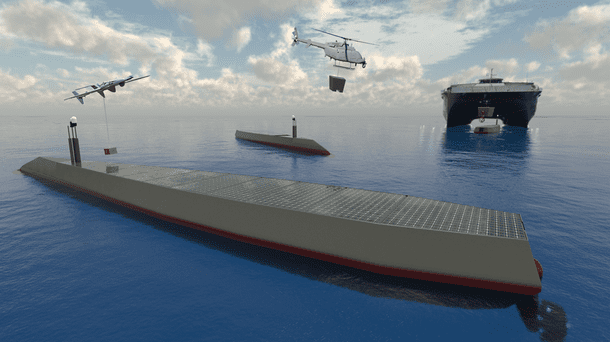
L3Harris was chosen for phase one of the two-phase No Manning Required Ship (NOMARS) program. The L3Harris design concept will streamline NOMARS’ construction, logistics, operations and maintenance life-cycle. L3Harris
MELBOURNE, Fla.— L3Harris Technologies has been selected to design an autonomous surface ship concept for the U.S. Defense Advanced Research Projects Agency (DARPA) to demonstrate the reliability and feasibility of an unmanned ship performing lengthy missions, the company said in a March 2 release.
L3Harris was chosen for phase one of the two-phase No Manning Required Ship (NOMARS) program. The L3Harris design concept will streamline NOMARS’ construction, logistics, operations and maintenance life cycle. The company teamed with VARD Marine to validate the concept and design of the architecture and hull, mechanical and electrical systems.
The L3Harris design features an advanced operating system that can make decisions and determine actions on its own, without direct human interaction. This concept optimizes autonomous surface ship operations to support the U.S. Navy’s future missions.
“L3Harris continues to pioneer innovative autonomous solutions that offer fully automated and integrated ship control and preventative maintenance systems to the U.S. Navy and its allies,” said Sean Stackley, president, Integrated Mission Systems, L3Harris. “The NOMARS program selection reinforces our commitment to deliver highly reliable and affordable autonomous solutions that transform the way the U.S. Navy conducts its future missions.”
L3Harris is a world leader in unmanned surface vehicle (USV) systems, with over 125 USVs and optionally manned vehicles delivered. The company’s USVs are actively serving U.S and international navies, universities, research institutions and commercial businesses.
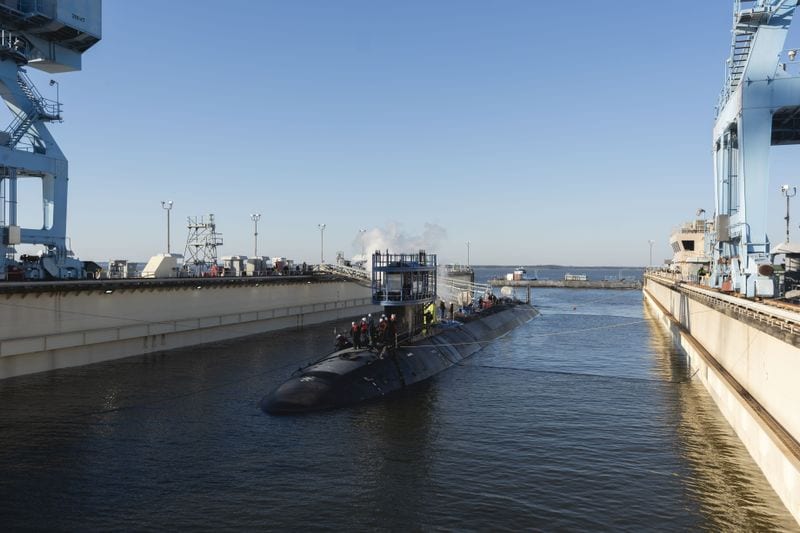
Newport News Shipbuilding division recently reached a significant construction milestone by successfully launching the Virginia-class submarine Montana (SSN 794). The ship was christened on Sept. 12, 2020, and is scheduled to be delivered to the U.S. Navy in late 2021. HII / Matt Hildreth
NEWPORT NEWS, Va. — Huntington Ingalls Industries launched the Virginia-class submarine Montana (SSN 794) into the James River at the company’s Newport News Shipbuilding division on March 3, the company announced in a release.
The 7,800-ton submarine, which had been in a floating dry dock since being transferred from a construction facility in October, was submerged and moved by tugboats to the shipyard’s submarine pier, for final outfitting, testing and crew certification.
“For our shipbuilders, launching Montana signifies five years of hard work, commitment and dedicated service,” said Jason Ward, Newport News’ vice president of Virginia-class submarine construction. “We look forward to executing our waterborne test program and working toward sea trials and delivering the submarine to the Navy later this year.”
Through the teaming agreement with General Dynamics Electric Boat, approximately 10,000 shipbuilders, as well as suppliers from all 50 states, have participated in Montana’s construction since the work began in 2015. Montana is approximately 92% complete and scheduled to be delivered to the U.S. Navy in late 2021.
Virginia-class submarines, a class of nuclear-powered fast attack submarines, are built for a broad spectrum of open ocean and littoral missions to replace the Navy’s Los Angeles-class submarines as they are retired. Virginia-class submarines incorporate dozens of new technologies and innovations that increase firepower, maneuverability and stealth and significantly enhance their warfighting capabilities. These submarines are capable of supporting multiple mission areas and can operate at submerged speeds of more than 25 knots for months at a time.
NOAA Begins Transition Exclusively to Electronic Navigation Charts
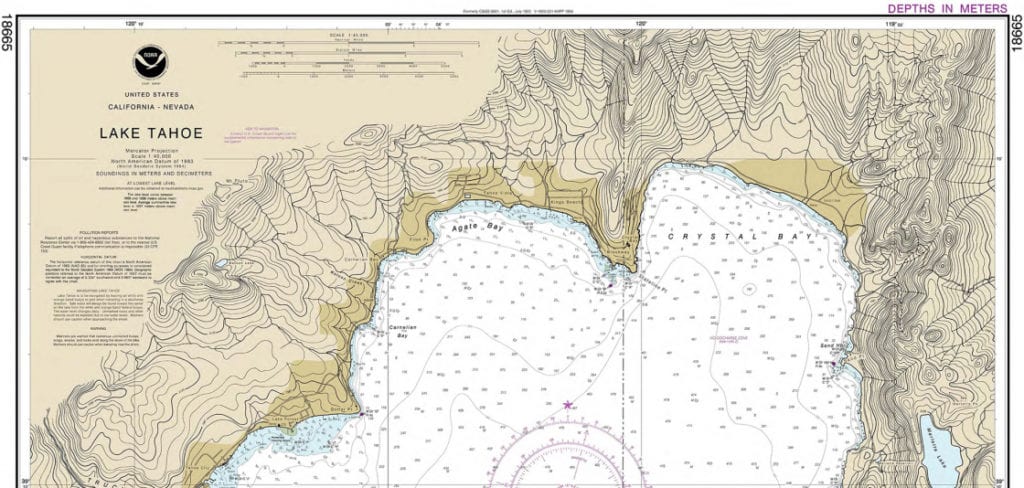
A paper chart of Lake Tahoe, the first paper chart to be entirely replaced with electronic navigational charts. NOAA
WASHINGTON — NOAA will begin to implement its sunset plan for paper nautical charts this month, starting with the current paper chart 18665 of Lake Tahoe, the agency announced in a Feb. 26 release. After August, NOAA’s electronic navigational chart will be the only NOAA nautical chart of the area.
This is the first traditional paper chart to be fully supplanted by an electronic chart as part of NOAA’s Office of Coast Survey Raster Sunset Plan, which includes a new process to notify mariners of the transition of individual paper charts to electronic charts. These charts are easier to update and maintain, keeping mariners safer with up-to-date information on marine hazards.
As part of the sunset plan, released in 2019, mariners will be officially notified of this chart’s cancellation in the U.S. Coast Guard Local Notice to Mariners. A note in the lower left corner of the chart will state that it is the last paper edition and it will be canceled six months later on August 26.
NOAA will continue to announce the cancellation of additional paper charts as the sunset plan progresses, initially based on volume of sales or downloads, and in regions with improved NOAA electronic navigational chart coverage. Cancellation of all traditional paper and associated raster chart products will be completed by January 2025.
NOAA announced the start of a five-year process to end traditional paper nautical chart production in late 2019 via a Federal Register Notice. While NOAA is sunsetting its traditional nautical chart products, it is undertaking a major effort to improve the data consistency and provide larger scale coverage within its electronic navigational chart product suite.
Over the next four years, NOAA will work to ease the transition to electronic products by providing access to paper chart products based on electronic data. The online NOAA Custom Chart tool enables users to create their own paper and PDF charts from the latest NOAA ENC data.
Boeing Loyal Wingman Uncrewed Aircraft Completes First Flight
Boeing Australia and the Royal Australian Air Force have successfully completed the first test flight of the Loyal Wingman uncrewed aircraft. Boeing
AUSTRALIA — Boeing Australia and the Royal Australian Air Force (RAAF) have successfully completed the first test flight of the Loyal Wingman uncrewed aircraft, the company said in a March 1 release.
The flight of the first military aircraft to be designed and manufactured in Australia in more than 50 years flew under the supervision of a Boeing test pilot monitoring the aircraft from a ground control station at the Woomera Range Complex.
“The Loyal Wingman’s first flight is a major step in this long-term, significant project for the Air Force and Boeing Australia, and we’re thrilled to be a part of the successful test,” said Air Vice-Marshal Cath Roberts, RAAF head of Air Force Capability. “The Loyal Wingman project is a pathfinder for the integration of autonomous systems and artificial intelligence to create smart human-machine teams.
“Through this project we are learning how to integrate these new capabilities to complement and extend air combat and other missions,” she said.
Following a series of taxi tests validating ground handling, navigation and control, and pilot interface, the aircraft completed a successful takeoff under its own power before flying a pre-determined route at different speeds and altitudes to verify flight functionality and demonstrate the performance of the Airpower Teaming System design.
“Boeing and Australia are pioneering fully integrated combat operations by crewed and uncrewed aircraft,” said Boeing Defense, Space & Security President and CEO Leanne Caret. “We’re honored to be opening this part of aviation’s future with the Royal Australian Air Force, and we look forward to showing others how they also could benefit from our loyal wingman capabilities.”
With support from more than 35 Australian industry teams and leveraging Boeing’s innovative processes, including model-based engineering techniques, such as a digital twin to digitally flight-test missions, the team was able to manufacture the aircraft from design to flight in three years.
This first Loyal Wingman aircraft is serving as the foundation for the Boeing Airpower Teaming System being developed for various global defense customers. The aircraft will fly alongside other platforms, using artificial intelligence to team with existing crewed and uncrewed assets to complement mission capabilities.
Additional Loyal Wingman aircraft are currently under development, with plans for teaming flights scheduled for later this year.
Fairbanks Morse Delivers Four Common Rail Technology Engines for ESB 6
Fairbanks Morse recently delivered four engines to General Dynamics NASSCO for use on the future expeditionary sea base ship USS John L. Canley (ESB 6). Show in this 2020 photo is ESB USS Hershel “Woody” Williams (ESB 4). U.S. Navy/ Mass Communication Specialist Seaman Apprentice Conner Foy
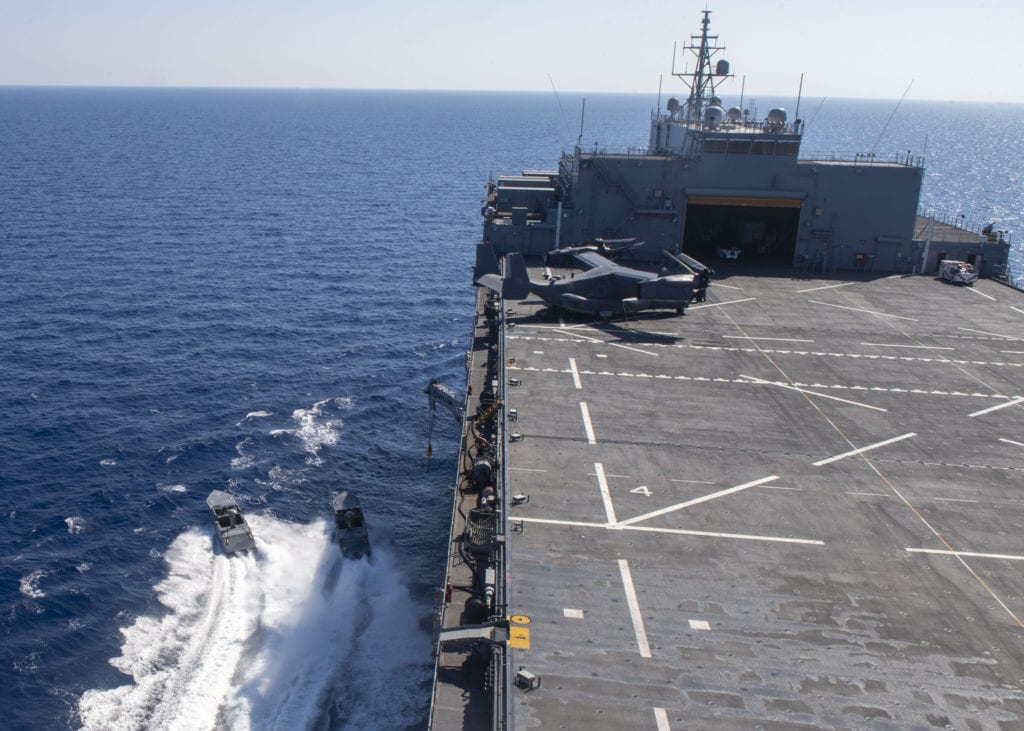
BELOIT, Wis. — Fairbanks Morse, a portfolio company of Arcline Investment Management, recently delivered four FM 6L48/60CR engines to General Dynamics NASSCO in San Diego for Military Sealift Command on the future expeditionary sea base ship USS John L. Canley (ESB 6).
The ship is the sixth in the U.S. Navy’s Military Sealift Command Expeditionary Transfer Dock (ESD)/Expeditionary Sea Base (ESB) program and is designed to serve as a mobile sea base that provides access to critical infrastructure for the deployment of forces and supplies.
“We are proud to once again deliver American-made power and propulsion systems that support critical operations for the U.S. Navy’s global missions,” said George Whittier, Fairbanks Morse’s CEO. “Our common rail technology solution is one of the most fuel-efficient and reliable maritime power solutions available and will generate significant cost savings for the U.S. Navy over the operational lifetime of the engines.”
The four FM 6L48/60CR engines are rated at 6,480 kW and will deliver a total of 25,920 kW of installed power. The engines use common rail technology to deliver high fuel efficiency throughout the ships’ operational conditions. Common rail technology uses a high-pressure header, high-pressure pumps, electronically controlled fuel delivery, electronic governing system and an advanced control system to deliver precise amounts of fuel throughout all engine operations. This results in improved performance increased fuel efficiency and lower emissions.
ESB class ships are used for a wide range of military operations and may support multiple operational phases. Among these are Airborne Mine Counter Measures (AMCM), counter-piracy operations, maritime security operations, humanitarian aid and disaster relief missions, and U.S. Marine Corps crisis response.
ESB 6 honors Marine Corp Sergeant Major (retired) John L. Canley, a Medal of Honor Recipient for his actions serving during the Battle of Hue City in Vietnam Jan. 31 – Feb. 6, 1968. The Medal of Honor is the nation’s highest military honor.
General Dynamics NASSCO started construction on ESB 6 in June 2020 and is also contracted to build ESB 7. Fairbanks Morse will begin construction on engines for ESB 7 later this year.
Fairbanks Morse has served the U.S. Navy for more than 70 years, providing high-quality engines for marine propulsion and ship service systems. Today, Fairbanks Morse engines are installed on approximately 80% of U.S. Navy ships with a medium speed application.
DoD Adds Two Mark VI Patrol Boats to Ukraine Aid Package
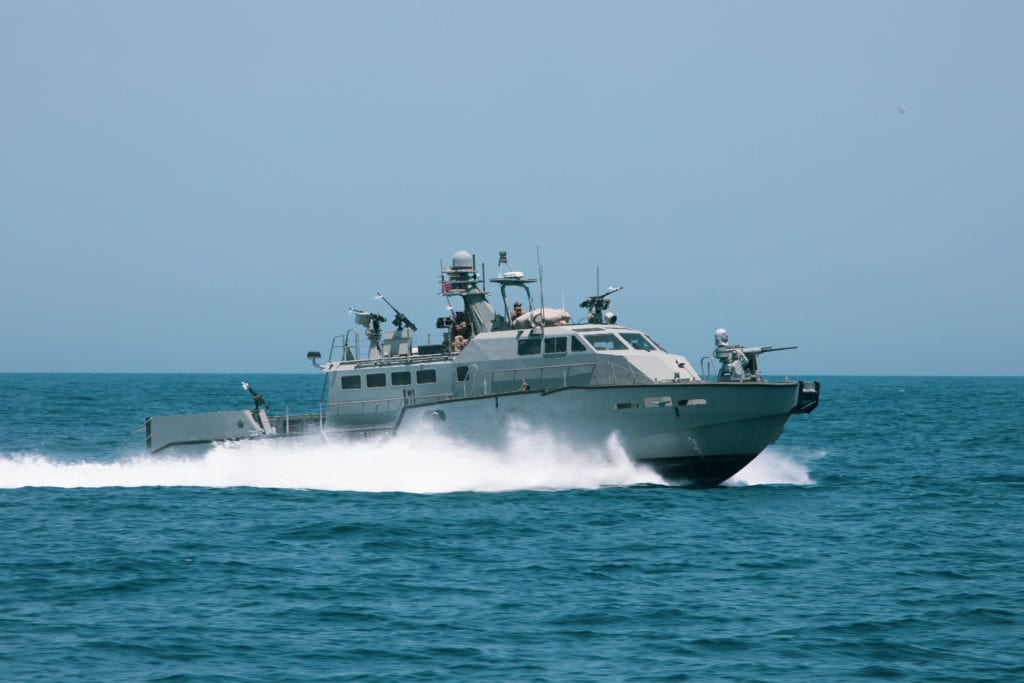
A Mark VI patrol boat, shown here in the Arabian Gulf in March 2020. U.S. Army / Pfc. Christopher Cameron
ARLINGTON, Va. — The Department of Defense has added two more modern patrol boats for Ukraine in a new security assistance package.
“The Department of Defense announces a new $125 million package for the Ukraine Security Assistance Initiative that includes training, equipment, and advisory efforts to help Ukraine’s forces preserve the country’s territorial integrity, secure its borders, and improve interoperability with NATO, the department said in a March 1 release. “This action reaffirms the U.S. commitment to providing defensive lethal weapons to enable Ukraine to more effectively defend itself against Russian aggression.
“The USAI package includes two additional armed Mark VI patrol boats to enhance Ukraine’s capacity to patrol and defend its territorial waters,” the release said. “To date, the U.S. has committed a total of eight Mark VI patrol boats.”
The Mark VI boats are being built by SAFE Boats International LLC of Bremerton. Washington.
The U.S. State Department has approved the possible foreign military sale of up to 16 Mark VI patrol boats and related equipment to Ukraine for an estimated cost of $600 million, the Defense Security Cooperation Agency (DSCA) said in a June 17, 2020, release.
The patrol boats will be operated by the Ukrainian navy to defend territorial waters and other maritime interests. They each will be armed with two MSI Seahawk A2 gun systems and two Mk44 cannons and equipped with electro-optical/infrared sensors and loud-speaker systems.
The sale will “improve Ukraine’s capability to meet current and future threats by providing a modern, fast, short-range vessel,” the DSCA said.
Mark VI patrol boats are used by the Navy Expeditionary Combat Command for escort of high-value ships, coastal patrol, and other maritime security missions.
AeroVironment Completes Acquisition of Arcturus UAV
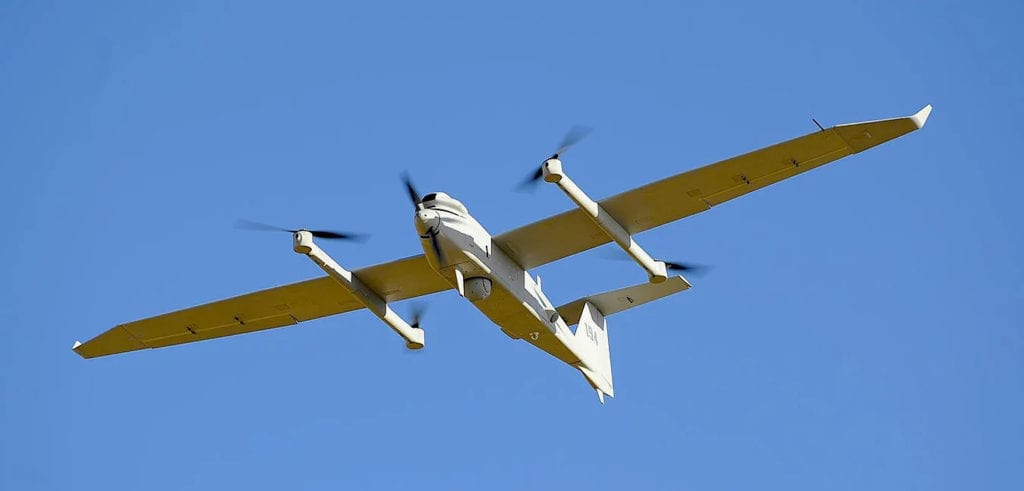
Arcturus UAV’s Jump 20 VTOL drone. Arcturus UAV
SIMI VALLEY, Calif. — AeroVironment Inc. has completed its acquisition of Arcturus UAV Inc.,a designer and manufacturer of high-performance unmanned aircraft systems (UAS). The approximately $405 million transaction was previously announced in a press release on Jan. 13.
The United States Special Operations Command (USSOCOM) selected Arcturus UAV as one of six companies qualified for the potential $975 million indefinite-delivery/indefinite-quantity MEUAS IV [Medium-Endurance UAS IV] contract in June 2020. The contract enables awardees to compete for site-specific task orders and provide USSOCOM with unmanned aircraft systems services and support for intelligence, surveillance and reconnaissance (ISR) operations.
Arcturus UAV employs its vertical takeoff and landing Jump 20 UAS in support of USSOCOM operations, minimizing the logistical footprint of UAS operations while delivering multi-payload, multi-mission capabilities. Arcturus UAV is also one of four awardees selected for funded development and demonstrations supporting the U.S. Army’s FTUAS [Future Tactical UAS] program, a potential billion-dollar, next-generation UAS program.
“Like AeroVironment, the Arcturus UAV team is laser-focused on supporting its customers around the world with the most reliable and effective products and services for their missions,” said Wahid Nawabi, president and CEO of AeroVironment. “As we welcome the Arcturus UAV team to AeroVironment, we commit to maintaining or exceeding the high level of service our existing and new customers experience. The Jump 20 and T-20 platforms, combined with associated ISR services, represent a significant expansion to AeroVironment’s portfolio of intelligent, multi-domain robotic systems that will enhance long-term shareholder value and help our customers around the world proceed with certainty.”
AeroVironment completed the acquisition of Arcturus UAV on Feb. 19, resulting in Arcturus UAV becoming a wholly owned subsidiary operating under the AeroVironment brand.
Taking COVID into account, NATO presses on with ambitious ASW exercise in Mediterranean
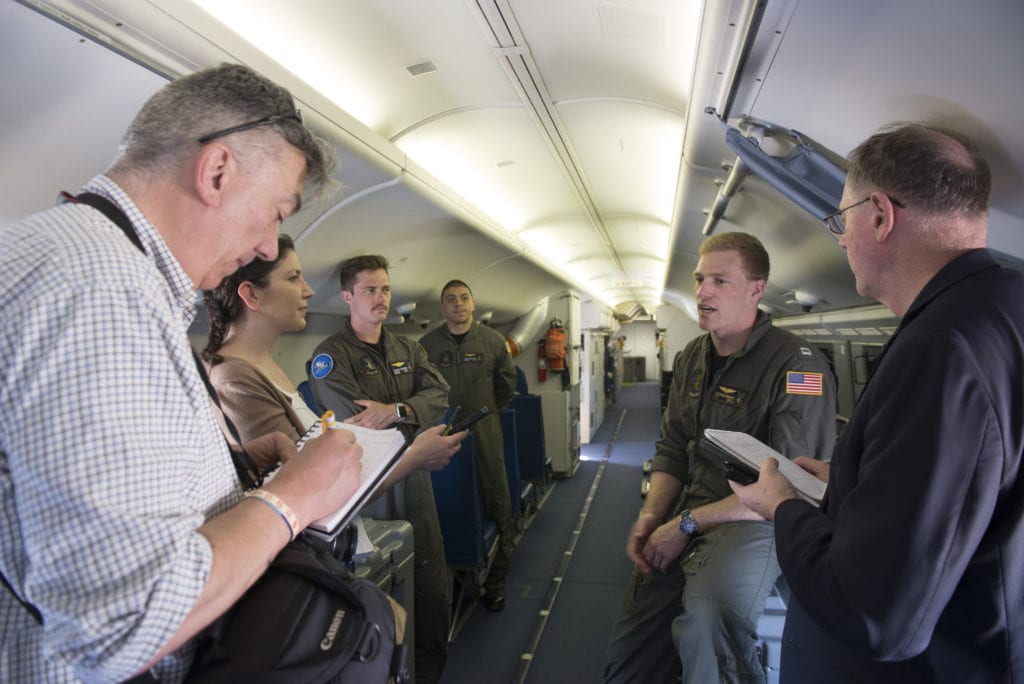
Lt. Stefan Knight, a naval flight officer assigned to Patrol Squadron (VP) 4, speaks to the press about VP-4’s involvement in Dynamic Manta 2020, Feb. 25, 2020. Dynamic Manta is an annual exercise hosted by NATO’s Allied Maritime Command to provide training in anti-submarine warfare and anti-surface warfare in order to enhance overall multi-lateral operations among NATO allies. U.S. Navy / Mass Communication Specialist 2nd Class Juan Sua
NATO will exercise its anti-submarine warfare and anti-surface warfare capabilities of allied naval units from Feb. 22 to March 5 during Exercise Dynamic Manta in the central Mediterranean.
Dynamic Manta 2021 includes five surface combatants with their organic helicopters from France, Greece, Italy, Spain and Turkey; six submarines from France, Germany, Italy, Turkey and the U.S.; five land-based maritime patrol aircraft from France, Germany, Greece, Italy and the U.S.; and the French Navy’s Charles De Gaulle Carrier Strike Group, with escorts from France, Germany, Greece and the U.S.
Spanish navy Rear Adm. Manuel Aguirre Aldereguía, commander of Standing NATO Maritime Group Two (SNMG 2), is the on-scene commander of Exercise Dynamic Manta.
Last year, Dynamic Manta 2020 began just as the global pandemic was gripping Italy and the world. This year, the exercise was planned and is being executed with all the precautions and health regulations to keep people safe.
According to Frenchnavy Vice Adm. Didier Piaton, deputy commander of NATO Allied Maritime Command, Dynamic Manta in the Mediterranean is one of two major anti-submarine warfare exercises held each year, along with Dynamic Mongoose in the high North Sea.
“Like all MARCOM exercises, this one will demonstrate NATO’s willingness and capacity of keeping resilience and readiness, and to maintain the security of our allied nations,” Piaton said.
This year, the French navy’s Charles DeGaulle carrier strike group will join for training for a limited time, and will enhance its own ASW skills on its way to its operational deployment. This interaction is an opportunity for NATO and allied units to train together to enhance interoperability and build expertise.
The Italian navy is hosting the exercise in waters near the Sicilian city of Catania, not far from the naval air station at Sigonella. Rear Adm.Andrea Petroni, commander of the Italian navy’s submarine service, said the central Mediterranean and its location on the southern flank of Europe represents a realistic and valuable training opportunity.
“It’s important to participate in this kind of advanced International training activity to exchange knowledge and share lessons learned in order to increase the operational capabilities and professional development of the crews,” Petroni said.
Aldereguía said COVID-19 was a new factor in exercise planning process. Procedures were instituted to prepare the units of SNMG 2 so the task group can maintain its high degree of readiness while taking care of the health and well-being of the crews and staff members.
“We are in a COVID-limited environment, “said U.S. Navy Rear Adm. E. Andrew Burcher, Commander Submarines, NATO, and exercise director. “A year ago, we became aware of the virus just as Dynamic Manta 2020 was starting. We had to make adjustments as we went. We were able to hold Dynamic Mongoose 2020 later in the summer. And we’re going ahead and conducting this exercise, with no material impact on the operation or the exercise. It shows how well the NATO Alliance and the countries have adapted to this new reality and travel-restricted environment. We’re doing the best we can under the circumstances, and that’s a testament to how great this organization is.”
While NATO is technically able to complete the exercise and have a productive training experience, Burcher said the pandemic has precluded a lot of personal interaction compared to previous years.
“What’s lost are the personal connections that make the alliance stronger,” he said. “Our center of gravity of NATO is alliance cohesion, and the reason alliance cohesion exits is because of the friendships and partnerships exist when we meet personally on ships and shake hands with each other.”
Burcher said there are other differences between the 2020 and 2021 event. Although NATO’s Science and Technology Organization Center for Maritime Research and Experimentation (CMRE) will not join the ships at sea with its research ship, the Alliance, and its group of unmanned vehicles as they did in 2020, CMRE will still be involved this year. “We will be utilizing CMRE for technical analysis capability to improve our training as well as our understanding of the operating environment,” Burcher said.
“Most importantly, we’re going to have the benefit of having the Charles de Gaulle carrier strike group go through the exercise area,” Burcher said. “This is an important and unique opportunity for both the submarines and the surface ships to engage in a high threat environment. The submarine will be looking at how they prosecute a high-value unit as it transits in a typical transit scenario, while at the same time the CSG will be able to proceed through a submarine-dense environment and practice their ASW skills. That is a unique opportunity. We are taking advantage of integrating the schedules of national operations with NATO operations.
“Even in the COVID environment we are advancing and moving forward with our ASW skills,” Burcher said.
Cubic to Deliver P5 Combat Training System for the F-35
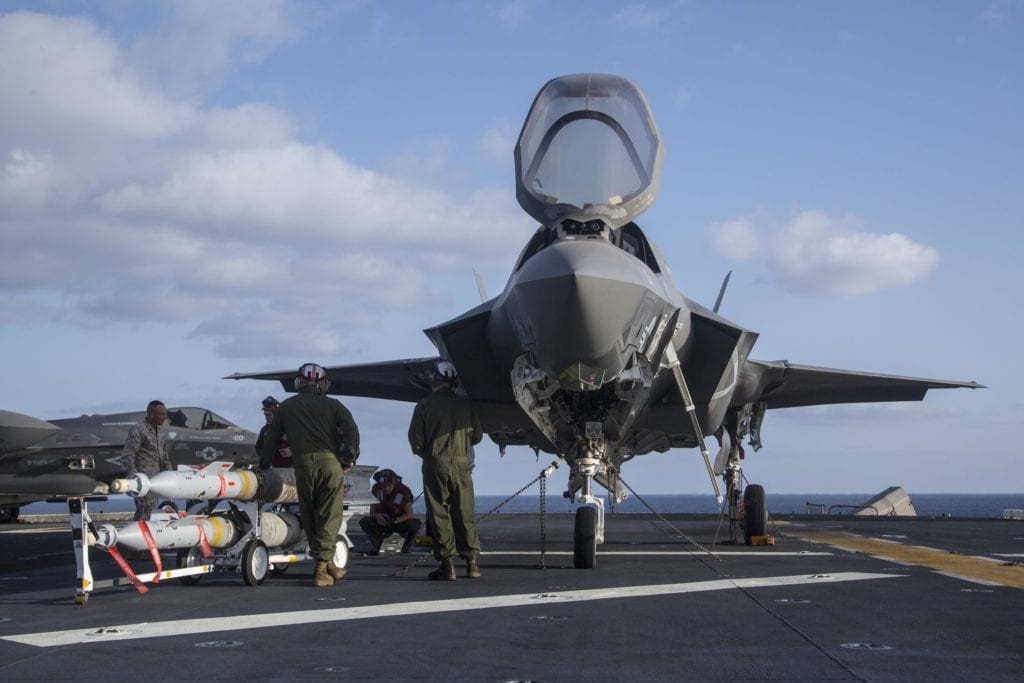
U.S. Marines with Marine Fighter Attack Squadron 211, 13th Marine Expeditionary Unit (MEU), guide ordnance toward an F-35B Lightning II aboard the Wasp-class amphibious assault ship USS Essex (LHD 2), Sept. 22, 2018. Cubic Mission and Performance Solutions will provide two more production lots of the P5 Combat Training System for the F-35. U.S. Marine Corps / Cpl. Francisco J. Diaz Jr.
SAN DIEGO —Cubic Mission and Performance Solutions (CMPS) business division was awarded a contract worth $32 million from Lockheed Martin for two more production lots of the P5 Combat Training System (P5CTS) for the F-35 Lightning II, Cubic announced in a Feb. 19 release.
Under the contract, Cubic will deliver over 150 training subsystems for Lockheed Martin’s F-35 Air Combat Maneuvering Instrumentation (ACMI) system. This new order increases the total number of F-35 P5 on contract to over 1,150 and ensures fielding of F-35 P5 out to 2025.
Unlike traditional P5 podded solutions for fourth-generation fighter aircraft, the F-35 P5 is an internal subsystem configuration that relays time, space and position information between participating aircraft and range ground stations during training sorties.
“Our advanced and interoperable P5CTS is used on more than 30 ranges worldwide and continues to set the standard for joint, multiservice and coalition training,” said Mike Knowles, president of Cubic Mission and Performance Solutions. “Training for today’s advanced threats to air combat operations requires adaptable, high-fidelity training tools. Cubic’s P5CTS provides secure and scalable instrumentation solutions that enable integrated fourth- and fifth-generation training for our U.S. forces, allies and partners.”
The worldwide P5 infrastructure includes the integration of P5 pods and internal subsystems, ground stations and software, and is an investment shared by 17 countries. A recent upgrade to this training infrastructure is the integration of decryptors in the P5 ground stations to enable F-35 live monitoring at training ranges.
Cubic and its principal subcontractor, Leonardo DRS, will continue to produce and maintain the F-35 P5 internal subsystem. The Leonardo DRS Airborne and Intelligence Systems business division is responsible for the design and production of the airborne P5CTS Internal Subsystem.
State Dept. Approves Possible Sale of RAM Block 2 Missiles for Egyptian Navy
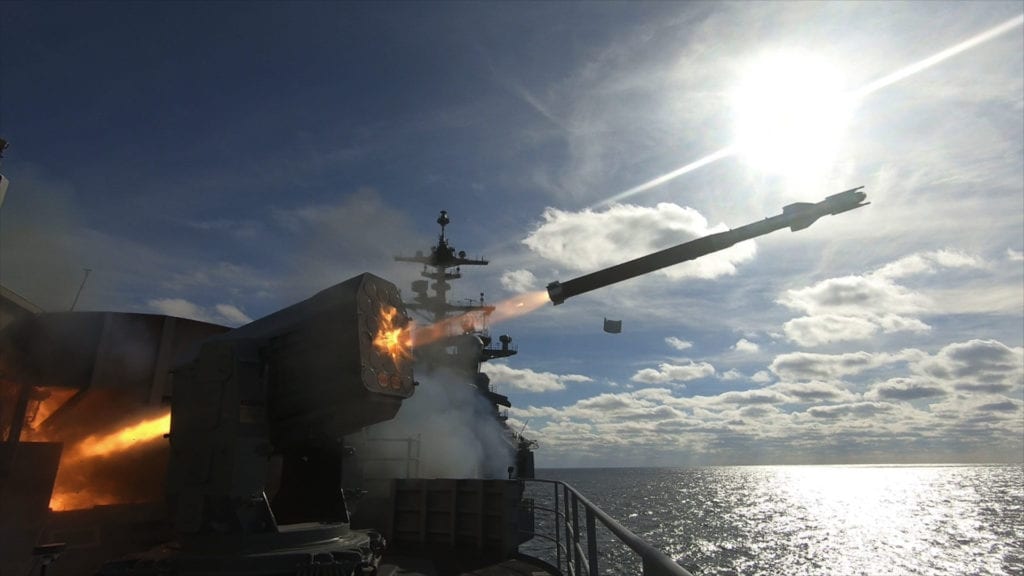
The Nimitz-class aircraft carrier USS Abraham Lincoln (CVN 72) launches a Rolling Airframe Missile (RAM) during combat system ship qualification trials in this 2018 photo. U.S. Navy photo
WASHINGTON—The U.S. State Department has approved a possible Foreign Military Sale to the government of Egypt of Rolling Airframe Missile (RAM) Block 2 tactical missiles and related equipment for an estimated cost of $197 million, the Defense Security Cooperation Agency (DSCA) said in a Feb. 16 release.
Egypt has requested to buy up to 168 RIM‑116C RAM Block 2 missiles, according to the release. “Also included in the possible sale are RAM Guided Missile Round Pack Tri-Pack shipping and storage containers; operator manuals and technical documentation; U.S. government and contractor engineering, technical and logistics support services; and other related elements of logistical and program support.”
The proposed sale will support the Egyptian navy’s fast missile craft to provide “significantly enhanced area defense capabilities over Egypt’s coastal areas and approaches to the Suez Canal. Egypt will have no difficulty absorbing this equipment into its armed forces since Egypt already operates previously procured RAM Block 1A missiles,” the release said.
The principal contractor will be Raytheon Missiles & Defense, Tucson, Arizona.