GA-ASI Plans to Demonstrate Maritime Capability in the United Kingdom
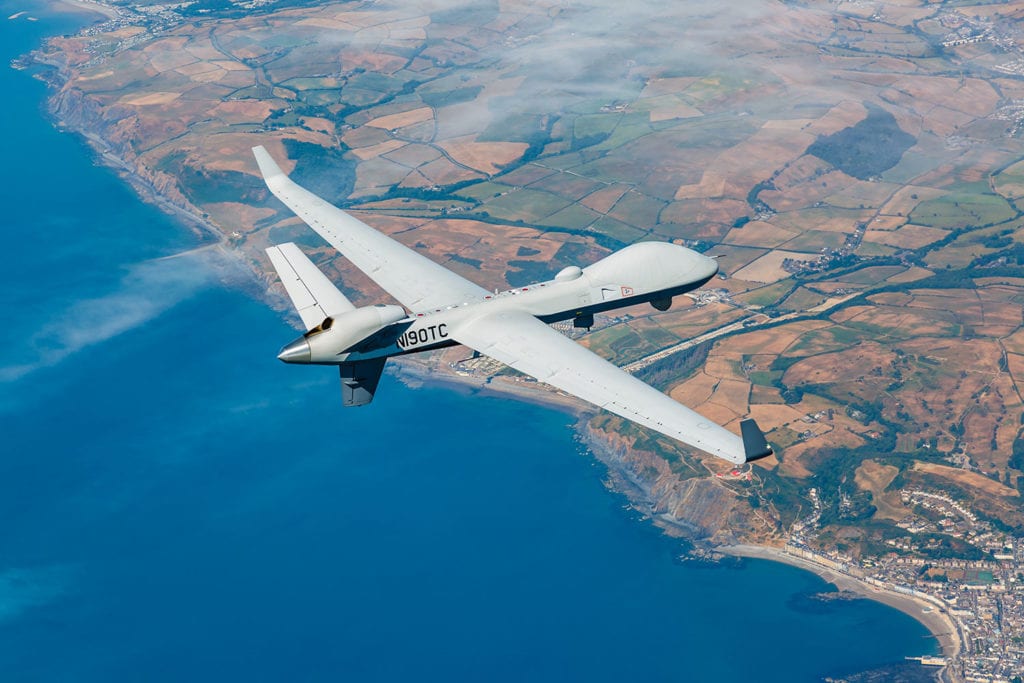
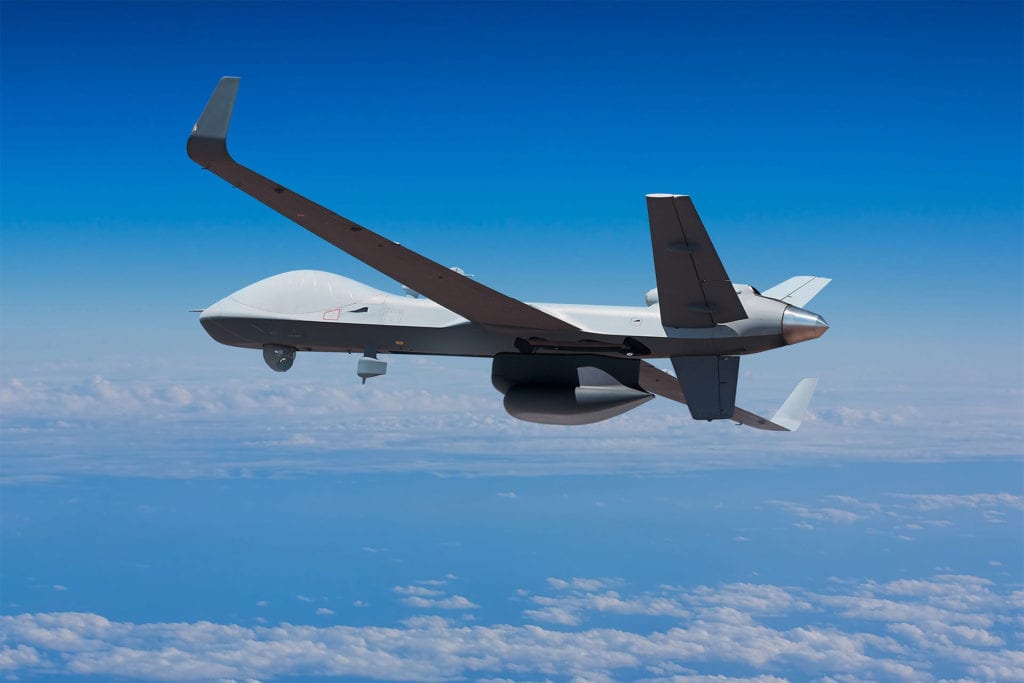
General Atomics Aeronautical Systems Inc.’s SkyGuardian remotely piloted aircraft. GA-ASI

SAN DIEGO — General Atomics Aeronautical Systems Inc. (GA‑ASI) plans to take a company-owned SkyGuardian remotely piloted aircraft to the United Kingdom later this year to undertake a series of operational capability demonstrations for NATO allies, including The Netherlands, the company said in a Feb. 3 release. The U.K.’s Protector program is a derivative of SkyGuardian with a range of U.K. modifications and the Royal Air Force (RAF) is supporting this visit. 

The GA-ASI aircraft will be configured with maritime capability, including a multi-mode maritime surface-search radar with Inverse Synthetic Aperture Radar imaging mode, an Automatic Identification System receiver, and a High-Definition, Full-Motion Video sensor equipped with optical and infrared cameras. This will build on previous GA-ASI demonstrations showcasing the unmanned advantage, which include the transatlantic flight of SkyGuardian in 2018, maritime demonstrations in Greece in 2019 and last year’s validation flights in Japan. 

“GA-ASI will work closely with multiple European allies to demonstrate the capabilities of MQ-9B, including in the maritime environment, and how MQ-9B can complement and team within a networked environment with other national assets,” said Tommy Dunehew, vice president of International Strategic Development for GA-ASI. 

The series of civilian and military capability events is expected to kick off in July at the Royal Air Force’s Waddington Air Base and will culminate with the MQ-9B’s participation in the U.K.-led Joint Warrior exercise that will showcase how maritime capabilities can be integrated with other air, surface and land platforms. SkyGuardian flights will further develop GA-ASI’s revolutionary Detect and Avoid capability, which will enable Protector to fly in unsegregated UK airspace. It will also assist RAF Waddington, the future home of the RAF Protector fleet, to best prepare to integrate the new aircraft into its daily operations. 

MQ-9B represents the next generation of remotely piloted aircraft (RPA) system having demonstrated airborne endurance of more than 40 hours, automatic takeoffs and landings under SATCOM-only control and the detect and avoid system. Its development is the result of a company-funded effort to deliver an RPA that can meet the stringent airworthiness certification requirements of various military and civil authorities. 

MQ-9B has garnered significant interest from customers throughout the world. The U.K. Ministry of Defence selected MQ-9B SkyGuardian for its Protector program, and in 2020 signed the production contract for deliveries to the Royal Air Force. SkyGuardian was selected by the Australian Defence Force under Project Air 7003, and the Belgian Ministry of Defense signed a contract for SkyGuardian


Northrop Grumman, Ultra Demonstrate ASW Using Unmanned Helicopter

Northrop Grumman collaborates with Ultra to demonstrate unmanned anti-submarine warfare capability. Northrop Grumman

SAN DIEGO — Northrop Grumman Corp. and U.K.-based Ultra equipped a modified, manned Bell 407 (acting as an MQ-8C Fire Scout surrogate) platform with Ultra sonobuoys, receiver and processor to complete an unmanned aircraft systems (UAS) anti-submarine warfare (ASW) capability demonstration, Northrop Grumman said in a Feb. 2 release. 

This successful demonstration of the UAS ASW mission on Oct. 29 was the first time a vertical takeoff surrogate unmanned aerial system had been used to conduct a large area multi-static acoustic search. The mission payload and effects were controlled from the ground with the resultant ASW picture disseminated to locations across the globe. 

“Adding an ASW capability to Fire Scout’s existing multi-mission capabilities would further enhance this highly-versatile platform,” said Dan Redman, Fire Scout maritime mission expansion lead, Northrop Grumman. “This ASW capability would offer commanders flexibility to employ not only UAS systems in this particular ASW role, but also utilize the increased availability of crewed aircraft more incisively against an expanded mission set. This would increase the total available effect of the manned/unmanned teamed force mix.” 

By jointly developing and demonstrating UAS ASW capabilities, initially on an MQ-8C Fire Scout manned surrogate as part of an industry-led initiative, the two companies are combining their world-leading expertise and experience with the aim of bringing unique ASW solutions to global customers. While the U.S. Navy has not yet identified a clear requirement for UAS ASW capability, it has shown interest in the development and continues to support and monitor progress.    

“Operating prototype hardware in a high-pressure real-world environment can be challenging,” said Thomas Link, president of Ultra Maritime. “Our partnership will bring an innovative and leading ASW capability into operation, combining both manned and unmanned ASW systems that will help defend our warfighters and provide increased capability to our forces.” 

The MQ-8C Fire Scout can fly missions in excess of 12 hours, providing commanders an unrivaled level of layered multi-source/sensor intelligence, surveillance, reconnaissance and command and control/comms relay capabilities over land and sea. When operating in a manned-unmanned teaming concept, Fire Scout enables commanders to employ manned assets in a more focused manner, allowing them to exploit hybrid manned/unmanned teaming opportunities. 

Ultra’s applications engineers are trusted partners in the design, development and production of the key elements of mission critical, intelligent and highly regulated systems. 


Davie Polar Icebreaker Program Confirms GE as Strategic Partner

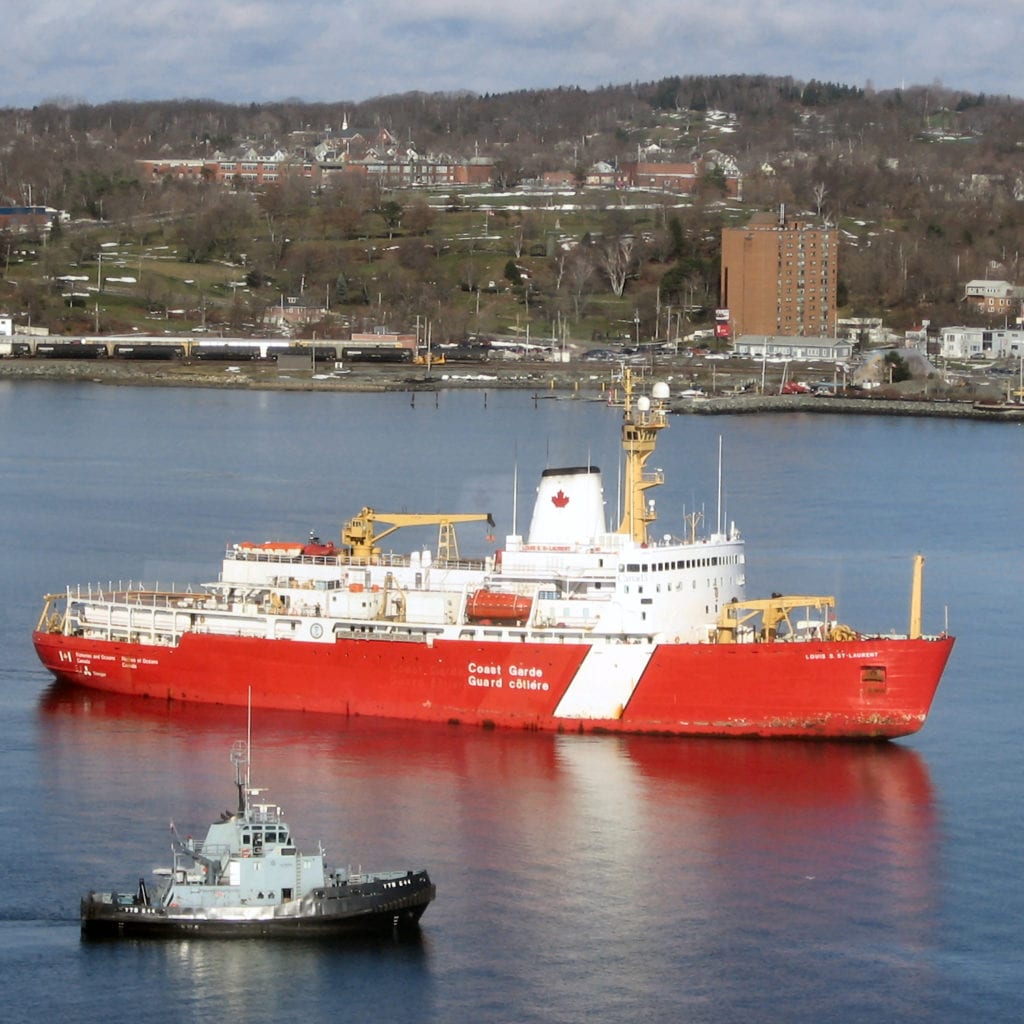
CCGS Louis S. St-Laurent, one of Canada’s aging polar icebreakers, shown here transiting Halifax Harbor. Wikipedia / Verne Equinox

LEVIS, QUEBEC — Davie, Canada’s premier builder of polar and ice-capable ships, welcomed GE as a strategic partner in its polar icebreaker program, the flagship of Canada’s National Icebreaker Centre, Davie said in a Feb. 2 release. 

Launched in August 2020, the NIC is a center of excellence for polar technologies and Arctic expertise. It reflects Davie’s role as Canada’s icebreaking partner and builder of the new icebreaker fleet, under the National Shipbuilding Strategy. This will create thousands of good jobs, a vibrant world-class maritime cluster in Québec and drive exports of Canadian innovation. 

Canada’s current polar icebreakers are very old. CCGS Louis S. St-Laurent is deep into its sixth decade and CCGS Terry Fox is fast approaching 40 years in service. A new polar class will enable Canada to maintain a continuous Arctic presence benefiting all Canadians, including the northern communities, enabling ice-choked trade, supporting Arctic sovereignty and protecting the polar environment. 

GE’s Power Conversion business offer a full spectrum of best-in-class integrated electrical propulsion and power systems, including its Seajet podded propulsion units. The ice-class range of Seajet – a technology jointly developed with AETC Sapphire – is available for Polar Class notation, with a power range of 7.5 MW to 15 MW. In the Seajet system the electric motor is housed in the hull mounted pod and directly connected to the propeller, freeing up cargo and operational space in the ship. Maneuverability and efficiency are greatly improved, and total fuel consumption and exhaust emissions are reduced. Customizable for different ship types, with simplified installation, Seajet pods can enhance performance in an array of commercial, offshore marine, and ice breaking ships.  

Davie is Canada’s only mega-yard with 50% of total capacity, able to build up to eight large, complex ships simultaneously. The 150-meter polar will be easily accommodated in Davie’s 351-meter Champlain Dry Dock. An integrated build schedule would ensure polar would complement other Davie programs such as the six program icebreakers it is set to build under the NSS. In fact, it would facilitate a steep learning curve and economies of scale to significantly benefit both programs by mitigating cost, schedule and performance risks. 

Moreover, a recent analysis conducted for Davie by Deloitte, drawing on ISED and StatCan numbers, concluded that building polar icebreakers at Davie will generate up to 2,500 well-paid jobs, engage over 1,300 suppliers (with 900 plus in Québec) and contribute up to $2.5 billion to the Canadian economy. 

“We welcome GE to our polar program,” said James Davies, president and CEO of Davie Shipbuilding. “Their leading-edge propulsion system combined with decades of icebreaker experience and electric and power system capabilities are unsurpassed. Their inclusion also greatly strengthens Canada’s National Icebreaker Centre. Together, we can ensure the polar is stimulating the post-pandemic economy and protecting Canada’s Arctic interests into the far future.” 

Philippe Piron, president and CEO of GE Power Conversion, said, “GE are ready to begin work with Davie Shipbuilding to deliver Canada’s new generation of polar class ships. GE and Davie skills are complementary. GE are prepared to deliver the robust systems and equipment that are essential for the powerful polar class ships that Davie will build for Canada. We are excited to have the opportunity to strengthen Canada’s National Icebreaker Centre under Davie’s leadership, and we look forward to engaging broadly with Canada’s marine industry.” 

GE joins Vard and Serco as partner in Davie’s polar program. Davie expects to soon announce steel, critical systems and other service partners. 


MBDA and Rheinmetall Win Contract for Naval High-Energy Laser System

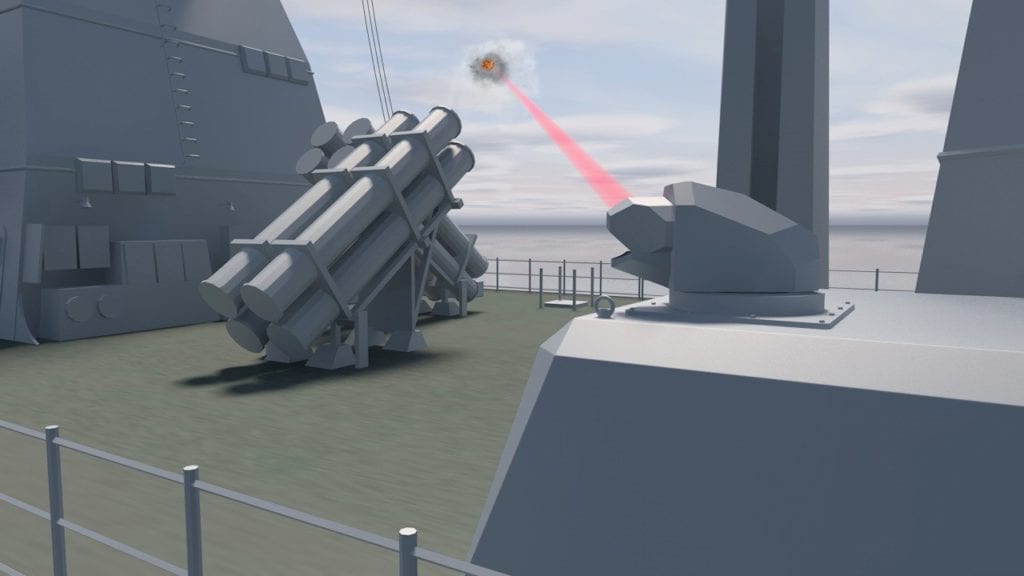
An artist’s conception of a laser weapon. MBDA

SCHROBENHAUSEN/ DUSSELDORF, Germany – Germany’s Federal Office for Bundeswehr Equipment, Information Technology and In-Service Support (BAAINBw) has awarded ARGE consortium — consisting of MBDA Deutschland GmbH and Rheinmetall Waffe Munition GmbH — a contract to fabricate, integrate and support testing of a laser weapon demonstrator in the maritime environment, MBDA said in a Jan. 28 release. The order value is in the low double-digit million euro range. 

Work will be shared out on a roughly equal basis. MBDA Deutschland is responsible for tracking, the operator’s console and linking the laser weapon demonstrator to the command-and-control system. Rheinmetall is in charge of the laser weapon station, the beam guiding system, cooling, and integration of the laser weapon system into the project container of the laser source demonstrator. 
 
The demonstrator is to be fabricated, tested and integrated by the end of the 2021. Trials onboard the German Navy frigate F124 Sachsen are to take place in 2022. 
 
“The contract is an important step on the path to an operational high-energy laser system, said Doris Laarmann, head of laser business development at MBDA Deutschland. “Our two companies will apply their respective strengths to make this project a success on behalf of the German navy. Once it’s installed, the demonstrator will also be used to test important aspects such as the interaction and function of the sensor suite, combat management system and effector as well as rules of engagement.”   
 
Alexander Graf, head of Rheinmetall Waffe Munition’s laser weapons program, and Dr. Markus Jung, who leads the company’s laser weapon development effort, agreed, saying the contract marks a systematic extension of the functional prototype laser weapon successfully tested in recent years, with the experience gained now dovetailing into one of the most ambitious projects in the field of laser weapon development in Europe.
 
A breakthrough development in the history of defense technology, lasers engage targets at the speed of light, operating with great precision and producing very little collateral damage. A demonstrator system featuring these capabilities will soon be put to the test under highly realistic operating conditions onboard a German frigate. 


Austin Sworn In as Secretary of Defense

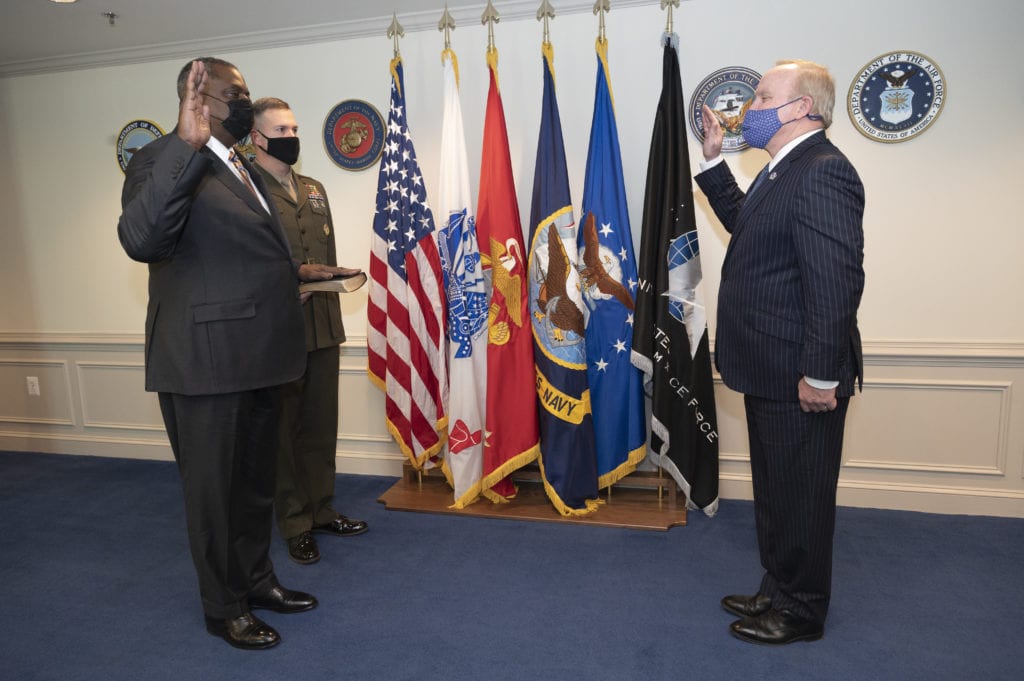
Washington Headquarters Services Director David Muir swears in Lloyd J. Austin III as secretary of defense, the Pentagon, Washington, D.C., Jan. 22, 2021. Holding the Bible is the Junior Military Assistant to the Secretary of Defense, Marine Corps Lt. Col. Caleb Hyatt. DoD / Lisa Ferdinando

ARLINGTON, Va.— Retired Army Gen. Lloyd J. Austin III was sworn in Jan. 22 as secretary of defense at the Pentagon by Washington Headquarters Services Director David Muir after a morning confirmation vote from the Senate. 

Austin issued the following message to the Defense Department the same day:  

“I am honored to have this chance to serve again and to do so alongside you and your families. My wife, Charlene, and I know all too well the sacrifices you make to keep this country safe. That safety is job one, and I promise to work as hard as you do at it. 

“The way I see it, my job as Secretary of Defense is to make you more effective at doing yours. That means ensuring you have the tools, technology, weapons, and training to deter and defeat our enemies. It means establishing sound policy and strategy and assigning you clear missions. It means putting a premium on cooperation with our allies and partners. And it means living up to our core values, the same ones our fellow citizens expect of us. 

“Right now, of course, doing my job also means helping our country get control of the pandemic, which has killed more than 400,000 Americans. You have already come to the aid of our Nation’s health care professionals. You can expect that mission to continue. But we must help the Federal Government move further and faster to eradicate the devastating effects of the coronavirus. To that end, we will also do everything we can to vaccinate and care for our workforce and to look for meaningful ways to alleviate the pressure this pandemic has exerted on you and your families. 

“None of us succeeds at this business alone. Defending the country requires teamwork and cooperation. It requires a certain humility, a willingness to learn, and absolute respect for one another. I know you share my devotion to these qualities. 

“I am proud to be back on your team.” 


Royal Navy Ready to Deploy a Carrier Strike Group for First Time in a Generation

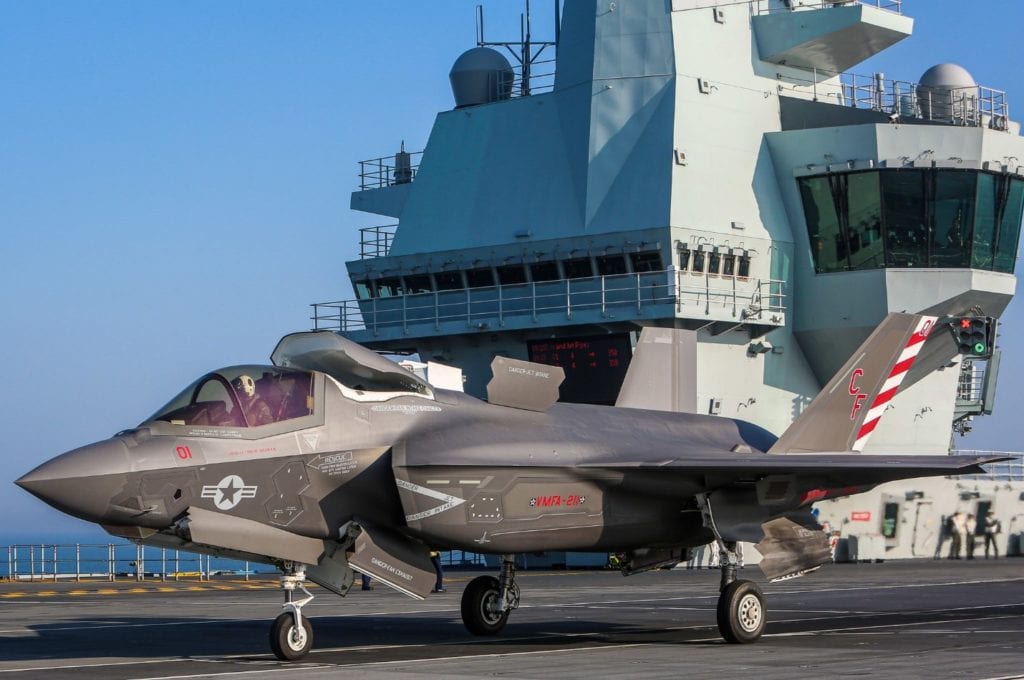
A VMFA-211 F-35B operates from HMS Queen Elizabeth. U.K. Royal Navy

Adm. Anthony David Radakin, First Sea Lord of the Royal Navy, said the upcoming deployment of the HMS Queen Elizabeth (R08) carrier strike group exemplifies the Royal Navy’s commitment to global operations.

Speaking this week at the Surface Warships 2021 conference in London, Radakin said the U.K. continues to demand more from the Royal Navy’s “equipment and people, deploying further, faster and longer to deliver U.K. forward presence around the globe.” 

“We, as a nation, have declared ourselves ready to deploy a carrier strike group for the first time in a generation,” Radakin said.  “HMS Queen Elizabeth, one of the most advanced and capable aircraft carriers in the world, will deploy at the heart of a multi-national carrier strike group, with Royal Navy and RAF jets and helicopters embarked. She will sail through the Mediterranean, Suez, Indian Ocean and on into the Indo-Pacific, and, on the way, she will exercise with our allies and partners from around the world.”

The U.S. and U.K. defense secretaries made a joint declaration on Jan. 19 regarding the joint participation for the Queen Elizabeth Carrier Strike Group deployment this spring.  “The leaders look forward to seeing the culmination of nearly a decade of U.S.-U.K. carrier cooperation when Carrier Strike Group 2021 sets sail from Portsmouth, UK later this year,” the statement said.

The inaugural deployment will include a submarine, destroyers HMS Diamond and HMS Defender, frigates HMS Kent and HMS Richmond, as well as USS The Sullivans (DDG-68) and a frigate from the Royal Netherlands Navy.  The strike group will be supported by the Royal Fleet Auxiliary stores ship RFA Fort Victoria and new Tide-class oiler. The airwing will  include jet and rotary wing aircraft from the Royal Navy and Royal Air Force, along with F-35B Joint Strike Fighters from U.S. Marine Fighter Attack Squadron 211 (VMFA 211).

VMFA 211 has been operating from Queen Elizabeth and helped the carrier strike group achieve its initial operating capability (IOC) declaration for the carrier strike group earlier this month.

According to a MOD UK statement, the CSG’s IOC means that all elements of the group from fighter jets to radar systems to anti-ship weapons have been successfully brought together and operated.

“Both the air and naval elements of the CSG have now met this milestone, which includes qualified pilots and ground crews being held at short notice for carrier-based operations and trained to handle weapons and maintain the equipment,” the statement said. “Another marker of success at this stage includes the ability to deploy anti-submarine warfare capabilities such as frigates and destroyers, as well as both fixed and rotary wing aircraft including Merlin helicopters to operate alongside the carrier.”

The Queen Elizabeth was commissioned in 2017. With a displacement of 65,000 tons and 920 feet in length, she is the Royal Navy’s largest ship ever.  Her sister ship, HMS Prince of Wales (R09), was commissioned two years later.

Radakin said the Royal Navy is taking a larger role in global operations. He pointed to recent deployments of ships like the amphibious assault ship HMS Albion and to the Pacific, and HMS Montrose (F236), which has been deployed in Bahrain, serving with the U.S. Fifth Fleet since April 2019.

“We didn’t just forward base her, she has been available 99 percent of the time, and has the lowest rate of defects of any ship in class,” Radakin said.  “The successful Montrose model gives me confidence that we can manage deploying ships, and even start to imagine them never returning to U.K.”


Raytheon’s Maritime Surveillance Systems Flight-Tested on GA-ASI SeaGuardian for Japan Coast Guard

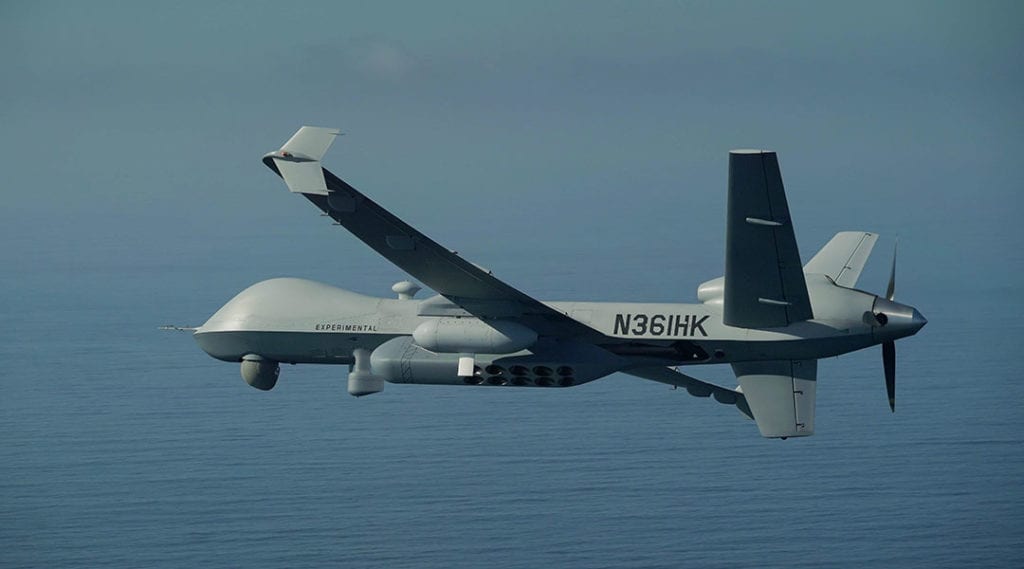
General Atomics Aeronautical Systems Inc.’s SeaGuardian remotely piloted aircraft. GA-ASI

SAN DIEGO — Japan’s coast guard recently completed successful flight testing of Raytheon Intelligence & Space (RI&S) maritime surveillance technologies onboard a General Atomics Aeronautical Systems Inc. SeaGuardian remotely piloted aircraft, the company said in a Jan. 21 release.

RI&S provided its SeaVue Expanded Mission Capability (XMC) radar and AN/DAS-4 Multi-spectral Targeting System for the tests, which were conducted in the Hachinohe, Aomori Prefecture, Japan, between Oct. 15 and Nov. 10, 2020. 

The tests validated the wide-area maritime surveillance systems support for the Japan Coast Guard to carry out missions for search and rescue, disaster response and maritime law enforcement. 

“Our advanced intelligence, surveillance and reconnaissance solutions can aid the Japan Coast Guard to perform their duties effectively in alignment with Japan’s maritime security priorities,” said Barbara Borgonovi, vice president of Intelligence, Surveillance and Reconnaissance Systems for RI&S. “Through our partnership with GA-ASI, SeaVue XMC and DAS-4 contribute to SeaGuardian’s critical role to help operators make decisions faster. Our wide-area surveillance technologies have proven track records that can be tailored to any mission in the maritime environment.” 

The SeaVue XMC radar provides enhanced wide-area surveillance by identifying targets of interest rapidly and efficiently, such as small maritime vessels. SeaVue MR delivers expanded capabilities including small-target detection at longer ranges and higher altitudes, and a software-defined digital architecture to add new functionality without changing hardware. 

The DAS-4 sensor suite offers operators next-generation electro-optical surveillance in high-definition and full-motion video to identify and engage targets with pinpoint accuracy. The flight tests support the Japan coast guard’s policy on strengthening maritime security, which calls for modernized maritime technologies to protect Japan’s sovereignty. 


GA-ASI Completes UAV ASW Demonstration of Sonobuoy Dispensing and Remote Processing

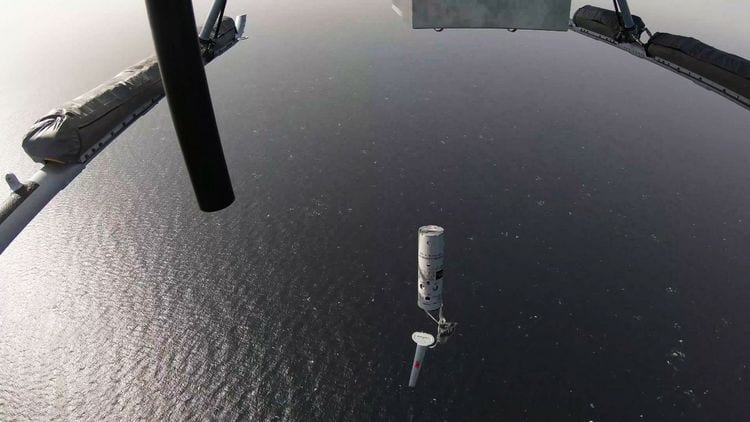
General Atomics Aeronautical Systems, Inc. recently completed development and test of the world’s first self-contained anti-submarine warfare capability for an unmanned aircraft system. GA-ASI

SAN DIEGO — General Atomics Aeronautical Systems Inc. (GA-ASI) recently completed development and test of the world’s first self-contained anti-submarine warfare (ASW) capability for an unmanned aircraft system, the company said in a Jan. 19 release. 

On Nov. 24, GA-ASI successfully demonstrated an A size sonobuoy­­ carriage, release, process and control from a company-owned MQ-9A Block 5 on a U.S. Navy Pacific test range. Using a satellite communications link, GA-ASI remotely processed bathythermal and acoustic data from deployed A size Directional Frequency Analysis and Recording (DIFAR-AN/SSQ-53G), Directional Command Activated Sonobuoy System (DICASS-AN/SSQ-62F) and Bathythermograph (BT-AN/SSQ-36B) sonobuoys and accurately generated a target track in real time from the Laguna Flight Operations Facility located at Yuma Proving Grounds.  

The MQ-9A Block 5 successfully deployed one BT, seven DIFAR, and two DICASS buoys to initiate prosecution and continuously track a MK-39 Expendable Mobile ASW Training Target over a three-hour period. Target track was generated using General Dynamics Mission Systems-Canada’s UYS-505 Sonobuoy Processing Systems. GA-ASI is developing this first-of-its-kind capability for its new MQ-9B SeaGuardian UAS in partnership with the U.S. Navy under a Cooperative Research and Development Agreement with Naval Air Systems Command, Patuxent River, Maryland.  

“This demonstration is a first for airborne ASW. The successful completion of this testing paves the way for future development of more anti-submarine warfare capabilities from our MQ-9s,” said GA-ASI President David R. Alexander. “We look forward to continuing collaboration with the U.S. Navy as they explore innovative options for distributed maritime operations in the undersea domain.” 

GA-ASI first demonstrated a sonobuoy remote processing capability in 2017 from an MQ-9A. Since then, GA-ASI has added a Sonobuoy Management & Control System (SMCS) to monitor and control deployed sonobuoys, and developed a pneumatic sonobuoy dispenser system (SDS) capable of safely carrying and deploying 10 U.S. Navy-compliant A size or 20 G size sonobuoys per pod. The MQ-9B SeaGuardian has four wing stations available to carry up to four SDS pods, allowing it to carry and dispense up to 40 A size or 80 G size sonobuoys, and remotely perform ASW anywhere in the world. 

In a standard configuration, SeaGuardian’s endurance exceeds 18 hours, encompassing a mission radius of 1,200 nautical miles with eight hours of on-station time for submarine prosecution, providing a low-cost complement to manned aircraft for manned-unmanned teaming operations. GA-ASI has already received orders for this MQ-9B SeaGuardian ASW capability from two separate foreign customers and anticipates demand to be extremely strong for the MQ-9B SeaGuardian with its high-end maritime capabilities and low cost relative to legacy manned maritime platforms. 


INDO-PAC Commander Says Chinese Aggressiveness Helps U.S. Make More Friends

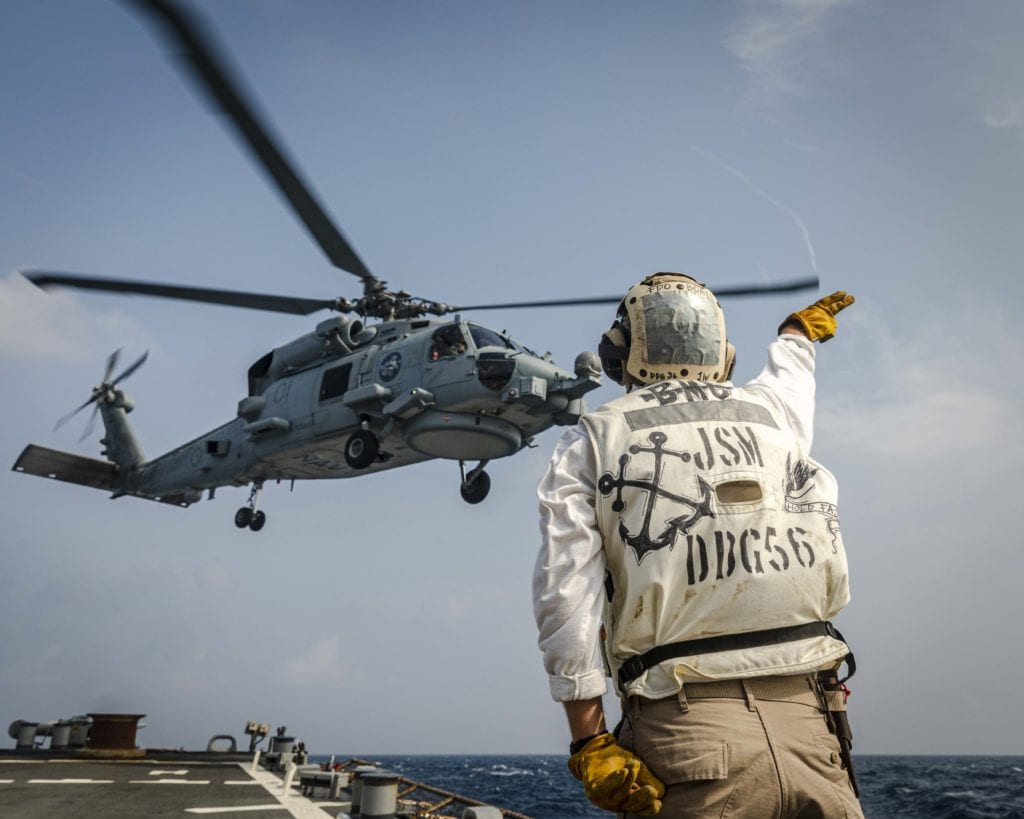
A Royal Australian Navy MH-60R Sea Hawk helicopter takes off from the Arleigh Burke-class guided-missile destroyer USS John S. McCain  during exercise Malabar 2020 in the Bay of Bengal, Nov. 3, 2020.Ships, aircraft and personnel from Australia, Japan, the United States and host nation India took part. U.S. Navy / Mass Communication Specialist 2nd Class Markus Castaneda

ARLINGTON, Va. — China’s political, economic and military aggressiveness is driving Asian countries like India and Vietnam toward closer ties with the United States, the head of U.S. Indo-Pacific Command says.

In recent years, China has locked horns politically and sometime physically with the Philippines, Vietnam and other nations bordering the South China Sea where the People’s Liberation Army Navy has built military outposts on artificial islands in disputed waters. Last summer China exchanged gunfire with India over their ill-defined border in the Himalayan region, leaving at least 20 Indian soldiers dead.   

“The Communist Party of China represents the greatest long term strategic threat to security in the 21st Century,” Indo-Pac Commander Adm. Philip Davidson told the Surface Navy Association virtual symposium Jan. 12 in a live-streamed appearance from his headquarters in Hawaii.

The new U.S. Navy, Marine Corps and Coast Guard Maritime Strategy focuses on China and Russia, as the two most significant threats to global peace and prosperity. But in its introduction, the document singles out China “due to its growing economic and military strength, increasing aggressiveness, and intent to dominate its regional waters and remake the international order.”

The ill will China is generating has made several nations in the Indo-Pacific region reconsider their relations with the United States, Davidson said, citing particularly India and Vietnam.

“The strategic opportunity for the United States in the century going forward is a budding and building relationship with India,” he said, adding, “when you think about the economic potential, the  opportunity for collaboration on issues that challenge the whole of the Indo-Pacific and around the globe, having India more closely cooperating with the United States — where possible — I think is a very important strategic opportunity.”

As for former enemy, and not-quite-ally Vietnam, Davidson said the relationship “has advanced greatly over the course of the last several years. In the near term, we’re very focused on immediate needs they have.” In addition to some military-to-military training, U.S. help included the remediation of dioxin contamination and unexploded ordnance left over from the war.

“We continue the accounting for our missing in action from the Vietnam War as well. That’s a gateway to deeper collaboration in the future,” Davidson said.

Davidson said there are a number of other countries with deep interest in the Pacific that the United States is working with, including Japan, the U.K., France, New Zealand, Australia and Canada.

“We can’t forget the Philippines is our ally, Thailand is our ally,” he said, adding there’s also more opportunity with Singapore, which supports the forward-deployment of U.S. Navy littoral combat ships.


SOUTHCOM Chief: Maintaining Ties with Latin American Partners is Key in Great Power Competition

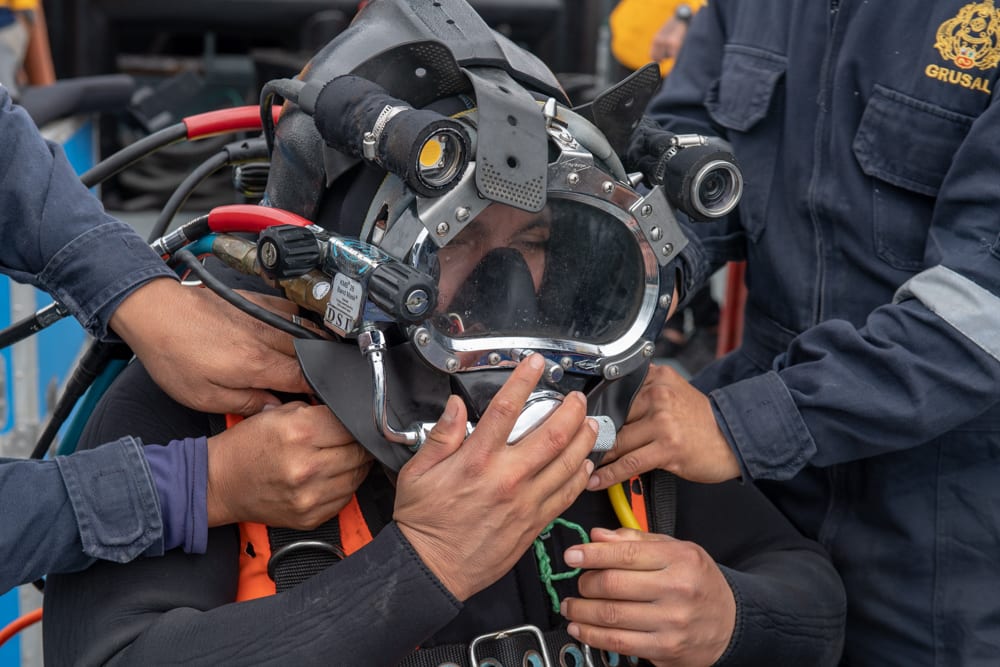
Peruvian navy divers check diving equipment prior to entering the water, during a subject matter expert exchange with U.S. Navy divers from Mobile Diving and Salvage Unit (MDSU) 2, as part of Southern Partnership Station 2019. Competition with Russia and China is spurring the United States to seek a global advantage through partnerships in Latin America. U.S. Navy / Mass Communication Specialist 1st Class Peter Lewis

ARLINGTON, Va. — Great power competition with an emerging China and a resurgent Russia is driving the United States to seek an all-domain, global positioning advantage, through alliances and partnerships in Latin America, the head of U.S. Southern Command (SOUTHCOM) says.

“Russia has interest in Cuba, Nicaragua and Venezuela, and some legacy interests in other [Western Hemisphere] countries,” U.S. Navy Adm. Craig Faller, said Jan. 14 at the Surface Navy Association Virtual Symposium. “Their interest really is to counter U.S. interest, while China’s interest “is economic dominance,” he said.

There are 31 countries in SOUTHCOM’s area of responsibility — Central and South America, south of Mexico, and the Caribbean Basin — 28 of them democracies, and the United States has good relations with most of them, the admiral said. However, China has been actively engaging several of those countries with economic and land deals leading to large infrastructure projects with possible military and diplomatic implications.

“Why would China want to achieve a deep-water seaport off El Salvador, Jamaica, perhaps the Dominican Republic?” Faller asked. “Their long term interest is economic dominance, and they’ll do what it takes,” he said.

“The Panama Canal is key terrain in all of this,” Faller said, noting China is negotiating deals for ports at either end of the canal. “South America has a positive water ratio and much, much excess arable land. China has none of that,” Faller said, noting that China “is working river access, energy access. Access to soybeans.

“Additionally, hundreds of Huawei systems are in place, in Latin American cities, well ahead of any competitor in that space,” Faller said. The Chinese telecom giant is the world’s second largest phone maker. American officials are concerned Huawei networks will give the Chinese government new avenues of surveillance. Huawei says that it does not spy for the Chinese government. The Pentagon is worried Chinese telephonic equipment sold to South American governments could make communication between the U.S. and partner nations less secure.

“The U.S. is  responding in a good way with a clean network program by the State Department,” Faller said.

The best way to counter Chinese influence in Latin America and the Caribbean is to build and maintain military-to-military partnerships, continue joint naval exercises, cooperate in counter narcotics operations and maintain constant U.S. presence in the region, Faller said.