Northrop Grumman to Enable New F-35 Warfighting Capability
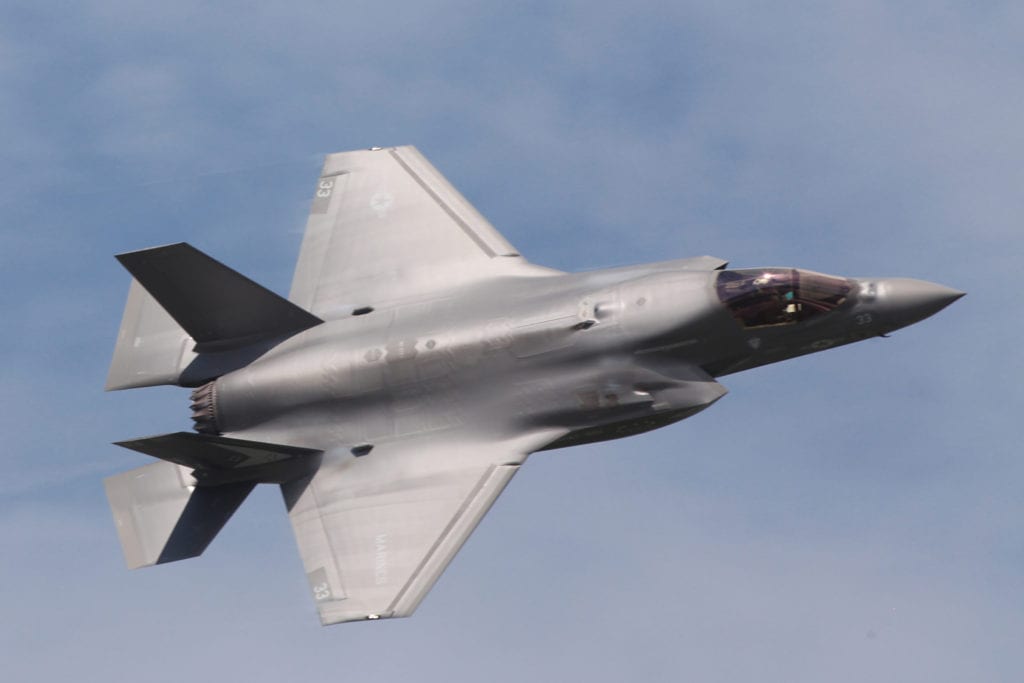
Pilots with Marine Fighter Attack Training Squadron 501 fly the F-35B Lightning II during the Marine Corps Air Station Beaufort Air Show, 2019. U.S. Marine Corps / Warrant Officer Bobby J. Yarbrough

BALTIMORE — Northrop Grumman has received a contract award from Lockheed Martin to enable new functionality to protect the 5th Generation F-35 Lightning II multi-role fighter, Northrop Grumman said in a Jan. 12 release.

As part of a collaborative arrangement between Northrop Grumman, BAE Systems and Lockheed Martin, the three companies will integrate Northrop Grumman’s AN/ASQ-242 Integrated Communications, Navigation and Identification (ICNI) and BAE Systems’ AN/ASQ-239 Electronic Warfare/Countermeasures system for optimal operational utility. 

“This arrangement allows us to collectively provide enhanced capabilities without compromising the size, weight or power of the aircraft,” said Howard Lurie, vice president, F-35 programs, Northrop Grumman. “We are proud to be a primary partner of the F-35 team, providing our U.S. and allied warfighters superior combat effectiveness.” 

Northrop Grumman’s ICNI system provides F-35 pilots with more than 27 fully integrated operational functions. Using its industry-leading software-defined radio technology, Northrop Grumman’s design allows the simultaneous operation of multiple critical functions while greatly reducing size, weight and power demands on the advanced F-35 fighter. These functions include Identification Friend or Foe, automatic acquisition of fly-to points, and various voice and data communications such as the Multifunction Advanced Data Link. 

The BAE Systems’ AN/ASQ-239 system is an advanced, proven electronic warfare suite that provides fully integrated radar warning, targeting support, and self-protection to detect and defeat threats and enable the F-35 to reach well-defended targets. 

“As Lockheed Martin’s electronic warfare integrator for all F-35 aircraft, we’re committed to equipping our customers with advanced capabilities that help them conduct their missions,” said Deborah Norton, vice president of F-35 Solutions at BAE Systems. “Under this collaborative agreement, we will work closely with Lockheed Martin and Northrop Grumman to enhance the capability of our fully integrated EW system – heightening pilots’ situational awareness and helping them evade, engage and defeat modern threats.” 

As the provider for F-35’s ICNI continuously since low-rate initial production Lot 1, Northrop Grumman has delivered more than 750 shipsets to date. Components of the new functionality are planned to begin incorporation starting in 2025 (Lot 17) and will include upgraded electronics and software. 

Northrop Grumman plays a key role in the development, modernization, sustainment and production of the F-35. The company manufactures the center fuselage and wing skins for the aircraft, produces and maintains several sensors, avionics and mission systems as well as mission-planning software, pilot and maintainer training courseware, electronic warfare simulation testing and low-observable technologies. 


Royal Canadian Navy Welcomes New Commander

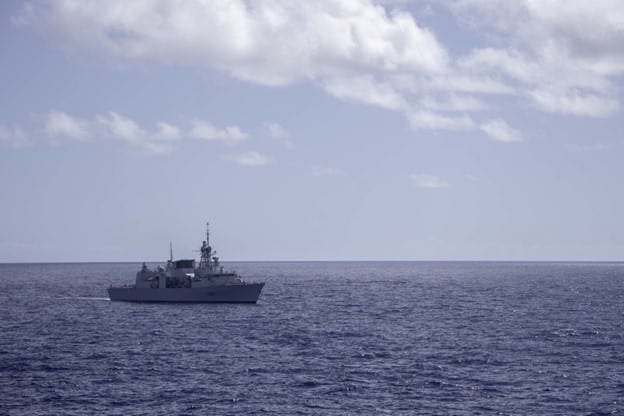
The Royal Canadian Navy ship HMCS Winnipeg (FFH 338) transits the Pacific Ocean while participating in a gunnery exercise during Exercise Rim of the Pacific 2020.  U.S. Navy / Mass Communication Specialist 3rd Class Jenna Dobson

OTTAWA – Vice Adm. Craig Baines assumed the duties of commander of the Royal Canadian Navy (CRCN) in a virtual change of command ceremony ceremonies Jan. 12, presided over by Gen. Jonathan Vance, chief of the defense staff (CDS), at National Defence Headquarters.

Baines becomes the 37th CRCN, relieving Vice Adm. Art McDonald, who will be promoted to the rank of admiral and will succeed Vance as the 20th CDS.

Baines is a 33-year veteran of sea-going appointments and staff officer positions, with an initial sea tour aboard HMCS Saguenay (D79) and command of HMCS Winnipeg (FFH 338).  He commanded Canadian Forces Base Esquimalt, Canadian Fleet Atlantic, Maritime Forces Atlantic and Joint Task Force Atlantic, and became the of deputy vice chief of the defense staff in July 2020.

“Change of command ceremonies represent both continuity and change, and it’s a tremendous pleasure to mark the change of command of the Royal Canadian Navy between two great sailors: Vice Admiral Art McDonald and Vice Admiral Craig Baines,” said Minister of Defence Harjit S. Sajjan. “Under Vice Admiral McDonald’s leadership, we have seen the RCN maintain an impressive operational tempo at home and abroad. His focus on people and innovation have positioned the navy for success as it transitions to the future fleet.”

“Through his 33 years of service, Vice Admiral Baines has a proven operational and institutional track record from which to draw upon as he continues to put Canada’s sailors first in all that he does,” Sajjan said. “I am delighted to appoint Vice Admiral Baines to command the Royal Canadian Navy and I know that he will lead by example, put our ethos into practice, and continue to steer the navy towards the objectives of the future fleet.” 

Baines said it was a huge honor to continue to serve with a group of outstanding Canadians who wear a uniform on behalf of their country, often serving in a complex environment far from home.

“We will continue to prioritize support to our sailors, defense team members and their families while managing ongoing cultural change, domestic and international operations, fleet recapitalization, training and readiness, all while innovating throughout our organization to make us the most inclusive, respect-driven navy we can be.”

The Royal Canadian Navy is composed of 28 warships, submarines, and coastal defense vessels, plus many more auxiliary and support vessels, with approximately 8,300 regular force and 3,600 reserve sailors, supported by approximately 3,800 civilian employees.

With its motto of “Ready, Aye, Ready,” the RCN generates combat-capable, multipurpose maritime forces that support Canada’s efforts to participate in security operations anywhere in the world, as part of an integrated Canadian Armed Forces.


HII Completes Assembly Building for Navy’s Orca XLUUV Hulls

Hampton Mayor Donnie Tuck, Virginia Governor Ralph Northam and HII Executive Vice President and President, HII Technical Solutions, Andy Green break ground on HII’s Unmanned Systems Center of Excellence in this September, 2020 photo. The first phase of the center is now complete with the construction of the first of two planned buildings. Huntington Ingalls Industries

NEWPORT NEWS, Va. — Huntington Ingalls Industries has completed the first phase of its Unmanned Systems Center of Excellence with the construction of a 22,000-square-foot facility, the company said in a Jan. 11 release. 

The first of two planned buildings on the 20-acre campus in Hampton, Virginia will be used to assemble hull structures for Boeing’s Orca Extra Large Unmanned Undersea Vehicle (XLUUV) program for the U.S. Navy. 

“We are thrilled to reach this critical milestone with the development of our Center of Excellence campus,” said Andy Green, executive vice president of HII and president of HII’s Technical Solutions division. “Opening this initial facility immediately expands our unmanned systems capability and helps support the increasing needs of our customers who defend our national security.” 

Construction began in September 2020, following a ground-breaking event with special guests, including Gov. Ralph Northam and other state and local government officials. 

Structural development of the main facility, a 135,000-square-foot building, is scheduled to be complete by the end of 2021. The purpose-built, state-of-the-art facility will be used for unmanned systems prototyping, production and testing. 

“HII has made significant investments in the unmanned systems industry during the last year, including this Center of Excellence,” said Duane Fotheringham, president of Technical Solutions’ Unmanned Systems business group. “This facility solidifies HII’s commitment to advancing development of unmanned systems for our current and future customers.” 

HII partnered with the Virginia Economic Development Partnership, the city of Hampton and the Hampton Roads Alliance to secure the project. More than 250 high-quality jobs will be created to support unmanned systems design and production at the facility. Employees began working in the first building on Dec. 28, 2020. 


New Pentagon Counter Drone Strategy: Unify Solutions Search, Avoid Duplicated Efforts

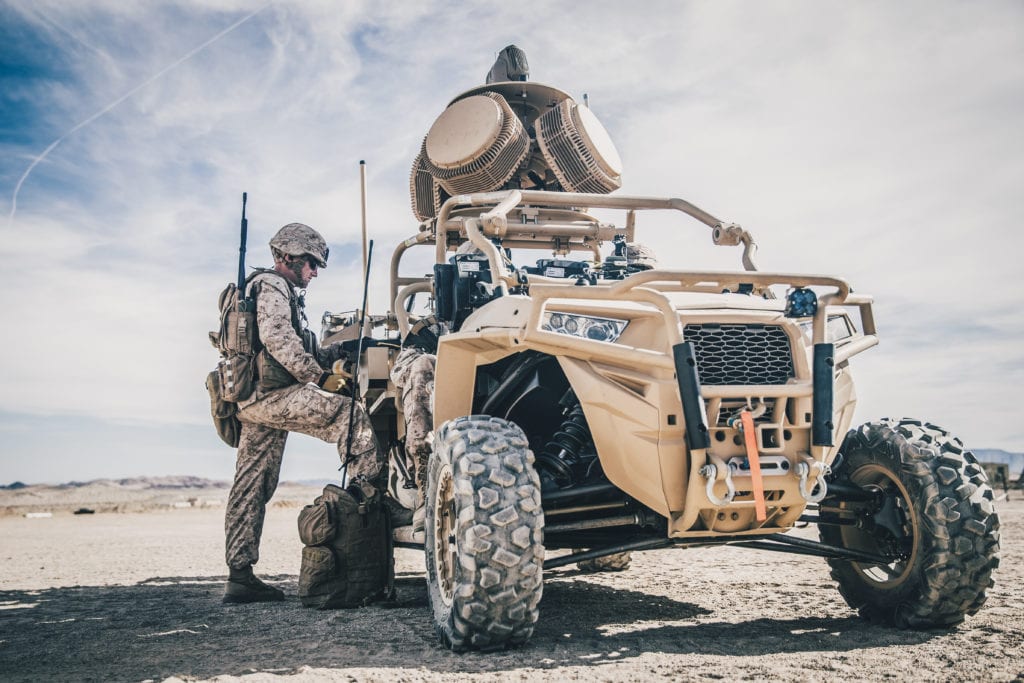
1st Lt. Taylor Barefoot, a low altitude air defense officer with Marine Medium Tiltrotor Squadron 163 (Reinforced), 11th Marine Expeditionary Unit, programs a counter-unmanned aircraft system on a Light Marine Air Defense Integrated System (LMADIS) during a predeployment training exercise at Marine Corps Air Ground Combat Center Twentynine Palms, Calif., Nov. 13, 2018. U.S. Marine Corps / Lance Cpl. Dalton S. Swanbeck

ARLINGTON, Va. — The Defense Department’s new strategy to thwart attacks and spying by small unmanned aircraft systems calls for protecting the force at home as well as overseas, while coordinating technology development across the services to avoid redundant programs that waste time and money.

In development since November 2019, when the Army was picked to unify counter-UAS efforts across the services, the strategy addresses both the potential threats from foreign adversaries and the hazards posed by reckless drone operators domestically.

The Army, Navy, Air Force and Marine Corps have all been developing systems to detect, deter, disable or destroy enemy drones. However, as the worldwide use and misuse of small, unmanned aircraft has grown exponentially, a coordinated effort to counter the risk — not only with technology but other solutions like doctrine, training and policy changes [ was needed, according to the report outlining the new strategy.

Most current solutions aim to sever the link between a remotely piloted drone and its operator, Army Major Gen. Sean Gainey, the director of the Pentagon’s Counter-UAS Office (JCO), told an online discussion of the new strategy Jan. 8 at the Center for Strategic and International Studies, Washington think tank.

“But where we see the threat going in the future,“ Gainey said, is toward “autonomous, massing swarming capability, [drones] integrating AI [artificial Intelligence] and potentially leveraging 5G” cell phone technology.   

The JCO will create integrated plans, technology, training concepts and doctrine that focus “appropriate resources on countering the UAS threat, while minimizing unnecessary duplication and redundancy,” said Gainey.

In addition to coordinating countermeasure steps across the U.S. military and with allies and partner nations, the Pentagon is also coordinating domestic efforts with the departments of Justice and Homeland Security, which includes the U.S. Coast Guard.

The widening use of small drones by non-state actors and terrorists has led some to call small UAS “the new IEDs” (improvised explosive devices).  Mindful of the expanding commercial use of small unmanned aircraft, Nicole M. Thomas, the JCO’s division chief for strategy and policy, noted “there are legitimate uses of drones,” although incompetent or deliberate misuse of a UAS could be a hazard.

Thomas said the JCO is completing details of the implementation plan, expected to be released by the end of January. “Those will all be action plans of things we’re going to do to make the strategy a reality,” she added.

In mid-January, the JCO will invite industry to demonstrate their “low collateral effectors,” non-lethal, low collateral damage capabilities, including jammers, at a common test range during the first week of April “and we’ll select the best ones, and move forward with that as the joint solution” Gainey said.


Teledyne Technologies to Acquire FLIR Systems

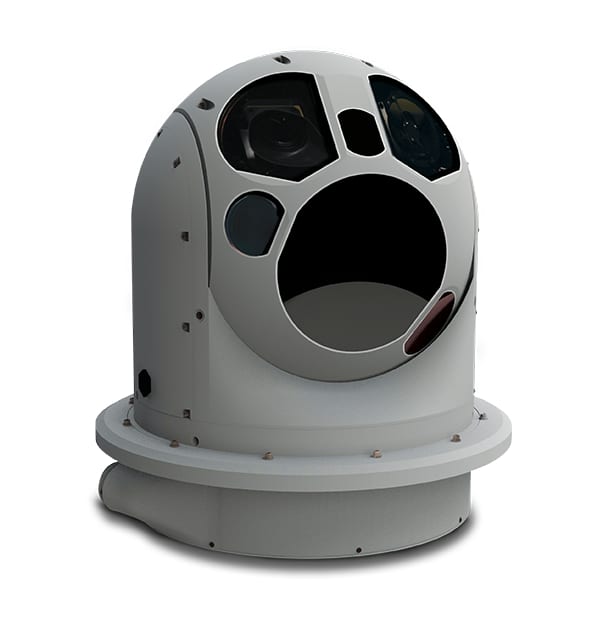
FLIR Systems’ SeaFLIR 380 HD, which provides long range, shipboard multispectral surveillance. FLIR Systems

THOUSAND OAKS, Calif. and ARLINGTON, Va. — Teledyne Technologies Inc. and FLIR Systems announced Jan. 4 they have entered into a definitive agreement under which Teledyne will acquire FLIR in a cash and stock transaction valued at approximately $8 billion. 

Under the terms of the agreement, FLIR stockholders will receive $28 per share in cash and 0.0718 shares of Teledyne common stock for each FLIR share, which implies a total purchase price of $56 per FLIR share based on Teledyne’s five-day volume weighted average price as of Dec. 31, 2020. The transaction reflects a 40% premium for FLIR stockholders based on FLIR’s 30-day volume weighted average price as of Dec. 31. 

As part of the transaction, Teledyne has arranged a $4.5 billion, 364-day credit commitment to fund the transaction and refinance certain existing debt. Teledyne expects to fund the transaction with permanent financing prior to closing. Net leverage at closing is expected to be approximately 4x adjusted pro forma EBITDA with leverage declining to less than 3x by the end of 2022. 

Teledyne expects the acquisition to be immediately accretive to earnings, excluding transaction costs and intangible asset amortization, and accretive to GAAP earnings in the first full calendar year following the acquisition. 

“At the core of both our companies is proprietary sensor technologies. Our business models are also similar: we each provide sensors, cameras and sensor systems to our customers. However, our technologies and products are uniquely complementary with minimal overlap, having imaging sensors based on different semiconductor technologies for different wavelengths,” said Robert Mehrabian, executive chairman of Teledyne. “For two decades, Teledyne has demonstrated its ability to compound earnings and cash flow consistently and predictably. Together with FLIR and an optimized capital structure, I am confident we shall continue delivering superior returns to our stockholders.” 

“FLIR’s commitment to innovation spanning multiple sensing technologies has allowed our company to grow into the multi-billion-dollar company it is today,” said Earl Lewis, chairman of FLIR. “With our new partner’s platform of complementary technologies, we will be able to continue this trajectory, providing our employees, customers and stockholders even more exciting momentum for growth. Our board fully supports this transaction, which delivers immediate value and the opportunity to participate in the upside potential of the combined company.”  

Jim Cannon, president and CEO of FLIR, said, “We could not be more excited to join forces with Teledyne through this value-creating transaction. Together, we will offer a uniquely complementary end-to-end portfolio of sensory technologies for all key domains and applications across a well-balanced, global customer base. We are pleased to be partnering with an organization that shares our focus on continuous innovation and operational excellence, and we look forward to working closely with the Teledyne team as we bring our two companies together to capitalize on the important opportunities ahead.” 


U.K. Carrier Strike Group Achieves Initial Operational Capability

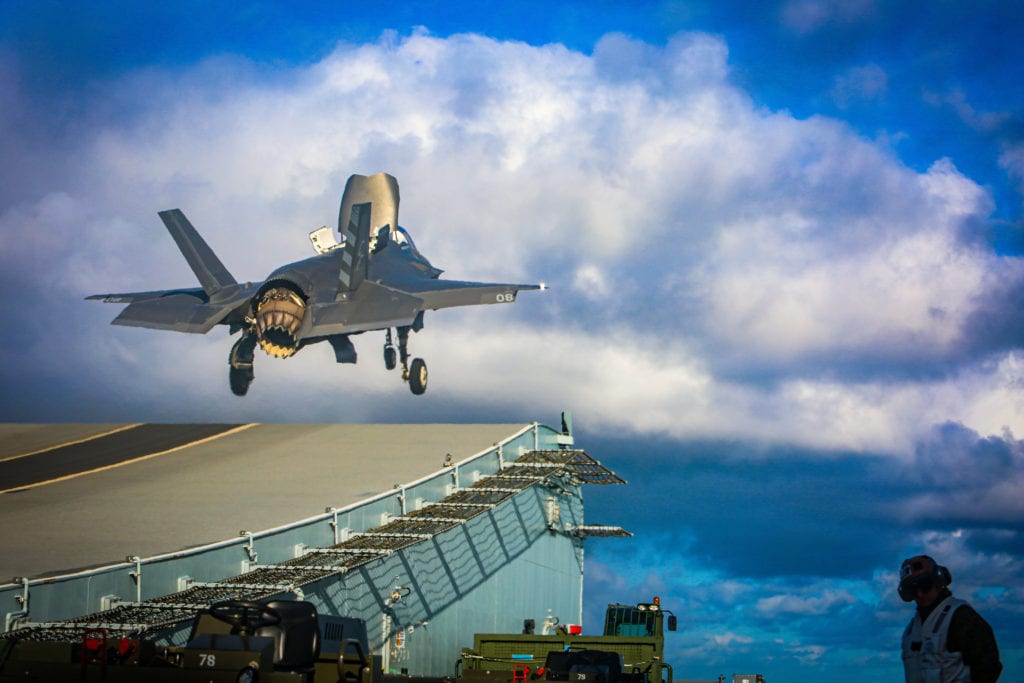
A Marine with Marine Fighter Attack Squadron (VMFA) 211 launches an F-35B Lightning II Joint Strike Fighter from the deck aboard Her Majesty’s Ship (HMS) Queen Elizabeth at sea on 10 October, 2020. U.S. Marine Corps / 1st Lt. Zachary Bodner

LONDON — The United Kingdom Royal Navy’s Carrier Strike Group (CSG) has reached Initial Operating Capability (IOC), meaning all elements of the group from fighter jets to radar systems to anti-ship weapons have been successfully brought together and operated, the U.K Ministry of Defence said in a Jan. 4 release. 

Both the air and naval elements of the CSG have now met this milestone, which includes qualified pilots and ground crews being held at short notice for carrier-based operations and trained to handle weapons and maintain the equipment. 

Another marker of success at this stage includes the ability to deploy Anti-Submarine Warfare capabilities such as frigates and destroyers, as well as both fixed and rotary wing aircraft including Merlin helicopters to operate alongside the carrier. 

“This is a hugely significant milestone for HMS Queen Elizabeth, the Royal Navy and the whole country,” said Defence Minister Jeremy Quin. “This achievement is a testament to the determination of our service personnel and industry workforce who have delivered this first-rate military capability, a capability held by only a handful of nations. I wish the entire Carrier Strike Group well ahead of their first operational deployment this year.” 

Following the success of the NATO Joint Warrior Exercises last autumn, the Carrier Strike Group capability has reached the key IOC milestone for the program on schedule. 

The multinational deployment in 2020 focused on incorporating all elements of the CSG with 13 of the United Kingdom’s allies including Belgium, Canada, Denmark, France, Germany, Latvia, the Netherlands, Norway, Spain, Turkey, Japan, United Arab Emirates and the United States. Exercise Joint Warrior saw the largest number of aircraft on a British Royal Navy carrier since 1983, as well as the most F-35B jets at sea across the globe. In addition to U.K. F-35Bs, the Queen Elizabeth has operated with U.S. Marine Corps F-35Bs assigned to Marine Fighter Attack Squadron 211. 

Full operating capability for the CSG is expected by December 2023. 


Australia Set to Acquire Two More P-8A Aircraft to Boost Maritime Patrol Capability

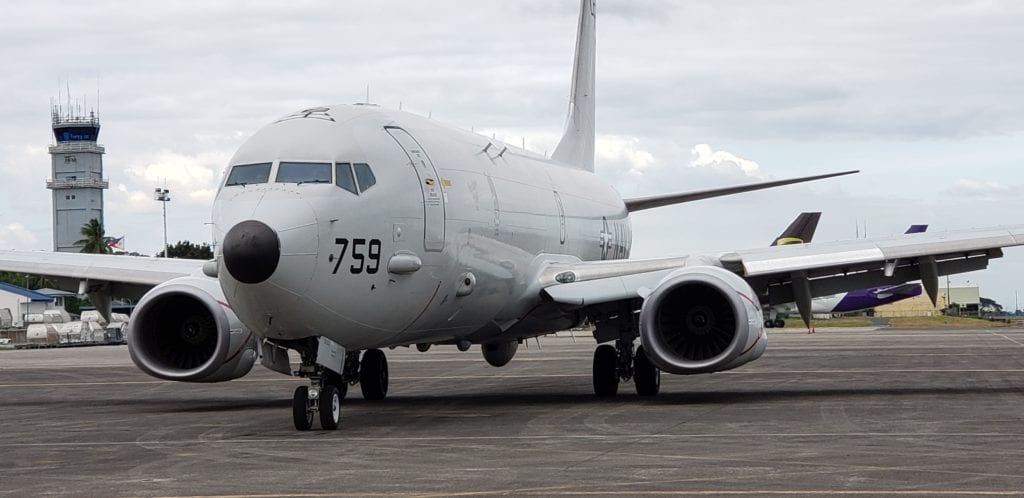
A P-8A aircraft 759 arrives at its parking spot in this 2019 photo. The Royal Australian Air Force will acquire two more P-8A Poseidons, bringing it total fleet size to 14. U.S. Navy / Lt. Cmdr. Alan Johnson

CANBERRA, Australia—The Royal Australian Air Force’s maritime patrol capability will be boosted with Australia set to acquire two more P-8A Poseidon surveillance and response aircraft, bringing the total fleet size to 14, the Australian Department of Defence said in a Jan. 4 release. 

The government has also approved sustainment funding for the current approved fleet of three MQ-4C Triton aircraft. 

Sen. Linda Reynolds, the Australian defense minister, said the announcement is part of the Morrison government’s unprecedented $270 billion investment in defense capability over the next decade. 

“Together, the Poseidon and the Triton will provide Australia with one of the most advanced maritime patrol and response capabilities in the world,” Reynolds said. “The Poseidon is a proven capability that will conduct tasks including anti-submarine warfare, maritime and overland intelligence, surveillance and reconnaissance, and support to search and rescue missions. These additional aircraft will enhance Air Force’s flexibility to support multiple operations and will play an important role in ensuring Australia’s maritime region is secure for generations to come. 

“The Morrison government’s continued investment in the Poseidon program is also creating more Australian jobs and opportunities for Australian small businesses, she said. “Several Australian companies are already completing work for Boeing Defence Australia, and industry investment including facilities works is over $1 billion.” 

The additional Poseidon aircraft are to be purchased through Australia’s existing cooperative program with the U.S. Navy. Reynolds said the program allows Australia to share in the benefits of their technical expertise and divide project costs. 

“Defence is committed to this cooperative approach; together we are striving to develop this military technology to the highest standards,” Reynolds said. 

The Poseidon is a highly versatile, long endurance platform capable of a range of mission types including maritime intelligence surveillance and reconnaissance and striking targets above and below the ocean’s surface. 

The planned integration of the Long Range Anti-Ship Missile (LRASM) into RAAF capability will also allow it to strike adversary surface vessels at significantly increased ranges. 


HII Expands Unmanned Capabilities by Acquiring Autonomy Business from Spatial Integrated Systems

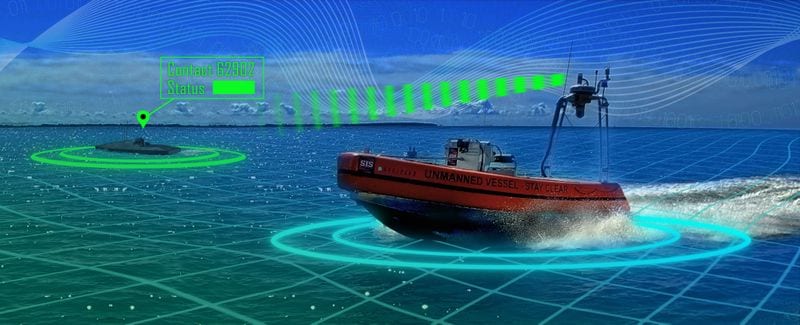
An illustration of Spatial Integrated Systems’ capabilities in unmanned systems. SIS’ unmanned systems solutions, including multi-vehicle collaborative autonomy, sensor fusion and perception, have been fielded for more than 6,000 hours on 23 vessel types. Huntington Ingalls Industries

NEWPORT NEWS, Va. — Huntington Ingalls Industries (HII) has acquired the autonomy business of Spatial Integrated Systems Inc. (SIS), HII said in a Jan. 4 release. The acquisition further expands HII’s unmanned systems capabilities with this highly skilled team and proven unmanned surface vessel (USV) solutions. 

“We are excited to welcome the SIS autonomy business employees to the HII family,” said Andy Green, HII executive vice president and president of Technical Solutions. “2020 was a significant year for HII in the unmanned systems industry, and this acquisition is the perfect complement to our existing portfolio and strategic partnerships.” 

“I am pleased that HII will carry on SIS’s vision to deliver advanced autonomy to our armed forces in support of our national interest,” said Dr. Ali Farsaie, CEO and founder of SIS. 

SIS’s unmanned systems solutions — including multi-vehicle collaborative autonomy, sensor fusion and perception — have been fielded for more than 6,000 hours on 23 vessel types. They have supported multiple development projects and demonstrations advancing autonomy in unmanned systems in the maritime, ground and air domains. 

“SIS is a leader in autonomous technology, and this acquisition adds significant breadth to our unmanned systems solutions,” said Duane Fotheringham, president of Technical Solutions’ Unmanned Systems business group. “This technology and the talented team provide unmatched capabilities in multi-domain collaborative autonomy and perception, allowing HII to uniquely address our customers’ needs.” 

SIS’s solutions are actively in use throughout the Department of Defense, coordinating and controlling multiple collaborative unmanned vehicles in the execution of mission applications including intelligence, surveillance, and reconnaissance, harbor patrol, high-value unit escort missions, payload delivery, mine clearance, and transporting supplies. SIS’s intelligent, goal-oriented USV solutions follow Unmanned Maritime Autonomy Architecture standards and integrate proven obstacle avoidance and International Regulations for Preventing Collisions at Sea-compliant behaviors. 

The acquisition of SIS’s autonomy business follows other recent unmanned systems activity by HII, including the acquisition of Hydroid, a strategic alliance with Kongsberg Maritime, an equity investment in Sea Machines, and the groundbreaking on a new HII Unmanned Systems Center of Excellence in Hampton, Virginia. 

The transaction closed on Dec. 31, 2020, and approximately 50 employees from SIS, primarily located in Virginia Beach, Virginia, have joined HII Technical Solutions’ Unmanned Systems business group. Sam Lewis, president and chief operating officer of SIS, will lead the company’s USV efforts, reporting to Fotheringham. The cost of the transaction is not being disclosed. 


Navy Awards Contract to Thoma-Sea Marine to Build 2 NOAA Ships

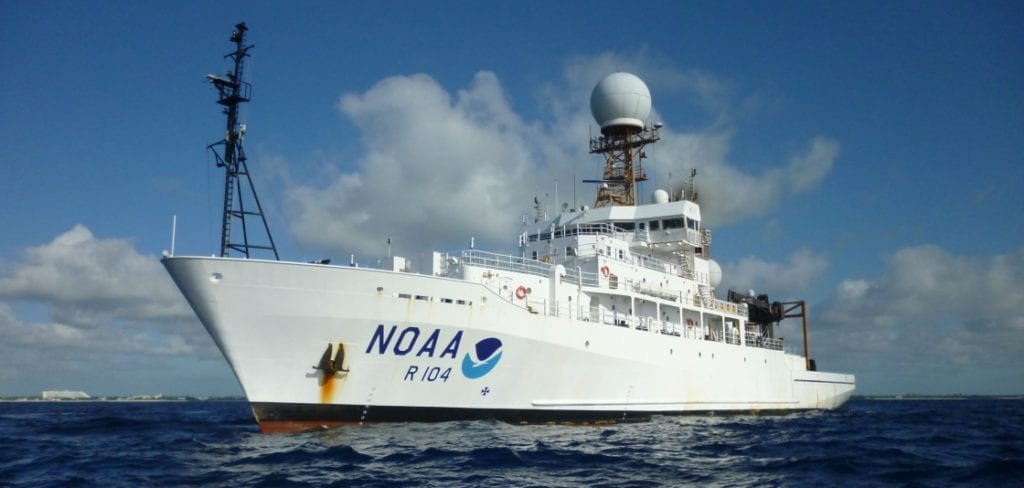
An existing NOAA research ship, the Ronald. H. Brown. NOAA / Wes Struble

WASHINGTON — The National Oceanic and Atmospheric Administration’s (NOAA’s) effort to recapitalize its aging fleet of research ships took a major step forward today with the U.S. Navy’s award of a $178.1 million contract to Thoma-Sea Marine Constructors LLC, Houma, Louisiana, for the detailed design and construction of two new oceanographic ships for the agency, NOAA said in a Dec. 31 release.

NOAA is acquiring the vessels through an agreement with the Naval Sea Systems Command, a leader in building, providing and procuring large research ships for the nation’s research fleet. 

“We can all be proud that these two new NOAA ships will be built in the United States by highly skilled workers, and to the highest standards,” said U.S. Secretary of Commerce Wilbur Ross. “The nation will benefit greatly from the information these state-of-the-art vessels will collect for decades to come.” 

The first ship, to be named Oceanographer, will be homeported in Honolulu. The second ship, to be named Discoverer, will be assigned a homeport at a future date. Both vessels will continue the legacies of their namesakes.  

The first Oceanographer served in the NOAA fleet from 1966 to 1996 and her sister ship, Discoverer, served from 1967 to 1996. 

The new ships will support a wide variety of missions, ranging from general oceanographic research and exploration to marine life, climate and ocean ecosystem studies. These missions include shallow coastal, continental shelf, and worldwide ocean survey and data collection. 

Designed as single-hull ships, Oceanographer and Discoverer will be built to commercial standards. They will incorporate the latest technologies, including high-efficiency, environmentally friendly EPA Tier IV diesel engines, emissions controls for stack gases, new information technology tools for monitoring shipboard systems, and underwater scientific research and survey equipment. 

“These state-of-the-art ships will play a vital role in collecting high-quality data and leading scientific discoveries,” said Neil Jacobs, Ph.D., acting NOAA administrator. “The science missions aboard these vessels promise to push the boundaries of what is known about our still largely undiscovered ocean.” 

The ships will be equipped to launch work boats, perform maintenance on buoys and moorings, deploy scientific instruments to collect weather and water column data, and conduct seafloor mapping surveys. Each vessel will operate with a crew of 20 and will accommodate up to 28 scientists. 

“This contract award represents a major step forward in the process to recapitalize NOAA’s ship fleet,” said NOAA Rear Adm. Michael J. Silah, director of the NOAA Commissioned Officer Corps and NOAA Office of Marine and Aviation Operations (OMAO). “We thank the Navy, our valued partner, for its assistance with this acquisition.” 

The NOAA ship fleet is operated, managed and maintained by OMAO, which is composed of civilians and officers with the NOAA Commissioned Officer Corps, one of the nation’s eight uniformed services. 


F-35 Deliveries by Lockheed Martin in 2020 Total 123

Two U.S. Air Force F-35A Lightning IIs conduct flight training operations over the Utah Test and Training Range on Feb 14, 2018. Lockheed Martin has delivered the 123rd F-35 aircraft of the year, an F-35A delivered to the Italian air force. U.S. Air Force / Staff Sgt. Andrew Lee

FORT WORTH, Texas – Lockheed Martin delivered the 123rd F-35 aircraft of the year last week, the company said in a Dec. 28 release.  

The 123rd aircraft is an F-35A conventional takeoff and landing (CTOL) variant, built at the Cameri, Italy, Final Assembly and Checkout facility and delivered to the Italian air force. In 2020, 74 F-35s were delivered to the United States military, 31 to international partner nations and 18 to Foreign Military Sales customers. 

In response to COVID-19 related supplier delays, in May the initial annual delivery goal was revised from 141 to 117-123 aircraft to strategically avoid surging, which would increase production-related costs and create future delays and disruption. 

“The F-35 joint enterprise team rapidly responded to the challenges of the COVID-19 pandemic to continue to deliver the unmatched combat capability the F-35 brings to the warfighter,” said Bill Brotherton, acting vice president and general manager of the F-35 program. “Achieving this milestone amid a global pandemic is a testament to the hard work and dedication of the team and their commitment to our customers’ missions.” 

Lockheed Martin took proactive measures to mitigate COVID-19 supplier impacts and position the program for the fastest possible recovery by adjusting employee work schedules, maintaining specialized employee skillsets, and providing accelerated payments to small and vulnerable suppliers. Lockheed Martin provided accelerated payments to more than 400 F-35 suppliers in 45 states and Puerto Rico. 

Though COVID-19 will have short-term impacts on production, the F-35 program continues to work diligently and is on track to meet the joint government and industry recovery commitments over the coming years.   

There are more than 600 aircraft operating from 26 bases and ships around the globe. More than 1,200 pilots and 10,000 maintainers are trained, and the F-35 fleet has surpassed more than 350,000 cumulative flight hours. Nine nations have F-35s operating from a base on their home soil, nine services have declared Initial Operational Capability and six services have employed F-35s in combat operations. The U.S. Air Force deployed the F-35 for 18 consecutive months from April 2019 until October 2020 in the U.S. Central Command Area of Responsibility with hundreds of weapons employments in support of U.S. servicemembers and their allies.  

The year also included initial fielding of the Operational Data Integrated Network, the follow-on to the Autonomic Logistics Information System, with excellent initial results. The system will be fully operational in 2022. Mission capable rates for the aircraft continued to improve in 2020 with rates greater than 70% across the fleet, and even higher for deployed units. The F-35 also proved its value in joint all-domain operations with multiple exercises that highlighted the aircraft’s ability to gather, interpret and share information with various platforms.