Caudle: ‘Era of Platform-Centric Thinking is Over’
By Brett Davis, Editor-in-Chief
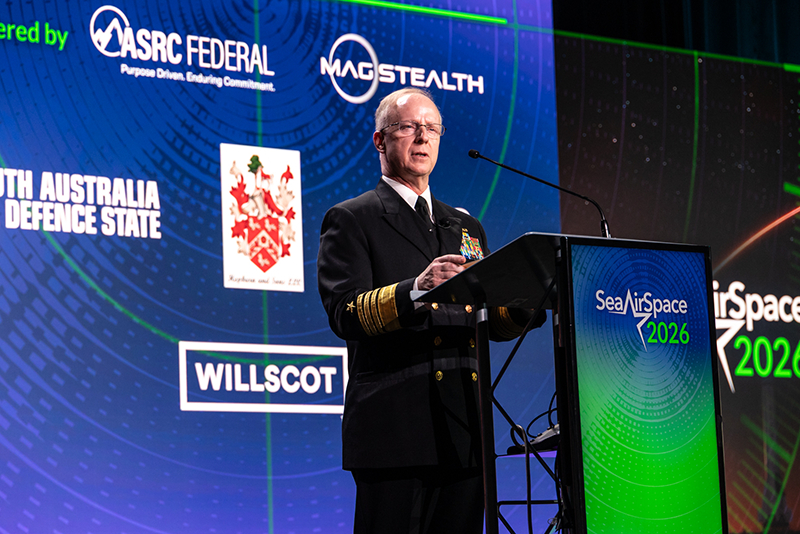
Ongoing operations against Iran are the “early expression of the Golden Fleet design” the Navy is pursuing, which will require a new way of doing business with the defense industry, Chief of Naval Operations Admiral Daryl Caudle said at the opening luncheon at Sea-Air-Space 2026 on Monday, April 20.
The Golden Fleet Initiative “integrates a high-low mix of crewed and uncrewed platforms,” including uncrewed surface and underwater vehicles, into “tailored force packages” for combatant commanders, he said.
All of these will be “enabled by advanced manufacturing, artificial intelligence, directed energy and containerized capabilities,” he said, “because the era of platform-centric thinking is over.”
The low side would be attritable uncrewed systems that could be built and deployed rapidly, and the high side would be the main battle force, including submarines, destroyers and the new battleship, which would begin design work under the new Pentagon budget.
“It creates a continuous engine that can produce, adapt and employ combat power faster than any adversary, levering the hedge strategy in order to optimize our Navy,” Caudle said.
His message to the industry officials in the room was simple: “Build systems that integrate. Build systems that scale. Build systems that sustain in contact. And build them fast.”
To that end, Caudle said he has introduced the Fleet Introduction Operating System, or FIOS.
“Under FIOS, when the Navy receives a new capability, subsequent updates and upgrades should be as seamless as updating an app on your phone,” he said. “That means common interface standards. It means modularity. Open architecture. Virtualization with digital twins. Familiar look and feel. Modern training content that matches the style of what we are doing … FIOS is how we end the era where the fleet is the integration lab. If a capability shows up, it’s ready to fight, day one.”
Sailor Concerns
Earlier in the day, Caudle met with reporters to discuss his priorities and to push back on recent news reports about poor Sailor food during Operation Epic Fury.
“Nutrition for Sailors has been one of my top priorities,” he said, as he wants to treat Sailors “like world-class athletes.”
He said at least some of the photos sent to media reports appear to have been taken on shore facilities, not at sea, and all ships in the operation had at least 10 days’ worth of food, and most had more than 30.
“But in no way, shape or form has there been a time, at least in this deployment, where they’ve not meant the nutritional requirements” of Sailors, Caudle said.
Sailors occasionally might grumble about individual meals but otherwise he had heard no food complaints until the story broke.
The food is just part of the Navy’s push to better the lives of its service members, which Caudle said will be reflected in the pending defense budget request.
The Navy tries to get a quick jump on unsafe living conditions if there is a “tactical” issue, he said, but a recent unhealthy leak situation at the Red Hill facility in Hawaii led to a pilot program where responses to public works issues have been moved from Naval Facilities Command, a systems command, to a local captain and region commander to align solving those issues with the base command.
“public work divisions is not only base operations stuff … but it’s also tied into NAVFAC, so it’s not that easy just to split that out, so we had to figure out how to do that, so we’re working that with the mid-South region now down in Norfolk and Hampton Roads.”
The Navy has been pushing to improve unaccompanied housing for Sailors. “When the budget rolls out, that the administration and secretary of the Navy are certainly behind funding barracks and getting more and better quality situations there … you’re going to see that in the budget and you’re going to see that as a high priority for us,” he said.