Commandant Gives an Update on Marines Future
By Vicky Uhland, Seapower Correspondent
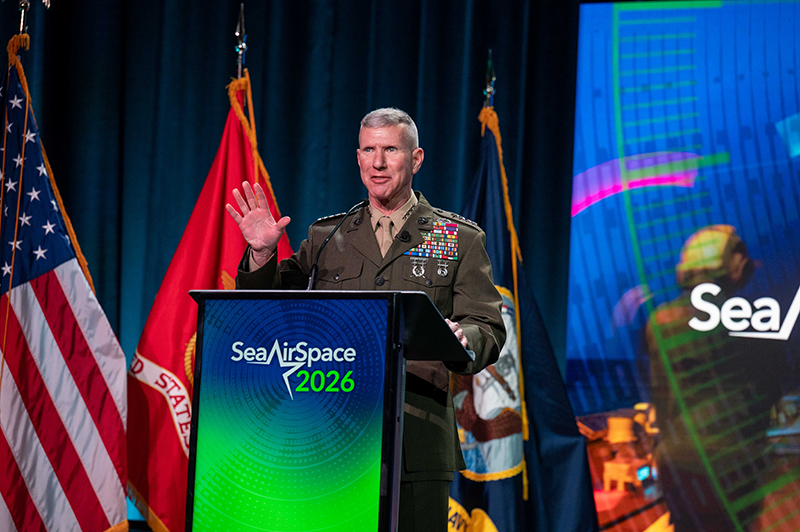
Marines don’t win wars; they win battles, said General Eric Smith, commandant of the U.S. Marine Corps, during the Tuesday afternoon session “250 Years Strong — Building the Marine Corps of Tomorrow.”
“If you’re looking for a chain-mail fist, you’re looking at the U.S. Army,” he said. “If you’re looking to get popped in the nose, you’re looking at the Marine Corps.”
Smith outlined how the Marines are evolving with the changing character of war. The amphibious ready group remains the crown jewel of the expeditionary force, he said, and is currently deploying a three-ship Marine expeditionary unit — one from the East Coast, one from the West Coast and one from Japan. “We could use 5.5 MEUs, but we are committed to an unwavering goal of a 3.0 MEU presence,” he said.
Smith said the Marines are also optimizing maintenance schedules to get more out of ships, are targeting investments in service-life extensions and are moving forward with procurement of new, more capable ships.
“Our current investment of 31 amphibious ships is not adequate,” he said, noting that the 2027 defense budget is a significant down payment on a generational investment in ships, but more money is needed.
Another area of emphasis is littoral mobility, mainly in the Indo-Pacific, which Smith called the world’s most challenging environment due to scale and size.
Smith said the Marines are also bolstering their logistics network.
“For decades, we operated with uncontested logistics, but the days of being three steps away from an MRE” or other supplies are over, he said. “As the maritime environment becomes less permissive, the global positioning network comes in.”
Smith said another challenge that “worries me greatly right now” is sufficient magazine depth, which can give commanders freedom of action and reduce operational risk.
Smith also highlighted current areas of achievement, including a clean financial audit for the third year in a row, the only service agency to do so. Barracks 2030 is delivering modern, safe and comfortable living conditions for Marines, and the Marine Corps Total Fitness program is helping make warriors physically, mentally, spiritually and socially resilient, he said.
Smith also answered some audience questions, including:
What can industry do to improve Marine resilience?
“Keep on budget. Don’t sell me what I don’t need. Give me what I’m asking for at a price I can afford,” Smith said.
What in-house innovations are impressing you?
The Drone Dominance task force in Quantico is doing an amazing job with drone technology, Smith said. “We’re still too expensive and haven’t learned all the lessons of Ukraine, but we’re getting faster and faster.”