Gecko Robotics’ Komodo Robot Aids Ship Flight Deck Maintenance
By Richard R. Burgess, Senior Editor
ARLINGTON, Va. — Robots and other unmanned systems are advocated to relieve humans for the “dull, dirty, and dangerous” jobs and missions the Navy is called upon to complete. One example is the increasing use of robotics for assessment and maintenance of ship surfaces such as the flight decks, weather decks, and well desks as applicable of amphibious warfare ships and guided-missile destroyers. Artificial intelligence is being added to speed up the processes.
Flight decks are coated with non-skid, a rough coating that reduces the slickness of the decks, enhancing the safety of operations sea for personnel, aircraft, and ground support equipment. The coating needs to be replaced periodically as it is worn down by operations. Assessing that need is being accomplished by Gecko’s Komodo robots.
The U.S. Navy and the General Services Administration have awarded Gecko Robotics of Pittsburgh, Pennsylvania, a contract with a ceiling of $71 million “to deploy artificial intelligence and robotics to assess and maintain the health of military assets,” the company said in a release. “Gecko will start work with 18 ships [per year] in the U.S. Pacific Fleet with the initial award worth up to $54million over a five-year period.
“The Chief of Naval Operations has set a target of 80% fleet readiness, which Gecko will have a crucial role in helping to meet,” Gecko said. “Gecko’s advanced AI and robotic technology identify repairs up to 50 times faster and more accurately than manual methods, reducing maintenance delays and boosting battle readiness. This work will be carried out across destroyers, amphibious warships, and littoral combat ships.”
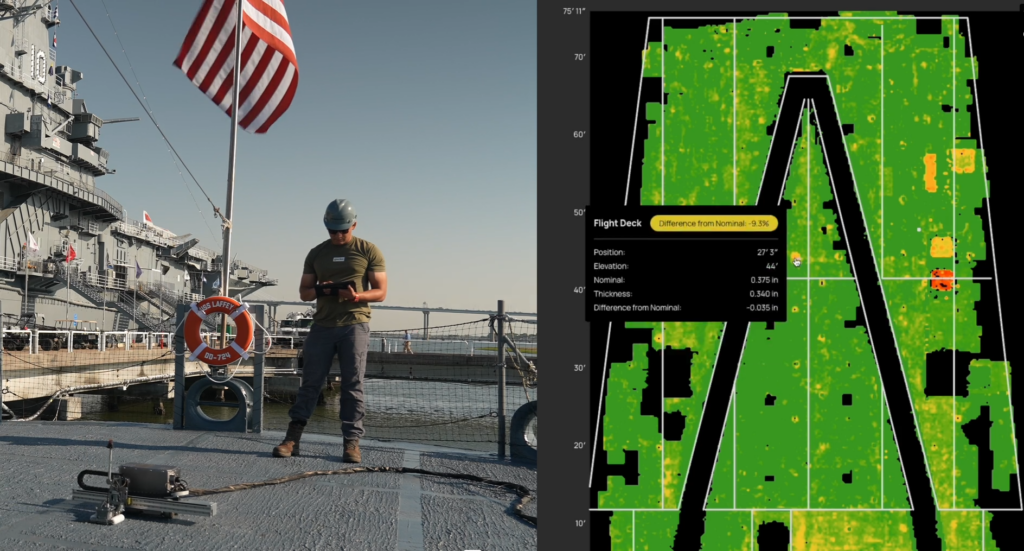
Gecko’s Komodo robot is designed to assess the extent of corrosion of non-skid, said Troy Demmer, co-founder and president of Gecko, in an interview with Seapower. The crawling robot uses “electromagnetic acoustic conduction to create an ultrasonic waveform that can penetrate that non-skid down to the base metal and be able to assess any sort of corrosion.”
The Komodo is able to operate during different sea states on the ship’s flight deck, enabling an assessment of the deck at sea six to 12 months before the ship enters a maintenance availability, reducing the time spent on the task of refurbishing the deck. The robot rolls along like a paint roller, its sensor scanning the deck in its passes, taking measurements, and recording those data points on a map display of a laptop computer. The measurements allow the Navy to determine the areas of the deck that need attention for non-skid maintenance.
Gecko also uses its Toka wall-climbing robots to scaling U.S. Navy ship hulls in order to assess corrosion.
Demmer expects the U.S. Naval Surface Force Atlantic to request Gecko’s services in the future in a separate contract.
“Where value hasn’t improved, that’s where opportunity lives. Cracking the cost equation is just as important as cracking the physics equation,” said Justin Fanelli, Chief Technology Officer for the Department of the Navy, quoted by Geck in its release. ”We’re now seeing solutions that make innovation adoption easier and in doing so save time, money and risk. When these American companies, pure play defense and dual use companies like Gecko Robotics, choose to do hard things and move the needle on our outcome metrics, not by percentage points but by orders of magnitude, it results in faster, better portfolio management.”
Gecko employs about 275 personnel, half of them based in Pittsburgh.