Navy’s MQ-25A Stingray secures Milestone C approval
From Neil Lobeda, May 19, 2026
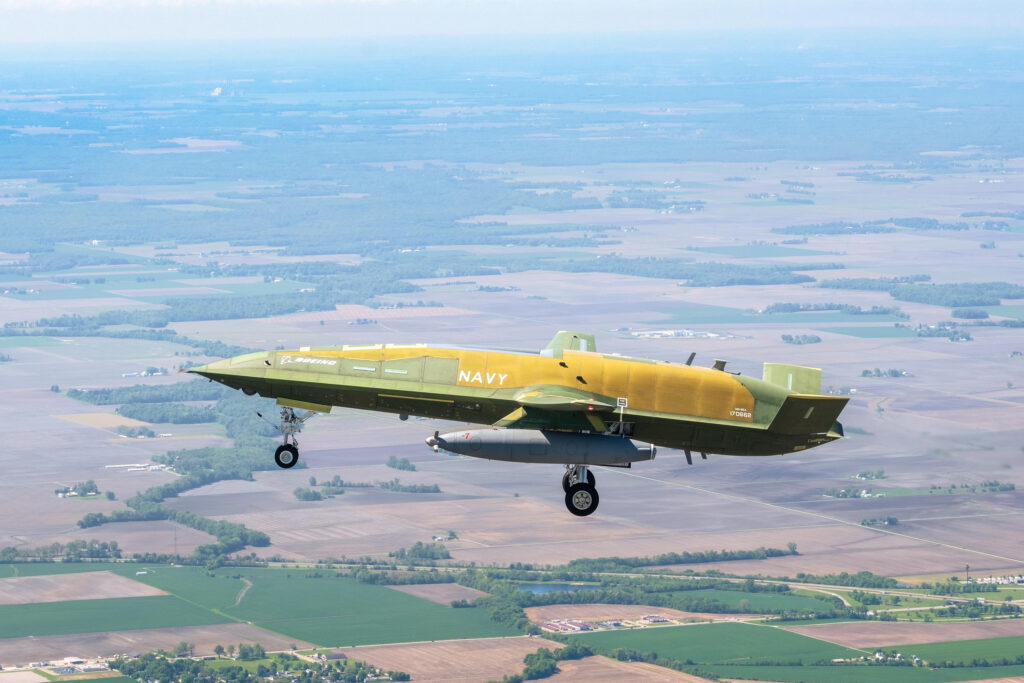
Following a successful first flight in April, Acting Secretary of the Navy Hung Cao announced today that the MQ-25A Stingray received Milestone C approval to move into Low-Rate Initial Production (LRIP).
The milestone marks a major step forward in the Navy’s commitment to unmanned carrier aviation. An LRIP Lot 1 contract for three aircraft is expected to be awarded this summer and include priced options for Lot 2 (3 aircraft) and Lot 3 (5 aircraft).
“Unmanned refueling extends our reach against any adversary,” stated Acting Secretary of the Navy Hung Cao. “Moving the MQ-25A Stingray to Milestone C and into production is arming our warfighters with a capability that increases the lethality of our Carrier Strike Groups. This is a decisive advantage that delivers our warfighters what they need to fight and win.”
As the world’s first fully integrated, carrier-based unmanned aerial vehicle, the MQ-25A serves as the pathfinder for the future of unmanned carrier aviation. Stingray will provide the Carrier Air Wing (CVW) with essential organic refueling, allowing more F/A-18E/F aircraft to focus on strike missions. This will expand the operational reach of the air wing while preserving the service life of F/A-18E/Fs, improving readiness across the Super Hornet fleet. The Stingray is also at the forefront of integrating unmanned systems alongside manned platforms within the CVW, setting the stage for future advancements in naval aviation.
“Milestone C approval represents an important step for this program,” said Vice Adm. John E. Dougherty IV, Portfolio Acquisition Executive Aviation. “MQ‑25A will provide persistent aerial refueling and unlock greater capacity across the air wing, ensuring our carrier strike groups remain lethal, flexible, and forward‑ready.”
“The aircraft is ready, production is ready, and the program is ready to move this groundbreaking capability forward, paving the way for unmanned carrier aviation and enhancing fleet capability, capacity and lethality,” said Capt. Daniel Fucito, Unmanned Carrier Aviation program manager.
The MQ‑25A program is managed by the Unmanned Carrier Aviation Program Office (PMA‑268), which is responsible for the MQ‑25A Stingray unmanned air system and the Unmanned Carrier Aviation Mission Control System (UMCS). PMA‑268 is aligned under the Carrier Strike Deputy Portfolio Acquisition Executive (DPAE), within the Portfolio Acquisition Executive for Aviation (PAE(A)).
Editor’s note: Boeing released the following statement:
“Boeing is honored to work alongside our U.S. Navy partner in achieving this historic milestone in the MQ-25A Stingray’s development life cycle,” said Troy Rutherford, vice president, Boeing MQ-25 program. “We remain focused on getting this game-changing unmanned aircraft into the hands of the fleet and integrated into the carrier air wing.”