NPS Online Student Advances Fleet Analysis of Autonomous Systems
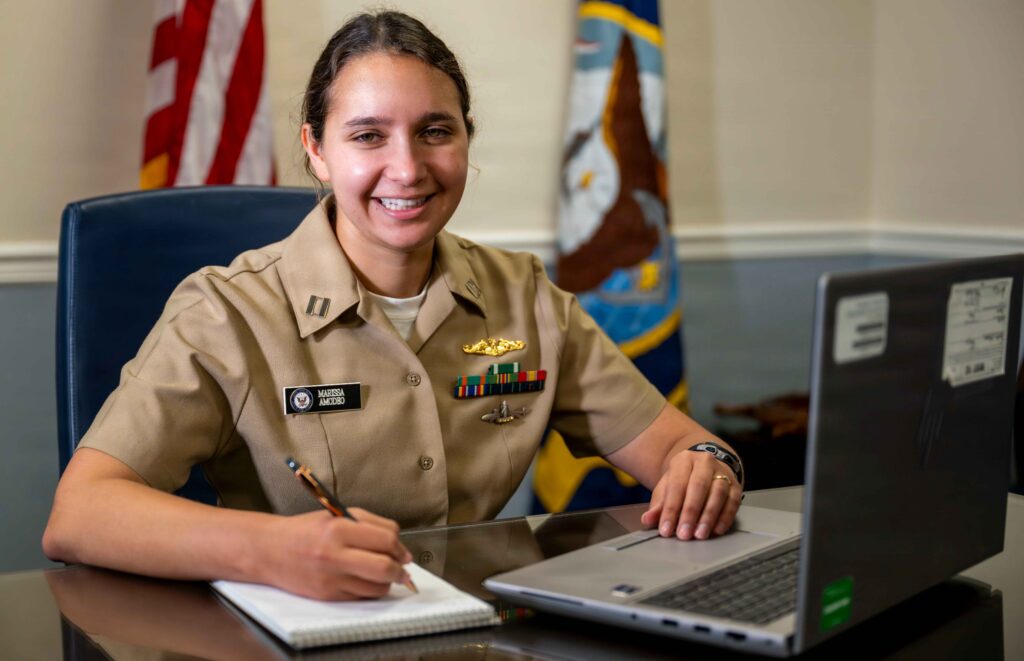
From Mass Communication Specialist 2nd Class Andrew Langholf, May 6, 2026
MONTEREY, Calif. — Advanced analyses completed by a Naval Postgraduate School (NPS) distance learning student is helping inform the U.S. Navy’s future employment of autonomous systems, demonstrating how NPS Online students, and the school’s unique certificate programs, offer the same impact on fleet needs as their counterparts on campus in Monterey.
U.S. Navy Lt. Marissa Amodeo, assigned to the Office of the Chief of Naval Operations Assessment Division, OPNAV N81, completed the systems analysis certificate program this past March. Through the coursework required for one of her classes in the program, titled Combat Systems Simulation, Amodeo developed a model and supporting analysis to inform autonomous systems concepts of operations, or CONOPS.
The work was well received by senior leadership, including OPNAV N81 director U.S. Navy Rear Adm. Douglas Sasse, with the potential to help inform future Navy acquisitions of unmanned systems. More specifically, Amodeo’s work focused on how the Navy can move from buying new technology, to fielding that technology as an advanced warfighting capability as effectively and efficiently as possible.
“My project tackled a key operational issue — making sure Navy investments in emerging technology, like small, unmanned surface vehicles, translate into usable warfighting capability,” Amodeo said. “We are fielding robotic technologies quickly, but we still do not fully understand the deployment of bottlenecks. Identifying and quantifying those constraints is essential to mission success.”
As an analyst, Amodeo’s job is to support the OPNAV N81 mission to provide detailed, evidence-based analyses that inform decisions on resources, acquisitions, and readiness.
“At OPNAV N81, our mission is timely, data-driven analysis that informs resource decisions,” she said. “My goal was to provide an analytical foundation that helps shape planning for these platforms and supports their integration into the fleet.”
Stew Sharp, a senior member of the OPNAV N81 campaign analysis team, said Amodeo’s work demonstrates how technical education strengthens U.S. Navy warfighting.
“Lt. Amodeo’s work is a powerful testament to how technical education can be a direct force multiplier for our mission,” Sharp said. “By applying advanced systems analysis, she transformed a complex operational challenge into a clear, data-driven model, revealing the critical bottlenecks we must address to successfully integrate unmanned systems.”
“Her initiative provides the analytical foundation to guide future investment, ensuring our advanced technology delivers a decisive edge in real-world naval operations,” Sharp continued.
NPS distance learning programs give military professionals access to advanced graduate education in the NPS Department of Operations Research that they can apply directly to operational challenges at their commands. In the systems analysis certificate program, students develop analytical skills that support complex operational questions, including force design, decision support, and emerging warfighting concepts.
“The NPS program gave me the toolkit to do this,” Amodeo said. “The combat systems and simulation course helped me build a discrete event queuing model, and the broader curriculum strengthened my systems thinking so I could turn a complex process into actionable insight.”
As the Department of the Navy works to understand how autonomous systems can be integrated into future operations, the connection between education and application becomes increasingly important. For officers serving in operational and assessment roles, graduate-level analysis helps commands evaluate concepts earlier, make more informed decisions faster, and directly align emerging capabilities with fleet needs.
“The biggest takeaway is that deploying autonomous systems at scale is a systems problem, not a linear one,” Amodeo said. “Processes that work for one or two units can break at scale when bottlenecks appear.”
“My analysis showed that when demand hits many assets at once, small constraints can delay deployment, even under optimistic assumptions,” she added. “Logistics and maintenance capacity can determine readiness, so the Navy has to invest in the process, not just the platform.”
Dr. Dashi Singham, research associate professor in NPS’ Department of Operations Research, taught the course leading to Amodeo’s analysis. She said distance learning students are uniquely positioned to bring current operational problems into the classroom and use simulation tools to understand and inform decisions before they are made.
“Many distance learning students work in operational environments where real systems can be modeled using discrete event simulation,” Singham said. “That allows them to test potential policy changes in a simulated environment and provide immediate, data-driven recommendations across a variety of fleet settings.”
Amodeo said her full-time job as an OPNAV N81 analyst is a heavy lift, but the addition of an NPS class to her already busy schedule is anything but a distraction. In fact, the skills learned through the four-course certificate sequence immediately strengthened the work she was doing, Amodeo says, and ultimately advanced to the quality of the analyses she delivered to the fleet.
“These programs are not a distraction from the job. They are a force multiplier,” Amodeo said. “They help you ask better questions, challenge assumptions with data, and deliver more impactful results for the fleet and warfighter.”
NPS, located in Monterey, California, provides warfighting-focused graduate education, including classified studies and interdisciplinary research, to advance the operational effectiveness, technological leadership, and warfighting advantage of the naval service. Established in 1909, NPS offers master’s, doctoral, and distance learning certificate programs to Department of War military and civilian students, along with international partners, to develop warfighters and leaders who can think critically, solve complex operational problems, and deliver mission-ready solutions through advanced education and research.