One Day Before Departure, Phelan Touted Need for New Budget, New Business Practices, New Battleship
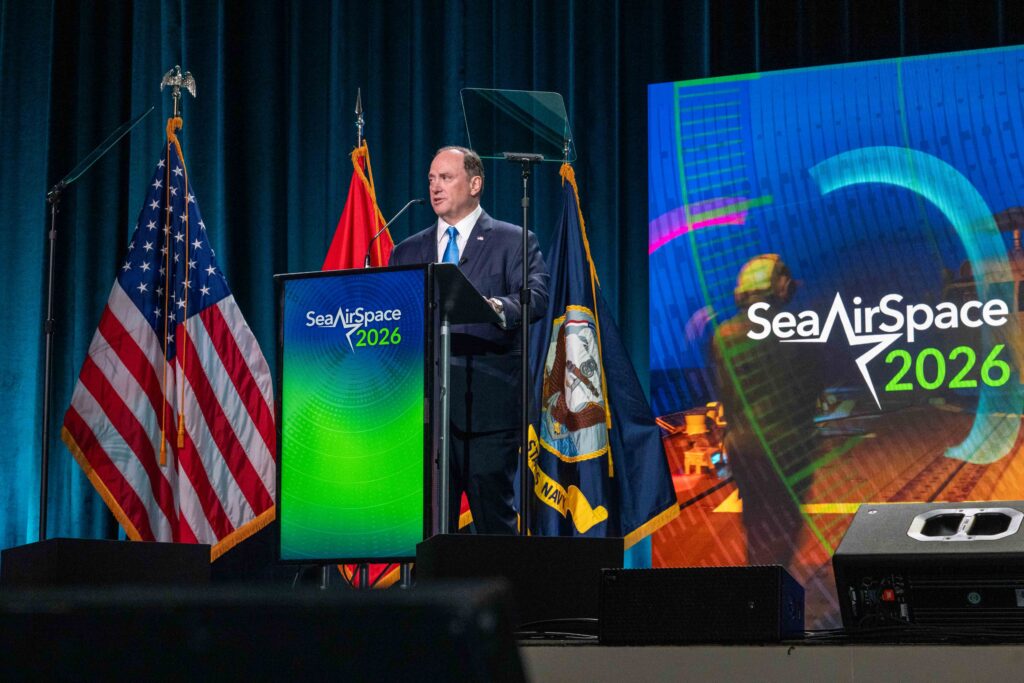
Editor’s note: This story appeared April 21 in Seapower’s Show Daily at Sea-Air-Space. On April 22, Pentagon Spokesman Sean Parnell announced on X that John Phelan was leaving the administration; other media reports said he had been forced out. Undersecretary of the Navy Hung Cao is now acting secretary of the Navy. This article is about his keynote speech at Sea-Air-Space.
On the day the Pentagon released a $1.5 trillion fiscal 2027 defense budget, Navy Secretary John Phelan addressed Sea-Air-Space and said the Department of the Navy needs a budget, not a series of continuing resolutions from Congress.
Phelan also defended the controversial planned Trump-class battleship, saying it brings a needed capability and would anchor the new “high-low” Golden Fleet concept outlined the day before by Chief of Naval Operations Admiral Daryl Caudle, speaking from the same stage.
Phelan also echoed Caudle in saying doing business with the Navy must change, which is why the service recently announced a new portfolio acquisition executive (PAE) structure, appointing five senior leaders to act as single accountable officials for key domains to accelerate capability delivery and keep a lid on costs.
Phelan said he will soon testify on the budget on Capitol Hill and will tell lawmakers a continuing resolution — a budget carrying forward current levels of spending — “would have extremely negative consequences for the DoN. It’s like running a business and not being able to charge what your competitors do,” he said. “Continuing resolutions impose constrained short-term funding conditions that force legacy program tradeoffs and impact our ability to innovate and therefore our readiness over time.”
The Golden Fleet initiative “is about delivering the fleet of the future through three mutually reinforcing pillars. One, to maintain and enhance maritime dominance. Two, revitalize the maritime industrial base and three, change how the Department of the Navy does business,” Phelan said.
The initiative includes the proposed Trump-class battleship, or BBG(X), certain to be a target of some in Congress.
“I know the question many of you and the pundits are asking, why battleships, and why now? The answer is straightforward and grounded in the realities of high-end conflict in shaping the next large surface combatant,” he said.
Phelan said he has discussed the issue with top admirals and commanders and said they don’t want to have to choose between air defense, anti-ship warfare, anti-submarine warfare or long-range strikes.
“Battleship strike groups will offer commanders more options than what exists in today’s fleet,” he said. The ships would be “built to fight and stay in the fight by sustaining fires, maintaining pressure and outlasting any adversary … these are not capabilities you can fully distribute across smaller systems alone.”
Phelan said he has heard the critiques of the proposed battleship, that it would be too vulnerable, too expensive, too big. “We’ve heard that before about carriers and about submarines and yet when it matters most, those are the platforms that combatant commanders call for.”
However, he said the battleship would be just a “small part” of the Golden Fleet and would operate as part of a distributed network that would include smaller ships, crewed and uncrewed.
“This is not about replacing the fleet … the strategic reality is that manned platforms combined with unmanned systems, acting interchangeably, is the most powerful winning combination.”
Reviews from Carriers to Barracks
In a roundtable interview with reporters after the keynote speech, Phelan said the Navy is studying all aspects of how it does business, from planning the battleship to building barracks for Sailors more efficiently.
Phelan said the Navy is reviewing CVN 82 and 83, the next Ford-class carriers “to review the costs, the designs, the systems, to make sure that they make sense and they have all the systems and requirements that we want going forward,” a study he said should wrap up next month.
“I think one of the things we have to do a better job of in the Navy is kind of what I call total cost of ownership. So, what does it really cost to sustain and maintain these things? … To be honest, we’re reviewing every program, so the carrier’s just one of them.
“We’re doing the same thing in maintenance. We’re doing the same thing on infrastructure. We’re doing the same thing on milcon [military construction]. I’m still trying to understand why barracks cost, you know, on average more than $1,500 a foot, right? That’s insane.”
The budget proposal aims to improve the military industrial base to, among other things, improve submarine production rates. Phelan said that will be a challenge bigger than improving the production rate of surface ships.
“The submarines [are] a challenge because it’s one of the most complicated things I have seen, having been in there and looking at it, and I’ve been to a lot of places, including SpaceX, etc. This thing’s an underwater space station in effect, if you really look at it, particularly the Columbia.”
Phelan said he has walked a lot of shipyards and “I see a lot of machinery from the 1960s and I see 1980s practices. For example, when a welder runs out of materials, they’re not right next to ’em. They’re sometimes in another building a mile away. Bathrooms are not in the same building. These are things that slow down time on the deck plate.”
Phelan also said the Navy is looking at having some of its ships built by foreign partners, an idea President Trump has raised as a possibility.
“We are going to study that and take a hard look at it,” he said. It might make sense for foreign shipyards to build support ships, or to build modules for combatant ships. The United States will be looking at ships that are rapidly producible and could “hit the fleet fast, so that would tend to lead you more to the Koreas, Japans of the world,” he said. “I guess I would say everything’s on the table. We just need to look at it, understand it, understand the implications be