Q&A: Ashley Johnson, Technical Director, Naval Surface Warfare Center, Indian Head Division
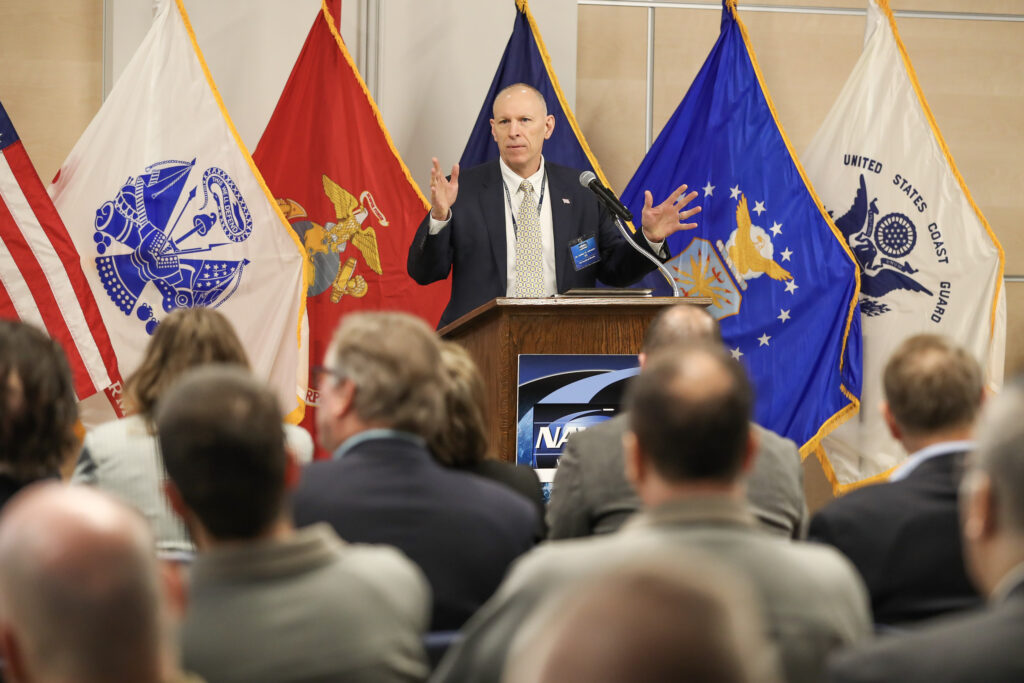
The Naval Surface Warfare Center Indian Head Division (NSWC IHD) is a working capital organization that develops and manufactures energetics for the Navy, Marine Corps and other services. The IHD in going through a $1.9 billion upgrade called the Energetics Comprehensive Modernization Plan (ECMP) to improve its capabilities and infrastructure to meet the requirements of the future.
Ashley Johnson, a Senior Executive Service civilian, became the technical director of Naval Surface Warfare Center, Indian Head Division in 2014. He discussed the role of the Navy’s own manufacturer of energetics with Senior Editor Richard R. Burgess. Excerpts follow.
What is the mission of the Indian Head Division?
JOHNSON: The short answer is full-spectrum energetic materials, from cradle to grave. We do basic research, applied research, advanced technology demonstrations, manufacturing, logistics, engineering and fleet support. In the sense of energetic material systems, most people would immediately equate those two things like warheads, rocket motors, and bombs and so forth but it’s really much more expansive than that because it can involve fuzes and handling equipment associated with the systems — such as the packaging, handling, shipping and transportation.
Now that the wars in Iraq and Afghanistan are over for the United States, and with the growing tensions of Russia and China, how is your work shifting?
JOHNSON: My previous job was the director of Marine Corps Science & Technology and deputy chief of Naval Research, Office of Naval Research for expeditionary warfare and combating terrorism. Our investment in the GWOT [the Global War on Terrorism] writ large was really about finding the enemy: It was a C4ISR, big data, intel, logistics kind of thing, because the assumption, deservingly so, was that we could defeat our enemy without any issue once we found them.
As a result, for that period of time, not a lot was done in the United States in the development of state-of-the-art and attention to detail on the munitions industrial base, commercial or organic. I say that not accusingly, just saying that as a matter of fact. Unfortunately for us, all of our potential adversaries or adversaries — Russia, China, Iran, and North Korea — did not take that vacation. We had a large comparative advantage in that ammunitions space — range, speed, terminal effects, signatures management, safety to some extent. They recognized they were behind, and they continued to invest in those areas, so, we have lost a fairly large comparative advantage as we focused on the necessities of GWOT.
We’re approaching something that looks an awful lot like the Cold War as it looked in the ‘70s and ‘80s with the Soviet Union, which had a large capability. The question is clearly not can we find them; the question is, can we defeat them because they have systems that can rival ours. The situation is driving us toward really looking at ourselves in the mirror and saying, what is our state-of-the-art? Is it representative of what we are really capable of or is it representative of what we’re willing to continue to keep using? What is our industrial base and are we capable of manufacturing and providing at the point of use all of the things that we think we need in the context of something like we’re seeing in Ukraine where Russia is coming to grips with that. You can use a tremendous amount of ordnance in these kinds of sustained conflicts. Do you have the industrial base with which to sustain that operation?
I was surprised to learn that Indian Head is not just an RDT&E activity but also a major manufacturing facility.
JOHNSON: Indian Head has been in energetics since 1890. Indian Head was established initially as a proving ground for Navy guns, and it literally was cut out of the woods in southern Maryland for that purpose. After its victory in the Battle of Manilla Bay, the Navy recognized that the only vulnerability in its crushing defeat of the Spanish Navy was the fact that the Spanish Navy used smokeless powder. Although it didn’t really factor much into the outcome, it was recognized as a significant liability.
And so, the Navy wanted to pursue the manufacture or acquisition of [smokeless] powder. A commercial vendor was busy manufacturing propellant for European markets and did not have the capacity to produce it for the U.S. Navy. Very shortly after that, a bill was put through Congress and Indian Head was established as a naval powder factory. The Navy started to make its own propellant at Indian Head over a hundred years ago. Indian Head continues to be the source for a lot of unique munitions.
Of course, that’s changed over the years. For example, a plant was built at Indian Head solely for manufacture of every pound of the propellant for the Polaris Missile System. It did the same thing for [the] Poseidon missile.
Interesting. Is there anything you’re supplying to Ukraine with its war with Russia?
JOHNSON: I really cannot comment. I would just say we’re relevant to that theater also and I’ll leave it at that.
Indian Head has been involved at the ground floor of supplying munitions for the Navy for over a hundred years and that’s kind of what we’re just being asked to do again.
Specifically, what are we concerned about right now? Solid rocket motors. The Standard Missile figures prominently in this conversation, as do things like Tomahawk. There used to be 12 manufacturers in the United States for tactical rocket motors and now there are only two commercial vendors: Aerojet Rocketdyne in Arkansas and Northrop Grumman, which is using a Navy facility in Rocket Center, West Virginia. That’s it. The largest capacity left in the United States to produce cast composite rocket motors is Indian Head. We have a very large latent capacity that isn’t really being used yet which is why those partnerships are so exciting. Aerojet has partnered with the Navy, and we are going to make rocket motors here for our Standard missile to augment the commercial supply which is exactly where our mission is. We go into areas where we are needed, or we go into areas where no one can go.
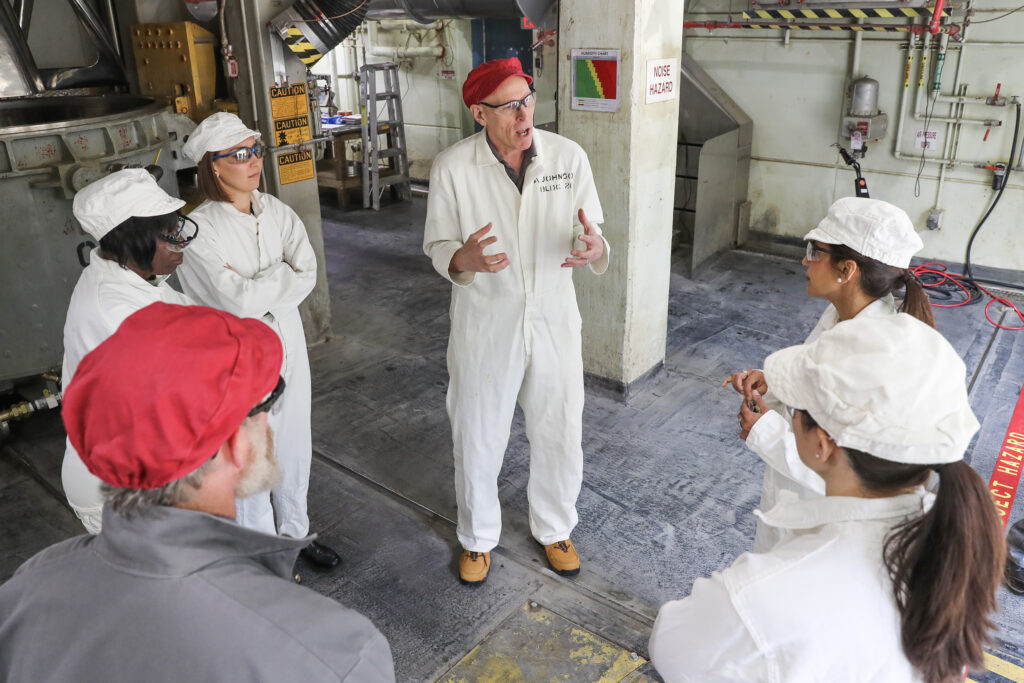
Indian Head is viewed as part of the organic — government-owned — industrial base. There is no competition with commercial vendors going on right now. All of us in the munitions industrial base recognize it’s an all-hands-on-deck situation. This is the only way that we’re going to meet this need. It’s kind of the way we’ve been doing business for over a hundred years anyway. It’s just for the last 10 or 15, we sort of forgot about it.
Why is the Energetics Comprehensive Modernization Plan (EMCP) needed?
JOHNSON: We are a very expensive facility. The net replacement value for Indian Head is between $5 [billion] and $6 billion. You’d be hard-pressed to recoup that or duplicate it if I gave you that much money just because of how difficult it is to build facilities like Indian Head. If you have a facility with that kind of unique capacity and capabilities, it takes a lot of money to take care of it.
If you go through a period of time — 10, 15, 20 years — when you use munitions essentially as a bill payer for other requirements, you don’t generate the resources you need to take care of facilities like Indian Head. When you have to exercise it again, you’ve got a “big principal” that you’ve got to pay down. ECMP involves the restoration and sustainment of weight and capacity that the Navy owns. We can do things, but we’re a little out of shape, and so, it’s a readiness issue.
The other part of ECMP is about modernization and increasing capacity. Our commercial partners — Aerojet Rocketdyne and Northrop Grumman — are well over 90% and probably closer to 95% in the utilization rate of whatever capacities they have. There is a need for the industrial base of the United States, commercial as well as organic, to grow to meet the demand signal that we’re seeing for munitions and so forth. Ultimately, we’re getting to 11 times our current capacity to meet the demand signals that we see from all of our customers as well as our commercial partners. That second piece of ECMP really helps build out the capacity to meet the demand.
The third and probably the most interesting, at least for me, element of ECMP is about hybridizing our business and investment model. In the past, we had to operate like a business since we’re a working capital fund activity as opposed to a general funded activity. That creates problems in periods of a bear market because, if I’m asked to recoup all my cost from just my customers, when people aren’t buying things, it becomes hard to amortize the costs. That’s when things don’t get done. That’s when maintenance becomes an issue because you have to start making choices. And so, what we’re doing with ECMP is trying to establish more of an ownership and responsibility at the Navy level off the top so that those things get paid for first and then we enter into more of a time and materials conversation with our customers.
So, it’s the hybridization of the business and investment model of Indian Head so that there is an appropriated line of accounting that gets put into this equation in addition to a working capital.
What are some of the major projects or improvements that are involved?
JOHNSON: Some of the initial stuff is really quite simple: fixing loading docks that have cracks in them; fixing secondary roads that have large potholes that I’d rather not drive nitroglycerine over; general improvements to the roads, lighting or other utilities. We may need a half a million dollars to unlock the latent capacity that’s there. I just can’t get at it because I’ve got these secondary and tertiary issues which are preventing me from using it.
With modernization, we’re talking about very specific improvements like casting and curing [of rocket propellant and warheads]. A major part of being able to make rocket motors is being able to mix the composite propellant. It needs very specialized vertical mixers. We have them in all sizes, but we need more of them. A major project improvement would be a second cast composite plant where we would increase the capacity of a lot of those unit operations, but also, do it in sort of a state-of-the-art. Indian Head’s cast composite plant was built 35 to 40 years ago. You wouldn’t do that now the same way, so we’re going to take advantage of efficiencies in industrial engineering and state-of-the-art equipment to basically double down or triple down on the capacities that we currently have.
So, really, the focus that is most meaningful is our cast composite manufacturing and that addresses modern rocket motors as well as warheads.
By cast composite, you mean mixing the chemicals and then molding them for a rocket motor?
JOHNSON: Yes. The process is very similar to making a cake batter. The very first thing that we do is get all the ingredients, then we put them in a mixer that looks an awful lot like a KitchenAid mixer. It’s obviously a little more involved than that but effectively does the same thing. We blend the ingredients, then once we get them out, we cure the mixture and it hardens in the places we want it [rocket motor or warhead body]. And then it gets assembled into an all-up round. That entire process involves mixing, casting and curing and the transportation of those assets.
What categories of engineers do you need?
JOHNSON: Engineers of just about every flavor, right now primarily mechanical and chemical. Actually, mechanical dominates but we need both. But I need industrial engineers, I need electrical engineers, so just about every type and flavor. I also need the hard scientists, too: physicists and chemists.
We have another mission that has to do with chem/bio which I won’t get into right now, but it’s a big part of what we do, so we have biologists. We have life scientists here as well. We’ve got maybe about a thousand technical people all the way through Ph.D., close to a hundred Ph.D.s here in the hard sciences. But I have a need for program managers, comptrollers and business folks. Now with this huge modernization effort I need guys who actually need to be able to do construction and construction management whether it be contracting or building management.
What is Indian Head’s place in the local economy?
JOHNSON: We’ve got about 2,500 government civilians and about 500 contractors. I might have to add 500 to 700 individuals just in our manufacturing operations alone to meet the demand signal. They’re going to government civilians, contractors, and partners like Aerojet people who are going to be working here side-by-side with our guys. It’s a big shot in the arm or opportunity for the state and for the local communities because we’re just going to get bigger. Indian Head is already, on any given day, the largest employer in the county.
How do you plan to attract extra employees?
JOHNSON: That’s the easy part. It’s not hard to get people excited about being a patriot. It’s not hard to get people excited about coming to do what we at Indian Head. Energetics work is pretty exciting. You make things that go boom and whoosh, and it’s also exciting science. So, attracting talent is easy; it’s the retention of the talent that’s harder. Can you compete for people’s attention in terms of how the environment looks around? Is it a nice place to live? Are there things to do? We’re working with the state and the county on that because where we are located it’s kind of out of the way and that might be for obvious reasons, but it’s still an issue with regard to being able to retain people. We’ve got to try to make that ecosystem around us as inviting as possible.
The other piece is really about people who are drawn to this work like to do stuff and, like over the last 10 or 15 years, you can’t retain talent when people aren’t doing anything. And so, a lot of people have left the market or, if they’ve got into it, they got bored because we really weren’t buying a lot in the area of munitions and/or similar systems, and so, they’ve left. I think the demand signal will take care of that. But it’s important to commit to this, because, after these surges are over, we need to maintain our focus on this area.