Raytheon Doubled ESSM Production in 2025
By Richard R. Burgess, Senior Editor
Raytheon Missiles & Defense (Booth 911) doubled production of the Block II RIM-162 Evolved SeaSparrow Missile (ESSM) in 2025 as it addressed the increased demand from the U.S. Navy and its partners in the NATO consortium, a company official told Seapower.
“Last year, we produced over 350 ESSM missiles, which more than doubled what we were able to deliver in 2024,” said Misty Holmes, vice president for the Shipboard Organization within the Naval Power division. Her portfolio includes the ESSM, the Rolling Airframe Missile and the Standard family of surface-to-air missiles. She noted Raytheon delivered the 500th Block II version of the ESSM last September.
“We’re continuing to increase production this year to deliver over 400 all-up rounds, and we have a North Star in terms of our production capacity to go beyond 700 per year to meet that increased demand signal and service the needs of all of our customers’ navies,” Holmes said.
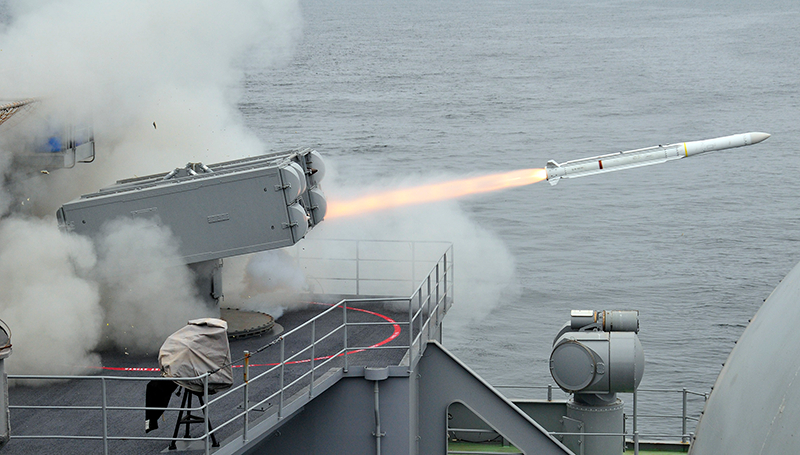
The ESSM, which became operational in 2004, is a short-to-medium shipboard surface -to-air missile deployed on several classes on U.S. Navy ships, including many guided-missile destroyers, aircraft carriers and amphibious assault ships. The missile is designed to counter advanced, highly maneuverable threats, and features a warhead specifically designed to defeat hardened anti-ship cruise missiles. In 2007, a surface-to-surface/anti-low-velocity air threat capability was introduced on the missile. The missile was developed by a consortium of 12 NATO nations and has been acquired by Japan through direct commercial sales.
“I believe that gives ESSM a unique and a distinct advantage in today’s munitions programs over those that are solely developed and managed by one nation,” Holmes said. “The consortium is NATO’s largest and most successful cooperative weapons project, and it’s been together for over 15 years supporting international military industrial cooperation.
The Block II ESSM, which became operational in 2020, features an active guidance system in addition to semi-active guidance, reducing the need for shipboard radar illumination.
“This particular capability does come with significant digital processing margin,” Holmes said, “[A]s we are focused on innovation, [we] can continue to upgrade this capability to keep it ahead of pace with the threat to ensure that we’re keeping our ships and our Sailors, both U.S. and international allies, safe and coming home.”
Recent conflicts in Ukraine and the Red Sea have spurred demand for such weapons as the ESSM, which was fired against Houthi missiles and drones during 2023 and 2024.
“I do see this as a multi-factor issue, Holmes said. “We are seeing increase in the defense budget across numerous of our customers largely in Europe as well as others due to the threats, the war in Ukraine, the realization of expenditures in the Red Sea and others. So, we are seeing that increased demand signal come in pretty globally.”
Holmes said Raytheon is focused on the increased demand signal.
“This production really does showcase exceptional program performance that has been heavily supported by a very robust supply chain that’s been meeting and exceeding targets, and that supply chain is extremely diverse and global, she said. “Our suppliers, in ESSM’s case, are not just suppliers, there are partners, international industrial-based partners. Two areas that have been really big on this production are our industrial partners delivering on their contracts to make all those components ready for integration, and then the dedicated action by the Raytheon factory teams to improve throughput and remain focused on the goal that we have to meet and exceed our production targets. We’ve been working on test efficiencies, optimization and throughput to ensure we can continue to improve on our delivery.”
Is Raytheon working on a Block III ESSM? Holmes would only say, “We are working on enhanced kinematics and maneuverability, things that will keep this weapon system ahead of the threat for the next few decades. But we’re eager to participate with the U.S. in the consortium in their next significant variant.
“We don’t sit back and rest on our laurels that what we’ve delivered is good enough,” she said. “We’re constantly adding capability to the suite of capabilities to make sure [that we are] staying ahead of the threat and those are investments we’re making in future ESSM capabilities as well in terms of funding new research and development ahead from government requirements.”