Sea-Air-Space: Readying our Platforms: Admirals Focus on 80% Combat Surge Ready
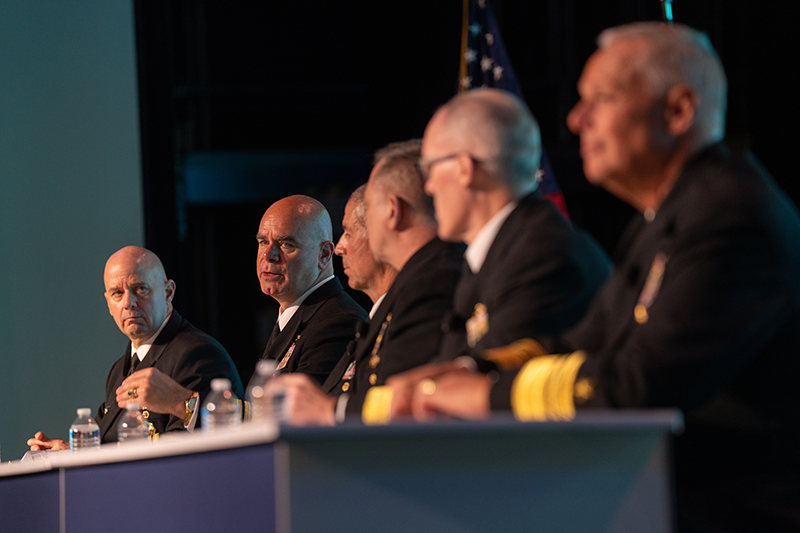
U.S. Navy type and system commanders discussed their efforts to achieve a combat surge readiness (CSR) of 80% during the opening panel of the Navy League’s 2025 Sea-Air-Space Expo in National Harbor, Maryland.
Speaking in an April 7 panel — moderated by Acting Chief of Naval Operations Admiral Jim Kilby — were Vice Admiral Daniel Cheever, commander, Naval Air Forces; Vice Admiral Robert Gaucher, commander, Naval Submarine Forces; Vice Admiral Brendan McLane, commander, Naval Surface Forces; Vice Admiral Carl Chebi, commander, Naval Air Systems Command; and Vice Admiral James Downey, commander, Naval Sea Systems Command.
“Combat surge ready-certified units meet a minimum condition requirement for material condition, training, manning and munitions,” Kilby said, noting the type commanders on the panel were designated the single accountable officers “to ensure their respective forces achieve 80% CSR.”
Kilby laid out the task for his admirals to achieve 80% CSR despite the scheduling, materials, workforce, maintenance availabilities and operations tempo challenges for the fleet, necessary to ready the fleet to meet potential combat with potential adversaries such aa China.
He pointed out that the current drive for readiness began in 2018 when then-Defense Secretary James Mattis directed the service to turn around the dismal readiness of its F/A-18 Super Hornet strike fighter fleet of 250 ready jets and increase the number to 341, a level sustained during the years since. By changing its maintenance practices, the Navy achieved the goal in one year. With that inspiration, other Navy communities, such as the surface and submarine forces, have adopted changes to their maintenance and logistics practices to increase the readiness of warships and submarines.
Kilby said the CSR rates for submarines, surface warships and aircraft carriers today are 67%, 68%, and 70%, respectively.
Cheever noted achieving the 80% for Super Hornet strike fighters was an “all-hands effort all the time” and involved extensive partnering with the defense industry. He defined CSR as such: “If we go to war, we have everything we need.”
Chebi said the CSR effort has since expanded to included 22 other types of Navy and Marine Corps aircraft and that the effort to achieve the CSR goal was a “team effort” that had to be focused on data versus stories.
He recounted the Navy “had to be told to do that,” referring to the strike fighter readiness initiative, but that “we developed the playbook. It worked.”
He said the Navy still had challenges with improving CSR in joint programs because it cannot control all aspects of the initiatives.
McLane credited the aviation community with the inspiration for the surface community to similarly focus on readiness. His efforts include CASREP [casualty report, a term for systems degraded or broken] burn-down, restoring ship systems to full capability, and getting ship maintenance availabilities (repair periods) finished on time. An innovative approach to availabilities is to bring ships in more often for shorter period, a method that increases a ship’s likelihood of completion on time. A recent set of 100-day availabilities of were completed 100% of the time, he said.
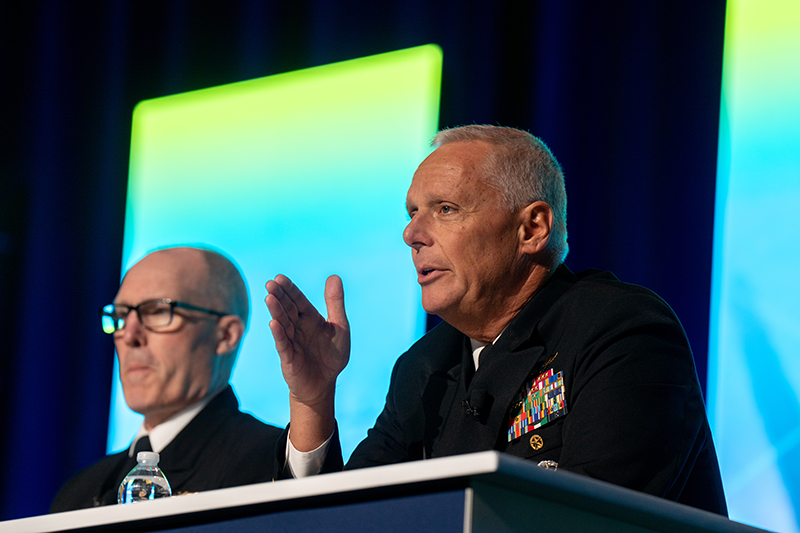
Addressing problems with amphibious assault ship availabilities, McLane said a focus on planning 120 days in advance is inadequate, recommending locking in the plan 500 days in advance and awarding the contract 350 days in advance. Noting recent problems with quality assurance, he recommended involving the original equipment manufacturers rather than necessarily hiring the lowest bidder.
Ships Ahoy
Downey, speaking of new construction ships, noted 12 ships were delivered in 2024, and 92 ships were under contract, 56 of which were under construction. He said he is focused on planning milestones, trying to order materials two years ahead of the construction start of a ship. For improving availabilities, more predictive data are needed, he said.
Gaucher said his goals are to complete submarine availabilities on time and make them ready for combat. He noted the Navy’s four shipyards have room for 10 attack submarines in maintenance but currently have 17 submarines in or awaiting availabilities.
The “just-in-time” parts delivery concept does not work well in practice for the submarine force, he said, recommending instead a “just-in-case” stockpiling concept for parts.
Gaucher said the Navy’s shipyards need more structural engineers, not just mechanical and electrical engineers.
He also said the submarine force’s inventory of Mark 48 torpedoes has increased by two per boat, and he expects another increase by two within six months.