Vice Adm. Douglas L. Williams Relieves Vice Adm. Johnny Wolfe Jr. at Portfolio Acquisition Executive Strategic Systems Programs Change of Command Ceremony
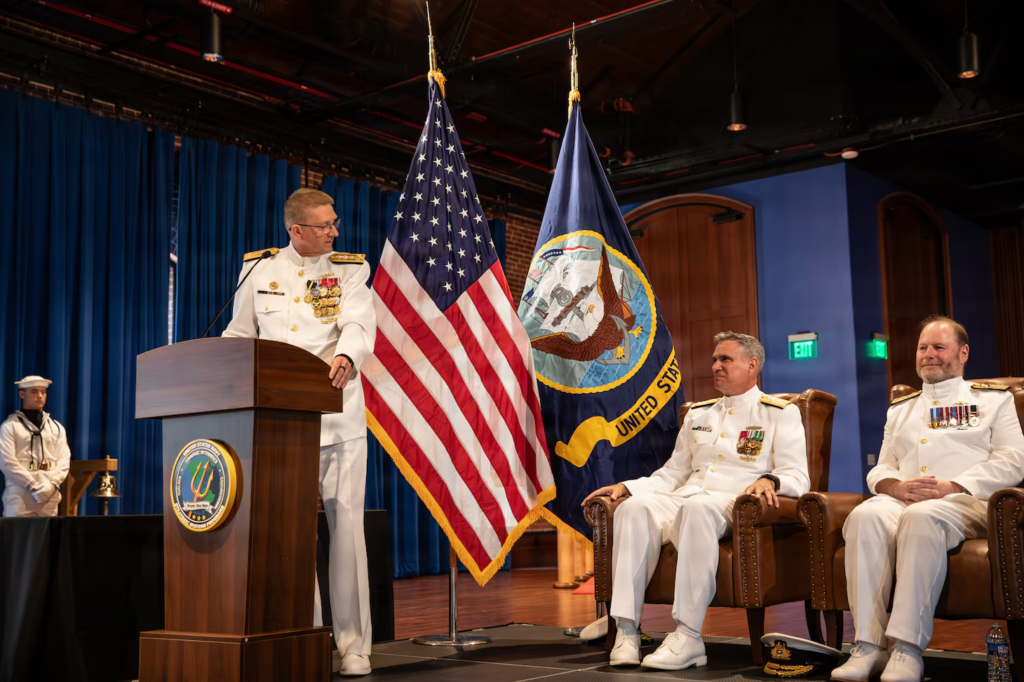
by Portfolio Acquisition Executive Strategic Systems Programs Public Affairs
June12, 2026
WASHINGTON NAVY YARD – On June 12, 2026, Portfolio Acquisition Executive (PAE) Strategic Systems Programs (SSP) held a joint retirement and Change of Command ceremony at Admiral Leutze Park, recognizing the transfer of leadership from Vice Adm. Johnny Wolfe Jr., to Vice Adm. Douglas L. Williams. The honorable William Mahan, performing the duties of the Assistant Secretary of the Navy for Research, Development, and Acquisition, presided over the event and former Commander of U.S. Strategic Command Adm. Charles “Chas” Richard (ret.) delivered remarks as the keynote speaker.
“Wow, what a legacy you leave, Johnny,” Richard said. “Your achievements culminated in SSP being recognized as the organizational standard for acquisition commands and your example and leadership have ensured that the next generation is ready to carry the torch. Vice Adm. Williams, congratulations on this next chapter for you and your family. We can be confident that you will carry on this tradition of excellence in the stewardship of your new command.”
Williams previously served as the director for test at the Missile Defense Agency (MDA), where he was responsible for all aspects of planning, designing, and execution of the missile defense system flight, ground, and cyber testing, as well as wargames and exercises. He brings more than 30 years of active-duty experience to the role and has been acquainted with PAE SSP’s no-fail mission since the very start of his naval career, serving various roles and leadership positions across PAE SSP, culminating in the role of technical director as his last assignment before becoming a flag officer. In 2022, Williams was selected to the rank of Rear Admiral (lower half) and was assigned to MDA.
Now, he returns as a newly appointed vice admiral taking on the mantle as the 15th director of PAE SSP and overseeing the Navy’s premier strategic weapon system (SWS) and regional strike capabilities, including the Conventional Prompt Strike and Nuclear-Armed Sea-Launched Cruise Missile programs.
“I want to extend my deepest gratitude to Vice Adm. Wolfe,” Williams said. “Your visionary leadership and steadfast dedication have set a standard of excellence that will endure long after your departure. The importance of SSP to our country’s national defense has never been more vital. We remain the proud stewards of the sea-based leg of the nuclear triad, a true corner stone of our national sovereignty. SSP has invested nearly 30 years in preparing me for this moment. I am ready to join you in getting the job done. Our country is depending on us, and we will deliver.”
Wolfe, the outgoing PAE SSP director, took charge of the command in 2018. Under his leadership, PAE SSP achieved major milestones, etching the command’s significance in U.S. Navy history and consistently providing the nation – and its warfighters – with unparalleled warfighting capabilities. Wolfe led PAE SSP’s execution of the development, acquisition, sustainment, safety and security, fleet support and modernization of the Trident II (D5) SWS and established the programs to develop the Navy’s Regional Strike Systems in support of the full spectrum of deterrence.
“It is hard to believe this day has finally arrived,” Wolfe said. For my entire adult life, I have had the distinct honor and privilege of wearing this uniform, of serving our great nation, and of being a part of something vastly larger than myself—the United States Navy. Serving as the Director of SSP has been the honor of a lifetime. The scope and scale of our mission have always been vital, but the growth we have seen over the last nine years has been nothing short of extraordinary. We have expanded our reach, established new programs, and taken on unprecedented new challenges to meet the demands of a changing world. I am exceedingly proud of what this team has accomplished. As we look to the future, the mission of SSP is evolving at a rapid pace. The defense of our nation requires us to be more agile, more innovative, and more forward-thinking than ever before.”
Wolfe retires from the U.S. Navy after a distinguished military career spanning more than 38 years of active-duty service. His leadership ensured relentless dedication to the Navy’s strategic deterrence mission and to national security priorities. As he brings down the curtain on a decorated naval career, he leaves PAE SSP and its workforce with a solid foundation forged through trust and commitment to the nation’s defense.
“If there is a central theme I have tried to live by throughout my career – and the one message I want to leave with you today – it is simple yet absolute: the mission is paramount, but it is the people who are most important,” Wolfe said. “It is a philosophy of servant leadership. Our primary role as leaders is to take care of our people, to empower them, to foster their growth, and to ensure they have everything they need to succeed. Because I have learned, time and time again, that when our people thrive, the mission will never fail.”
PAE SSP is responsible for sustaining the strategic weapon system on the Ohio-class ballistic missile submarines and supporting the integration of the D5LE weapon system on the new Columbia-class SSBNs. Looking to the future, PAE SSP is actively modernizing the sea-based leg of the nuclear triad through the development of the D5LE2 SWS and pioneering regional strike capabilities of the future through development of the nuclear-armed sea launched cruise missile and the non-nuclear hypersonic conventional prompt strike system.