
Future Challenges May Involve Rethinking How the U.S. Fights, Speakers Say


Brett Davis is a lifelong journalist and writer with extensive experience writing about defense issues and technology. He studied journalism and photography at the University of North Alabama in his hometown of Florence and then earned a master’s degree in journalism from the University of Missouri. He worked for a dozen years as Washington Correspondent for the Huntsville Times newspaper, then became editor of Aerospace Daily & Defense Report, published at the time by McGraw-Hill. He served as content manager for Backfence.com, a pioneering local journalism website, was editor of Unmanned Systems magazine at the Association for Uncrewed Vehicle Systems International and editor in chief of Inside Unmanned Systems magazine for Autonomous Media. He previously served as Deputy Editor of Seapower magazine. He’s also a fiction writer: His latest, The Moon Above, is the story of a Tuskegee Airman published by Scarsdale Publishing.
The United States is facing a variety of challenges, from Houthi rebels in the Red Sea to the People’s Republic of China, but the preferred American way of fighting — massive overmatch — may not be tenable for the future, two panelists said during the luncheon event at the opening day of Sea-Air-Space.
China is investing in its military faster than the U.S. is, and the new U.S. defense budget is a 1% increase in the top line, which amounts to a decrease with inflation, said retired Admiral James “Sandy” Winnefeld, chair of the President’s Intelligence Committee.
“Even if we could build the ships that we wanted to build, we would have trouble maintaining them all,” he said. “And then manning is a challenge for us. So, it’s entirely possible that the means that we want to apply to this problem … are not going to be there.”
What the nation may need to do is adopt a “whole of nation approach, not just a military-on-military approach, which involves diplomacy, economics, information, and of course the military,” he said.
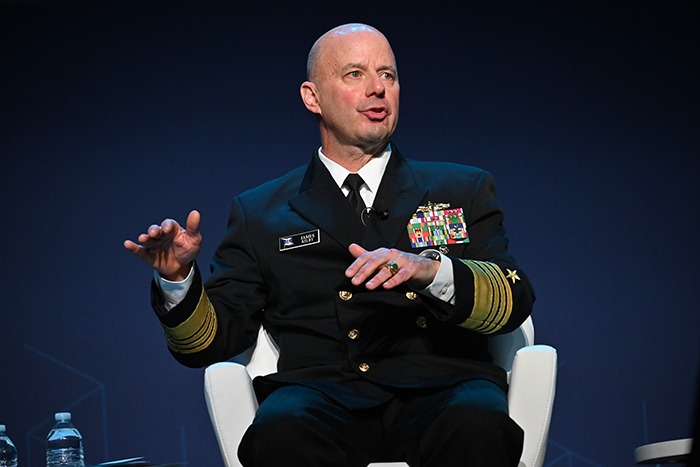
Vice Chief of Naval Operations Admiral James Kilby said one way forward is with disruptive technology, the sort being developed by the Disruptive Capabilities Office, the group set up last fall by Secretary of the Navy Carlos Del Toro to more quickly move technology to the field.
He wouldn’t go into specifics of what the office is working on, but it’s intended to look at a broad swatch of technology and see what can be tested and moved rapidly to the warfighter.
“The Disruptive Capabilities Office is meant to look across the whole DoD spectrum and understand what can be brought to bear quickly and to put that together in a test environment, test it, and have some confidence in it before we go after it,” he said.
“… That is different behavior than how we’re used to doing it, and it’s basically capability focused,” he said. It builds on the work of Task Force 59, which deployed maritime unmanned systems, and is aimed at ways to “produce some capability now versus the perfect in future,” he said.