ARLINGTON, Va. — Linking climate change’s impact on trade, fishing, energy and employment with the economic and environmental toll of illegal, unreported and unregulated fishing, U.S. Navy Secretary Carlos Del Toro says the world’s “blue economy” has never been more important or more challenging.
“From climate change to illegal and unreported fishing, the environmental challenges facing our oceans are global challenges that require truly a global response,” Del Toro told an ocean security forum at a Washington think tank Dec. 16.
The Navy secretary told a live audience at the Center for Strategic and International Studies, and others watching remotely, that the Navy-Marine Corps team “is determined to do our part.”
The World Bank defines the blue economy as the “sustainable use of ocean resources for economic growth, improved livelihoods, and jobs while preserving the health of ocean ecosystem.”
On climate change, Del Toro said the marine environment is under threat from receding shorelines, melting sea ice, extreme weather and “a more aggressive competition for resources” like fish stocks and underwater energy and mineral deposits.
Prompted by President Joe Biden and Defense Secretary Lloyd Austin’s concerns about the climate challenge, Del Toro said the Navy Department, among other actions, is implementing hybrid technology to power five classes of combat ships and eight classes of logistics ships, purchasing zero emission vehicles and assessing a renewable energy system at Marine Air Station Miramar, California, to reduce reliance on San Diego’s power grid.
Del Toro said IUUF is having “profoundly destabilizing effects on many regions. This is happening on an industrial scale as nations like China not only refuse to restrain their distant waters fishing fleet, but actively subsidize the devastation they’re actively causing,” he said.
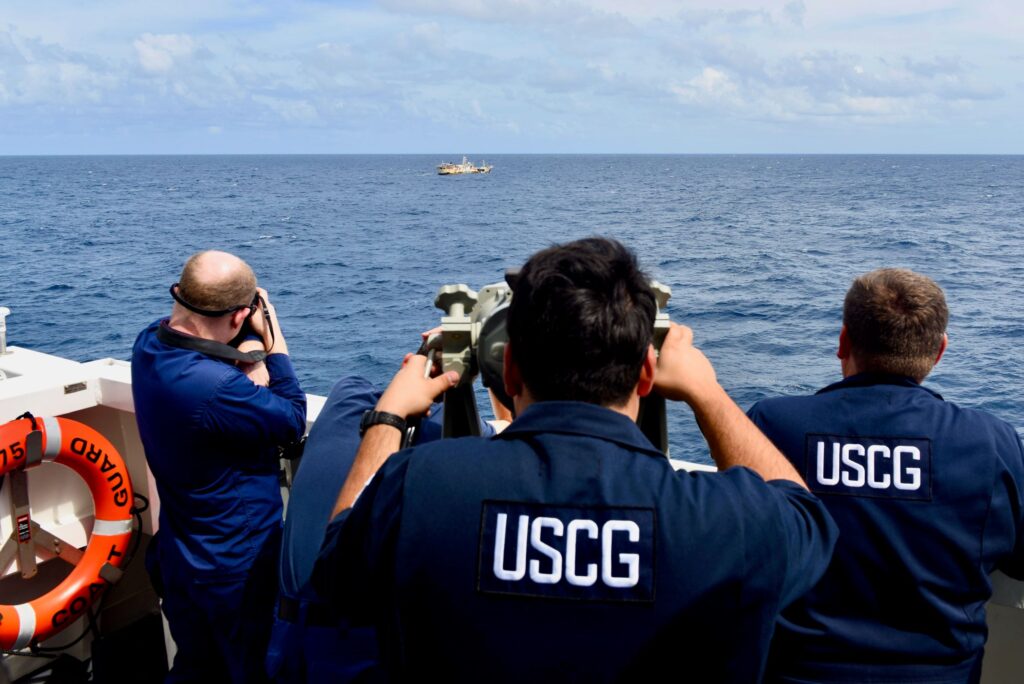
IUUF has taken such a toll on the economies of small maritime nations and world fish stocks — while increasing geo-political tensions and spawning instability — that the U.S. Coast Guard says it’s a greater security threat today than piracy at sea.
The combined Navy, Marine Corps and Coast Guard Maritime Strategy includes IUUF as part of the threat posed by near peer competitors China and Russia. The document notes China’s “state-subsidized distant water fishing fleet steals vital resources from nations unable to defend their own exclusive economic zones.”
Del Toro noted Coast Guard law enforcement teams have been deployed aboard several Navy ships as part of the Oceania Maritime Security Initiative.
Also speaking at the forum, Coast Guard Commandant Adm. Karl Schultz said his agency has taken an increasing leadership role in building trust and partnerships with foreign maritime states, particularly with the small island nations of the Pacific who lack the resources to enforce sovereignty over their resources and waters. Ocean-going Coast Guard cutters have trained partner nation coastal protection forces and aided them with situational awareness.
He noted the National Security Cutter Stone (WMSL 758), on its first voyage sailed down the east coast of South America, partnering with the maritime forces of Guyana and Brazil, and later with Ecuador and Colombia on the Pacific coast.
The Coast Guard, with approximately 57,000 personnel, does not have the capacity to be “the world’s fish cops,” Schultz said, “but I think we could bring some leadership. We could stitch together partners. We have a recognized brand that’s sort of known across the globe.”


- Shall We Play a Game? Winning Isn’t the Point, Experts Say - April 5, 2023
- U.S. Goal: Maintaining Extended Presence in Arctic’s Harsh Environment - April 4, 2023
- Joint, Combined Exercise Shows Marine Littoral Regiment Idea is on ”Right Track’ - February 24, 2023