
Sea-Air-Space: Looking Ahead to a Modern Marine Corps


Brett Davis is a lifelong journalist and writer with extensive experience writing about defense issues and technology. He studied journalism and photography at the University of North Alabama in his hometown of Florence and then earned a master’s degree in journalism from the University of Missouri. He worked for a dozen years as Washington Correspondent for the Huntsville Times newspaper, then became editor of Aerospace Daily & Defense Report, published at the time by McGraw-Hill. He served as content manager for Backfence.com, a pioneering local journalism website, was editor of Unmanned Systems magazine at the Association for Uncrewed Vehicle Systems International and editor in chief of Inside Unmanned Systems magazine for Autonomous Media. He previously served as Deputy Editor of Seapower magazine. He’s also a fiction writer: His latest, The Moon Above, is the story of a Tuskegee Airman published by Scarsdale Publishing.
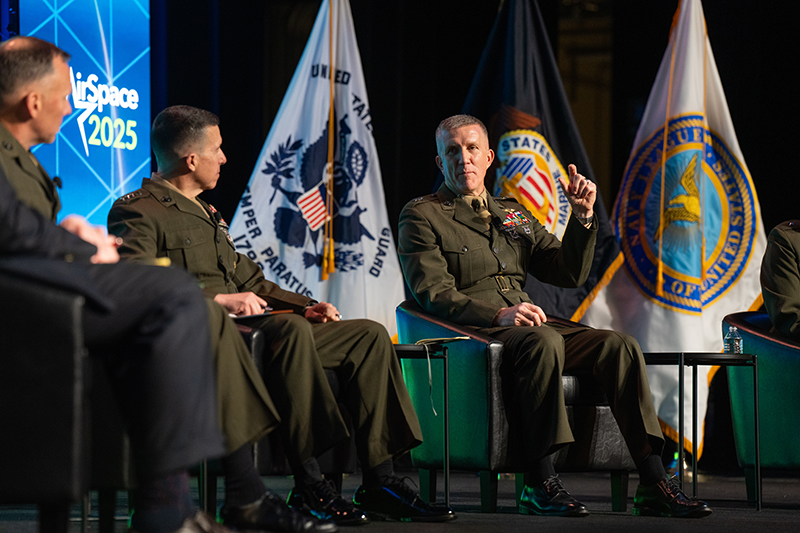
Six years into its modernization initiative, the Marine Corps has a head start on some of its sister services. But there’s still more to be done, said panelists during the April 8 session “Modernizing the Marine Corps: Building an Agile, Lethal and Resilient Force.”
“It’s exciting and we need to go faster,” summed up Lieutenant General Eric Austin, deputy commandant for combat development and integration and commanding general of the Marine Corps Combat Development Command.
Austin emphasized the Marine campaign of learning and its influence on force design. “How we responsibly modernize the Marine Corps is how we execute force design,” he said.
Lieutenant General Benjamin Watson, commanding general, Training and Education Command, said the Corps has traditionally relied on brick-and-mortar training solutions, “but that’s not the world we’re in these days.”
He cited initiatives like Project Triumph’s emphasis on leveraging technology to be more efficient and effective, and Project Tripoli’s emphasis on a live, virtual and constructive training environment.
“We’re increasingly fielding more complicated and sophisticated systems that are tougher and more costly to train on. I think if you look at what we’re seeing in contemporary conflict, it’s not much of a stretch to say we will never fight again with what’s traditionally known as air superiority,” Watson said, citing the need for unmanned systems integration, data and artificial intelligence.
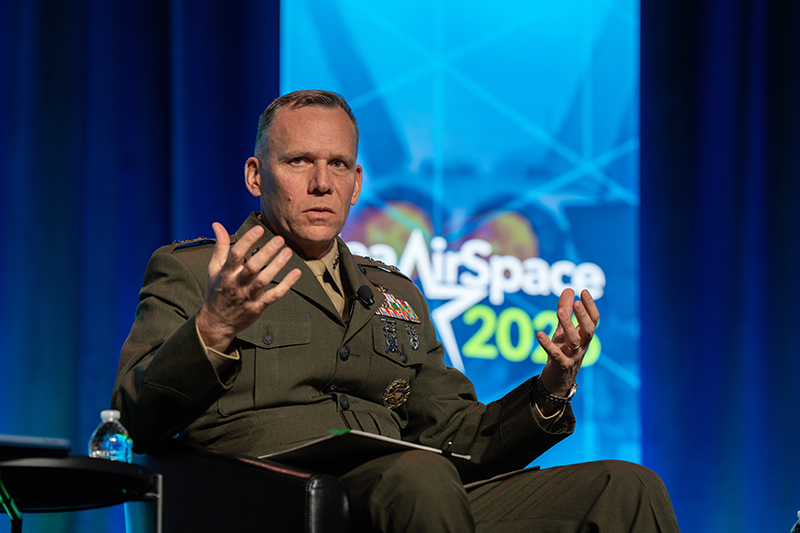
“One of our mantras is the idea that any Marine using a precision weapon can kill someone who needs killing at 500 meters. But now that’s up to 15, 20 kilometers and beyond” through the use of technology like first-person view drones, he said.
Major General Jason Woodworth, commander, Marine Corps Installations Command, and assistant deputy commandant, Installations and Logistics, discussed the importance of Barracks 2030, noting that modernizing aging structures is one of the commandant’s top priorities.
“It’s where warrior and family readiness starts. If Marines are good at home, they’re better at work,” he said.
Brigadier General Robert Brodie, director, Expeditionary Warfare OPNAV N95, said he’s seeing good collaboration between the Marine Corps and industry on modernization initiatives. He said in terms of shipbuilding, the most successful companies have great relationships with other industry partners as well.
Brodie and the other panelists said to further facilitate Marine-industry partnerships, members of the Corps need to do a better job of defining exactly what they’re looking for from industry — including opportunities for industry to help them understand a problem, define the problem and shape solutions.