
White House Demands Steam, Hydraulics for Future Carrier
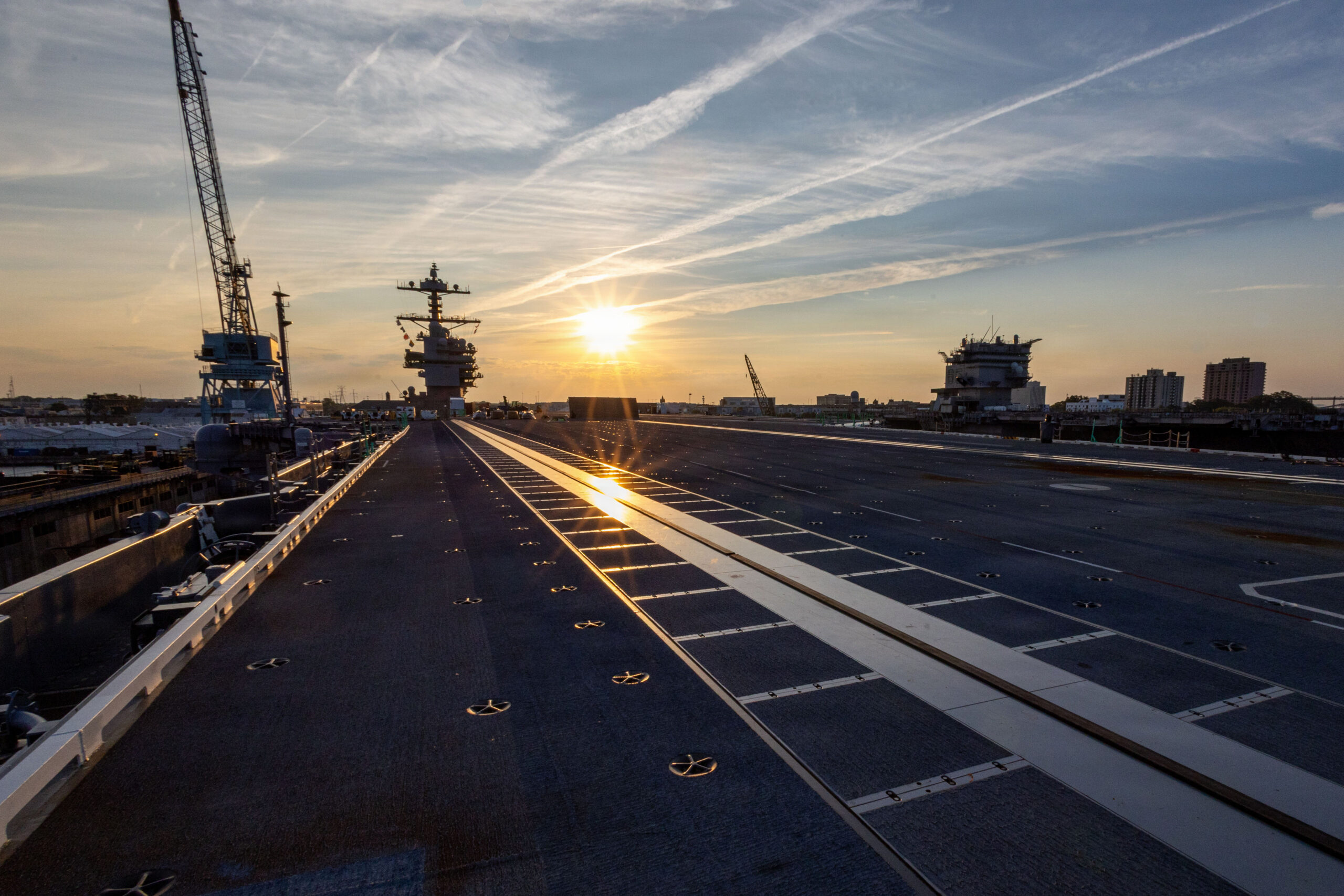


The White House announced Aug. 13 that President Trump signed a National Security Presidential Memorandum directing the secretary of war to replace Advanced Electromagnetic Aircraft Launch Systems and Advanced Weapons Elevators with “traditional steam and hydraulic systems” on a future Ford-class aircraft carrier.
The move would commence with CVN 81, the future USS Doris Miller, the fourth Gerald R. Ford class of carriers, expected to be commissioned in 2034.
The electromagnetic launch system, or EMALS, was developed by General Atomics and was first installed on the USS Gerald R. Ford (CVN 78). The system completed 10,000 catapult launches and arrested landings back in 2022 and is part of the design for the USS John F. Kennedy (CVN 79) and USS Enterprise (CVN 80), as well as the Doris Miller.
EMALS is intended to reduce stress on airframes, launch various sizes of aircraft, among other things, but the president has long said he is not a fan of the system. The memorandum calls for the defense secretary and the secretary of the Navy to produce “a plan on the required measures to replace the Electromagnetic Aircraft Launch System and Advanced Weapons Elevators with steam and hydraulic systems for the construction of CVN-81, including timelines and resourcing requirements.”
Budgetary, Security Concerns
General Atomics, which builds the systems and is also under contract to provide EMALS and Advanced Arresting Gear systems for a future French navy carrier, said in a statement to Seapower that “given CVN 78’s successful operational performance and record 13-month deployment, the decision not to proceed with EMALS and AAG on CVN 81 warrants careful reconsideration. With nearly 50% of production complete, changing course now could introduce significant cost, schedule, and integration risks.”
The company said the decision could have “broader implications for carrier readiness, national security, and U.S. technological superiority, potentially creating opportunities for adversaries to close the capability gap. It also comes at a time when strengthening the U.S. supplier industrial base is a national priority, making workforce stability, production capacity, and the ability to sustain critical technologies more important than ever.”
The move has been blasted by some congressional lawmakers, including Sen. Mark Kelly of Arizona, a former Navy combat pilot who told MS NOW the move could add billions to the cost of the carrier.
Brent Sadler, senior research fellow at the Heritage Foundation, said, “the president is directly engaged in the nation’s naval and commercial shipbuilding revival — that is good and long overdue. As such, the president is directing a plan be crafted for returning to steam catapults and traditional arresting gear in the next to be built Ford-class aircraft carrier (CVN 81).
“This doesn’t mean it will happen — as the president will be given the performance data of several deployments and during combat operations of these new systems on the Ford aircraft carrier, as well as the cost and potential added time for moving back to legacy systems at this point in construction of CVN 81.”
USS Abraham Lincoln
Aircraft carriers have been in the news lately, as family members of Sailors aboard USS Abraham Lincoln (CVN 72) have reported dwindling morale, apparent suicide attempts and deteriorating living conditions during a lengthy deployment to the Middle East.
Family members aired these issues at a recent town hall meeting in San Diego, according to Stars and Stripes and other news outlets.
“We have not observed an increase in suicidal ideations or attempts aboard the ship,” a U.S. official said in a statement provided to Seapower. “We take every service member’s well-being seriously and have religious, medical and mental health professionals available to assess and address concerns as they arise.”
CVN 72 has five Navy chaplains, one clinical psychologist, one clinical social worker, three behavioral health technicians and an embedded integrated prevention coordination counselor, the statement says, as well as CAPT Fathom, an expeditionary facility dog to support crew morale and emotional welfare.
“These resources are available to Sailors and Marines throughout the Strike Group 24 hours a day, 7 days a week. Sailors go through normal transitions throughout a deployment cycle. Adapting to life at sea can be difficult, so we’ve learned how to provide resources and help Sailors with these transitions. We are not experiencing an uptick in mental health issues aboard Abraham Lincoln.”
Family members have also said Sailors on the ship are reporting supply shortages. The statement says, “Lincoln is operating in a highly contested environment where traditional supply hubs in the Middle East were disrupted by combat actions. In response, leadership prioritized mission-critical supplies: first food, then hygiene items, then mail. Current reports from the ship confirm continuous access to clean water, functional AC, and healthy meal options.”
News reports have said the USS George Washington is on the way to replace the Lincoln, although the Navy declined to comment on ship movements.