
Royal Australian Navy divers train at Pearl Harbor for U.S. Virginia-class sSN sustainment
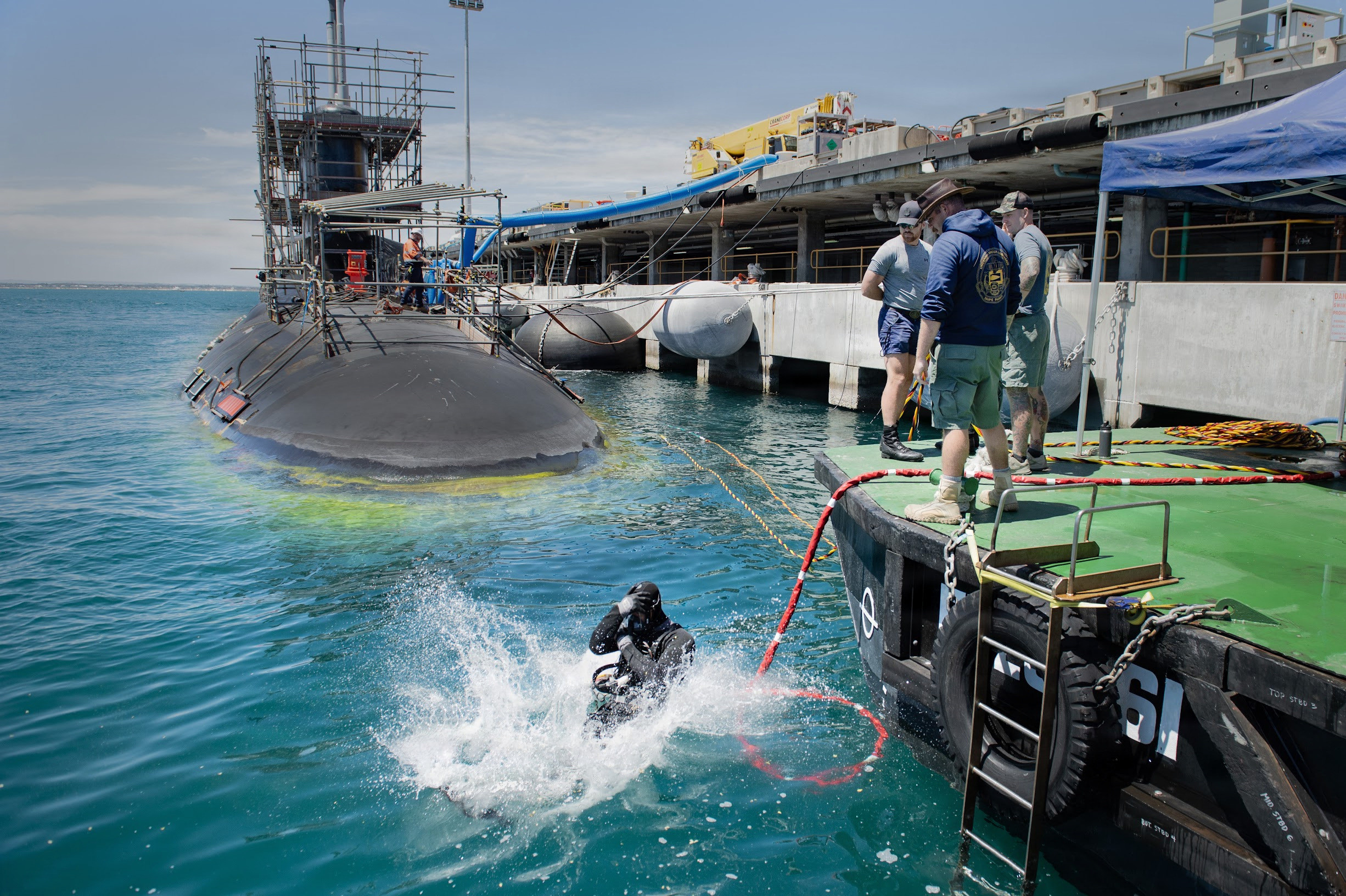


JOINT BASE PEARL HARBOR-HICKAM, Hawaii — Inside the flooded ballast tanks of a Virginia-class submarine, where there is no natural light and spaces are tighter than shoulder-width, Royal Australian Navy divers are learning how to sustain one of the world’s most advanced undersea platforms. Although the work is gritty, technical, and claustrophobic, it represents one of the clearest signs yet that AUKUS—the enhanced security partnership between Australia, the U.S. and the U.K.—is progressing and delivering results.
“It’s really exciting to be part of the first group of divers to receive this training in the U.S. for a new capability back in Australia,” said Royal Australian Navy Lieutenant Cantona*. “Usually in the military you’ve got your [standard operating procedures] and structures, but here we’re essentially creating something brand new, which is very unique and rare.”
Cantona is one of eight Australian divers who underwent an immersive five-month training rotation at Pearl Harbor Naval Shipyard and Intermediate Maintenance Facility (PHNSY & IMF). They were the first Australian divers trained to maintain U.S. nuclear-powered attack submarines at the same level as American Sailors and shipyard personnel. Their mission involved learning the skills needed to execute diver operations on Virginia-class submarines in Australia.
“It’s a privilege to be here,” said Cantona during his training in Hawaii. “We’re laying the groundwork for a future force—one that can keep submarines ready, at sea and on mission from the Indian Ocean.”
The training is both physically demanding and technically rigorous. Each diver was fully integrated with U.S. Navy dive teams, executing underwater work that includes component swaps inside ballast tanks, torpedo tube inspections, fly-by-wire system checks and rigging operations. They also completed radiological diver certification and shipyard safety qualifications.
“We treated them like one of our own,” said Chief Warrant Officer Michael Tuft, command diving officer at PHNSY & IMF. “No special treatment. They’re on our teams, doing the same dives, attending the same briefs, the same post-job cleanup. And they crushed it.”
Tuft said the Royal Australian Navy divers were paired in two-person teams and assigned directly to U.S. dive lockers, giving them immediate exposure to the rhythm of day-to-day maintenance operations. While the clearance diving branch, the specialized diving unit of the Royal Australian Navy, is no stranger to complex undersea tasks, nuclear submarine maintenance introduces new technical demands.
“You can’t just drydock a sub every time something breaks,” said Tuft. “A lot of the work—especially inside the ballast tanks—has to happen in the water. And not just anyone can do that. You need divers trained to this level of precision, with this level of trust.”
Trust is a recurrent theme in the diving community and throughout the broader AUKUS partnership. Below the surface, there is no room for second-guessing.
“The person beside you is your backup. You’ve got to know they’ll be there if something goes wrong,” said Royal Australian Navy Able Seaman Finn. “What’s amazing is that the U.S. teams gave us that trust from the start—and we’ve earned it.”
That trust is essential not just for safety, but for strategic readiness. As the U.S., U.K. and Australia continue implementing AUKUS Pillar I, interoperability is no longer a future goal—it is a present requirement.
Over the past year, the Australian divers were able to demonstrate their skill during two major AUKUS submarine maintenance periods. First, during the U.S.’s maintenance period for USS Vermont (SSN 792) in November 2025, then again during the U.K.’s maintenance period for HMS Anson (S123) in February 2026. Both maintenance availabilities, which took place at HMAS Stirling in Western Australia, support Australia’s long-term goal of building a sovereign sustainment capability for nuclear-powered submarines, a key requirement for AUKUS. The Australian divers will have another opportunity to demonstrate their skills at the U.S. Navy’s next planned submarine maintenance period before the end of this year.
At the AUKUS Defense Ministers’ Meeting in May 2026, Secretary of War Pete Hegseth, Australia’s Deputy Prime Minister and Minister for Defence Richard Marles, and the U.K.’s Secretary of State for Defence John Healey confirmed that AUKUS Pillar I remained on track. In their joint statement, the defense ministers also announced that key milestones were being met to establish Submarine Rotational Forces-West (SRF-West) as early as 2027. Under SRF-West, U.S. and U.K. nuclear-powered attack submarines will conduct rotational deployments from HMAS Stirling. As part of SRF-West, Australian maintenance workers—including these newly trained Royal Australian Navy divers—will play an increasing role in maintenance activities as they continue building the expertise to operate and sustain their own fleet of attack submarines.
“This is one of the most important building blocks of SRF-West,” said Elizabeth Tolin, deputy division head for SRF-West at the AUKUS Integration & Acquisition program office. “Ultimately, most of the sustainment work will be done by Australians. We’re training them to our standards now, so we can operate together with confidence anywhere in the world.”
Tolin, who helped establish the diver training pipeline, said this effort required transforming PHNSY & IMF into an international training venue, a first for naval shipyards. PHNSY & IMF, which was previously named the lead maintenance activity for SRF-West, will establish a maintenance detachment in Western Australia where American maintainers there will continue working alongside their Australian counterparts.
“We had to build the machinery—curriculum, systems, policy—before we could even put students in the water,” Tolin said. “What you’re seeing now is a partner stepping up with speed and precision.”
The partnership is built not just on shared values, but on operational necessity.
“Well, if submarines break, they can’t always come back to Hawaii,” Tuft said. “If they’re near Australia, they can pull in there, and we know that we’ve trained the Australians to the same U.S. standards. They can fix that submarine and get it back on the front lines.”
“SRF-West is the cornerstone for AUKUS Pillar I,” said Rear Adm. Doug Adams, director, AUKUS, International and Systems. “For the U.S. Navy, conducting rotational deployments out of HMAS Stirling reduces transit times, increases attack-submarine presence and delivers peace through strength in the Indo-Pacific region. Building the maintenance capability in Australia will keep our submarines fit to fight and prepares the Royal Australian Navy and its sustainment partners to work on their own future fleet of conventionally armed, nuclear-powered submarines.”
According to Tuft, this training is creating a flexible and resilient workforce across the Indo-Pacific.
“If we’re overwhelmed, we can call [the Australians] and say, ‘Hey, can you send me six people?’ They can do the same with us. That’s the kind of partnership we’re building. We can support each other with everything.”
For the Australian divers, the experience is as personal as it is professional.
“Diving inside a submarine’s ballast tanks, shoulder to the wall, with no visibility—it gets the heart rate going,” said Finn. “But it’s a massive privilege to gain these skills and help stand up something this important from day one.”
Tuft said few people outside of the program understand the scale of what is being built.
“This is one of the first times we’ve ever trained foreign partners to maintain our submarines,” he said. “It says everything about the strength of our alliance and how much we trust Australians to help carry it forward.”
As the divers prepared to return to Australia and support future submarine maintenance periods, Cantona said the most important work may still be ahead.
“We’ll need to rewrite some policies, update training manuals, and build the infrastructure to scale what we’ve learned here,” he said. “But we’re ready for that. We’ve got the backing. We’ve got the knowledge. Now we’re going to make it ours.”
From Ashley Calingo, AUKUS Integration & Acquisition, Sept. 22, 2026