
CH-53K King Stallion recovers MH-60S to fly again
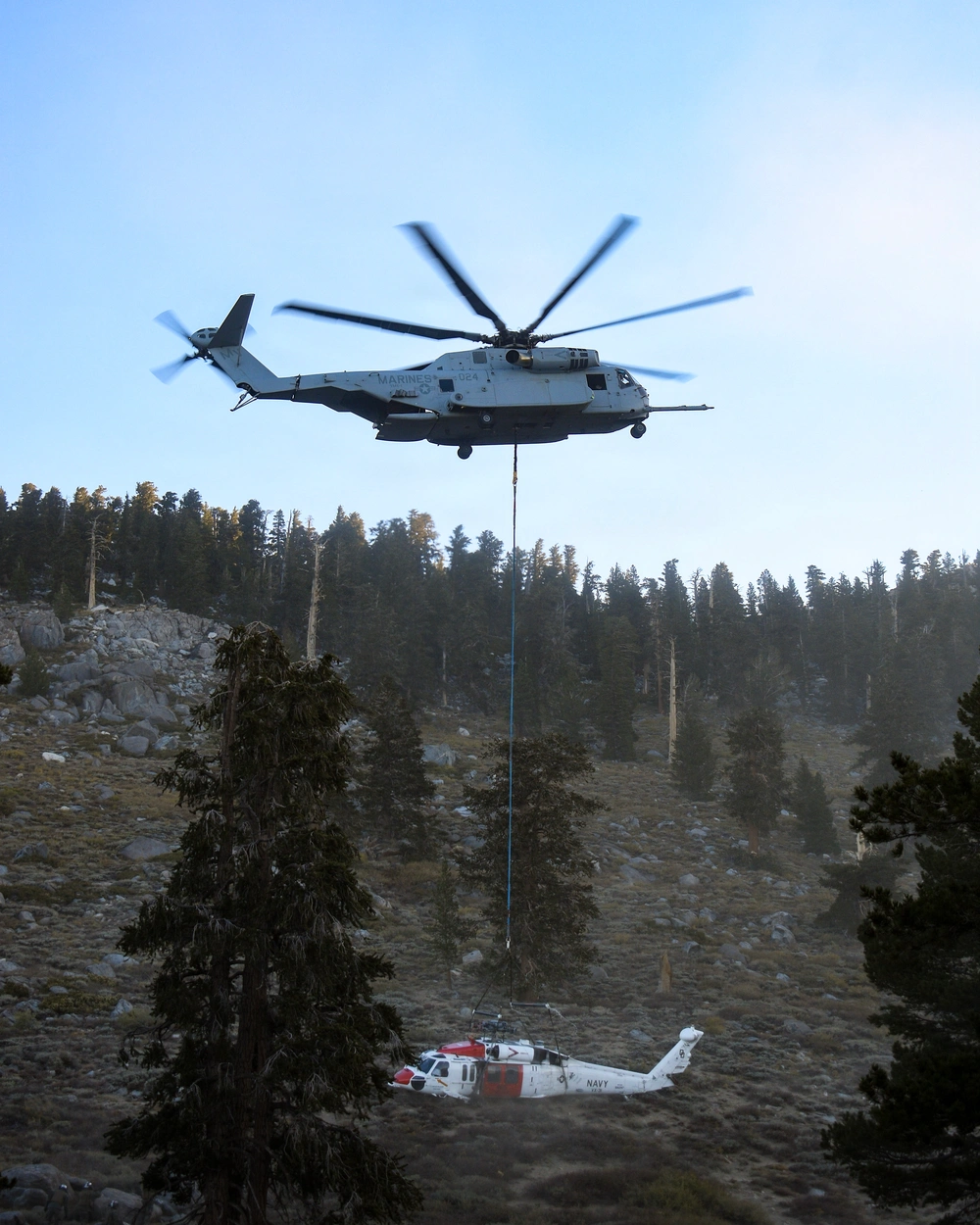


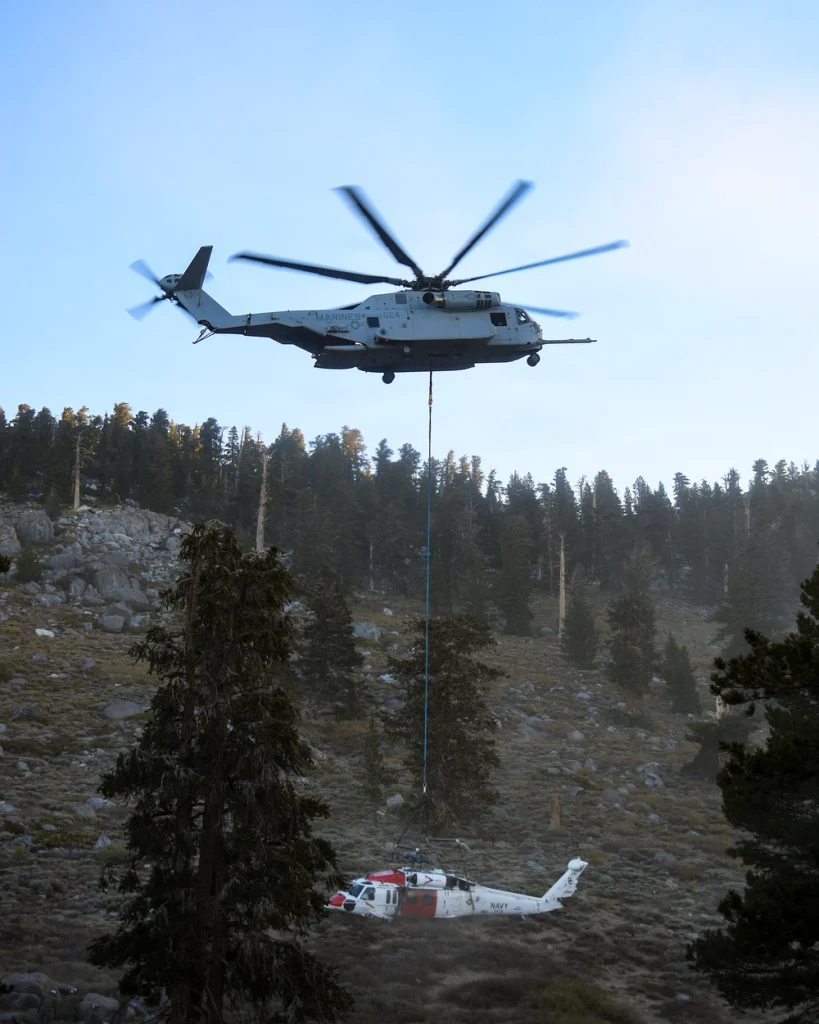
PATUXENT RIVER, Md. — A CH-53K King Stallion recovered a downed MH-60S Seahawk from the Sierra Nevada mountains in late September. The nearly 16\,000-pound aircraft was recovered by a CH-53K from Marine Operational Test and Evaluation Squadron (VMX) 1 using a “long-line” with a U.S. Marine Corps Helicopter Sling Load rigging and delivered to an airfield at Naval Air Weapons Station\, China Lake\, California. Because the MH-60S was recovered without incident or damage it will be able to fly again without extensive maintenance.
The recovery utilized a specialized rigging configuration developed with the Naval Air Warfare Center Aircraft Division (NAWCAD) Cargo Lab and Maritime Industrial Base and NAWCAD Structures Lab.
Major Lee Henderson, VMX-1, was the pilot and lead planner for the joint operation.
“We integrated established MH-60S crane-lifting procedures and the hoist sling with a 70-foot long-line to ensure proper load distribution and obstacle clearance,” said Henderson.
Because the long-line used in the recovery is longer than a standard U.S. Marine Corps equipment sling line used across the military in sling load operations, the recovery operation presented an opportunity to certify the CH-53K in its use.
The MH-60S, which belongs to Air Test and Evaluation Squadron (VX) 31, landed hard at an elevation of 10,000 feet but had no damage. It was unable to take off because of the angle of the terrain. The remote location and elevation added difficulty getting personnel and equipment to the site – meaning it would be extremely difficult to defuel the helicopter to reduce weight.
Enter the CH-53K. The King Stallion is the only aircraft capable of performing the recovery of the MH-60S due to the power requirement and restrictive terrain.
“The hardest part of this recovery wasn’t necessarily lifting the H-60,” said Henderson. “It was figuring out how to do it safely without causing any additional damage.”
The goal of the recovery operation was to keep the MH-60S in as “whole” a condition as possible to avoid damage to any part of it. Experts from the Cargo and Structures Lab were brought in to develop the rigging procedures; coordinate testing and certification of the long-line; perform long-line testing and data processing for the final report; and be on-site during recovery.
The H-60 Fleet Support Team at Marine Corps Air Station Cherry Point, North Carolina, was also consulted to provide guidance on proper configuration of the MH-60S for lifting and also to assist with weight reduction recommendations.
Michele Hoefer is an aerospace engineer with the Cargo Lab.
“We wanted to maintain full structural integrity,” Hoefer said, “so instead of using the main rotor head to lift the aircraft we used the built-in lift points, using the hoisting sling that was designed for it.”
Brandon Norris is the team lead at the Structures Lab and coordinated all the testing of the 70-foot long-line prior to the actual recovery event.
“We were fortunate to acquire a commercially available long-line,” said Norris. With the use of a locally available Defense Supply Center crane that could test the long line up to 20,000 pounds, his team performed safety and test lifts at Naval Air Station Patuxent River, Maryland, then ran all data through flight clearance for the necessary recovery permission.
“It took us less than two weeks from when the squadron reached out to us to finish testing and gain the necessary clearances,” said Norris. “Best of all, we were able to utilize existing infrastructure to reduce cost!”
Hoefer said the team planned to only remove the H-60S main rotor blades and tail blades, to prevent them being damaged in transit.
“The heavy weight of the H-60, the elevation, the distance to be traveled, and the weather on site meant that this would be putting the CH-53K in the corner of its envelope,” she said, “both for power required and for fuel consumption.”
Henderson approached the lift with a healthy respect for the risks associated in an operation like this.
“I was confident in the aircraft and the team,” he said. “But I understood the challenges of the recovery and what was at stake for everyone involved.
“Once we got to the actual lift the (CH-53K) gave us the power and precision we needed to get the job done.”
According to Henderson the CH-53K’s available power, precision flight-control system, and ability to calculate instantaneous power available using real-time engine performance and environmental conditions significantly reduced risk during this complex recovery and enabled precise, efficient execution.
The mission demonstrated the effectiveness of an integrated Navy and Marine Corps in an austere environment.
“It was a team effort from start to finish,” confirmed Henderson.
From Portfolio Acquisition Executive Aviation, Nov. 4, 2026