
Leidos Building Low-Signature Air Defense for Marines
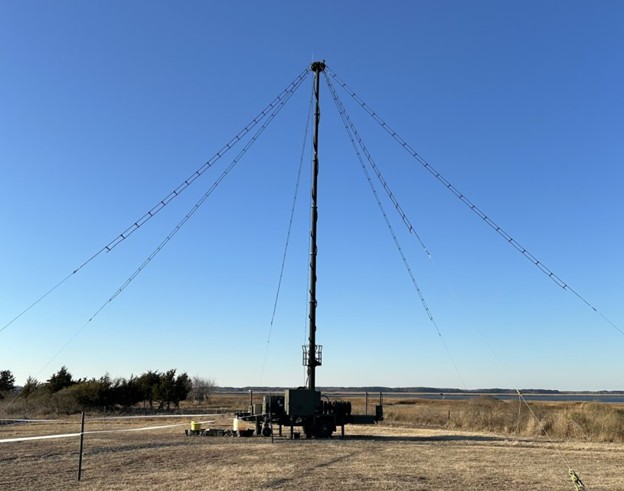


RESTON, Va. — Marines operating in contested environments need to detect threats in the airspace around them, without emitting a readily detectable signature that could compromise their location.
Leidos (NYSE: LDOS) will help meet that need by building and supporting 14 Medium Range Air Defense Radar (MRADR) systems under a new $40.8 million award.
Why it matters
MRADR is designed to provide persistent, 360-degree surveillance to help Marines track, identify, and defeat threats while minimizing the risk of revealing their position. The mobile system uses advanced antenna technology coupled with sophisticated signal processing designed to deliver that capability. In 2023, Leidos received a $32 million contract to develop four MRADR prototype systems for the Marine Corps. The new award moves MRADR from prototyping toward broader fielding, marking a pivotal shift from proving the concept to delivering real operational solutions.
Leidos will apply its engineering, manufacturing and integration experience to deliver the new systems, with work expected to be completed by August 2028. The award includes an option to retrofit previously developed prototype systems and existing Marine Expeditionary Long Range Persistent Sensor (MELPS) systems.
Expert perspective
“Marines need air defense capabilities that can keep pace with an increasingly complex operating environment,” said Matt Becker, vice president of Leidos Defense Sensors. “This award allows us to help the Marine Corps work toward a significant increase in survivable air-surveillance capability that supports the warfighter wherever the mission takes them.”
The big picture
Leidos designs and builds advanced sensing capabilities, including the Army Long Range Persistent Surveillance (ALPS) system designed to support Golden Dome for America, Multifunction X-Band Radar (MXR) counter-UAS radar supporting homeland defense, and electro-optical and infrared space sensing satellite payloads for missile warning and tracking.
The new award supports Leidos’ NorthStar 2030 strategy and its focus on defense technology designed to address evolving customer requirements and support mission effectiveness.
From Leidos, Nov. 18, 2026