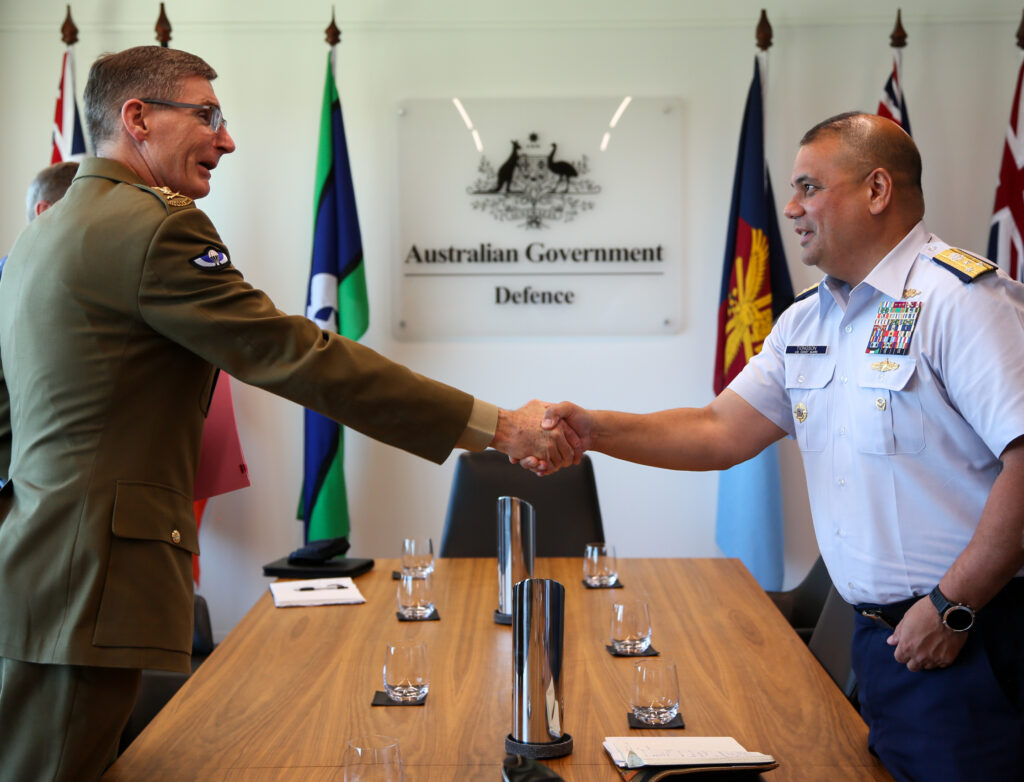
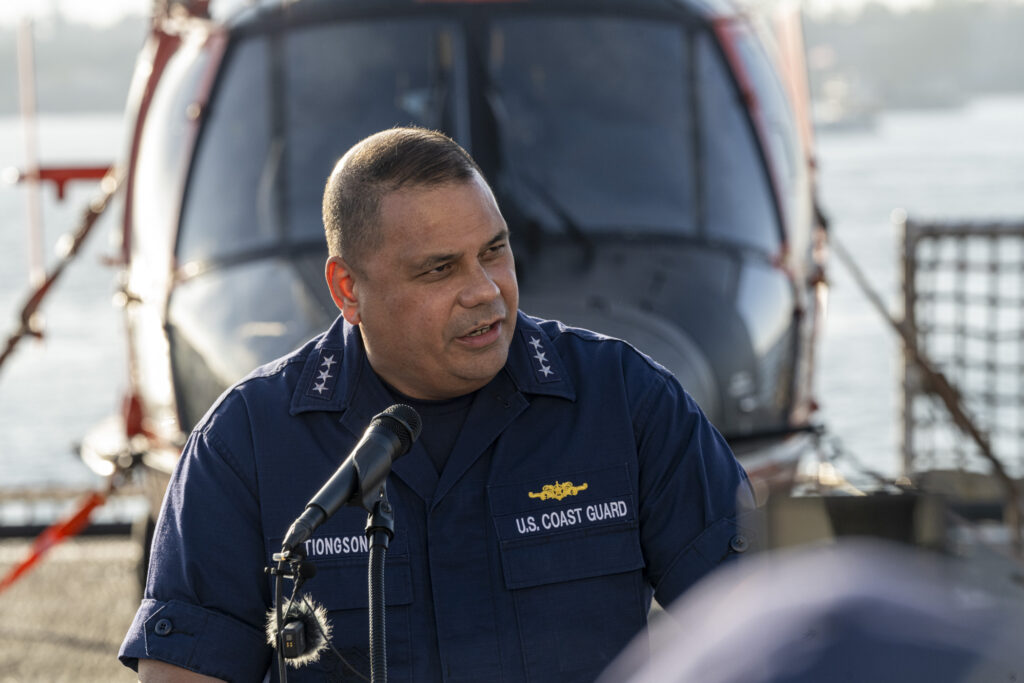
Vice Admiral Andrew J. Tiongson assumed command of Coast Guard Pacific Area in Alameda, California on July 8, 2022. He serves as the operational commander responsible for all Coast Guard missions westward from the Rocky Mountains across the Indo-Pacific, Arctic, and Antarctic regions, to the coast of eastern Africa. He concurrently serves as commander, Defense Force West and provides Coast Guard operational support to the Department of Defense and Combatant Commanders.
A 1989 graduate of the U.S. Coast Guard Academy, Tiongson has served on board five Coast Guard cutters and a U.S. Navy cruiser, serving as commanding officer of three of the cutters.
Tiongson discussed the roles and missions of the Pacific Area with Senior Editor Richard R. Burgess. Excerpts follow.
How would you describe the roles of the Coast Guard in the expanse of the Pacific area?
TIONGSON: The Coast Guard, in many ways, fills a little bit of a vacuum within the entire Indo-Pacific region the smaller nations in Oceania, and the Western Pacific for nations like the Philippines, Japan, South Korea, et cetera, and Taiwan, for that matter. That niche that we fill is maritime governance, basically the array of Coast Guard statutory missions: search and rescue, marine environmental response, maritime security law enforcement, fisheries, facilitating commerce, and the global marine transportation system. All of those things are missions that we do day in and day out and, frankly, what I see mostly is nations within the Indo-Pacific that see how we can do that for our country, and they want to copy that [and] learn from it. They want to work with us and emulate how we provide maritime governance to the United States. That’s what we get from engaging with a lot of our partners throughout the Indo-Pacific region.
How does the Coast Guard Pacific Area support U.S. Indo-Pacific Command (INDOPACOM)?
TIONGSON: [Through] that niche that we fill. For example, a lot of what’s happening out in the Western Pacific are the coast guards. We see tons of articles about the Philippines coast guard and the PRC [Peoples Republic of China] coast guard interacting with each other. We, as a coast guard, fit right in there and we have very similar missions. So, it makes it easier for us to talk back and forth and we do that with our larger national security cutters. In fact, one of them is departing Hawaii today [May 21] heading into the Western Pacific, and it will have our first trilateral exercise with the [Republic of] Korea coast guard, Japan coast guard, United States Coast Guard working together to have a regional approach to maritime governance issues in that region.
In other places ── Oceania or Blue Pacific Region ── our smaller cutters are even more prevalent and better. These small nations’ coast guards or navies are akin to these smaller vessels. It’s not like we’re overwhelming them with a large vessel that comes at your port. In fact, large vessels cannot even fit in some of these ports, but our smaller cutters can. We’re able to do subject matter expert exchanges on things like maritime law enforcement, search and rescue, those types of things. In a competition phase, maritime governance is extremely important. To help nations and to work with nations to exhibit maritime governance and proper maritime behaviors is key. I think that INDOPACOM is extremely grateful and wired into all of the things that we do.
Our national security cutters that go into the Western Pacific, the vast majority of the time will be under the tactical control of 7th Fleet and they work with us directly to ensure that we’re getting after our nation’s strategic goals. And with all the activities we do in the Oceania of Blue Pacific region, we work hand-to-hand with INDOPACOM.
What are the expectations of the trilateral agreement signed with the coast guards of Japan and the Republic of Korea?
TIONGSON: The expectations are very simple: In a nutshell, we will work together to improve the security, the safety and the prosperity of our shared regions. We have sent [USCGC] Waesche to execute that first implementation with the Korea coast guard, Japan coast guard, and U.S. Coast Guard, but it’s not our first trilateral that we’ve done. We’ve had great success working with Japan coast guard and Philippines coast guard, all working together, again, for the safety, security, and prosperity of the region as well as our nation, the United States.
As one example, there was an oil spill off of one of the Philippine Islands that rely upon the ocean for subsistence and their economy. The people that helped out the Philippine coast guard and the response to that [included] a five-person U.S. Coast Guard team and a Korea coast guard team, and Japan coast guard sent a couple of folks as well, so it’s amazing what you can do with small groups of people in this region. The U.S. Coast Guard commander O-5 running a unified command cell was able to address the issue and help employ all of the resources in the right way to get after that threat to the livelihood of this Philippine island. That woman O-5 ended up being the key adviser to the commandant of the Philippine coast guard and the president of the Philippines.
Not only is it about big ships and aircraft, but it’s also about small groups of people that go and provide such expertise, whether it’s an exchange of ideas or assistance.

What is the operational impact of the new Sentinel-class fast response cutters (FRCs) based in Guam?
TIONGSON: The FRCs, first off, are game changers for the Coast Guard in general. Back in the day, we had patrol boats that were limited in terms of the sea states they could handle, the food that they could carry, the number of crew members and certainly their duration at sea. The FRCs have changed that. We are looking at FRCs giving new light on how we can employ those. So, for us, they’re very much a game changer, particularly in the vastness of the Pacific Ocean. We have three that are stationed in Guam right now. We have sent them as far as Australia and the Philippines and, along the way, they provide IUU [illegal, unreported, and unregulated] fisheries enforcement. They will also pull into different partner nations and provide subject matter expert exchanges on things like search and rescue, maritime law enforcement, fisheries, humanitarian assistance and disaster response. In addition to that, what really makes them a big game changer for us is the 14 now bilateral agreements we have with nations in the Blue Pacific. Those are shiprider agreements that enable us to take one of their authorities that are underway with us and help that nation by enforcing their laws and regulations against anybody who is trying to take their sovereign resources in their exclusive economic zones [EEZs].
Our partnerships are becoming so strong that, now, in two countries, we have what is called an expanded and enhanced shiprider agreement in which we do not even need a physical human being on board the platform; all we need to do is call into the nation. An example could be a PRC fishing vessel that is in your EEZ fishing. Would you like us to enforce your laws and regulations, the rules and regulations? A lot of times it comes back, yes, and we exercise that agreement.
And, really, what they are doing is sending a signal that the United States presence is here. We want to become a trusted partner with you and in order to be that trusted partner, we have to be there.
In addition to the three FRCs we have in Guam, the Coast Guard was just appropriated two more, and those two more will go hopefully to Guam. We want to build up Guam with three new FRCs. And then we want to put one in Honolulu, Hawaii.
What has the USCGC Harriet Lane accomplished since it was based in Hawaii?
TIONGSON: Harriet Lane is a complete game changer for us. Harriet Lane recently completed her inaugural patrol, visiting nations like Samoa, Vanuatu and Papua New Guinea. They have done exactly what I mentioned the FRCs are doing but on a larger scale.
The Pacific Area is scheduled to receive the first of the offshore patrol cutters. What missions will they be performing?
TIONGSON: We are extremely excited to have new offshore patrol cutters starting out in our AOR [area of responsibility]. This is an incredible program for the Coast Guard and the largest shipbuilding program that we have had since World War II. I had the great opportunity to watch the first one, Argus, being launched late last year. They will provide us with more offshore capacity. Think of all of those types of missions that I mentioned these platforms are going to be doing those types of missions for us globally. They are replacing our medium-endurance cutters, but I believe what we will see is that they will come with a great deal of capability and we will find new ways to employ them that we could not do with our 210-foot and even our 270-foot cutters.
How have the new HC-130Js aircraft at Barbers Point, Hawaii, added capability to your aviation operations?
TIONGSON: The cockpit avionics upgrades coupled with the efficiencies of the engines and a propeller-type design allow us to fly these HC-130J aircraft higher, get on scene faster and stay on scene longer. When you think in terms of maritime domain awareness and search and rescue, these things are definitely a game changer for our service compared with the HC130H model and the other fixed-wing assets we have had. Yes, we’re excited to have those in Barbers Point as well as Kodiak, Alaska, and to be transitioning to them in Sacramento, California.
What concerns do you have about sustaining your icebreakers until the polar security cutter comes online?
TIONGSON: In a nutshell, there is more and more of a need for U.S. Coast Guard presence in the high latitudes than ever before. I see that in terms of great-power competition up in the Arctic region. I see that in Antarctica, with Chinese PRC research icebreaker vessels that are down there a great deal, and with Chinese expansion on that continent. The U.S. presence is needed. How that presence gets into those areas is via icebreaking. We need them [polar security cutters] fast and we needed them yesterday.
It is a challenge to sustain the two that we have right now. We have one heavy icebreaker, 1970s-vintage Polar Star, which provides icebreaking so that we can resupply our McMurdo station there, run by our National Science Foundation, and several other agencies there at are on that station for the scientific missions. After doing that, she goes right into the drydock and we try to fix everything. This is a vessel that works in the harshest of maritime environments. Am I worried about sustainment of it? Absolutely yes. The Coast Guard cutter Healy, that operates primarily for us in the Arctic, also is aging. She has done a trans-Arctic voyage and is set up to do yet another one. She runs the same type of schedule as the Polar Star: operations for several months and then a major maintenance period to keep her running.
Recently we were appropriated a commercially available icebreaker. It will help us a great deal in our missions that are Arctic-related. A light icebreaker, it could not handle the thickness of ice in the Antarctic, but definitely will help us out with what the Healy s mission is.
Is the commercial icebreaker going to be crewed by Coast Guardsmen or by a contract crew?
TIONGSON: That’s a great question and we are working through differing courses of action for that. The first thing is we’ve got to figure out what the crew is going to be and look like. The second thing that has to happen is we have to paint the icebreaker in U.S. Coast Guard markings on the vessel so that people are not confused when they see our American flag flying proudly from it. The third is, over time, we have to militarize the vessel, about it meeting military specifications: the flight deck for landing helicopters, things like that, and certain military specifications for safety and security reasons. It is really a phased approach that happens over time. Although it was just recently appropriated to us, we still have to procure the vessel. We have set up its home port in Juneau, Alaska, in terms of the pier space and then certainly maintenance activities.
For your missions closer to home, are your forces sufficient or is the number of tasks overwhelming them?
TIONGSON: We are not set up that we can handle all of these things all at once. Right now, the biggest example would be Operation Vigilant Century [OVS], [with Atlantic Area cutters] working on irregular migration coming from Haiti and Cuba for which a lot of Coast Guard resources are out on the seas, ensuring their safety and our security as we move forward. As we surge into places like that off of Haiti in the Florida Straits area, that means that those assets can’t go somewhere else, so that hinders us in looking at different places. Typically, the Atlantic area would provide some of those cutters over to the Eastern Pacific to conduct the counter-drug mission. But, right now, they are not, because they are doing this OVS mission set. And so, we have to come up with unique and innovative ways to try to fill those vacancies. So, yes, we got pressurized to do those things here in defense of the homeland.
I will also offer that the Coast Guard, like the other armed services, has personnel issues in terms of our workforce and recruiting. Although recently we have been having great success and we are doing pretty well, we are still down about 2,500 people and, in our organization, 2,500 is a lot. We have been working very hard to figure out what can we not do in terms of priority of the missions and platforms that will loosen up the pressures on our people so that our people and platforms can focus on the highest risks to our nation. That means that we have laid up some 87-foot coastal patrol boats and did an advanced decommissioning of one of our 50-plus-year-old 210-foot cutters. We have released some of the pressure on the personnel system because now we don t have to fill those billets and positions.
Is there anything you would like to add?
TIONGSON: What I would emphasize is I was very specific in the words “a trusted partner.” That’s what we are trying to be throughout the Indo-Pacific region and everywhere from Central America and South America, Arctic nations, Antarctic, and then certainly, Western Pacific, Central Pacific and the Blue Pacific.
One of our key things is that we always want to see the threats and challenges through the eyes of our partners, always meeting them where they are and with what they need. That’s an important phrase there because sometimes, with the U.S. in all of our might, we overwhelm some of these smaller nations. So, always meeting them where they are at with what they need is a very important thing to how engage with different countries. We are getting good support from our administration and Congress with what we talked about the Indo-Pacific and the Coast Guard. An example already was the Harriet Lane. We talked about the two additional FRCs that were appropriated to us in the FY24 budget. Previous to that, we’ve increased the number of liaison [personnel] and attaches we have in the region. We’ve stood up two other Centers of Expertise: The Marine Environmental Response Regional Activity Center and the IUU Fisheries Center of Expertise. These are all people. But again, it’s not about scale and aircraft. People engage a lot, provide subject matter expert exchanges, provide training and then they make a big difference throughout the region in terms of us being a trusted partner. On our unfunded priorities list, we have a second kind of Harriet Lane or Indo-Pacific support cutter. And then in our FY25 budget we have two additional FRCs for the Indo-Pacific area. So, a lot of things are happening and it’s very exciting to be part of this.