Since the 2018 National Defense Strategy reoriented the Joint Force toward great power competition, China — our primary pacing threat — has accelerated its military modernization and ramped up coercive behavior across every domain. Nowhere is this more evident than in the First Island Chain, where Beijing’s revisionist ambitions collide head-on with our strategic interests. In this contested space, logistics is no longer a rear-area task — it’s a frontline risk. If a capability can’t be produced or pre-positioned inside the theater, there’s a real chance it won’t reach the warfighter at all.
The vast distance between the First Island Chain and the U.S. power base, combined with China’s expanding anti-access/area denial arsenal, or A2/AD, has turned the supply chain from a guaranteed support function into the modern battlespace’s Achilles’ heel.
Mitigation of this new reality demands a shift in power projection, deliberate global pre-positioning to set the theater and a sustainment strategy that keeps our platforms and support systems agile, resilient and ready for a fight over thousands of miles of unforgiving waters, from the U.S. homeland to dispersed Pacific archipelagos. A recent article in the Wall Street Journal outlined one plausible scenario, a strategic naval blockade of Taiwan, which makes the need for agile logistics and forward-positioned capabilities even more urgent.
When imagining the future fight, the battlespace transforms into a clash across a sprawling maritime theater with dispersed stand-in forces using interior lines and an intricate web of logistical support. The battlespace will be persistently monitored — defined by constant intelligence, surveillance and reconnaissance; autonomous systems; electronic warfare; degraded communications and navigation; and a menu of A2/AD capabilities that limit freedom of maneuver. These conditions fundamentally alter how Marines must think about and execute logistics.
Russia and Hamas targeted their enemies’ homelands. China has also targeted the U.S. homeland, sending a signal that the United States and other vital points will not be off-limits from cyberattacks on critical infrastructure, strategic lines of communication, mobilization assets and weapon system vendors to disrupt forces and supply flows. Perhaps unsurprisingly, a recent Wall Street Journal report revealed that Chinese officials privately acknowledged their role in cyberattacks against U.S. infrastructure, admitting to years of intrusions into the computer networks of American ports, water utilities, airports and other critical targets.
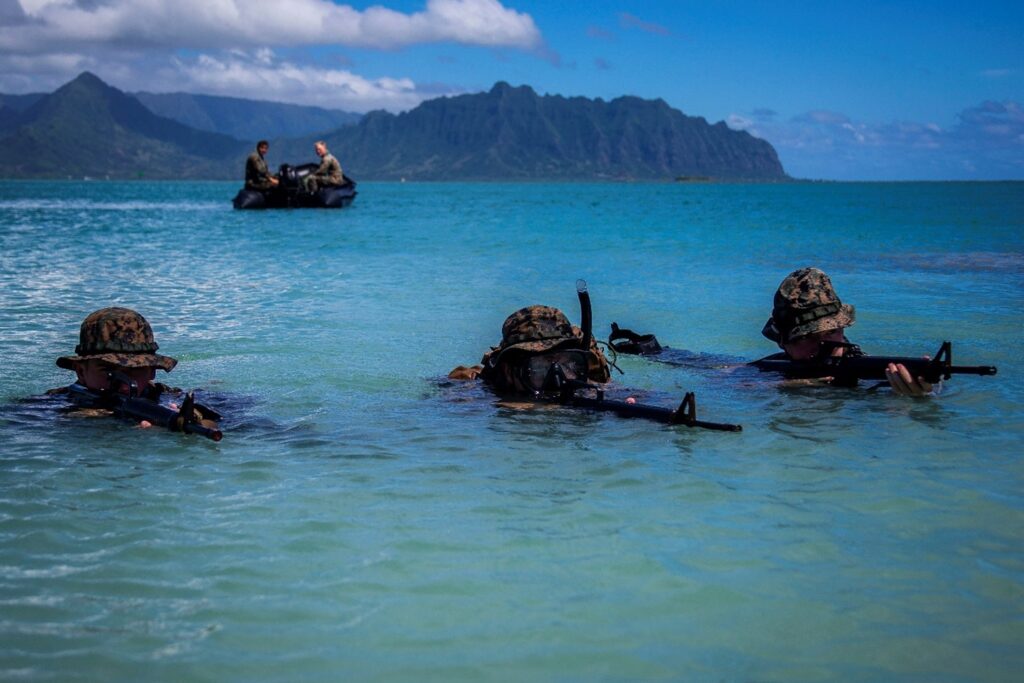
In the vast expanse of the First Island Chain, Marines — along with the joint force and partner nation forces — operate today as dispersed, agile nodes, deliberately scattered to complicate enemy targeting and reduce signature detection.
Marine Corps Systems Command’s Program Manager Combat Support Systems is actively developing and fielding a suite of capabilities that redefine logistics support in a contested landscape. Guided by the modernizing principles behind the force restructuring plan Force Design, we’re building integrated systems where every innovation meshes and enables the Marine Air-Ground Task Force commander to counter threats and disruptions in real time.

To understand the task at hand, picture a system where every logistics capability supports the kill web. Deployable Logistics IT is a powerful enabler, ensuring asset visibility of medical supplies both in the continental United States and with forward units. Condition-Based Maintenance Plus applies machine learning to enhance decision-making by alerting commanders to maintenance issues and enabling timely resolution to prevent degradation in operational readiness. The Electronic Maintenance Support System equips Marines with diagnostic and networked tools to isolate and troubleshoot faults. Once a fault is diagnosed, Marine fabricators can use advanced manufacturing (3D printing) to produce replacement parts at the point of need in theater — mitigating potential disruptions to the supply web. Signature management capabilities cloak emissions of individual warfighters while the use of netting veils command and control nodes and larger equipment sets.
Meanwhile, an overhauled, more deployable medical support system extends care well beyond the traditional golden hour, ready to stabilize and treat casualties for longer durations, and provides surgical capability in smaller and more adaptive packages. Together, these interlocking capabilities transform potential disruptions into rapid recovery opportunities, sustaining warfighter survivability deep inside the weapons engagement zone and ensuring our forces remain agile and resilient — even when the logistics web itself is under stress.
The sections that follow highlight a few key elements of our integrated logistics capabilities that keep our dispersed Marines one step ahead in the contested Indo-Pacific battlespace.
Advanced Manufacturing
As aggression and the likelihood of kinetic operations increase, we can expect China to shape operations to affect stand-in forces, disrupt reinforcements deploying from the continental United States to the Pacific, and target the supply chain and commercial vendors once considered protected within the bastion of the homeland. With every link in the supply chain vulnerable, rapid field repairs are essential to sustain operations. The PM CSS is reimagining advanced manufacturing to enable on-demand repairs and critical parts production directly in the field. This technology was tested in real-world scenarios: During Rim of the Pacific 2024, a combined team of Sailors and Marines used metal and polymer 3D printers to print critical components like reverse osmosis pump parts and lot-pressure air fittings aboard ship, keeping the amphibious transport dock USS Somerset (LPD 25) in the fight.
Today, our advanced manufacturing units are forging bonds with partner nation forces by fabricating parts to support Indo-Pacific Command hosts such as Australia, the Philippines, South Korea and Japan. By integrating advanced hybrid-metal and liquid metal jetting technologies into containerized, expeditionary fabrication units, Marines are reshaping the traditional supply chain model — one that often begins in or flows through CONUS and may prove untenable in the opening phases of conflict. This capability pushes manufacturing to the edge, enabling rapid, theater-level production and reducing reliance on vulnerable long-haul logistics.
Complementing this capability, the Digital Manufacturing Data Vault prototype serves as a secure repository to store, process and share technical data packages and digital drawings, ensuring that military and allied industrial partners can rapidly produce required components on demand. This comprehensive approach not only shortens supply chains but also helps keep forces mission-capable, even in the most austere and contested environments.
EOD and Combat Engineering
Explosive threats are one of many A2/AD tools China could throw at us to reduce freedom of maneuver. Explosive ordnance disposal and combat engineering capabilities are being overhauled to meet the demands of a high-threat A2/AD environment. The Littoral Explosive Ordnance Neutralization capability is tailored for coastal environments and littoral transition points, ensuring effective neutralization of explosive threats from very shallow water, from surf zones and on to the beach. For EOD, the LEON capability consists of five increments of equipment: remotely operated vehicle, personal dive equipment, uncrewed underwater vehicle, uncrewed surface vehicle and amphibious underwater ground vehicle.
The Stand-off Defeat of Explosive Hazards family of systems seeks to deploy advanced sensors and ground-penetrating radar for standoff detection via uncrewed air and ground vehicles, keeping Marines out of harm’s way. The integrated sensors and auto-target recognition will identify threats and communicate across the tactical network. Together, these integrated solutions empower our EOD and combat engineer teams to swiftly and safely counter explosive threats, ensuring Marines remain protected and mission-capable in the most contested environments. The LEON and SDEH capabilities are a toolkit to increase mobility for commanders and ensure a path for maneuver into theater and intra-theater for forces and supplies.

Expeditionary Medical Systems
As kinetic threats escalate, expeditionary medical capabilities become essential to sustaining Marine forces. Credible medical care gives Marines confidence to go into harm’s way. The Expeditionary Advanced Base Operations concept created a new paradigm in many log functions, and medical is at the front of the line for modernization. The “golden hour,” a term coined during the Global War on Terror to describe the decisive period following an injury and casualty evacuation, is no longer the mantra. Now the focus is on sustaining 96-hour patient care hold times due to the distance between units and the overall contested environment. The PM CSS is facilitating that strategy shift by fielding modular, lightweight systems such as damage control resuscitation and damage control surgery. Distributed Marine units are equipped to deliver life-saving trauma interventions directly in austere environments where traditional evacuation routes and timelines could be unsupportable.
Complementing these innovations, advanced medical devices like the Expeditionary Portable Oxygen Generation System and Expeditionary Medical Refrigeration Unit ensure reliable access to medical-grade oxygen and blood products, even when power is reduced or unsupportable. Concurrently, a pilot modernization effort is underway within the 1st Marine Logistics Group Medical Logistics Company Warehouse. The goals are to provide a garrison and deployable capability with radio-frequency identification scanning, a dashboard for medical asset visibility and a decision support tool that can aid in deployment and ordering optimization — saving taxpayer dollars on wasted supplies and reducing labor requirements. These integrated solutions ensure Marines receive uninterrupted, advanced medical support, dramatically enhancing survivability and sustaining lethality deep within contested zones.
Uniforms and Signature Management
Operating in the contested Indo-Pacific — especially within the First Island Chain — requires our Marines to obscure sophisticated enemy sensors across multiple spectrums. Our Ultra-Lightweight Camouflage Net System sets a new standard in electromagnetic battlefield concealment by reducing signature in the visual, infrared and radar bands. Designed for rapid deployment by a small team, ULCANS effectively masks vehicles, artillery and personnel, ensuring operational stealth in dynamic environments. Building on this breakthrough, next-generation clothing articles are in development that incorporate advanced technology to mitigate near- to long-wave infrared signature. These innovations and enhancements elevate traditional uniform products from an era of visual concealment using standard textile industry practices to advanced production capabilities that provide Marines with tools to enhance survivability and lethality on an increasingly multidomain transparent battlespace, ensuring tactical superiority.
Beyond these core innovations, the PM CSS is advancing a suite of complementary capabilities that enhance a resilient logistics web. Our power modernization initiatives reduce fuel demands and streamline mobile energy solutions. Meanwhile, digital tools like CBM+ and automated test systems ensure commanders maintain real-time situational awareness, enable diagnostics and rapid maintenance, and support circuit card repair in theater — keeping equipment in the First Island Chain and reducing wasteful efforts to return gear to higher echelons of maintenance in CONUS or to rely on today’s overstressed supply chain.
Uncrewed aircraft systems with computer vision for airfield recon, deployable ICD-705-compliant shelters, augmented-reality-aided navigation, bridging, polymer ammunition and lighter, integrated personal protective equipment further ease logistical burdens and increase lethality. Together, these building blocks — designed to support the EABO concept — strengthen the distributed, logistics network needed for a future fight in the contested Indo-Pacific region.
While these capabilities do not regularly make headlines, they are the critical elements to enabling the EABO concept and strategy in general. Each innovation, whether in rapid field repairs, extended medical care or next-generation stealth textiles, forms an integral link in our resilient kill and logistics webs, ensuring dispersed Marines remain agile and ready for any threat or challenge.
Colonel Paul Gillikin, an infantry and special operations officer, is the program manager for Combat Support Systems at Marine Corps Systems Command in Quantico, Virginia.


- We Fight Tonight: Corps Capabilities for a Contested Indo-Pacific - April 25, 2025