Editor’s Note: Since this article first appeared in the July/August issue of Seapower, the 9th District has been renamed the Great Lakes District.
The 9th Coast Guard District, or D9 as it is known to the 5,000 people stationed at more than 78 units across five sectors, encompasses eight U.S. states and the five Great Lakes, including three of the world’s largest by surface area — Lake Superior, Lake Michigan and Lake Huron.
With 6,700 miles of shoreline and a 1,600-nautical-mile international border with Canada, the 9th District ensures safe passage each year for 80 million tons of bulk cargo — iron ore, taconite pellets, grain, salt, concrete and fertilizer — along a handful of vital shipping corridors. In D9, these waterways are essentially narrow passages; in the event of a marine casualty situation, bypasses are scarce. What’s more, 90% of the nation’s iron ore (taconite) comes from open-pit mines in Minnesota and Wisconsin on Lake Superior, where its shipping relies entirely on the Soo Locks, a complex of locks on the St. Marys River without which Lake Superior would be isolated from the rest of the Great Lakes.
Inside the 9th District is the 2,340-mile St. Lawrence Seaway. The primary access route to North America’s heartland, the seaway connects the Atlantic Ocean to the head of the Great Lakes. The route is the only navigable link for oceangoing vessels, including cruise ships, to reach the major inland ports of the Great Lakes, among them Ontario’s Port of Thunder Bay and the Port of Duluth-Superior.
D9 also has oversight of 5.5 million registered boaters with some of the busiest recreational boating activity in the world. Driving home the economic value of D9’s area of responsibility is the fact that America’s five great lakes contain 20% of the Earth’s fresh surface water, and 40 million Americans rely on the lakes for safe drinking water.
But there’s more: a “Hall-of-Fame” stat one might not expect, according to Rear Admiral Jon P. Hickey, the 9th District commander and senior Coast Guard commander for the Great Lakes and St. Lawrence Seaway.
“If you took the Great Lakes region, the eight states, the two Canadian provinces, the five lakes, and called that a nation, it would be the third-largest GDP in the world [after] the United States and China,” Hickey told Seapower. “The impact that this sector has, it’s real, it’s tangible. In the 9th District, we’re all about safety and security of these maritime regions, these lakes. It is a lifeblood of the U.S. economy.”
D9 is a thriving ecosystem in which all the moving parts — the multitude of lakes and waterways, the valuable cargo, the skilled workforce and the robust, if overworked, fleet — function seamlessly, usually without disruption and therefore, out of the public eye. None of the work is effortless, much less easy. Hickey described the “challenging” narrow passage along the St. Marys River, considered critical infrastructure by the Department of Homeland Security.
“That’s why we have the vessel traffic system. It is absolutely critical what these folks do to manage vessel traffic safely and securely in those waterways,” Hickey said. “You’ve got these … thousand footers [ships] going through there … carrying a product that’s essential to our economy, our security, and if anything were to go wrong, it’s likely [to] block the waterway. These are the things that keep me up at night. The idea of a marine casualty in the St. Marys River, the Detroit River, the St. Clair River because those are the single points of failure in the MTS,” or maritime transportation system.
The regulatory and security landscape surrounding maritime operations on the Great Lakes is nothing if not complex. With 1,600 nautical miles of maritime international border, Hickey said the long-standing cooperation with Canadian maritime authorities is crucial.
“We have an incredible partnership with [our Canadian partners],” Hickey said. “We call it ‘Shiprider,’ where they come on board our vessels, and we go on their vessels. So, it’s a seamless enforcement of Canadian and U.S. laws across that border. We’re ensuring the safety and security of our maritime transportation system, which on the Great Lakes is tantamount to our border. If you were to navigate from the Sioux Locks to Duluth, you would cross the Canadian and U.S. border, staying inside the channel, over 20 times.”
Unique to the 9th District is the Canadian and U.S. Laker fleet, which operates solely within the bounds of the Great Lakes and the St. Lawrence Seaway up to around Montreal, Hickey said. Made of Canadian and U.S. commercial cargo vessels designed for the transport of bulk commodities within the Great Lakes system, the Laker fleet is “not really considered international” and not subject to the same international regulations, such as SOLAS (International Convention for the Safety of Life at Sea), given they only operate within the internal waters of Canada and the U.S.
Meanwhile, the seasonal foreign trade routes through the St. Lawrence Seaway bring foreign flag vessels into the Great Lakes from mid-March to January every year. These vessels are subject to international regulations and must abide by SOLAS requirements because they are in U.S. and Canadian internal waters.
“We have to be very vigilant about … what’s coming in,” Hickey said. “Are they threats to our critical infrastructure, our safety, security? If they meet the threshold for a high-interest vessel, we are going to board them as soon as — or before — they get into the lakes. In the U.S. waters and in the seaway, we’re going to make sure we keep our American public safe and secure.”
Since January, D9 has allocated available operational capacity toward securing and defending the northern border, Hickey said. He said D9 is “leaning into” northern border concerns and intelligence, using resources on hand in anticipation of how border events elsewhere in the country play out.
“We’re also asking the questions of: ‘What would we need if we wanted to do more in the event that … illicit activity increases on the northern border as we continue to lock down the southern border?,’ that balloon effect,” he said. “We have really doubled down on our interagency coordination. [We are] making sure that illegal cross-border activity like drug trafficking and people trafficking is not happening, and we are as committed to that as we are to our search and rescue mission.”
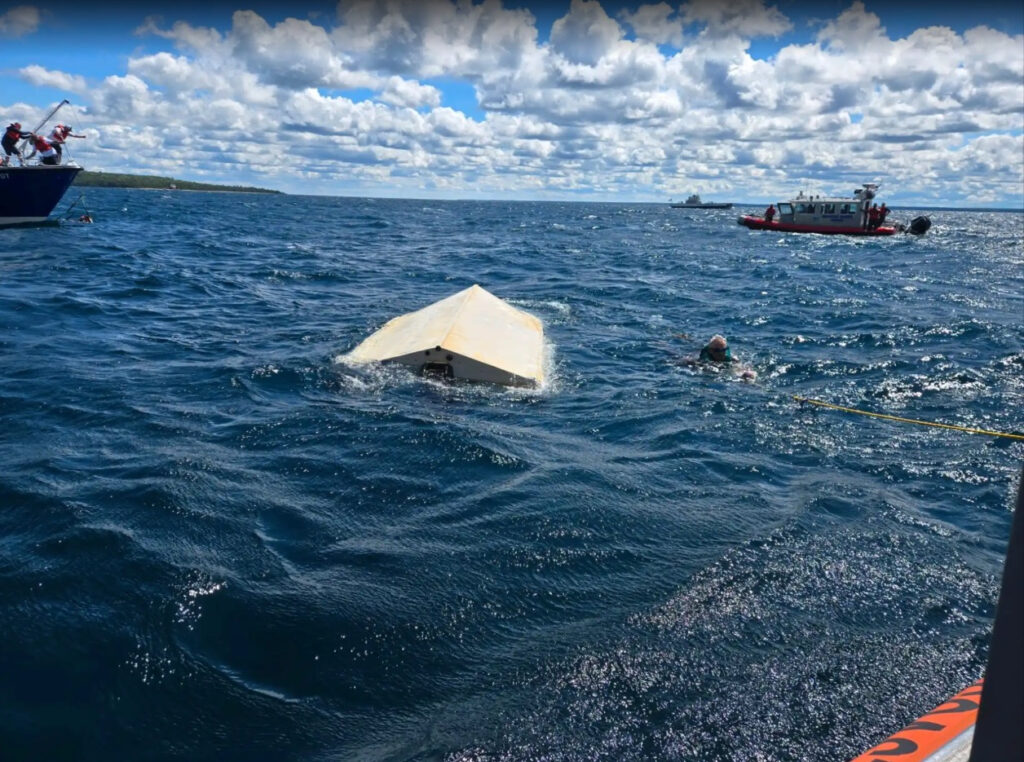
The 9th District does the second-most search and rescue cases after the 7th Coast Guard District in the Southeastern U.S. and Caribbean. In the past year, the people of D9 executed more than 2,000 SAR cases across the Great Lakes, Hickey said.
“We saved 873 lives,” he said. “I tell my people, if you save one life, you’ve impacted and changed the lives of everybody in their circle of trust, circle of love, friends, family and loved ones, for the rest of their lives. Search and rescue goes beyond just a mission. It is our special trust with the American public.”
Whether on behalf of recreational boating safety, icebreaking or the uneventful movement of critical bulk cargo, the D9’s Vessel Traffic Service teams rely on a healthy fleet of multimission cutters, response and patrol boats, and, by extension, U.S. Laker cargo vessels. This is not as easy as it sounds, according to Hickey, who said overdue maintenance and slow to no vessel recapitalization are ongoing challenges for VTS operations and overall readiness.
“Those VTS folks are like air traffic controllers. They maintain situational awareness,” Hickey said. “Our U.S. Laker fleet and the Canadian Laker fleet is old, and what we’re witnessing is an increase in our maritime casualties. I am concerned about the health of the fleet. We are in a downward readiness spiral … and it’s due to the perennial underinvestment in our Coast Guard. We have backlogs and maintenance across the board, whether it’s our cutter fleet, our boats, our aircraft or our shore infrastructure.”
In April 2025, DHS issued the Force Design 2028 report, which outlines plans for implementing transformational changes within the Coast Guard, including an overhaul of the agency’s acquisition and contracting system to expedite much-needed new ships. Shortly after the report’s release, Admiral Kevin Lunday, the acting commandant of the Coast Guard, told members of the House Armed Services Committee that efforts were underway and that production milestones outlined in Force Design 2028 are being met.
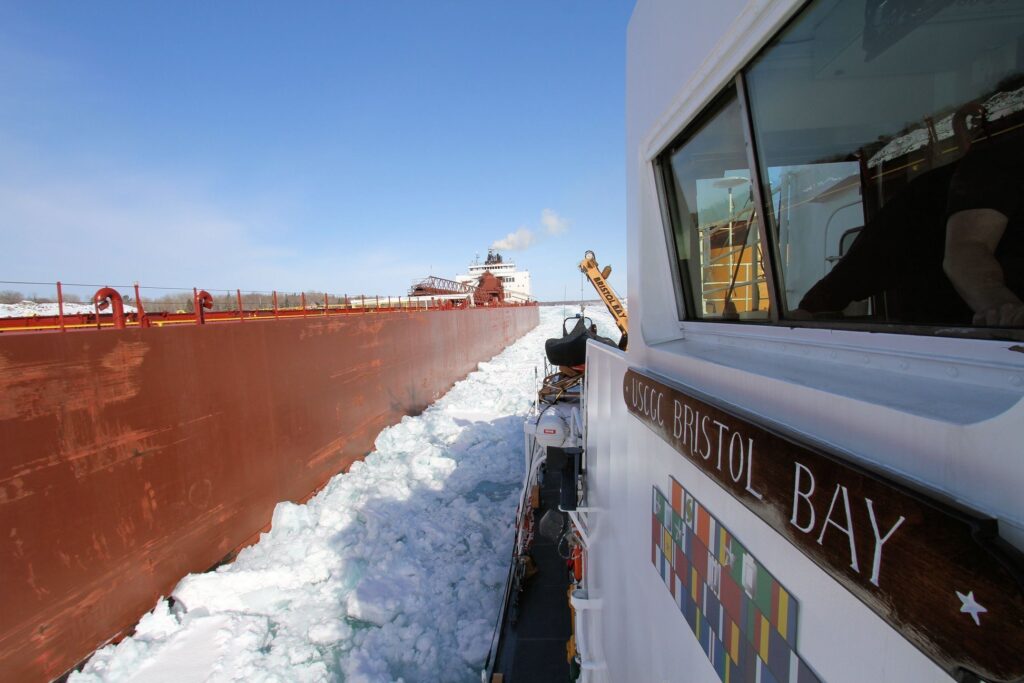
Hickey said the plans in Force Design 2028 can’t come soon enough. Citing last winter’s above-average ice season in the Great Lakes, he said it was the first time in a while the 9th District had been “stress-tested” with respect to the icebreaking mission. But, thanks to some excellent advanced planning by D9 district staff for maintenance and to complete aids to navigation, or ATONs, in the summer months, they were well prepared.
“We were able to cover down very, very well on the ice season. But, from my perspective, this plan to renew our fleet, our Coast Guard writ large, can’t come soon enough,” Hickey said. “When we talk about Force Design 2028 and recapitalizing the Coast Guard, the VTS system is part of that. We need to recapitalize that system. I am very grateful for the leadership of the administration to get after recapitalization and renewal of the Coast Guard, because it’s not sustainable.”
Daisy Khalifa is a journalist and publicist. With more than 25 years of professional, public affairs and writing experience in Washington, D.C., she recently relocated to the Minneapolis area. Khalifa has consulted and worked full-time in the federal government, for associations and for Fortune 500 companies, among them the Smithsonian Institution, MCI and Nextel Corp.


- Coast Guard District is Economic Nerve Center with Complex Northern Border Challenge - August 8, 2025
- Ports Seen as ‘Vital Resource’ for National Security - April 7, 2022
- COVID, War in Ukraine Complicate Global Supply Chain, Speakers Say - April 7, 2022