By Vicky Uhland, Seapower Correspondent
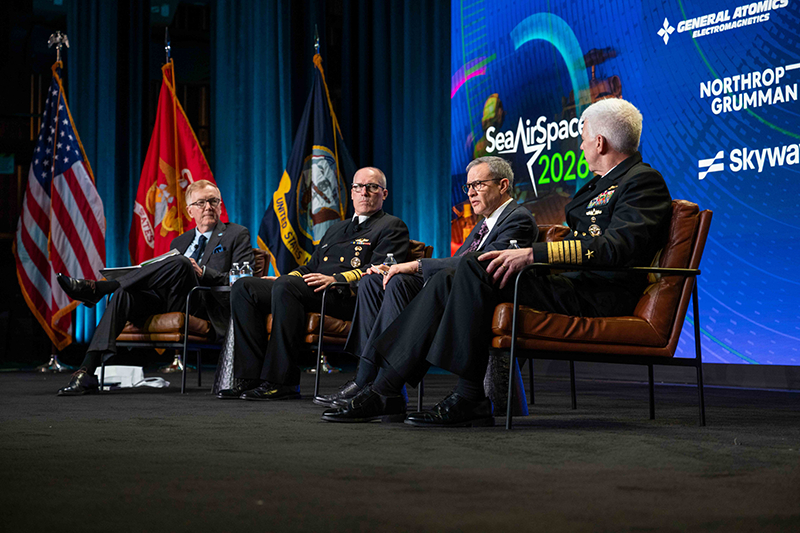
The U.S. Department of Defense is at an inflection point in maritime dominance through acquisition reform, said panelists at Tuesday morning’s fifth annual breakfast hosted by the Navy League’s Center for Maritime Strategy.
The Department of War is not just a moniker, “it represents a sea change in the way we go about business,” said U.S. Navy retired Captain William Toti, senior advisor to the deputy secretary of war. “We are mobilizing our industrial base in a way that’s never been done probably since World War II. We need everybody in industry to pull along as we go down this lane.”
Toti said when he joined the Department of Defense a year ago, he conducted a review and found war preparation was not taken seriously, critical munitions programs had been terminated and 100% of other critical programs were late and over budget.
“There was complacency all over the department and a loss of military dominance,” he said. “It was a department that lost its way; it was focused on the wrong things” and a reboot was necessary.
Vice Admiral Rob Gaucher, direct reporting portfolio manager (DPRM) submarines and program acquisition executive (PAE) undersea, said DRPM handles submarine building and the PAE structure maintains existing submarines.
For submarine building, the first priority is a “forward-looking supply-chain view to find bottlenecks,” he said. On the PAE side, he’s building out scorecards to measure five specific types of maintenance.
Panelists answered a series of questions about the future of maritime dominance from audience members and the session moderator, retired Navy Admiral James Foggo, dean of the Center for Maritime Strategy. Questions included:
There are going to be three carrier strike groups coming home from the Gulf; how do you get them repaired?
Admiral Karl Thomas, commander of U.S. Fleet Forces Command, said the biggest problem is capacity issues in the shipyard. The main levers include prioritizing maintenance continuum and “ensuring that shipyard workers are turning wrenches,” he said.
“Longer deployments mean more maintenance,” Thomas said. Maintenance of the USS Gerald R. Ford (CVN 78), which had a major fire on board in March, will exceed 10 months, he said, noting the Navy plans to hire 3,000 more shipyard workers a year to deal with those chores.
What challenges have you learned from Virginia-class submarine procurement maintenance, and how are we postured to overcome those challenges for Columbia and SSN(X)?
Thomas said the gap from “the kill chain from thinking I can manufacture something to when I actually get the ability to get the part” takes more than a year. “We as the Navy have not made it clear to industry” about the manufacturing requirements. This was a huge problem for the Virginia class, he said, and the Navy is leaning into advanced technology to do things quicker.
What is your metric for deciding if industry is supporting the Navy, and what does industry support look like to you?
“Accept the new paradigm [Deputy] Secretary [Steve] Feinberg has put in place. Don’t push back. This is how it’s going to be,” Toti said. “It’s OK to think outside the box but not OK to go to Congress. Congress is fully on board; nobody is pushing back on this.”
What advice would you give at this point in your careers that would make a difference to a junior Sailor or junior officer?
“The thing that kept me in the Navy to this point is the camaraderie,” Thomas said.
Toti said he’s been “so blessed to have three lucrative careers, and none of them was planned. Enjoy what you’re doing now and don’t worry about the future.”
“There are going to be plenty of bad deals out there, but there are incredibly good deals and things you get to do,” Gaucher said, recommending that young Sailors and officers “take a minute to remember the importance of what you do and what the Navy offers as a career.”


- Commandant Gives an Update on Marines Future - April 21, 2026
- Senior Leaders Forecast the Future of Maritime Dominance - April 21, 2026
- New Microwave Technology Can Disable Drone Swarms, Other Electronic Threats - April 21, 2026