By Richard R. Burgess, Senior Editor
ARLINGTON, Va. — A Silicon Valley-based technology company is finding success in developing and producing small, silicon chip-based navigation systems ideal for small unmanned systems.
ANELLO Photonics, headquartered in Santa Clara, California, is producing navigation systems based on MEMS (Micro-Electro-Mechanical Systems), a technology that integrates components like sensors, actuators, and structures on a single silicon chip.
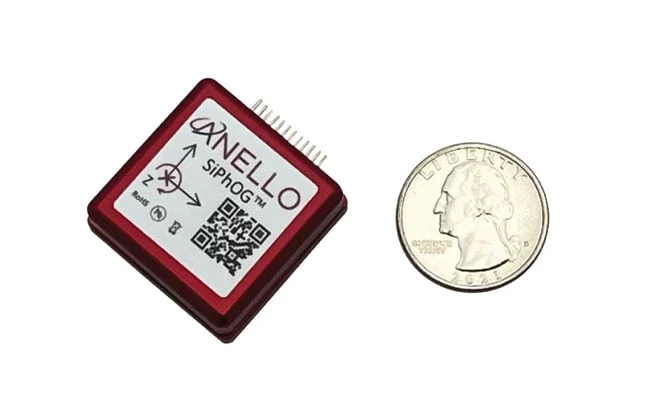
The products core is the SiPhOG (silicon photonics optical gyroscope), a photonics chip that takes the place and function of a fiber-optic inertial navigation system common on aircraft, ships, and submarines.
“Fiber-optic gyros very high-end, generally navigation-grade for ICBMs, fighter jets, [and] submarines, very gold standard, [and] can navigate for weeks or months at a time,” said Kirsten Schauble, vice president for systems engineering at ANELLO, in an interview with Seapower. “They’re fantastic sensors; the problem with them is that they are big, bulky, power hungry, and extremely expensive.”
As such, fiber-optic gyros are impractical for small unmanned systems, particularly attritable systems.
“We’ve taken the same phenomena of a fiber-optic gyro [with dozens of discrete optical components] … [and] taken all of those [active and passive] optics components [including couplers, modulators] — and put that onto a two-millimeter by five-millimeter silicon photonics chip,” Schauble said.
The SiPhOG is “mass producible, very robust, able to get the same precision because we’ve innovated so much on the photonics side,” she said.
Because the SiPhOG is relatively inexpensive and very small and lightweight and consumes little electric power, it is ideal for equipping swarms of autonomous or small systems such as autonomous unmanned aerial vehicles (UAVs), unmanned surface vessels (USVs) and unmanned underwater vehicles (UUVs).
Schauble said the SiPhOG is ideal for lower-cost Group2/3 fixed wing drones, USVs, and 10-foot-to-200-foot vessels.
“We’re able to bring high precision to lower-cost, lower size-weight-power regime capability on smaller vessels,” she said.
The company’s Maritime Inertial Navigation System is designed to provide precision navigation in GPS-denied environments.
ANELLO’s full 3-axis SiPhOG, the X3 IMU [inertial measuring unit], can integrate into drones and UUVs and directly aid sensor fusion, Schauble said. The X3 can connect to a central processing unit to run all of a drone’s sensor fusion and for a full navigation solution, she said. The X3 features open interface and architecture, built for flexible plug-and-play.
In January the company recently received a $20 million contract from the Office of the Under Secretary of War for X3 IMUs for fixed-wing UAVs, Schauble said.
According to a company press release, ANELLO was selected in January by the Department of War (DoW) for a $20 million award under the Accelerate the Procurement and Fielding of Innovative Technologies (APFIT) program to fast-track the procurement, production, and scaling of ANELLO’s GPS-denied navigation technology.
ANELLO’s SiPhOG is integrated on several drones, including HavocAI’s USVs, BlackSea Technologies’ Chaser USV and its Global Autonomous Reconnaissance Craft (GARC).
Schauble said ANELLO’s workforce is expanding from its current 35-to-40 personnel.
“We can’t build these things fast enough,” she said commenting on the flood of orders.



- ANELLO Photonics Miniaturizes Navigation Systems for Unmanned Systems - May 27, 2026
- Pilots Eject from T-45C Goshawk in May 26 Mishap - May 27, 2026
- Blue Ops Building V7 Combat USVs for Undisclosed Customers - May 22, 2026