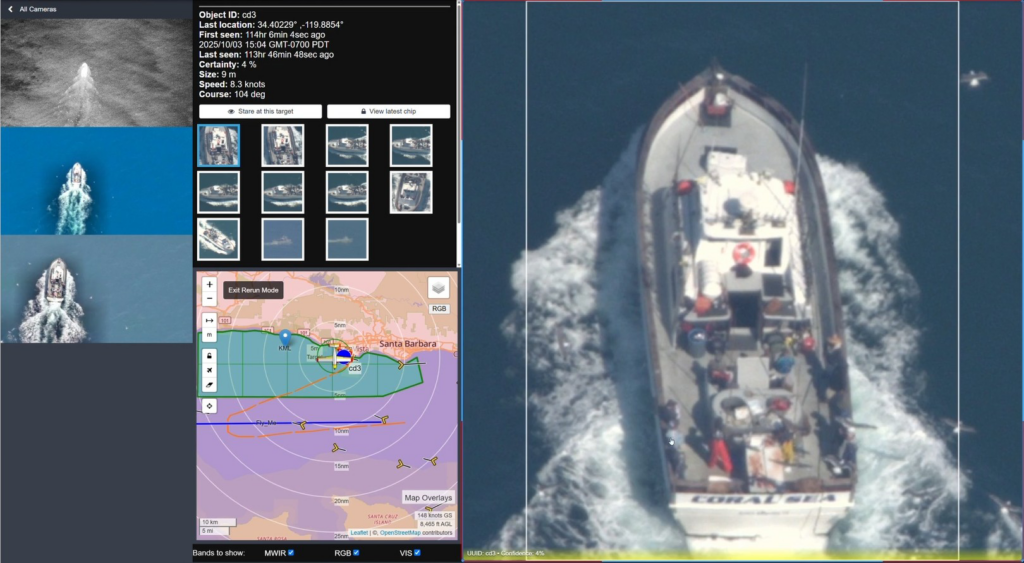
ARLINGTON, Va. – Integration of artificial intelligence (AI) with imaging sensors relieves operator workload on some drones and Navy aircraft and enables those operators to focus on decision making rather than sifting through overwhelming amounts of data, a sensor technology expert said.
“We focus on automating the experience of using sensors — especially in the maritime environment but also overland — to make it easier and faster as well as better for crews to gain intelligence from the sensors that they use,” said Greg Davis, founder and CEO of Overwatch Imaging, an imagery intelligence technology company, in an interview with Seapower. “That process uses artificial intelligence and autonomy to reduce the workload for the crews that are using sensors and also provide those crews with a super-human vision — to see more than they can naturally see by using the power of computing and AI.”
“The Navy has this problem [in that] they collect a lot more data than they can look at,” Davis said. “Sometimes they don’t even collect data because they know they can’t look at it.”
Davis likened the task as “needing to find a needle in a haystack.”
Over watch’s software, called Automated Sensor Operator (ASO), uses a connection to a sensor that same as the crew would.
“The crew interacts with a sensor through ethernet corrections or serial connections,” Davis said. “We use that same method of connecting to the sensor. We sit between the crew member and the sensor. From that position we can take command of the sensor and accomplish the job that the sensor operator wants to accomplish and do that in an automated way that allows the crew member to focus on something else. We provide alerts when there’s something to see.”
No modifications to an aircraft’s mission computer are required, Davis said.
“We add a small edge processor, a small, ruggedized computer that basically lives between the sensor and the operator workstation,” he said. “That small computer does the AI, the sensor autonomy, right there at the edge between the sensor and the crew in a way that does not change the existing airworthiness of the kit.”
Overwatch puts the ASO software on sensors of its own designs and the ASO is “compatible with third-party sensors like sensors that are on Navy [MH-60] Seahawks or on the [P-8] Poseidon,” he said.
Overwatch Imaging, based in Hood River, Oregon, has deep roots in the autonomous systems and drone industry, Davis said. It has had an existing SBIR contract for 2 years that started with a Navy requirement for AI-enabled video processing. Overwatch is expanding its work to include a contract with another unnamed agency.
Davis noted that special operations forces, the Coast Guard, Customs and Border Protection all have “the same characteristic of needing to search big areas to find small things. Once you find the small things, our crews are very good at responding.
The company also is working on applying its technology to radar
“We started building ASO for image-based sensors, but next up this summer for us is an ASO for other types of sensors,” Davis said. “Probably a synthetic-aperture radar will be the first extension for us beyond image-based sensors. But eventually we’ll probably make this for all of the sensors in use on naval aircraft and other kinds of sophisticated aircraft. The crew can focus on making decisions, rather than looking at a lot of raw data. Let’s use computers to look at the raw data. … freed up that crew time to do decision making rather than staring at a [computer] screen.