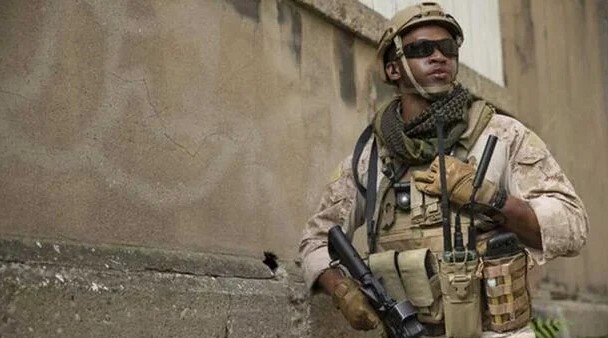
Company will provide combat instrumentation platform support
RESTON, Va. — Science Applications International Corp. (NYSE: SAIC) has been awarded an Indefinite Delivery Indefinite Quantity (IDIQ) contract with a $249 million ceiling from the U.S. Navy to continue supporting the Naval Air Warfare Center Weapons Division (NAWCWD)’s combat instrumentation platforms used for training and test evaluation ranges.
“SAIC’s expertise in systems integration and engineering provides solutions to support the U.S. Navy’s testing and training needs,” said Bob Genter, president, Defense and Civilian Sector at SAIC. “We are excited to build on our progress and continue our work at the Naval Air Warfare Center Weapons Division.”
Under the new contract, SAIC will perform systems design and integration, hardware and software upgrades or modifications for the Combat Environment Instrumentation Systems (CEIS). SAIC will also provide services to support global position system-based range equipment, airborne electronic warfare (EW) systems, warning & countermeasures systems and range Radio-Frequency/Electro-Optical Tracking systems. The company will deliver test support and instrumentation for unmanned aerial vehicle (UAV) and telemetry systems.
SAIC will continue supporting NAWCWD with products and services associated with CEIS EW systems, interfaces and auxiliary equipment. The company will also continue providing field service support to more than nine test locations within the Navy’s testing and evaluation domain.
Military Sealift Command Honors Merchant Mariners Past And Present With National Maritime Day Celebration
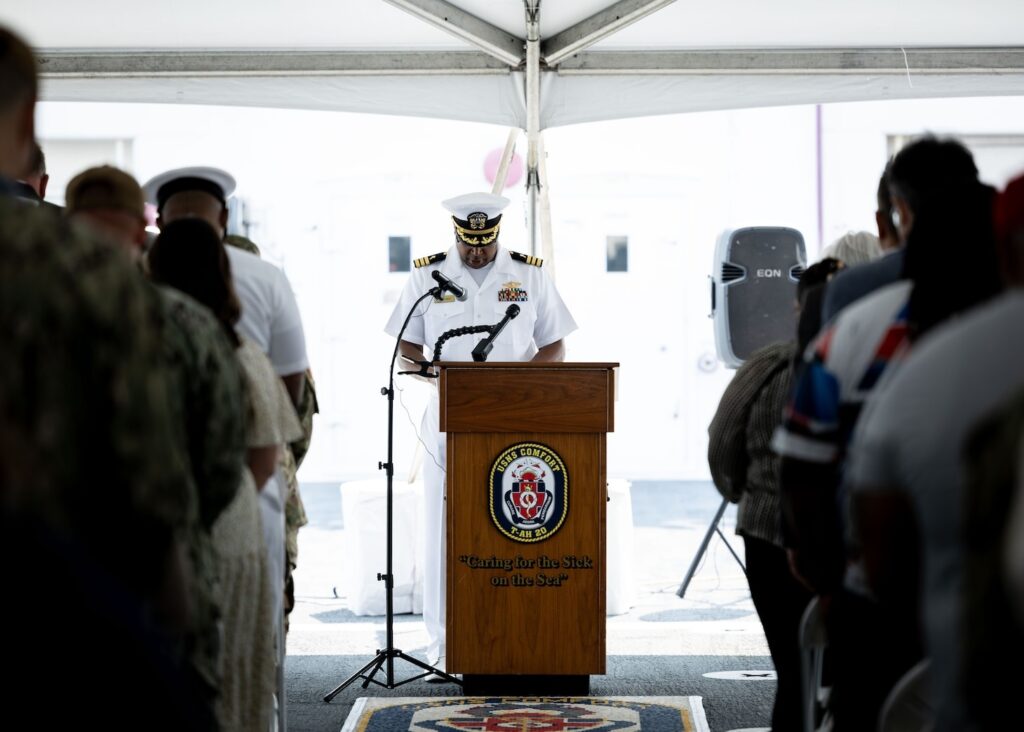
Norfolk, Va. (May 22, 2023) – Cmdr. Robert Jones, CHC, USN Naval Medical Center Portsmouth Deputy Command Chaplain, USNS Comfort (T-AH 20), delivers the invocation during Military Sealift Command’s National Maritime Day ceremony aboard Comfort May 22, 2023. National Maritime Day honors the thousands of dedicated merchant mariners who served aboard United States vessels around the world. (U.S. Navy photo by Ryan Carter)
Norfolk, Va. – Military Sealift Command (MSC) hosted a National Maritime Day celebration aboard hospital ship USNS Comfort (T-AH 20), May 22, honoring United States Merchant Mariners.
The event commenced with remarks from Rear Adm. Michael Wettlaufer, MSC Commander, and featured keynote speaker Mr. Dave Yoho, World War II Merchant Marine Veteran.
“The Department of Defense depends on the Merchant Marine to support 90 percent of our sealift requirements in national emergency, crisis or conflict,” said Wettlaufer. “Long serving as our nation’s ‘fourth arm of defense,’ American mariners bravely faced combatants and pirates, pandemics and natural disasters. They answer the call to serve their fellow Americans in ways and in places many of our fellow citizens don’t know about.”
“Today, and every day, we honor our American mariners, especially our MSC Civil Service Mariners, past and present, courageous women and men who serve our nation.”
In 1944, Yoho enlisted in the United States Merchant Marines at just 16 years old. He was assigned to a T/2 Tanker ship, often referred to as a fleet oiler, which was sent to the South Pacific during World War II.
There was a great wave of patriotism after the Japanese attack on Pearl Harbor, which inspired thousands to join the United States Merchant Marines. These mariners would become a part of the 250 thousand who served during World War II, said Yoho.
“They moved 15 million tons of goods to Europe and the United Kingdom, eight million tons of goods to the Mediterranean, 13 million tons of goods to the Pacific Ocean, and five million tons to Russia.”
During his speech, Yoho recalled his experience as a young Merchant Marine during wartime.
“We were in great trouble when the war started. We were outmanned, outmaneuvered, out-gunned, and out-financed, but we took a collective stand,” said Yoho.
“I was a fireman water tender. I [asked an officer], ‘Sir, what’s the best way to get out of here if we take a hit?’ He said, ‘Kid, if we take a hit, you don’t get out of here.’ That’s the first time I realized we could get killed.”
“The Merchant Marine had the highest mortality rate of any of the services. One out of 26 of us died,” said Yoho. “I bring you my story in hopes that you will tell others. Tell them about [mariners], and say we gave up our yesterdays for their tomorrows. Tell them this is from a 16-year-old boy in a 95-year-old man’s body.”
After Yoho’s speech, the ceremony ended with a moment of silence for fallen mariners and the ringing of eight bells.
On May 20, 1933, Congress designated May 22 of each year as “National Maritime Day” to commemorate the first transoceanic voyage by steamship S.S. Savannah in 1819. The S.S. Savannah was the first steam-powered ship to successfully cross any ocean. Today, National Maritime Day celebrates the thousands of merchant mariners who serve on United States vessels around the world.
Marine Corps Receives First of Two C-40A Transport Aircraft
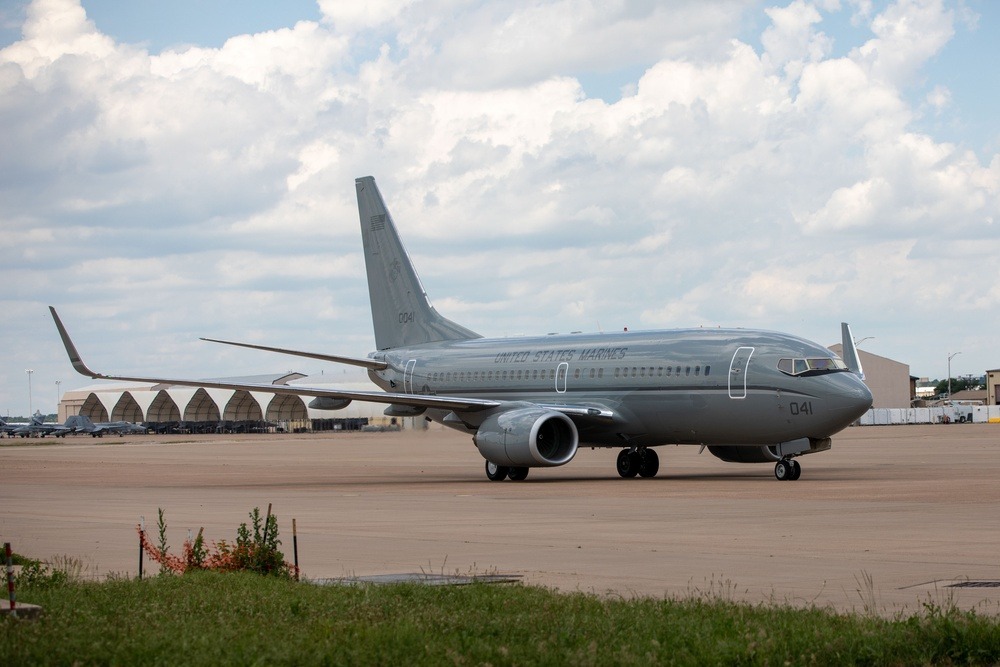
The Marine Corps’ first C-40A aircraft, assigned to Marine Transport Squadron (VMR) 1, Marine Air Group 41, 4th Marine Air Wing, Marine Forces Reserve, lands at Naval Air Station Joint Reserve Base Fort Worth Texas, May 19, 2023. VMR 1 will use these aircraft to support the Marine Corps and joint services with assault support in the form of air logistics, providing time-, place- or mission-sensitive, long-range, multipurpose air transport and critical logistical support of key personnel and cargo between and within combatant commands and theaters of war. (U.S. Marine Corps photo by Lance Cpl. Ashley Corbo)
*****
ARLINGTON, Va. — The U.S. Marine Corps has taken delivery of its first Boeing C-40A Clipper transport aircraft, the first of two that will be operated by the Marine Forces Reserve.
The C-40A arrived at Naval Air Station Joint Reserve Base Fort Worth Texas on May 19, the Marine Forces Reserve said in a release. It will be operated by Marine Transport Squadron One (VMR-1), a unit of Marine Aircraft Group 41, 4th Marine Air Wing.
“VMR-1 will use these aircraft to support the Marine Corps and joint services with assault support in the form of air logistics, providing time-, place- or mission-sensitive, long-range, multipurpose air transport and critical logistical support of key personnel and cargo between and within combatant commands and theaters of war,” the release said.
VMR-1 flew two C-9B Skytrain II aircraft from Joint Base Andrews-NAF Washington, Maryland, until 2017, when the squadron moved to NAS-JRB Fort Worth to provide crews to share C-40A Clipper transports with Navy Fleet Logistics Support Squadron 59. According to the 2022 Marine Corps Aviation Plan, VMR-1 will move to Marine Corps Air Station Kaneohe Bay, Hawaii, by fiscal 2024 to replace the two C-20G Gulfstream IV transports there that support the Indo-Pacific Command.
The two Marine C-40As were not new-build aircraft but were converted from two used Boeing 737 airliners. The Navy Air Reserve operates 17 C-40As — the first of which was delivered in 2001 — in six fleet logistics support squadrons for Navy-unique fleet-essential airlift missions.
World War II U.S. Merchant Mariners Honored during National Memorial Day Concert
WASHINGTON – On Sunday, May 28, during the National Memorial Day Concert on the U.S. Capitol grounds, the Public Broadcasting Service and Capital Concerts will honor more than 9,500 U.S. Merchant Marine men and women who were killed in action during World War II. WWII Merchant Marine veterans, representing the American Merchant Marine Veterans organization, will be honored in a special segment of the concert.
David Yoho, a WWII Merchant Marine veteran, will be a featured spokesman during the Concert. He will give a vivid and heartfelt interview about our Nation’s fallen heroes and the value of the Merchant Marine that has been recognized by U.S. Presidents and America’s senior military leaders. Mr. Yoho’s moving description of his wartime experience as a teenager and his respect for all his Merchant Marine shipmates will be a highlight of the show.
In addition to Mr. Yoho’s interview, the four Merchant Marine WWII veterans, William Balabanow, John Laughton, Charles Mills, and George Worsham, will honor their fallen shipmates during the show. In particular, Mr. Laughton and Mr. Worsham survived enemy attacks that sank their ships and killed many of their fellow Merchant Mariners.
On September 14, 1944, President Franklin D. Roosevelt said, “It seems to me particularly appropriate that Victory Fleet Day this year should honor the men and management of the American Merchant Marine. The operators in this war have written one of its most brilliant chapters. They have delivered the goods when and where needed in every theater of operations and across every ocean in the biggest, the most difficult and dangerous transportation job ever undertaken. As time goes on, there will be greater public understanding of our merchant fleet’s record during this war.”
More than 240,000 U.S. Merchant Mariners served during WWII. They faced torpedoes, bombings, kamikaze attacks, ice, and storms to deliver millions of troops and the necessary military goods for the Allies’ war effort. According to the U.S. War Shipping Administration, the U.S. Merchant Marine suffered one of the highest casualty rates of any service during WWII. Officially, a total of 1,554 merchant ships were sunk due to war conditions. Also, over 1,800 U.S. Naval Armed Guard shipmates were killed or missing in action during WWII, while manning guns on merchant ships.
The U.S. Merchant Marine Academy at Kings Point, NY honors 142 cadet midshipmen who died during WWII. Because of their supreme sacrifice, Kings Point is the only one of the Nation’s five federal service academies authorized to carry a Battle Standard flag as part of its Color Guard.
Captain Dru DiMattia, president of American Merchant Marine Veterans, said, “I appreciate the decision to honor U.S. Merchant Marine WWII casualties during the National Memorial Day Concert, as valued contributors to the Allies’ victory. This is a historical event for the U.S. Merchant Marine and our country. Our organization is honored by support from President Biden, Sen. Elizabeth Warren, Rep. Jimmy Panetta, the Department of Defense, the Maritime Administration, the National Park Service, and the Friends of the National WWII Memorial.” Capt. DiMattia is available for advance interviews.
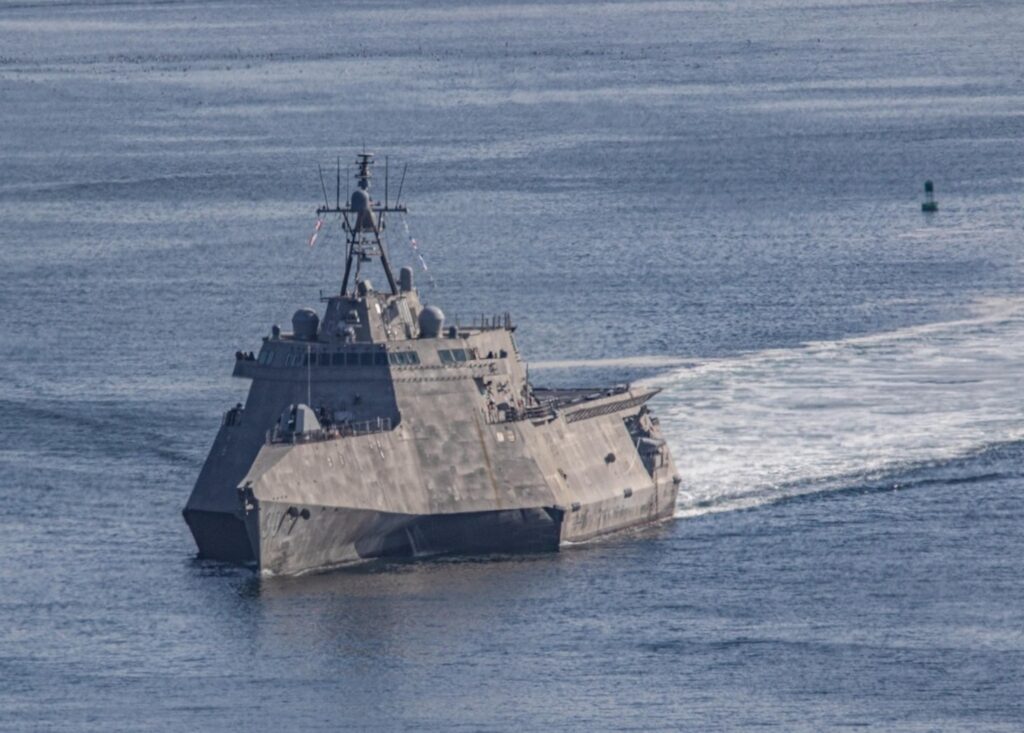
SAN DIEGO – The future USS Canberra (LCS 30) will join the U.S. Navy active fleet on July 22 with the U.S. Navy’s first international commissioning ceremony at the Royal Australian Navy Fleet Base East in Sydney, Australia.
Canberra is the first U.S. Navy warship to be commissioned in an allied country. It is the second U.S. Navy ship to bear the namesake of Canberra.
“I can think of no better way to signify our enduring partnership with Australia than celebrating the newest U.S. Navy warship named for Australia’s capital city, and commissioning her in Royal Australian Navy Fleet Base East surrounded by many of the Australian ships we have worked alongside for years,” said Secretary of the Navy Carlos Del Toro. “I look forward to this momentous day for the ship, crew, sponsor, and all our partners in government and industry who worked tirelessly to give the future USS Canberra the celebration it deserves.”
Australian Chief of Navy, Vice Adm. Mark Hammond said this historic event encapsulates both the depth of the historical ties, and modern day partnership between the Royal Australian Navy and the U.S. Navy.
“This is a unique demonstration of respect by the U.S. for the Officers and Sailors of the Royal Australian Navy,” said Hammond. “It is an opportunity to reflect on our shared history, and on a friendship forged while fighting side-by-side. On August 9, 1942 the RAN heavy cruiser HMAS Canberra was severely damaged off Guadalcanal (Solomon Islands) while protecting the U.S. Marines fighting ashore. In a surprise attack by a powerful Japanese naval force, Canberra was hit 24 times in less than two minutes and 84 of her crew were killed including Captain Frank Getting”
“I look forward to welcoming the U.S. Navy, and the crew of USS Canberra to Australia and we are honored to host the U.S. Navy’s first international commissioning. It will be a historical event to see the USS Canberra and HMAS Canberra alongside each other in Sydney. As we look to the future, the strength of our partnership remains a cornerstone of a secure, stable, free and open Indo-Pacific Region.”
The first USS Canberra (CA-70/CAG-2) was named at the direction of President Franklin D. Roosevelt in honor of the Australian heavy cruiser HMAS Canberra for the ship’s courageous actions during the Battle of Savo Island that took place Aug. 7-9, 1942. The new Baltimore-class heavy cruiser was renamed Canberra from Pittsburgh on Oct. 16, 1942, and was commissioned on Oct. 14, 1943.
Canberra will soon begin the transit for the Navy’s first international ship commissioning making stops along the transit in Indo-Pacific nations prior to its arrival in Sydney for commissioning.
A visit to the Australian capital city of Canberra is planned the day after commissioning, continuing the U.S. Navy tradition of building a strong relationship with namesake communities.
The ship’s sponsor is Australian Senator, the Honourable Marise Payne, the former Australian Minister of Foreign Affairs who attended the ship’s keel laying ceremony in Mobile, Ala. in 2020. The ship was christened June 5, 2021, by Alison Petchell, the Australian Government’s Defence Assistant Secretary for Industrial Capability Planning in the Nuclear Submarines Taskforce and former Minister Counsellor for Defense Materiel, on behalf of Senator Payne. The ship arrived for the first time at its homeport of San Diego last year.
The first U.S. Navy ship named after a foreign capital, Canberra (CA-70) was sponsored by Lady Alice C. Dixon, the wife of Sir Owen Dixon, then Australian Minister to the United States. Following World War II, Canberra was placed out of commission and in reserve on March 7, 1947. Five years later, the ship was selected to be the U.S. Navy’s second guided missile cruiser. The ship was re-commissioned on June 15, 1956, as guided missile heavy cruiser CAG-2. With its new designation, Canberra transported President Dwight D. Eisenhower and later was the ceremonial flagship for the selection of the Unknown Serviceman of both World War II and Korea interned at Arlington National Cemetery, was the Commander of the Atlantic Fleet Cruiser Force flagship, conducted an around the globe goodwill cruise, provided medical assistance to the crew of the Turkish merchantman Mehmet Ipar, was the Commander Task Group 136.1 flagship that was charged with maintaining a blockade during the Cuban Missile Crisis, and served in Korea and Vietnam. To highlight the ship’s role in naval gunfire support following operations in Vietnam, Canberra was re-designated to original classification and identification number CA-70 on May 1, 1968.
Canberra received seven battle stars for her service in World War II. The ship was decommissioned on Feb. 2, 1970, and was stricken from the Naval Vessel Register on July 31, 1978.
The present day USS Canberra is the 16th Independence-variant Littoral Combat Ship commissioned by the U.S. Navy. LCS are designed to be fast, optimally-manned, mission-tailored, surface combatants that operate in both littoral and open-ocean environments. LCS integrate with joint, combined, crewed, and unmanned systems to support forward-presence, maritime security, sea control, and deterrence missions around the globe. The future USS Canberra was built by Austal USA in Mobile, Alabama.
U.S.-Led Multinational Partnership Launches New Task Force for Maritime Security Training in Middle East
U.S.-Led Multinational Partnership Launches New Task Force for Maritime Security Training in Middle East
By U.S. Naval Forces Central Command Public Affairs | May 22, 2023
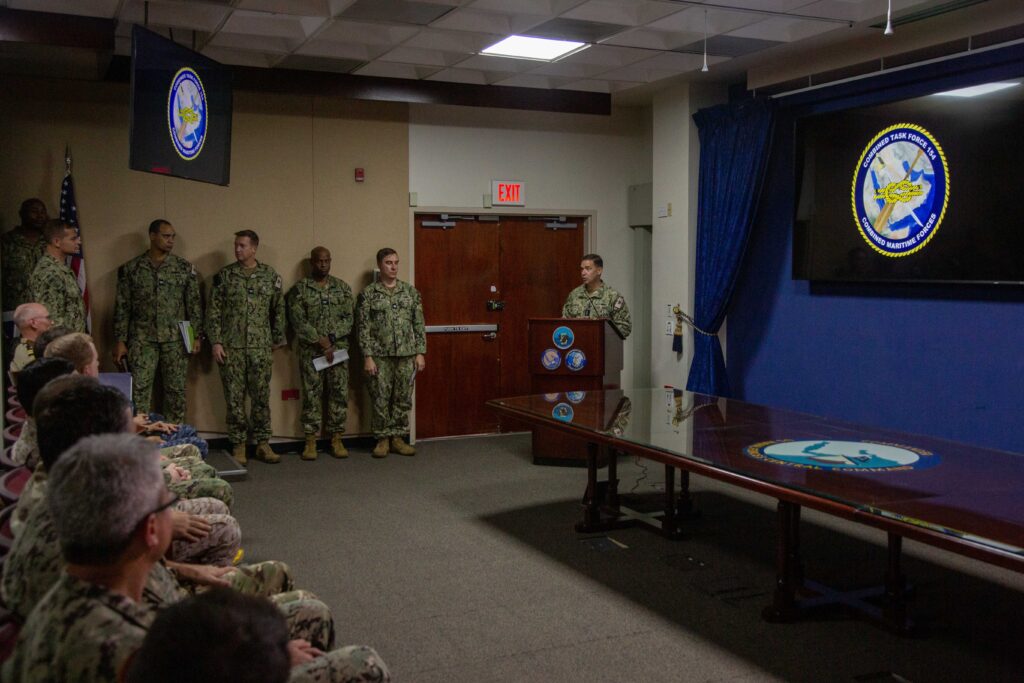
MANAMA, Bahrain — The U.S.-led multinational partnership, Combined Maritime Forces (CMF), established a new task force May 22 that will train partner navies and improve operational capabilities to enhance maritime security in the Middle East.
During a ceremony at U.S. 5th Fleet headquarters in Bahrain, leaders commissioned Combined Task Force (CTF) 154. The new staff is CMF’s fifth task force after standing up CTF 153 in April 2022 for maritime security in the Red Sea.
CTF 154 will lead multinational maritime training at locations across the Middle East, enabling more CMF partner-nations to participate in training opportunities without ships or aircraft, particularly during courses that are facilitated ashore.
“Our navies are at their very best when we train, operate and work together,” said Vice Adm. Brad Cooper, commander of U.S. Naval Forces Central Command, U.S. 5th Fleet and CMF. “Establishing CTF 154 demonstrates our deep commitment to strengthening and expanding partnerships through new training opportunities that will enhance regional maritime security.”
The new task force is commanded by a U.S. Navy captain who will build and lead a multinational staff. Another nation will assume command as early as this fall.
CTF 154’s core staff will be augmented by CMF partners during key training opportunities such as the task force’s inaugural event, Compass Rose. This week, CTF 154 is hosting Compass Rose in the Kingdom of Bahrain. More than 50 participants from Bahrain, Kuwait, Oman, Pakistan, Saudi Arabia, the United Kingdom and United States began arriving Sunday to attend courses on first aid and vessel boarding procedures.
“I am excited to lead an international team in this important work,” said Capt. Oliver Herion, CTF 154’s first commander. “Collectively, CMF has tremendous experience and expertise with critical skills, tools and relationships.”
CTF 154 will frequently organize training events around five core areas: maritime awareness, maritime law, maritime interdiction, maritime rescue and assistance, and leadership development. Each training opportunity will be tailored to meet partner requests ranging from basic to advanced levels.
“Focusing our efforts to facilitate training for the multinational partnership will refine our skillsets and reinforce our ability to operate together,” said Herion. “We are ‘Stronger Together’ and ‘Ready Together.’ That is what CMF is all about.”
CMF is the largest multinational naval partnership in the world, with 38 nations committed to upholding the international rules-based order at sea.
CMF’s other task forces include CTF 150 that focuses on maritime security in the Gulf of Oman and Indian Ocean; CTF 151, which leads regional counter-piracy efforts; CTF 152, dedicated to maritime security in the Arabian Gulf; and CTF 153 in the Red Sea.
USCGC Confidence returns home following 40-day Windward Passage and South Florida Straits patrol
USCGC Confidence returns home following 40-day Windward Passage and South Florida Straits patrol
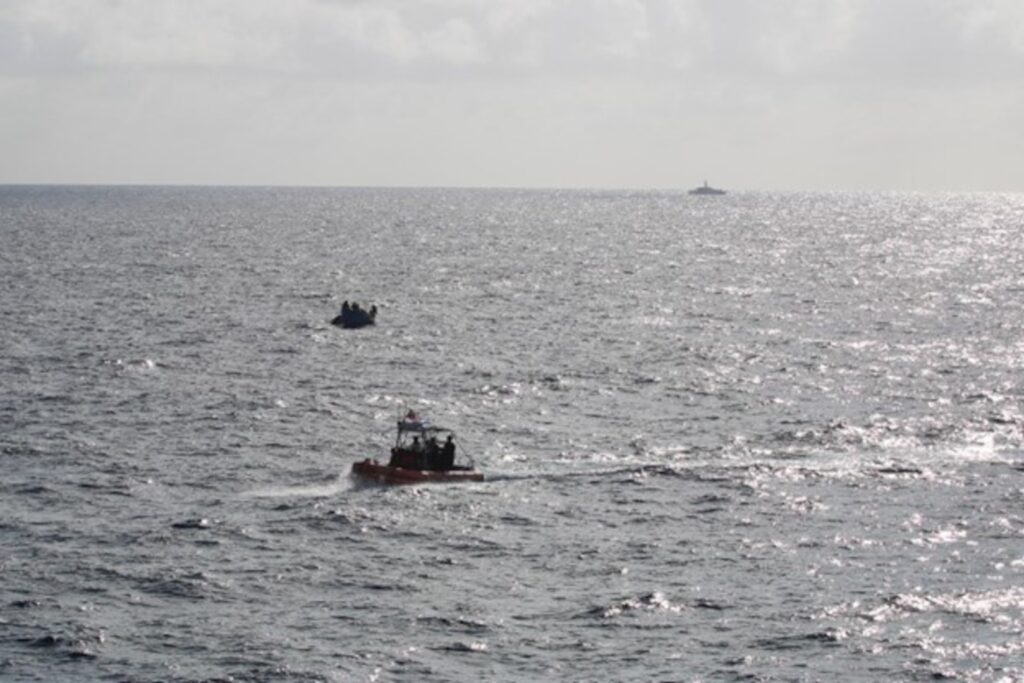
CAPE CANAVERAL, Fla. —The crew of the USCGC Confidence (WMEC 619) returned to their home port in Cape Canaveral, Monday, following a 40-day patrol in the Windward Passage and South Florida Straits.
Confidence’s crew contributed to the interdiction, care and repatriation of 138 migrants while patrolling in support of Operation Vigilant Sentry and Homeland Security Task Force – Southeast in the Seventh Coast Guard District’s area of responsibility. Confidence’s crew conducted maritime safety and security missions working with other Coast Guard cutters and air assets to detect, deter and intercept unsafe and illegal migrant ventures bound for the United States.
During the patrol, Confidence’s crew hosted members from the Haitian Coast Guard to further enhance key U.S. strategic partnerships and provide critical mission insight into operations within the Windward Passage.
“It was a pleasure to work with our Coast Guard, international and agency partners in the important mission to deter and respond to dangerous migration attempts,” said Cmdr. Thomas Martin, commanding officer of Confidence. “The crew professionally executed numerous transits, boat patrols and transfers to safeguard lives at sea.”
Confidence is a 210-foot, Reliance-class medium endurance cutter. The cutter’s primary missions are counter drug operations, migrant interdiction, enforcement of federal fishery laws and search and rescue in support of U.S. Coast Guard operations throughout the Western Hemisphere.
For more information on the United States’ recent immigration measures, follow these links:
For information on how to join the U.S. Coast Guard, visit GoCoastGuard.com to learn about active duty, reserve, officer, and enlisted opportunities. Information on how to apply to the U.S. Coast Guard Academy can be found here.
Rite-Solutions joins ServiceNow Partner Program to Help Navy Improve IT Service Management Processes
Release from Rite-Solutions, May 22, 20023
*****
Middletown, RI (May 22, 2023) — Rite-Solutions today announced it joined the ServiceNow Partner Program to develop applications and integrations that leverage the power of the Now Platform®. Rite-Solutions is accelerating digital transformation with Information Technology Service Management (ITSM) engagements.
As a ServiceNow Build partner, Rite-Solutions will develop solutions that help Navy Warfare Centers design, build, deliver, operate, and manage information technology (IT) services. The overall goal is to improve Navy readiness by increasing efficiencies, accelerating time-to-market, and reducing costs to automate ITSM workflows.
Building configurable applications that will be available to Federal customers through the ServiceNow Store will allow other Department of Defense and Department of Homeland Security organizations realize similar benefits.
“Rite-Solutions is excited to add ServiceNow Build Partner credentials to our portfolio,” says Laurie Carter, Senior Vice President of Business Development at Rite-Solutions. “This enables us to expand our capabilities to efficiently and effectively bring forth innovative, cost-effective solutions to our customers.”
Rite-Solutions, Inc.
Rite-Solutions, Inc. is an award-winning small business specializing in system engineering, software development, information technology (IT), and cyber security for government and commercial segments. Rite-Solutions has offices in Rhode Island, Connecticut, and Washington D.C. For more information, please visit http://www.rite-solutions.com.
ServiceNow, the ServiceNow logo, Now, Now Platform, and other ServiceNow marks are
trademarks and/or registered trademarks of ServiceNow, Inc. in the United States and/or other
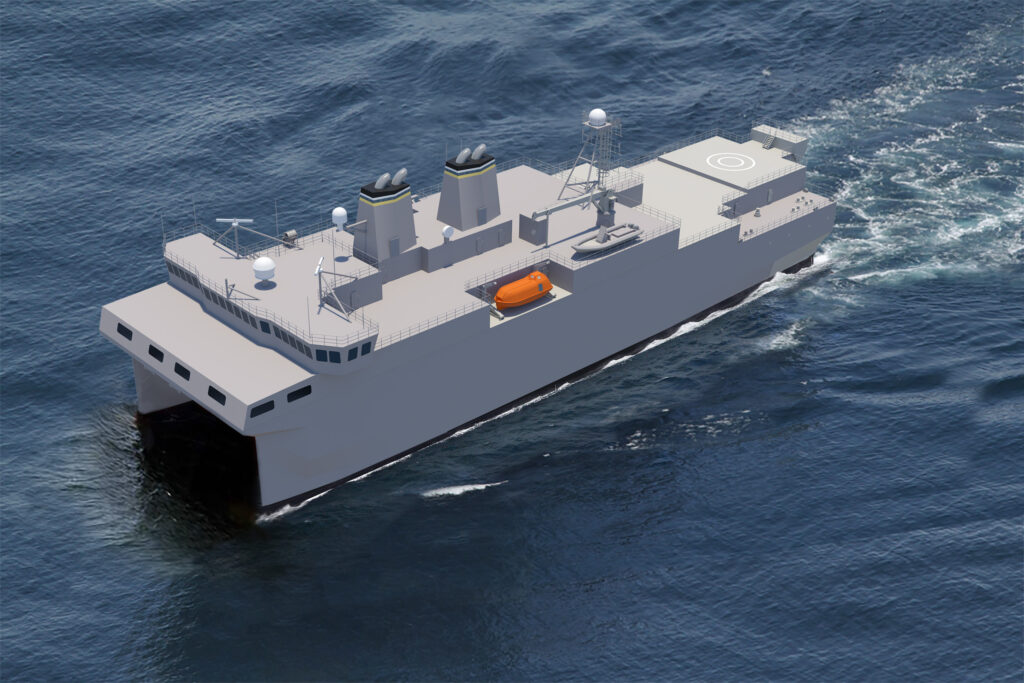
Mobile, Ala. –Austal USA was awarded a contract with a potential value of $3.195 billion for the detail design and construction of up to seven TAGOS-25 class ocean surveillance ships. Austal, as the prime contractor, has teamed with L3Harris Technologies (L3Harris), Noise Control Engineering (NCE), TAI Engineering (TAI), and Thoma-Sea Marine Constructors (TMC) for execution of the TAGOS program.
TAGOS ships provide a platform capable of theater anti-submarine acoustic passive and active surveillance. They support the mission of the Integrated Undersea Surveillance System (IUSS) by gathering underwater acoustical data.
“The Austal USA team is excited to support the U.S. Navy with this critical program. We have enjoyed our long partnership with the Navy in delivering aluminum ships and we are honored to continue that relationship in delivering high-quality steel ships on schedule and on budget,” Austal USA President Rusty Murdaugh said. “This contract award was enabled by our continual focus on our people and our facilities. The Austal USA workforce is proud of our role in providing for the Nation’s defense by delivering these ships to the Navy.”
“As the electronic and propulsion systems integrator, we’re excited to be a partner on the Austal USA team to develop the next class of TAGOS ocean surveillance ships,” said Anthony Nigara, President, Maritime, L3Harris. “Our strong partnership with Austal reinforces our commitment to delivering advanced, surveillance-capable platforms to meet the U.S. Navy’s mission requirements.”
Through continual capital investments, Austal USA has expanded its capability and capacity to enable concurrent production of aluminum and steel-hulled ships. The award of the TAGOS program follows the recent award of other steel programs to Austal USA including the U.S. Navy Towing and Salvage ship (T-ATS) and Auxiliary Floating Drydock Medium (AFDM) and the U.S. Coast Guard Offshore Patrol Cutter (OPC). The company will construct TAGOS using its proven ship manufacturing processes and innovative production methods that incorporate lean manufacturing principles, modular construction, and moving assembly lines in the company’s state-of-the-art enclosed steel production facility. The TAGOS contract award is the result of Austal’s proven shipbuilding and multi-hull ship systems management expertise and proven engineering team.
In addition to the steel ships mentioned previously, Austal USA is currently constructing the U.S. Navy’s Independence-variant Littoral Combat Ship and Expeditionary Fast Transport. This unique production capability to manufacture both steel and aluminum ships positions Austal USA to meet the growing demands of the U.S. Navy and U.S. Coast Guard.
L3HARRIS RECEIVES US MARINE CORPS ORDERS FOR MULTI-CHANNEL RADIOS
The L3Harris Falcon IV® family of manpack and handheld radios provide true resilience against peer threats using L3Harris’ broad portfolio of secure waveforms and mission-enabling technologies.
ROCHESTER, N.Y., May 17, 2023 — L3Harris Technologies (NYSE:LHX) announced orders totaling $160 million from the Marine Corps for multi-channel handheld and vehicular radio systems, bringing total program orders to $336 million.
The two new orders from the Marine Corps are under a 10-year, competitively awarded $750 million indefinite delivery, indefinite quantity contract for L3Harris Falcon IV® manpack and handheld radios. The technology in these radios enables greater interoperability among U.S. and allied forces.
“The resilient communications our battle-proven radios and secure waveforms offer allow Marines to talk to each other with confidence and exchange information at faster rates,” said Chris Aebli, President, Tactical Communications, L3Harris. “These radios are the most advanced systems industry can put into the hands of our warfighters, delivering enhanced capabilities to address evolving threats.”
By integrating voice and data communications, network routing and gateway functions, L3Harris’ software-defined multi-channel AN/PRC-163 handheld radios provide real-time battlespace situational awareness to help warfighters make informed decisions.
All U.S. military services, including Special Operations Command, and a growing number of key allies have broadly adopted the Falcon IV family of radios’ software-defined architecture. It provides flexibility for continuous upgrades with seamless integration of emerging technologies to meet future needs.
The latest Marine Corps commitments follow two Falcon IV orders from the U.S. Army last year totaling $235 million.