


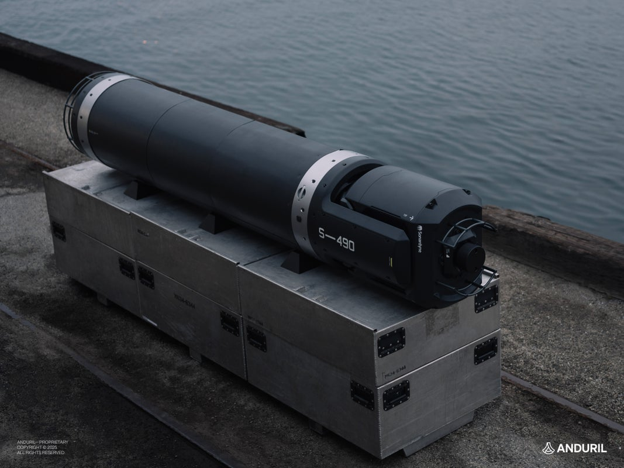
A rogue autonomous undersea vessel (AUV) moves through a channel. A sonar system deployed on Anduril’s Seabed Sentry picks up its signature, hands the track to Seabed Sentry, and pushes the track into Lattice. Seconds later, an operator in the Navy’s Unmanned Operations Center sees it on a screen, delivered through the Navy’s command-and-control system, and can take action to neutralize the threat. That sequence played out repeatedly during Lanternfish, a multinational demonstration event that brought together autonomous underwater vehicle and subsea technology from Australia, the United Kingdom, and the United States.
Anduril’s maritime team played a significant role in Lanternfish, proving out a counter-AUV kill chain from detection to alert.
Anduril paired Seabed Sentry with Ultra Maritime’s Sea Spear, a lightweight deployable sonar system. Sea Spear consistently detected, tracked, and classified medium and large-diameter AUVs. Seabed Sentry ingested those tracks and published them to Lattice, Anduril’s battle management platform. Lattice then passed the resulting operating picture through the Navy’s cUxV system. The result: a live feed of every subsea and surface asset moving through the exercise area, visible to Navy operators in real time.
For this exercise, two outcomes mattered most: an operator-free alert system and end-to-end system integration with the Navy’s cUxV architecture. In operations, this meant Seabed Sentry could detect an AUV and alert the Navy through its own C2 system without a human relaying the information by hand, all while Anduril’s software chain frictionlessly worked within the confines of the Navy’s relevant sensing and command technologies for this operating environment.
Lattice has been the backbone of air defense and counter intrusion operations for years, fusing radar, electronic warfare sensors, and interceptors into a single command and control layer. Lanternfish proved the same software stack works below the surface. Seabed Sentry runs on the same proven Lattice core that tracks and intercepts UAVs — now optimized for the tasks of edge processing and fusion of acoustic data sources.
This application of Lattice only works if it can fuse sensors and systems that Anduril does not build on its own. At Lanternfish, Lattice ingested tracks from Ultra Maritime’s Sea Spear and pushed the resulting picture into the Navy’s own C2 system, with no custom software engineering required for either side. The same open architecture that enables Lattice to pull in a new radar for air defense and force protection now facilitates the integration of a new sonars for undersea defense. Mastering one domain built the foundation for Anduril to enter the next.
The Case for Harbor Defense
Ports, harbors, and coastal waterways face a set of threats that looks less like large submarines and more like a swarm of small, cheap, autonomous underwater systems. Adversaries are investing in exactly this capability set to threaten ports, pipelines, undersea cables and the broader category of maritime infrastructure that keeps the fight at sea connected and supplied. But a harbor defense system built only to watch for submarines or surface vehicles misses that threat entirely. Detecting a small AUV requires a different sensor mix, a different pace of processing, a different decision speed, and a different set of solutions that can respond to incoming threats at machine speed — not a series of undersea defenses built around humans.
Lanternfish demonstrated the pathway toward closing that gap: sensors that detect small autonomous underwater threats, paired with a command-and-control layer that already runs the same way across air, land, and sea. Seabed Sentry and Lattice give commanders a way to see that picture and act on it before a threat reaches the pier.