
Bedrock Ocean Exploration Launches Onboard Automated Target Recognition with Real-Time Human Review
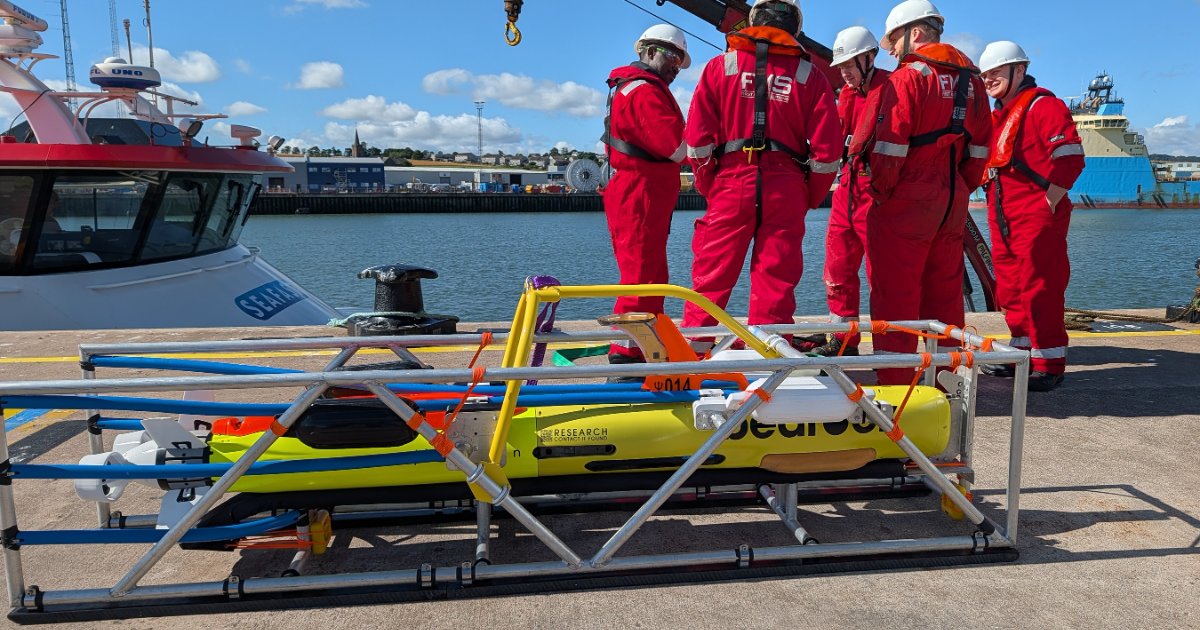


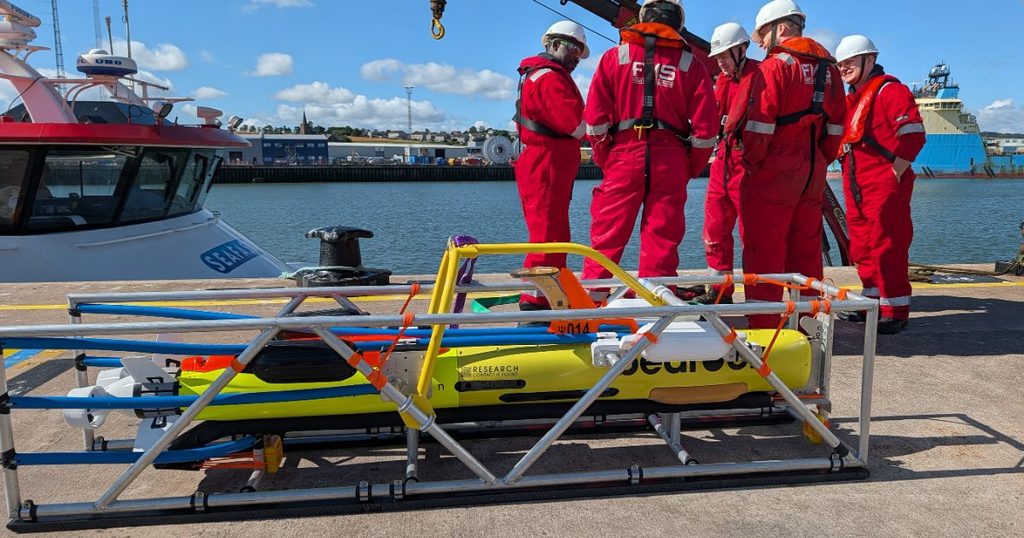
RICHMOND, Calif. — Bedrock Ocean Exploration (Bedrock), the autonomous intelligence infrastructure company powering the ocean economy, today announced that automated target recognition (ATR) is now running on board its fleet of autonomous underwater vehicles (AUVs). The proprietary model detects and classifies seafloor contacts, including objects of interest such as debris, infrastructure and potential unexploded ordnance, as each survey line is completed. It then sends them ashore in near real time, where experts review them while the vehicles are still on site.
ATR has become one of the most sought-after capabilities in marine surveys. Contact picking has traditionally been manual work. Data is recovered after a survey, transferred, processed, and run through separate software before analysts review the results, a cycle that can take days to months. Bedrock’s approach cuts that to minutes. When an AUV finishes a survey line, the ATR model runs on board, typically in less than a minute. When the vehicle surfaces, it sends geolocated contacts back to shore, each paired with its sidescan sonar image. The whole process typically takes less than five minutes.
“Every processing team in our industry wants a technology that can find things on the seafloor, but a list of coordinates from an algorithm isn’t a true contact,” said Dr. Bridgit Boulahanis, Head of Data and Solutions at Bedrock. “We built a system where the AUV finds candidates and a trained expert confirms them in minutes, all while our AUVs are still in the water. In mine countermeasures, for example, you’re deciding whether something could be explosive, so you need a human in the loop in real-time.”
Bedrock’s ATR solution runs on a proprietary deep learning model, architecturally similar to leading real-time object detection frameworks. It is pre-trained on Bedrock sidescan sonar data, supplemented by industry-trusted, open-source datasets.
Bedrock’s vertically integrated stack combines autonomous vehicles, adaptable sensing, and a data-processing pipeline that delivers insights orders of magnitude faster than traditional survey technologies. Unlike operators who swap sensors between missions and have to contend with the new artifacts each sensor introduces, Bedrock trains its model on consistent sensor data. That’s a crucial difference, and one that results in an ATR solution that is reliably more accurate and robust.
Contacts arrive alongside Bedrock’s onboard reports, which are near-real-time snapshots of what each vehicle has just seen on its sidescan sonar, multibeam echosounder, and magnetometer. Analysts can compare each detection with and without the model’s interpretation. They then accept, reject or annotate it based on what the client actually needs to know. Expert decisions support not only near-real time decision making but also continuous retraining of the model.
“Onboard ATR is a major milestone for Bedrock,” said Shelley Bower, Head of Intelligence and Autonomy Platform at Bedrock. “ATR isn’t new, but the Bedrock approach is disruptive. Our customers aren’t buying data. They’re buying decisions, and this unlocks the ability to make the right decision faster than any other ATR solution in the water today.”
Bedrock is already developing the next version of its model, expected in the coming months, which will combine sidescan sonar with magnetometer data to provide analysts the most complete picture of what is on the seafloor.
Onboard ATR is operational now across Bedrock’s AUV fleet.
From Bedrock Ocean Exploration, Nov. 17, 2026