
CNO Outlines Vision for Fleet Adaptation


WASHINGTON — Chief of Naval Operations Adm. Daryl Caudle highlighted the critical need for a dynamic and resilient naval force during his address at the Fantail Breakfast hosted by the Navy Memorial in Washington, D.C., Oct. 26, focusing on adaptation, operational endurance, and sustained fleet readiness. Speaking to military leaders and industry partners, Caudle outlined a strategic vision for the future Fleet centered on continuous modernization. He emphasized that to maintain a decisive advantage in the fight, the Navy must be capable of changing itself as problems change, utilizing software, modularity, and uncrewed systems.
“When I think about the Navy, we will need in the decades ahead, I keep coming back to two words: Adaptation and Endurance,” said Caudle. “Our advantage cannot depend on getting every prediction right. Our advantage must be our ability to adapt faster than the threat and endure longer than the fight.” To build this self-adapting force, the discussions highlighted the necessity of a highly responsive industrial base and a robust foundry of manufacturing capacity. Caudle called for stronger collaboration with industry partners to accelerate the transition of commercial technologies, open architectures, and software-defined capabilities directly into the fleet.
“Innovation that cannot transition to the Fleet, scale in production, or be sustained in combat is not yet the warfighting advantage we need,” said Caudle. “Speed is a weapon. And in the next fight, the side that can translate learning into fielded combat power faster will create advantages its adversary struggles to overcome.”
Addressing warfighting endurance, the CNO stressed that long-term operational success depends heavily on the Sailors who generate combat power. He highlighted key “Total Sailor: Fit to Fight” and quality-of-service initiatives, noting that the Navy has expanded Wi-Fi in unaccompanied housing—which currently sits at 90 percent coverage and is rapidly expanding to 100 percent—improved galley food service satisfaction from 56 percent to 80 percent following pilot improvements, and reduced the number of junior Sailors living aboard ships in homeport by more than 80 percent.
“Ships do not generate combat power by themselves. People generate combat power,” said Caudle. “Quality of service is not separate from readiness. It’s foundational to our ability to recruit, retain, develop, and sustain the people we send into harm’s way.”
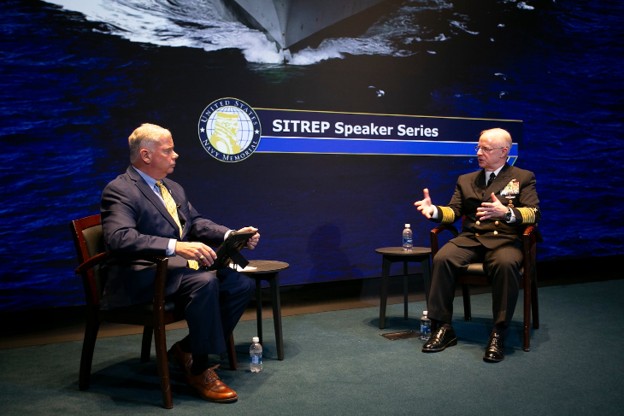
Following his formal address, Caudle participated in the Navy Memorial’s SITREP Speaker Series. Marking a milestone for the program, the engagement featured questions from both a live, in-person audience and online viewers for the first time. During the Q&A session, Caudle expanded on his vision for an adaptable force, challenging the traditional reliance on rigid carrier strike group deployments to solve diverse global challenges.
“For decades, our normal force generation model has been centered around strike groups. So, you lived in a have and have-not, a poor man rich man problem. A one or a zero,” said Caudle. “Could the Navy do more than a one or a zero? And of course it can. So this idea of packaging our Navy in a way to solve combatant commander key operational problems in a unique way by listening to what they really need, that may not be tied to the strike group.”
Using U.S. Southern Command as an example, Caudle noted that an effective, tailored force package for maritime domain awareness might combine uncrewed systems, Littoral Combat Ships, afloat forward staging bases, and U.S. Coast Guard integration rather than a traditional carrier strike group.
The engagement reinforced the Navy’s commitment to building a force that learns from real-time global operations, reconfigures quickly, and regenerates combat power to maintain a decisive advantage in any future conflict.
From the Navy Chief of Information, Oct. 26. 2026