
GrayMatter Develops Advanced Robotics for Future-Proof Shipbuilding


Richard R. Burgess, is senior editor for Seapower magazine. He is a retired naval flight officer and author of several books on naval aviation.
ARLINGTON, Va. — A California-based robotics company plans to build a shipyard and equip existing ones with advanced robotics to improve the flow of work and reduce the time and cost shipbuilding.
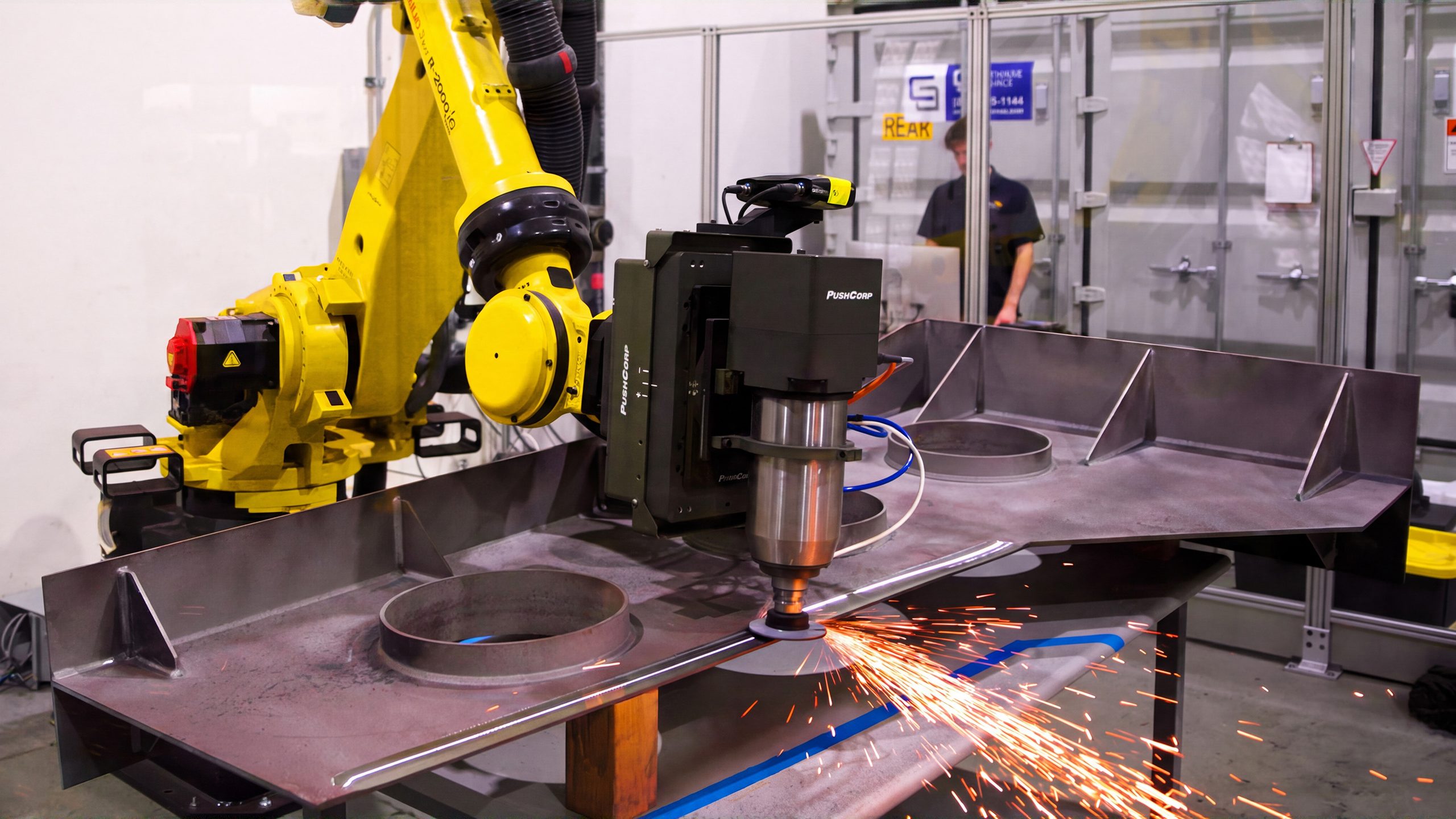
GrayMatter Robotics, based in Carson, California, specializes in physical artificial intelligence (AI) technologies, said Ariyan Kabir, co-founder and CEO of GrayMatter in an interview with Seapower. “What we do is what we call bringing AI across different layers of the factory to basically solve the human bottleneck problem.
“In manufacturing today, the demands of physical goods are soaring, [and] capacity is shrinking,” Kabir said. “We have lack of skilled workforce both at the factory as well as even in the engineering layer as well. If you look at an organization like Boeing, the average factory worker age is about 58, but the average age of a Boeing engineer is also 54, 56. So we have a very challenging time ahead for our national economy and national security if we don’t really bolster our manufacturing. So, at GrayMatter Robotics, we are building factory super intelligence to deliver superhuman decisions and execution across different layers of the factory. Wherever there’s a human bottleneck, whether it’s in the physical work or even on some of the work carried out by engineers, we build this technology and give them and augment the workforce so that they can be 10, 20, 50 time more productive by leveraging some of this technology.”
The company can perform a range of operations with its technology.
“If you look at any manufacturing operation, it’s a mix of different tool manipulation problems,” Kabir said. “When it comes to particularly ship building, it’s a sequence of operation. You get the raw sheet metal, you cut them, you weld them together, you grind them, you blast them, you apply coating, and then in between there are a lot of inspections. So, at GrayMatter Robotics, we specialize across the full breadth of tool manipulation problems, applications and use cases wherever you need to take a tool in hand and make some valuated change to an object leveraging that tool. But basically, we focus on how we help the end manufacturers produce a lot more from the same footprint of the factory floor or the shipyard, and at the same time help them keep on reducing cost per unit of the components that they’re manufacturing.”
GrayMatter and Path Robotic entered an agreement with shipbuilder HII designed “to accelerate the development and deployment of advanced physical AI automation across U.S. Navy shipbuilding programs, including aircraft carriers, submarines, destroyers, amphibious ships, future frigates and unmanned surface vessels,” HII said in an August 6 release.
“Under the agreements, HII intends to award up to $900 million in total shipbuilding work to Path Robotics and GrayMatter Robotics across seven years, contingent on the two companies meeting clearly defined technology and manufacturing readiness, and performance milestones outlined in the agreements, the release said. “This sustained demand signal enables Path Robotics and GrayMatter Robotics to make significant long-term investments in robotics, autonomous systems, facilities and workforce required to deliver Navy-grade production at scale.”
“This is a landmark deal,” Kabir said, of the new program called HYPR, High Yield Production Robotics. “This is unprecedented in the history of physical AI, the largest partnership in the history of physical AI. So HII has been really meaningful in terms of taking steps to future-proof shipbuilding.
“We [GrayMatter and Path] are building a completely new next-generation shipyard from the ground up where you can feed raw material and design and the parts or the ship come out on the other end. It’s fully autonomous inside that shipyard. And we are leveraging a range of different technology, especially our factory super intelligence across different layers, both the physical layer as well as some digital layer in orchestration and tying everything together. We have also launched a range of different domain agents that’s boosting the productivity, not just in the actual tool manipulation work, but also for industrial engineering, process engineering, solution engineering, design work, factory optimization prognostics, and health management and sustainment work.
“By doing that, we are creating this rapidly reconfigurable next-generation shipyard where you can adapt to no matter what design comes in play,” he said. “So as new ship orders come in, as new ship designs come in, it’s a rapidly reconfigurable shipyard. Also, on top of that, the way we are designing it is that this is rapidly deployable. So as the demand increases, we can rapidly build up the capacity.”
Kabir said the HYPR program will be established at a new location, which he was not at liberty to reveal at the time of the interview. After that, the program will be replicated at existing shipyards, he said.
The alliance with HII grew from a meeting.
“We actually got to know each other, two teams from our organizations,” Kabir said. “We met actually last year at a conference called Re-Industrialize in Detroit. So, the conversation started about a year ago. And then basically over the past year, we deeply engaged both of our teams across different levels, across different disciplines and functions, and that eventually led to this big partnership.”
“We are committed to making generational investments to develop new shipbuilding capability and to expand capacity,” said Eric Chewning, executive vice president of maritime systems and corporate strategy at HII, in the release. “Together, we are defining a new approach to robotics in shipbuilding: automation that can adapt to extreme levels of complexity, mix, and size. This collaboration represents a strategic investment in the future of American shipbuilding — strengthening industrial base resilience, expanding distributed shipbuilding capacity, feeding critical materials to our shipyards and workforce, and unlocking new production efficiencies essential to delivering the Navy’s growing fleet.”
GrayMatter, established in January 2020, develops much of its technology at its AI innovation center, a hundred thousand-square-foot facility in Carson.
“We have a range of different robot cells available to work on a range of different use cases and capabilities, but fully autonomously,” Kabir said. “And constantly we are working on different industry applications, different use cases of our partners, as well as launching new AI technologies for manufacturing and for factory super intelligence.
“Today we have been growing pretty rapidly in terms of real physical systems deployed in manufacturing production,” he said. “We’re the fastest growing physical AI company in the world. We work directly with the Navy, the Air Force, Fortune 100 companies such as Boeing, Raytheon, Lockheed Martin, HII, Caterpillar, Oshkosh, and then all the way to midsize businesses. Our focus is how do we help all the industry — aerospace, shipbuilding, industrial vehicle, energy, consumer product, and whatnot, so that we are able to bolster the backbone of our economy by making sure manufacturing is future-proof.”
Kabir emphasizes that “there is a lot of push from the government and also private sector to figure out how do we future-proof the national economy and national security. And at the core, the problem is basically capacity constraint. In the US, we have major capacity constraint when it comes to manufacturing. We are half a million skilled workers short today in US manufacturing. In the next seven years, that number is growing to become almost four million, and that’s going to be a big $2 trillion of risk to our economy on an annual basis. There are about 70,000 manufacturers [in the U.S.]. If you look at just the top 70, they have $3.2 trillion of backlog today.”
Kabir gave some examples of backlog cause by constraints to manufacturing: “If you’re a city in the US, you order a firetruck, you have to wait between three years to six years. If you’re a hospital and order a new ambulance, you have to wait between two to three years. We have massive shortage of munitions. So overall, we are severely constrained in manufacturing capacity, and that’s basically our focus. How do we help all the manufacturers drive or bring AI native manufacturing to augment their existing workforce and really maximize throughput per square feet of factory floor and minimize cost per unit?
Kabir said GrayMatter is now working with large suppliers of munitions but was not at liberty to reveal the names of the companies involved.
By Richard R. Burgess, Senior Editor, Sept. 10, 2026