
Havoc USVs With SAIC Routers Escort Army Ship in Exercises


Richard R. Burgess, is senior editor for Seapower magazine. He is a retired naval flight officer and author of several books on naval aviation.
ARLINGTON, Va. — An Army logistics ship was protected by a group of uncrewed surface vehicles (USVs) during recent demonstrations in the Pacific Ocean.
A group of six Havoc-built Rampage USVs escorted a U.S. Army medium support vessel (light) (LMSV) through a body of water and autonomously responded to an approaching vessel, said Paul Lwin, Havoc co-founder and CEO, during an interview with Seapower. Lwin showed a video of a similar earlier demonstration.
Lwin said the Army “wanted the autonomous vessels to protect a high-value asset, in this case the [LMSV],” showing six USVs surrounding the LMSV in an escort formation. A “threat vessel” approaches the formation from the 10 o’clock direction and the closest escort USV peels off from the formation to counter the approaching threat.
“All of our vessels — using all the data links and all the sensors we have—picked up the target vessel and figured out — with no humans in the loop — how to continue to protect the [LMSV],” he said, noting that as the threat vessel turned away the escorts reformed the formation while the closest USV pursued the threat vessel as a “kamikaze” boat.
A similar demonstration took place as part of a three-week episode of Exercise Balikatan 2026.
“Exercise Balikatan is a longstanding, bilateral military training initiative jointly sponsored and led by the Armed Forces of the Philippines and the United States Armed Forces,” according to information provided to Seapower. “It involves all services – Navy, Army, Air Force, Coast Guard, and Marines. The annual exercises are state-funded as a core component of the longstanding Philippines-United States Mutual Defense Treaty.”
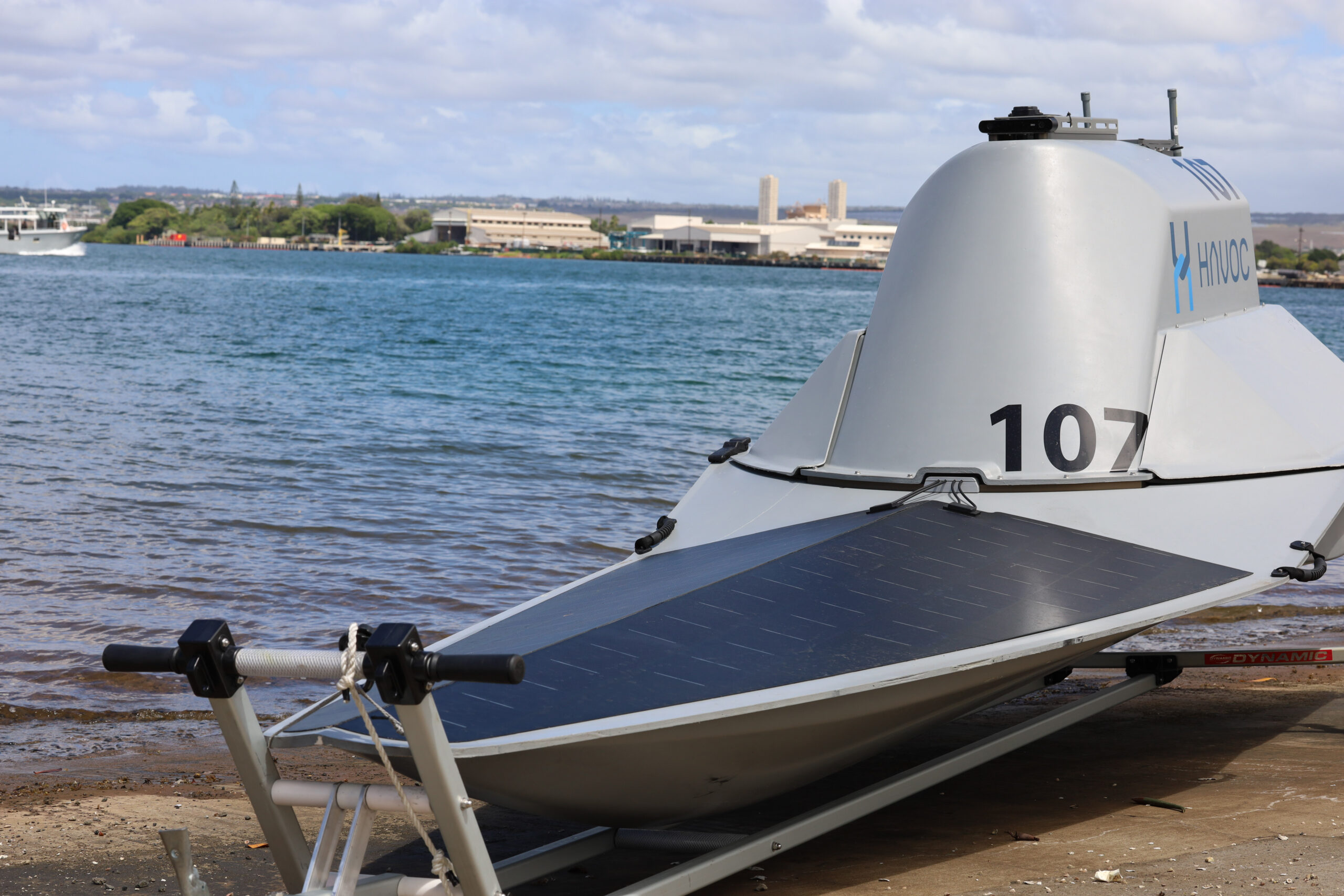
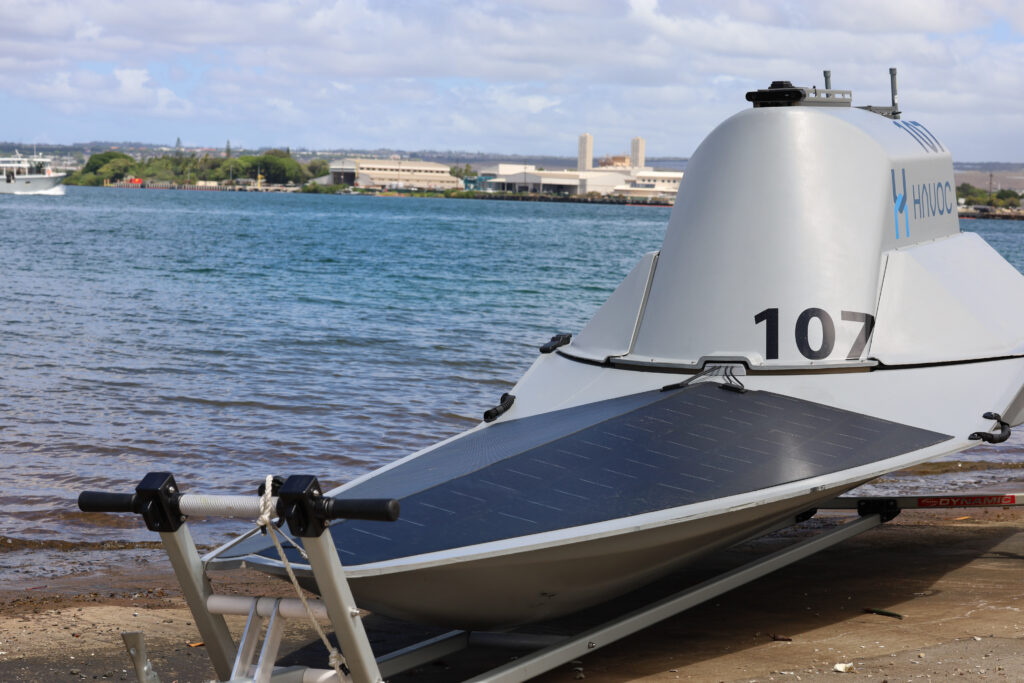
The Rampage is Havoc’s 14-foot-long USV. It is electric powered with solar energy and capable of 15 knots. They are designed for long-duration missions, Lwin said. The self-righting craft were equipped with sensors that include a commercial radar and electro-optical cameras that created target tracks that were passed as data with SAIC’s Joint Range Extension (JRE), a tactical data link router that transfers the data securely in real time over Link 11 and Link 16 to command-and-control centers for battlespace awareness.
Lwin said the Rampages were used for other missions during Balikatan, including contested logistics and general maritime domain awareness.
He said the USVs, which are six prototypes purchased by the Army, were very easy to deploy in the exercise, transported by ship in standard ISO 20-foot CONEX containers. They are also air-transportable in cargo aircraft. Training the soldiers to deploy the USVs and operate the software took two days.
Lwin said watching the soldiers operate the USVs day by day allowed Havoc officials to improve the operating procedures. The Army’s Facebook account even featured a video of soldiers launching a Rampage during the Balikatan exercise and showing how easy it was to operate, he said.
Barbara Supplee, SAIC’s executive vice president for its Army Navy Business Group, told Seapower that JRE enhances the command-and-control system of the Rampages by allowing tracks to be passed over Link 11 and Link 16 data links.
“We’re moving into other upgrades as well,” Supplee said, noting that the exercise was highly successful and that SAIC is learning how to improve the processes for JRE for the Havoc USVs.
She pointed out that JRE is available to U.S. allies and partners.
Havoc’s USVs also have been purchased by the Department of the Navy for use by the Navy and Marine Corps, including by the U.S. 6th Fleet’s Task Force 66 in European waters.
Havoc and SAIC are headquartered in Providence, Rhode Island, and Reston, Virginia, respectively.