
NAS Pax River Welcomes CNO Caudle to Highlight Fleet Modernization


PATUXENT RIVER, Md. — Chief of Naval Operations Adm. Daryl Caudle visited Naval Air Station Patuxent River Oct. 28 to discuss fleet modernization priorities, cutting-edge aviation capabilities and holistic sailor welfare.
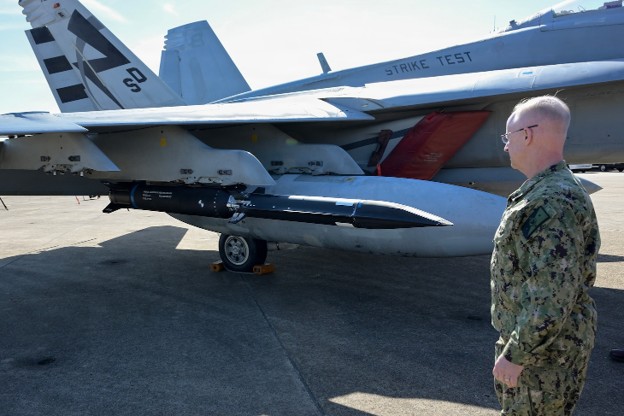
Chief of Naval Operations Adm. Daryl Caudle received a tour of several sites around NAS Patuxent River during his visit Oct. 28, including a briefing of the Navy’s new hyper-sonic air-launched missile, Blackbeard.
Addressing personnel gathered inside the recently constructed MQ-25A Stingray test hanger, Caudle emphasized how the research, development, test and evaluation conducted across Pax River directly underpins deployed warfighter lethality.
“There are a lot of things going on in this space and anything that flies, you know there is a certain standard that has to be maintained. The sustainment model has to be really pristine and the work that goes on here at Pax River is so inextricably tied to that readiness model,” Caudle said. “This enterprise is extremely important to Navy combat power globally.”
Attendees posed questions ranging from operational innovation and administrative modernization to quality-of-life programs. Addressing concerns regarding administrative bottlenecks in incentive programs like the Military Cash Award Program (MILCAP) and leave structures, Caudle acknowledged the need to streamline internal processes and committed to engaging leadership to improve efficiency.
When asked about the focus of future naval aviation research, Caudle identified adaptability and endurance as “the Holy Grail of modern warfare.”
“Endurance is such a crucial part of modern warfare, and then we see in spades the need to adapt quickly; the upgradability of airframes is so important,” he said. Pointing to the MQ-25 Stingray, the Navy’s carrier-based unmanned aerial refueling drone, he noted that autonomous systems are foundational to extending the reach and survivability of the carrier air wing and its missions.
Fleet modernization must also pivot toward open architecture “plug and play” systems, Caudle added, urging developers to avoid “Frankensteined,” disjointed software in favor of agile, streamlined, integrated software that can be upgraded anywhere by any branch of the service.
Highlighting the role of autonomous platforms in contested environments, Caudle underscored the mission of the recently established Robotic and Autonomous Systems Warfighting Development Center, formulates tactics, techniques and procedures to deliver operational autonomous capabilities to the fleet and are key to the “Air Wing of the Future.”
“I have to have [an unmanned system] in the middle of the Pacific Ocean and be able to launch it, recover it, sustain it and bring lethality from it,” he said.
Concluding the visit, Caudle reinforced the Navy’s focus on the “Total Sailor: Fit to Fight” initiative, emphasizing readiness across physical, mental and spiritual pillars. He emphasized that the Navy’s combat edge begins and ends with its Sailors, and keeping the fleet ready for the fight means investing in proactive nutritional health, sleep discipline, mental fitness and predictable career paths.
After the all-hands meeting, Caudle toured local tenant commands, including Air Test and Evaluation Squadron (VX) 23, to examine firsthand the new Blackbeard air-launched, long-range hypersonic strike missile, which was recently flight-tested aboard an F/A-18 E/F Super Hornet at Pax River.
From Robert Perry, Nov. 2, 2026