
NRL’s VXS-1 Squadron Retires East Coast’s Last P-3, Welcomes MC-12S
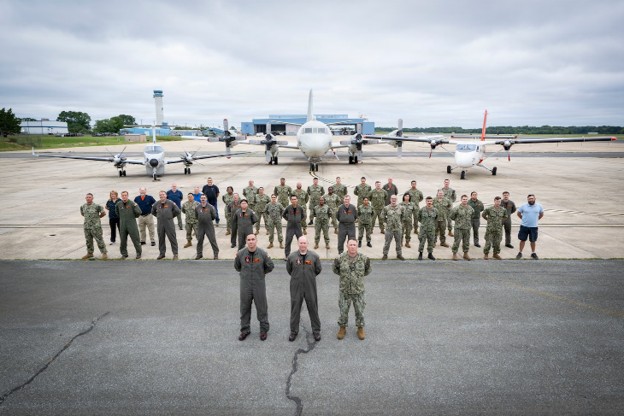


U.S. Naval Research Laboratory’s Scientific Development Squadron ONE (VXS) 1 gathers for a group photo at the Naval Air Station Patuxent River in Patuxent River, Md. Sep. 21, 2026. VXS-1 conducts airborne scientific experimentation and advanced technology development in worldwide operations supporting U.S. Navy and national science and technology priorities and war fighting goals. (U.S. Navy photo by Sarah Peterson)
The U.S. Naval Research Laboratory’s (NRL) Scientific Development Squadron ONE (VXS-1), commemorated the 63-year history of the P-3 Orion research aircraft and introduced its successor, the MC-12S Super King Air, during a ceremony Sept. 17 at Naval Air Station (NAS) Patuxent River (Pax), Maryland.
The squadron, also known as the Warlocks, serves as NRL’s airborne research arm.
For more than three decades VXS-1 has operated the NP-3C Orion. On Sept. 22 the Warlocks bid farewell to the U.S. Navy’s last active-duty P-3 on the East Coast departed for long-term preservation at the 309th Aerospace Maintenance and Regeneration Group (AMARG) at Davis-Monthan Air Force Base in Tucson, Arizona.
“The P-3 Orion has served as the cornerstone of our heavy-lift, long endurance airborne naval science, bridging the gap between laboratory concepts and frontline Fleet capabilities,” said NRL Commanding Officer, Capt. Randy Cruz. “While we celebrate the aircraft’s extraordinary service from combat route clearance to hurricane reconnaissance, the arrival of the MC-12S Super King Air ensures our team continues to deliver agile, high-altitude test capabilities to the warfighter.”
A 63-Year Mission Heritage Capt. Mark Zematis, commanding officer of NAS Pax River, reflected on the history of the P-3 Orion. “When you think about American sea power, minds often race toward carrier decks – to strike fighters and bombers,” he remarked. “But over six decades, the true sentinels of the global commons were not catapulted from flight decks. It was that aircraft there [NP-3C Orion], launched from coastal runways, climbing into fog and squall on the muscle of four Allison T56 turboprops, carrying 11 crew members into the vast expanse of ocean.”
The modified Orion has served as NRL’s premier heavy-lift airborne lab, accelerating new technologies directly into Fleet operations. Throughout its service life, the platform executed critical combat support, geophysical intelligence, environmental monitoring, and Fleet readiness operations worldwide.
VXS-1 has flown many major scientific campaigns on the P-3 platform, highlighting operational execution, U.S. Navy and Department of War (DoW) impact, and mission outcomes. These missions include Counter-IED [improvised explosive device] support in Afghanistan and the Aerogeophysical Survey in Afghanistan demonstrating the DoW’s ability to conduct high-altitude, wide-area reconnaissance in complex terrain.
“The P-3 became a tactical guardian for coalition ground troops,” Zematis continued. “Hovering out of audible range, Orion crews used their camera and communication suites to identify roadside IED emplacements, trace vehicle convoys, and pipe real-time video directly into tactical operations centers.”
The squadron also mobilized the NP-3 Orion on short notice to advance naval meteorology during severe weather systems, including Hurricanes Idalia and Francine. The aircraft flew directly into the storms, deploying atmospheric sensors and dropping sonobuoys to measure and collect real-time ocean-atmosphere dynamics. Onboard systems directly transmitted these measurements to U.S. Navy operational weather models and national forecast systems, allowing meteorologists to track storms and protect naval fleet assets, ship movements, and coastal installations.
“Platforms come and go, but true legends are distinguished by their refusal to become obsolete,” Zematis remarked. “The P-3 Orion served continuously on the frontlines of American defense for over six decades. Every sonobuoy dropped, every periscope tracked, every overland convoy escorted, and every data packet downlinked carries the fingerprint of Naval Air Station Patuxent River.”
Testing Next-Generation Research Capabilities “Our aircrews and project engineers demand a platform that can adapt to rapid technological change without compromising safety,” said Cmdr. Andrew R. Vawter, commanding officer of VXS-1. “While we bid a fond farewell to the workhorse NP-3C, the MC-12S Super King Air offers the precise modularity and high-altitude reach our teams require to test next-generation sensors in demanding real-world environments.”
The MC-12S Super King Air delivers a modern, high-altitude research platform that accelerates scientific payload integration. While the legacy NP-3C reached an altitude of 30,000 feet and flew up to 12 hours, the MC-12S reaches altitudes up to 35,000 feet, flies at speeds between 125 and 263 knots indicated airspeed, and provides five to seven hours of mission endurance.
The new aircraft features an easy-on, easy-off modular cabin design that accommodates reconfigurable equipment racks and workstations. It supplies more than 11 kilowatts of dedicated project power across 120-volt alternating-current and 28-volt direct-current systems. To support diverse sensor payloads, the MC-12S incorporates a large configurable belly radome with fuselage pass-through plates, an extended nose that houses an MX-15-sized retractable turret, and external antenna mounting provisions for GPS, Iridium, and Starshield systems.
Conduct Research, Science, and Technology Development with the Warlocks VXS-1 provides a secure, flexible, and cost-effective airborne testbed for researchers across the DoW, federal agencies, academia, and private industry.
“We have a different mission set than that of most other Navy squadrons,” Vawter said. “We operate as the airborne research arm of NRL. We are tasked to operate highly modified aircraft that are designed to receive nearly any kind of equipment or sensor and install and operate it, test it, or gather technical data with it, rapidly. This unique mission set is both more broad and more niche than that of traditional test and well outside that of Fleet VP [Patrol] squadrons.”
By offering streamlined payload integration, dedicated project power, and experienced military air crews, the squadron eliminates the overhead of procuring individual test aircraft. Researchers can deploy custom sensor suites, communication arrays, and atmospheric instruments directly onto the MC-12S Super King Air’s modular cabin racks and external mounting points.
From Emily Winget, Sept. 30, 2026