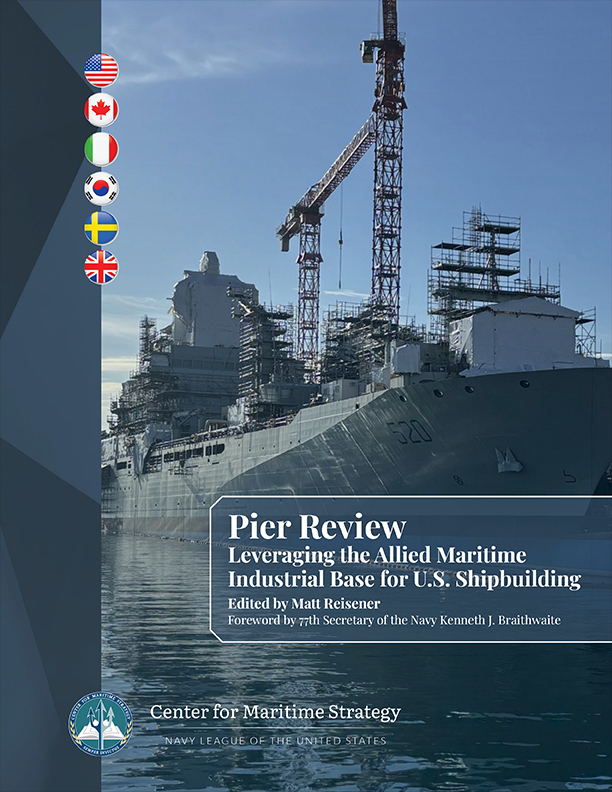
By Matt Reisener
America’s maritime industrial base (MIB) is in crisis. Decades of deindustrialization, inconsistent policy support, labor attrition and increasingly globalized supply chains have left the United States struggling to produce ships on time and on budget, all while strategic competition at sea intensifies. America’s MIB is unable to support the needs of its Navy, compete with rising naval and shipbuilding powers such as China, or reliably contribute to the protection of America’s most vital national interests in the decades to come.
However, many of the United States’ maritime allies are experiencing similar challenges to their domestic shipbuilding industries and have adopted creative approaches to solving them. The United States must utilize the experience, knowledge and resources of its allies to develop the best strategy possible for building a stronger, more resilient MIB.
Accordingly, the Center for Maritime Strategy conducted a study of America’s allied maritime industrial base to examine how five American allies (South Korea, Italy, Canada, Sweden and the United Kingdom) build commercial and naval ships, how they support their shipbuilding industries and what lessons America can learn from its allies about how to revitalize its MIB.
Each country faces similar shipbuilding challenges to America but has taken a different approach to addressing them. Although South Korea and Italy have successfully maintained strong commercial and naval shipbuilding sectors, Canada and the United Kingdom have largely allowed their commercial sectors to atrophy while primarily focusing on warship construction, while Sweden has seen both sectors significantly diminish and maintains only marginal naval shipbuilding capabilities. Many of America’s allies have successfully maintained strong MIBs by streamlining the process for designing and building ships. Among the countries studied, the most successful nations at sustaining strong commercial and naval shipbuilding industries have found ways to minimize late-stage design changes, build a greater variety of ships based on a common design and establish a shipbuilding culture which emphasizes delivering ships on time and under budget.
Similarly, the study illustrates how government investments in their MIBs can set their shipbuilding industries up for success, including by training the next generation of skilled tradespeople and supporting greater supply chain resilience. America’s most successful shipbuilding allies have also heavily invested in integrating new technology into their shipyards, fully embracing automation, digitization and artificial intelligence to support their work — often with strong government support for these efforts.
America can build a stronger, more capable MIB by partnering with and learning from its allies. Accordingly, this study provides recommendations for how America can apply these insights to support its MIB while embracing greater multilateral maritime cooperation.
CMS and speakers from the allied nations in the report will host a panel discussion on the new report on Tuesday, April 21 from 3:30-4:30 p.m. in the Cherry Blossom Ballroom.
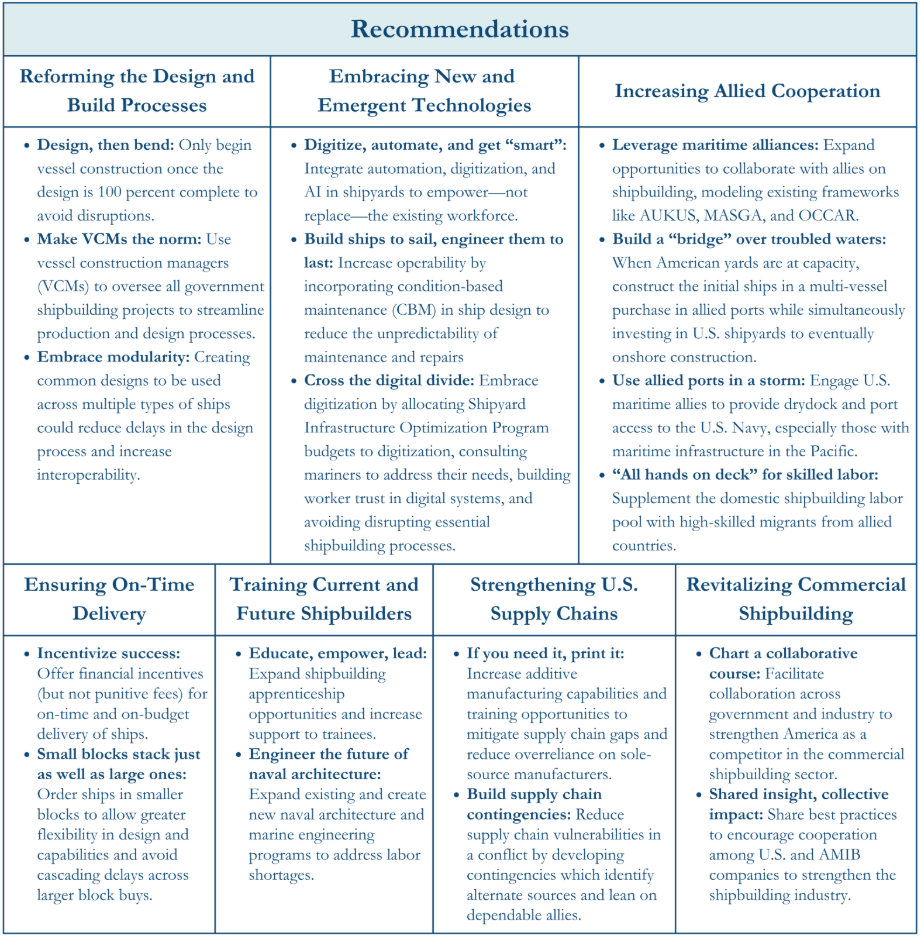
Read the full report here.



- MARTAC and Intrepid Powerboats Announce Manufacturing Partnership to Scale Autonomous Surface Vessel Production - June 22, 2026
- U.S. Navy Awards Castelion First Delivery Order for Blackbeard Hypersonic Weapon - June 22, 2026
- Honeywell Launches Compact Navigation System for Uncrewed Aerial Systems - June 22, 2026