
Q&A: Fincantieri Marine Group CEO George Moutafis


Richard R. Burgess, is senior editor for Seapower magazine. He is a retired naval flight officer and author of several books on naval aviation.
In February 2026, Fincantieri Marine Group (Booth 1223) issued the following release:
“As you may have seen in NAVSEA’s press release, the U.S. Navy tapped Fincantieri to build four of the first wave of Medium Landing Ships (LSMs) for the Marine Corps. Our $1B investment over the last 18 years to create concurrent production lines across our Wisconsin system of shipyards has positioned us to be a prime player in the American shipbuilding renaissance. This announcement represents a good start of follow-on workload, part of the framework agreed with the Navy to ensure stability following the announcement in November. Details are still being worked out between us and the Navy, and we will communicate any developments, as soon as they solidify. Our intent is to quickly build as many vessels as the Navy will trust us with, in the LSM class and other classes that our armed forces require, to contribute to our nation’s needs.”
Fincantieri Marine Group CEO George Moutafis later discussed the LSM program’s vessel construction management (VCM) concept with Senior Editor Richard R. Burgess.
The Vessel Construction Management concept proved successful with Philly Shipyards and its National Security Multi-Mission Vessel (NSMV) program. What advantages and disadvantages do you see with the VCM concept?
MOUTAFIS: Advantages: I trust our Navy wants to see whether this mechanism can deliver quality vessels fast, by streamlining oversight and creating unity of effort. Such benefits can be achieved if the concept is applied in its intended form:
A key aspect is to empower the VCM to make decisions on construction, favoring schedule, without compromising quality and without seeking constant guidance or approval from the Navy. When combined with a complete and final design and a commercial-type relationship between the VCM and shipbuilders, this can be truly powerful and harness efficiency in decision-making and speed.
So, overall, this concept is aimed at simplifying things. From that vantage point, this approach aligns perfectly with our goal of fast serial production of naval vessels, and we are ready to continue our partnership with the Navy and help them test this concept.
Disadvantages: More than disadvantages, it will be key for all parties involved (the Navy, the VCM, the shipbuilder(s) to embrace the concept, draw the relevant lines and collectively ensure we do not fall into mishaps of the past that might jeopardize what this concept is trying to achieve.
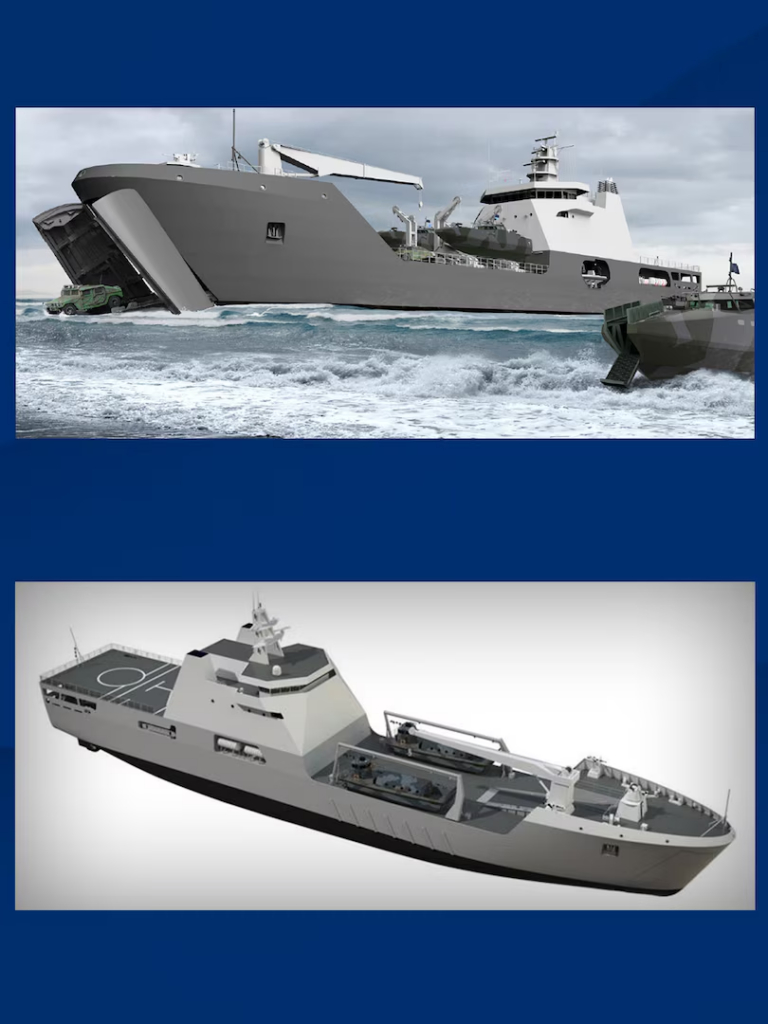
With the VCM chosen as the LSM program management concept, what changes will Marinette have to institute to accommodate the concept?
MOUTAFIS: We are ready. In Wisconsin we have a system of yards where we have executed successfully programs for our Navy, for our Coast Guard, but also for commercial customers, under a variety of contractual setups.
We will wait to see the details of how the Navy will position itself towards the program and how the VCM will seek to exercise oversight and work with us. We are ready to adjust to whatever those requirements are.
At first glance, an oversight and collaboration similar to the one witnessed during the NSMV program and a “build-to-print” design, for now, appear to alleviate some demands in terms of administration and engineering, allowing us to swiftly get into what we do best: swift serial construction … but it all remains to be seen.
What adjustments, if any, will be needed for your workforce as you shift from LCS production to the LSM?
MOUTAFIS: Using a “build-to-print” approach allows construction to happen quicker. Plus, it minimizes change and prevents extensive and time-consuming design iterations.
We will need to review all the technical details, but we do not foresee major adjustments to workforce. Our system-of-yards configuration ensures agility in the workforce, rendering them able to jump from Navy standards to commercial or ABS standards.
And with the right level of sustained demand signal, we will be able to improve efficiency and speed, which will be a win for all parties. Our system of yards can accommodate multiple parallel lines, almost concurrently.
How is Marinette fairing with the nationwide shortage of skilled shipyard workers?
MOUTAFIS: No doubt, shipbuilders and the related trades remain in high demand. We have expanded our recruiting efforts over the previous few years, and we are blessed to say that our efforts worked. Last year alone we hired nearly 800 employees and improved our retention by 50%.
Our Wisconsin operations saw positive feedback on several new initiatives over the previous 18 months, aimed at stabilizing the workforce. Efforts like cash bonuses to incentivize employee retention and tax-free subsidized childcare had a positive effect on our employees and our operations.
In years past Marinette had difficulty in retention of shipyard workers because of housing shortages in the region. Has that situation been alleviated to any degree?
MOUTAFIS: Yes, there has been a concerted effort by the local communities and developers to expand the number of local housing options that closely align to our growing workforce and their families. We believe this is less of an issue given the development and community support over the last couple of years in Northeast Wisconsin.
Is Marinette continuing with cooperative relationships with community colleges for workforce development? What is your assessment of the cooperation?
MOUTAFIS: Yes, we are continuing and seeking to expand our network of such collaborations. We have a continuously growing relationship with Northeast Wisconsin Technical College to not only reinforce the need to up-skill current employees, but also to introduce new technologies and digital tools to attract the shipbuilders of the next generation.
Imagine a not-so-distant future replete with examples of shipyard welders leveraging cobots (collaborative robots) to weld in places where it’s difficult for humans to easily work. That is the future of shipbuilding and why we’re equipping our employees with digital tools like exoskeletons for demanding and repetitive tasks and augmented and virtual reality that allows workers on the deckplates to communicate challenges directly to the engineering team using a wearable digital device.