
Changing Polar Region Presents New Challenges and Opportunities for Navy, Coast Guard, Industry


By Erika Fitzpatrick, Seapower Correspondent
The U.S. military and allied nations are ramping up their strategic offensive and defensive capabilities in the Arctic to confront an expanding presence from adversaries such as China, Russia, Iran and North Korea, said Vice Admiral Doug Perry, U.S. Navy Commander of Joint Force Command Norfolk, at Sea-Air-Space on Monday, April 20.
“We have to acknowledge that is not a situation we want to allow to continue, to the detriment of free nations and certainly [of] the United States,” Perry said during a polar issues panel moderated by Dr. Abbie Tingstad, professor of Arctic Research at the Center for Arctic Study and Policy at the U.S. Coast Guard Academy.
The Arctic polar region is primarily ocean, surrounded on its edges by the eight member states of the Arctic Council: Canada; the Kingdom of Denmark, which includes Greenland and the Faroe Islands; Finland; Iceland; Norway; the Russian Federation; Sweden; and the United States, where Alaska includes a 1.5-million-square-mile exclusive economic zone in its surrounding waters.
Council decisions are achieved in agreement with six “permanent participants” that represent Aleut, Arctic Athabaskan, Gwich’in, Inuit, Saami, and Russian Indigenous people, who have inhabited the Arctic for millennia and are about 10% of the 4 million Arctic residents.
The Arctic in the last four decades has warmed three times faster than the worldwide average, according to a 2024 Arctic Council report, by its Arctic Monitoring and Assessment Programme. The has led to new concerns, collaborations, and potential conflicts among Arctic nations, all touched on by the Sea-Air-Space panelists.
For instance, Russia is revitalizing assets throughout the high north, including air bases; granting oil and gas rights to China; and refilling liquid natural gas tankers that are now built for the Arctic’s northern sea route. Although some of the Russian Federation’s long-range aviation is focused elsewhere, Perry said its northern fleet is “large unimpacted by the Ukrainian fight.”
A More Arctic NATO
Those are emerging threats, Perry said, but on the plus side: “Also what has changed in the last couple years is that Finland and Sweden joined NATO.”
With the exception of Russia, Perry works directly with these and other Arctic nations in his other role as the director of the U.S. 2nd Fleet Combined Joint Operations from the Sea Centre of Excellence (CJOS COE), established in May 2006. Representing 13 nations, CJOS is the only such center based in the United States and one of 27 NATO-accredited COEs worldwide to collaborate on maritime-based joint operations.
Perry said Arctic allies and partners in his geography under NATO are shoring up defenses against new Russian capabilities; increasing domain awareness and readiness through synchronized, scheduled exercises; and providing deterrence through an enhanced presence in the region.
Cooperation is key because it’s an “ugly endeavor” to operate ships, icebreakers and submarines in the harsh Arctic climate “all the time,” Perry said, adding that it’s not feasible to operate foot patrols across Greenland and Canada. “It’s not achievable and it would be really expensive.”
But allies must be a regular show of force in the region. “That’s where the missiles are going to fly — they’re going to fly over the polar region,” Perry said, “whether they’re coming from North Korea or China or Russia, and so we need to understand how to defend against that.”
Icebreakers on the Way
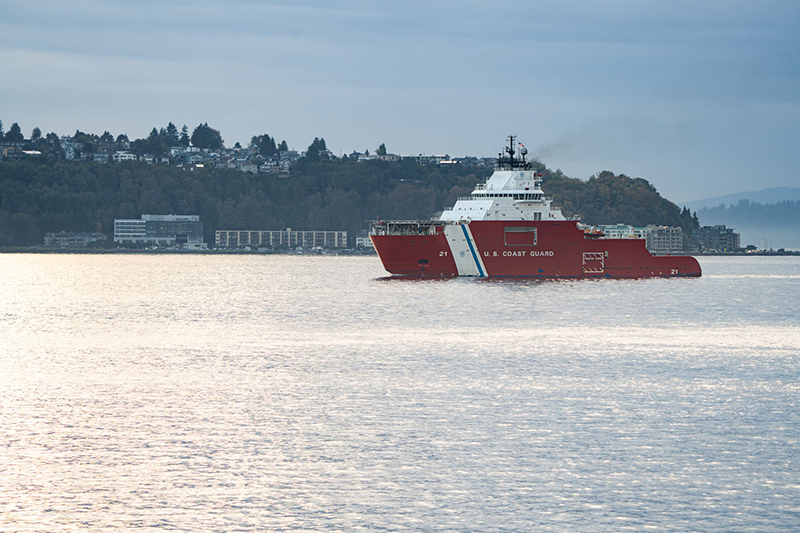
And “the icebreakers are coming,” said an excited Vice Admiral Nathan Moore, deputy commandant of Operations at the U.S. Coast Guard. “For us in the Coast Guard, that is something that we have not been able to say — well, ever.” Two of three planned heavy icebreakers, being built at “world record speed,” should be operational in fiscal 2028.
This bigger fleet — including 11 Arctic Security Cutters — expands USCG patrol capabilities amid a 37% rise in U.S. Arctic maritime traffic, including of foreign military vessels traversing the area. “There’s a lot of icebreaker capacity coming,” Moore said. He added that allies have broadened their focus beyond search and rescue and pollution response to safety and sovereignty.
USCG still has to designate Arctic-trained personnel to command the new vessels and figure out how to supply, maintain and sustain the fleet in the remote region. For instance, Dutch Harbor, on Alaska’s Amaknak Island in Unalaska, is seven or eight days away by sea from the deep waters of the high north.
That’s why it’s essential to maintain relationships with allies, who operate deep water ports and bases the United States needs to use, Perry said.
Although there are challenges, the United States and partner nations still have immense knowledge that positions them well to compete in the region, said retired Navy Vice Admiral Bill Merz, a former submarine commander who is now senior vice president of Aerospace and Defense Technologies at Oceaneering.
“It’s a fascinating place to operate,” Merz said of the Arctic, teaming with life and spectacular visuals above and below the ice. But the operational environment is ever-changing and dangerous, he said, describing a cacophonous riot of crashing and shifting floes of varying thicknesses in areas that are almost impossible to map.
Leverage the Magic
Allied Arctic nations can partner with industry to gain even more intelligence of the region. The U.S. oil and gas industry, he said, has unparalleled experience operating on the ocean floor for long stretches, including with uncrewed vehicles that can function without human intervention for months. “So, there’s a lot of magic there,” he said.
He conceded that China’s Navy is disciplined and will be a regional player eventually. “But I tell you, they got a lot to learn,” Merz said. “There’s a difference between showing up at the Arctic and living and sustaining yourself in an environment where … communications are horrible, navigation’s tough” and there’s very little, if any, infrastructure.
“That understanding is a tremendous advantage that we have and that we need to take advantage of,” he said. “And as we bring industries and the navies together, that’s a powerful partnership.”